Following the people and events that make up the research community at Duke

Students exploring the Innovation Co-Lab

Category: Climate/Global Change Page 8 of 11

Students Bring Sixty Years of Data to Life on the Web

For fields like environmental science, collecting data is hard.

Fall colors by Mariel Carr

Fall colors in the Hubbard Brook Experimental Forest, in New Hampshire’s White Mountains.

Gathering results on a single project can mean months of painstaking measurements, observations and notes, likely in limited conditions, hopefully to be published in a highly specialized journal with a target audience made up mostly of just other specialists in the field.

That’s why when, this past summer, Duke students Devri Adams, Camila Restrepo and Annie Lott set out with  graduate students Richard Marinos, Matt Ross and Professor Emily Bernhardt to combine over six decades of data on the Hubbard Brook Experimental Forest into a workable, aesthetically pleasing visualization website, they were really breaking new ground in the way the public can appreciate this truly massive store of information.

The site’s navigation shows users what kinds of data they might explore in beautiful fashion.

Spanning some 8,000 acres of New Hampshire’s sprawling White Mountain National Forest, Hubbard Brook has captured the thoughts and imaginations of generations of environmental researchers. Over 60 years of study and authorized experimentation in the region have brought us some of the longest continuous environmental data sets ever collected, tracking changes across a variety of factors for the second half of the 20th century.

Now, for the first time ever, this data has been brought together into a comprehensive, agile interface available to specialists and students alike. This website is developed with the user constantly in mind. At once in-depth and flexible, each visualization is designed so that a casual viewer can instantly grasp a variety of factors all at the same time—pH, water source, molecule size and more all made clearly evident from the structures of the graphs.

Additionally, this website’s axes can be as flexible as you need them to be; users can manipulate them to compare any two variables they want, allowing for easy study of all potential correlations.

All code used to build this website has been made entirely open source, and a large chunk of the site was developed with undergrads and high schoolers in mind. The team hopes to supplement textbook material with a series of five “data stories” exploring different studies done on the forest. The effects of acid rain, deforestation, dilutification, and calcium experimentation all come alive on the website’s interactive graphs, demonstrating the challenges and changes this forest has faced since studies on it first began.

The team hopes to have created a useful and user-friendly interface that’s easy for anyone to use. By bringing data out of the laboratory and onto the webpage, this project brings us one step further in the movement to make research accessible to and meaningful for the entire world.

Post by Daniel Egitto

Disaster Plans and the Mentally Ill

Houston, Miami, San Juan — Category 5 hurricanes, the most destructive storm systems, have made a record-breaking 6 landfalls this year. This represents a quarter of the total category 5 hurricane landfalls that the Atlantic has seen since 1851.

With statistics like these, disaster relief plans are becoming more important than ever. But do these plans do enough for marginalized groups, specifically the mentally ill?

Allan K. Chrisman, M.D., believes more can be done. As a career psychiatrist who has been deployed by the Red Cross in the aftermath of storms like Katrina and Matthew, Chrisman has seen and experienced the importance of including the mentally ill in disaster relief plans.

At his talk to physicians in Duke’s Hospital on Sept. 28, Chrisman, an emeritus  professor at Duke, highlighted specific aspects of disaster relief that are not doing enough for the one in four U.S. adults suffering from mental illness each year.

According to Chrisman, this part of the population is often less prepared for impending storms. When storms do hit, existing symptoms can be exacerbated, or new symptoms can appear.  Disruption of routine, inconsistency of taking medication and the overall stress that comes with emergencies all contribute to this exacerbation of mental illness.

While the Red Cross has an “everyone is welcome,” policy for their shelters, not being able to identify the needs of the mentally ill seeking sanctuary limits the organization’s ability to help. As a deployed psychiatrist, Chrisman worked with displaced mentally ill people to ensure they continued to get the care they needed even during the stress of a weather emergency.

One tool used by Chrisman and his colleagues to help these groups is the C-MIST framework. This system categorizes “functional-based needs” based on communication, maintaining health, independence, service and support, and transportation. It seeks to ensure not only that individuals are being given an option for a safe space in the wake of emergencies, but also that these spaces offer them the specific services they require.

Chrisman emphasized the need “to provide round-the-clock access to qualified mental health resources.”

He said that by following these inclusive protocols, disaster relief programs can do even more to protect the most vulnerable parts of the population.

By Sarah Haurin

New Blogger Daniel Egitto: Freshman and Aspiring Journalist

Hi, I’m Daniel Egitto, a freshman at Duke with an intended major in English. I’m from Florida, and I spent the better part of my childhood growing up in some small, quiet suburbs surrounded by pretty much nothing but farms, rivers and untouched forest for acres and acres around. Out where I lived, it was nearly impossible to ever get more than a few miles from the wilderness that still covers a huge chunk of Florida today. Mazes of pine and oak forests made up my backyard, crisscrossed with bubbling springs and dotted with the occasional deer, coyote or alligator peeking out of the trees. It was there in those Florida woods, kayaking and hiking through some of America’s last wild places, that I first fell in love with the natural world and the conservationist issues facing our country today.

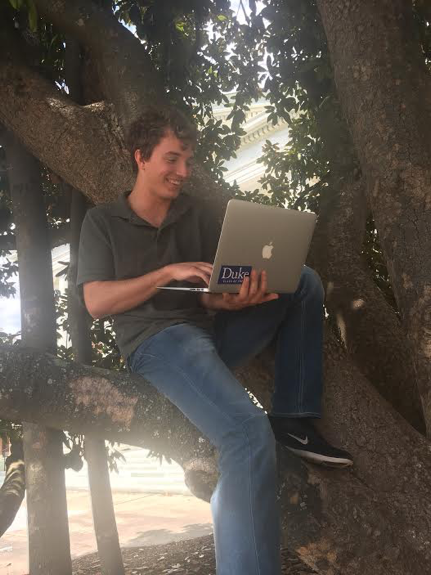
Daniel Egitto in a tree

Incoming freshman Daniel Egitto is pursuing an English major for a future career in journalism.

Because despite its treasure trove of both scientific and recreational gems, Florida has a truly terrible history of protecting natural heritage. Governor Rick Scott, for example, brought in a gag rule on the words “climate change” appearing in any state environmental document, while at the same time the well-being of those springs I came to know and love in my childhood has faced rising challenges due to unsustainable farming practices and water use policies. An unacceptable number of Americans are still unaware of both the struggles and opportunities this country’s biodiversity has always offered, and because of this I have come to develop a passion for both science education and topical journalism in general.

In high school my experiences led me to reach out into my community, engaging with children about basic scientific concepts at a local robotics camp and “Science Saturdays” series. I also became heavily involved with my school’s newly-founded newspaper, where I helped shift its focus onto important yet poorly-publicized struggles of both our society and our world as a whole.

As I enter into my first year on Duke campus, I hope to work with the Duke Research Blog to further both my interests and my goals. I’m currently pursuing a future career in journalism, and by working with Duke Research I hope we can all help nurture a more informed and understanding world.

In addition to my work with this blog, I also intend to get involved with the Chronicle and Me Too Monologues on campus.

Energy Program on Chopping Block, But New Data Suggest It Works

Duke research yields new data about energy efficiency program slated for elimination

Do energy efficiency “audits” really benefit companies over time? An interdisciplinary team of Duke researchers (economist Gale Boyd, statistician Jerome “Jerry” Reiter, and doctoral student Nicole Dalzell) have been tackling this question as it applies to a long-running Department of Energy (DOE) effort that is slated for elimination under President Trump’s proposed budget.

Evaluating a long-running energy efficiency effort

Since 1976, the DOE’s Industrial Assessments Centers (IAC) program has aimed to help small- and medium-sized manufacturers to become more energy-efficient by providing free energy “audits” from universities across the country. (Currently, 28 universities take part, including North Carolina State University.)

Gale Boyd

Gale Boyd is a Duke Economist

The Duke researchers’ project, supported by an Energy Research Seed Fund grant, has yielded a statistically sound new technique for matching publicly available IAC data with confidential plant information collected in the U.S. Census of Manufacturing (CMF).

The team has created a groundbreaking linked database that will be available in the Federal Statistical Research Data Center network for use by other researchers. Currently the database links IAC data from 2007 and confidential plant data from the 2012 CMF, but it can be expanded to include additional years.

The team’s analysis of this linked data indicate that companies participating in the DOE’s IAC program do become more efficient and improve in efficiency ranking over time when compared to peer companies in the same industry. Additional analysis could reveal the characteristics of companies that benefit most and the interventions that are most effective.

Applications for government, industry, utilities, researchers

This data could be used to inform the DOE’s IAC program, if the program is not eliminated.

But the data have other potential applications, too, says Boyd.

Individual companies who took part in the DOE program could discover the relative yields of their own energy efficiency measures: savings over time as well as how their efficiency ranking among peers has shifted.

Researchers, states, and utilities could use the data to identify manufacturing sectors and types of businesses that benefit most from information about energy efficiency measures, the specific measures connected with savings, and non-energy benefits of energy efficiency, e.g. on productivity.

Meanwhile, the probabilistic matching techniques developed as part of the project could help researchers in a range of fields—from public health to education—to build a better understanding of populations by linking data sets in statistically sound ways.

An interdisciplinary team leveraging Duke talent and resources

Boyd—a Duke economist who previously spent two decades doing applied policy evaluation at Argonne National Laboratory—has been using Census data to study energy efficiency and productivity for more than fifteen years. Boyd has co-appointments in Duke’s Social Science Research Institute and Department of Economics. He now directs the Triangle Research Data Center (TRDC), a partnership between the U.S. Census Bureau and Duke University in cooperation with the University of North Carolina and Research Triangle Institute.

The TRDC (located in Gross Hall for Interdisciplinary Innovation) is one of more than 30 locations in the country where researchers can access the confidential micro-data collected by the Federal Statistical System.

Jerry Reiter is a Duke statistician.

Jerry Reiter is a professor in Duke’s Department of Statistical Science, associate director of the Information Initiative at Duke (iiD), and a Duke alumnus (B.S’92). Reiter was dissertation supervisor for Nicole Dalzell, who completed her Ph.D. at Duke this spring and will be an assistant teaching professor in the Department of Mathematics and Statistics at Wake Forest University in the fall.

Boyd reports, “The opportunity to work in an interdisciplinary team with Jerry (one of the nation’s leading researchers on imputation and synthetic data) and Nicole (one of Duke’s bright new minds in this field) has opened my eyes a bit about how cavalier some researchers are with respect to uncertainty when we link datasets. Statisticians’ expertise in these areas can help the rest of us do better research, making it as sound and defensible as possible.”

What’s next for the project

The collaboration was made by possible by the Duke University Energy Initiative’s Energy Research Seed Fund, which supports new interdisciplinary research teams to secure preliminary results that can help secure external funding. The grant was co-funded by the Pratt School of Engineering and Information Initiative at Duke (iiD).

Given the potential uses of the team’s results by the private sector (particularly by electric utilities), other funding possibilities are likely to emerge.

Boyd, Reiter, and Dalzell have submitted an article to the journal Energy Policy and are discussing future research application of this data with colleagues in the field of energy efficiency and policy. Their working paper is available as part of the Environmental and Energy Economics Working Paper Series organized by the Energy Initiative and the Nicholas Institute for Environmental Policy Solutions.

Energy Efficiency Graphic

For more information, contact Gale Boyd: gale.boyd@duke.edu.

Guest Post from Braden Welborn, Duke University Energy Initiative

Linking Climate Change, Air Pollution and Public Health

We often view climate change and air pollution as two separate entities. But, the two issues are united by one common driving factor: human emissions. Nicholas School of the Environment Earth Sciences Professor Drew Shindell reminds us how interconnected these issues truly are, and how we must begin viewing them as such to create change.

Shindell argues that climate change and air pollution are often misrepresented. Air pollution is a problem that seems elusive to the individual, and yet it is the

Dr. Shindell with Marcelo Mena (far left), Vice Minister of the Environment of Chile, and Governor Jerry Brown (CA) at the COP21 in Paris.

number one cause of premature death. The problem is often polarized from us, and we forget that we are largely at fault for its increasing effect. We place the blame on the emissions of large corporations, when our own car emissions are just as detrimental. Shindell argues that it is the “othering” of these issues that makes it hard for us feel a need to create change.

But, by clearly linking climate change and air pollution together, and linking those two to human health, Shindell believes we will develop a greater sense of responsibility for our environment. He gives the example of Pakistan, where increased ozone levels due to human emissions have severely decreased the air quality. As a result, there has been a 36% decline wheat and rice production. This dent in Pakistan’s agricultural systems poses a great threat on food security for the entire nation, and could potentially create a wave of health issues.

But policy often blurs the line between air pollution, climate change and human health. Shindell says he doesn’t know of a single jurisdiction that explicitly mentions the scope of negative effects air pollution and climate change can have on our health (stroke, lung cancer, new disease vectors, to name a few). He suggests expanding our metrics and developing a broader-based impact analysis so that humans are well-informed of the interconnectedness of these issues.

Is it easier to blame a big factory for pollution than to look at your own travel habits?

If we included public health in our impact estimates for methane emissions, for example, the cost would be much larger than anticipated. But, Shindell highlights that to bring these emissions down requires a change that is not easy to ask of our energy-dependent, consumer-driven world. Decreasing our meat consumption by 48%, for example, would save us billions of dollars, but to trigger such a change would demand a desire from the public to alter their behavior, which time and time again has proven to be challenging.

At the end of the day, this scientific issue is a largely psychological one. We assume our contributions make a negligible difference, when in reality it is our consumer behavior that will drive the change we wish to see in our environment. But, how are we expected to feel the burden of air pollution on our health, when policy isn’t directly linking the two together? How can we see climate change as an issue that threatens the security of global agricultural systems when legislation fails to draw the two together explicitly? It is here where we must see a change.

Post by Lola Sanchez-Carrion


Rooftop Observatory Tracks Hurricane Rain and Winter Snow

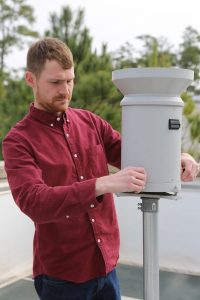
Jonathan Holt replaces the protective cover over the rain gauge.

Jonathan Holt replaces the protective cover over the rain gauge.

On Friday night, while most of North Carolina braced against the biting sleet and snow with hot cocoa and Netflix, a suite of research instruments stood tall above Duke’s campus, quietly gathering data on the the storm.

The instruments are part of a new miniature cloud and precipitation-monitoring laboratory installed on the roof of Fitzpatrick CIEMAS by graduate student Jonathan Holt and fellow climate researchers in Ana Barros’s lab.

The team got the instruments up and running in early October, just in time for their rain gauge to register a whooping six inches of rain in six hours at the height of Hurricane Matthew — an accumulation rate comparable to that of Hurricane Katrina when it made landfall in Mississippi. Last weekend, they collected similar data on the winter storm, their Micro Rain Radar tracking the rate of snowfall throughout the night.

The rooftop is just the latest location where the Barros group is gathering precipitation data, joining sites in the Great Smokies, the Central Andes of Peru, and Southern Africa. These three instruments, with a fourth added in early January, are designed to continuously track the precipitation rate, the size and shape of raindrops or snow flakes – which climatologists collectively dub hydrometeors — and the formation and height of clouds in the air above Duke.

Ana Barros, a professor of civil and environmental engineering at Duke, says that her team uses these field observations, combined with atmospheric data from institutions like NOAA and NASA, to study how microscopic particles of dust, smoke, or other materials in the air called aerosols interact with water vapor to form clouds and precipitation. Understanding these interactions is a key prerequisite to building accurate weather and climate models.

“What we are trying to do here is to actually follow the lifecycle of water droplets in the air, and understand how that varies depending on weather systems, on conditions, on the climatic region and the location on the landscape,” Barros said.

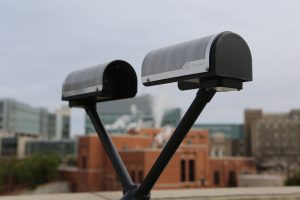
A distrometer on the roof of Fitzpatrick CIEMAS.

A laser beam passing between the two heads of the distrometer detects the numbers and sizes of passing raindrops or snowflakes.

Besides tracking dramatic events like Matthew, Barros says they are also interested in gathering data on light rainfall, defined as precipitation at a rate of less than 3 mm of an hour, throughout the year. Light rainfall is a significant source of water in the region, comprising about 35 percent of the annual rainfall. Studies have shown that it is particularly prone to climate change because even modest bumps in temperature can cause these small water droplets to evaporate back to gas.

Eliminating this water source, “is not a dramatic change,” Barros said. “But it is one of those very important changes that has implications for how we manage water, how we use water, how we design infrastructure, how we have to actually plan for the future.”

Barros says she is unaware of any similar instrument suites in North Carolina, putting their rooftop site in position to provide unique insights about the region’s climate. And unlike their mountainous field sites, instruments on the roof are less prone to being co-opted by itchy bears.

“When we can gather long term rain gauge data like this, that puts our research group in a really unique position to come up with results that no one else has, and to draw conclusions about climate change that no one else can,” Holt said. “It is fun to have a truly unique perspective into the meteorology, hydrology and weather in this place.”

Micro Rain Radar data from Hurricane Matthew and the snowstorm on Jan. 6th.

The Micro Rain Radar (MRR) shoots radio waves into the sky where they reflect off water droplets or snowflakes, revealing the size and height of clouds or precipitation. The team collected continuous MRR data during Hurricane Matthew (top) and last Friday’s snow storm (bottom), creating these colorful plots that illustrate precipitation rates during the storms.

Kara J. Manke, PhD

Post by Kara Manke

New Blogger: Lola Sanchez-Carrion

Hi! My name is Lola Sanchez-Carrion and I am currently a sophomore at Duke pursuing a double major in Biology and Global Health. I was born in New York, and raised between Miami and Lima, Peru. It was in Lima that I developed a passion for global health, and a strong understanding of the implications scientific research can have on communities like the one I lived in.

New Blogger Lola Sanchez-Carrion is a sophomore in pre-med.

New Blogger Lola Sanchez-Carrion is a sophomore in pre-med.

Throughout high school, I did volunteer work with “TECHO,” an NGO that works towards mitigating poverty by building emergency relief homes, improving health systems, and encouraging political advocacy in developing regions of South America. By working with this organization and interacting with communities on a personal level, I began taking greater notice of global health issues and the need to address them.

I was so moved by my experiences with TECHO that I wrote an article about it for an online publication for international schools, and in doing so another interest emerged: a desire to write about all things health/science-related. I wrote for my high school’s “Environmental Science Blog,” a medium through which student writers showcased conferences and events taking place on campus and around Lima regarding environmental activism. I organized a conference on climate change at my high school to instigate conversations on scientific topics relevant to those of my generation. I realized the power that one’s words, written and verbal, had on teaching and inspiring others, particularly those outside the realms of the “scientific community.”

I am currently on the pre-med track at Duke, but am still very much open to the idea of following a scientific career that does not entail pursuing a medical degree. My courses in Global Health, particularly classes taught by Dr. Broverman and Dr. Whetten, have allowed me to recognized the infinite opportunities that exist through research at Duke, and how tangible the impact from research really is.

I hope that by writing for the Duke Research Blog, I will get to experience this research hands-on, meet the interesting students and faculty behind the cutting-edge work, and share it with other members of the Duke community so that they too can experience that impact.

Apart from my work with the Duke Research Blog, I am a tour guide on campus and am a member of Duke’s WISER Club, an organization that works towards empowering and educating women in rural Kenya.

An Unconventional Career Map

Landscape ecologist Jennifer Swenson has a very special set of skills that come from having an “unconventional academic trajectory.”

JenniferSwenson

Jennifer Swenson is an associate professor of the practice in geospatial analysis at the Nicholas School of the Environment

Her diverse and interesting career began at UC Santa Barbara, where she chose to learn about International Relations and Geography. “I wanted to be versatile and globally aware,” she said. Undergraduate school is where she learned the geography techniques she now uses in her research,  and received stacks of reading for international relations.

After this, Swenson spent three years giving bicycle tours, working at a ski resort, and other jobs, until she went on a conservation trip to Ecuador to work for an NGO (non-governmental organization). She was able to use her geospatial techniques (GIS) to map trails and land cover change in Ecuadorian national parks, and also to evaluate forest corridors for an endangered species of monkey.

Connectivity between habitat remnants for critically endangered primate, Callicebus oenanthe, in San Martin, Peru. Presented at the 2nd Simposio de Primatologia en el Peru (Iquitos, November 2013) & at the Remote Sensing forConservation Symposium (London, May 2014) Schaffer-Smith, Swenson, Bóveda-Penalba, Murrieta-Villalobos

Connectivity between habitat remnants for critically endangered primate, Callicebus oenanthe, in San Martin, Peru. Presented at the 2nd Simposio de Primatologia en el Peru (Iquitos, November 2013) & at the Remote Sensing forConservation Symposium (London, May 2014) Schaffer-Smith, Swenson, Bóveda-Penalba, Murrieta-Villalobos

She learned many things, including how to manage a lab, and also became fluent in Spanish thanks to the total immersion. “It’s just another barrier,” she says, to have to use English. Plus, it is useful for reading papers that haven’t been translated.

“Everyone should learn a second or third language and have the opportunity to be immersed in that country.”

After this she went back to graduate school and got a Ph.D. in forest science at Oregon State.

Swenson’s research at Duke is often about conservation or biodiversity, and occasionally ecosystem studies. She is still using her special skills to try to do the greatest good.

“Its great to work towards that, but sometimes its hard to detect that you are doing change,” she says. “I still keep trying to forge ahead and do whatever I can for the environment. In the end, all those students that we train and send out will do great things, and that’s how we have the greatest impact for the environment.”

CalebCaton_100Guest Post by Caleb Caton, a senior at the North Carolina School of Science and Math

Checking in on Air Pollution — With an Expert!

I had the pleasure of meeting and interviewing Duke Professor Junfeng “Jim” Zhang, an avid environmental health researcher who has done amazing work on air pollution research. Because of my own interest in air pollution and its adverse health effects, I began by trying to grasp Dr. Zhang’s work through his detailed scientific explanations of his projects, such as looking at the human health effects of nano-technology.

Junfeng (Jim) Zhang is a professor of global and environmental health in the Nicholas School and the Duke Global Health Institute

Junfeng (Jim) Zhang is a professor of global and environmental health in the Nicholas School and the Duke Global Health Institute

From my reading on the projects I was interested in, I did not expect Zhang to be able to step back and capture the importance of his research in simple terms because his projects were quite complicated (such as testing human health effects due to chemically altered diesel fuel). However, it turned out that Zhang is well-versed in communicating both crucial details of his research and the overall meaning for human health.

The most captivating aspect of my interview with Zhang was our discussion of his contribution to the 2007 Nobel Peace Prize, which was awarded to the Intergovernmental Panel on Climate Change. Dr. Zhang essentially concluded that burning and replanting trees is not necessarily carbon-neutral, disproving the common view that replanting burned trees is always carbon-neutral. His arguments really sold the importance of his research to me and I very quickly agreed with his views on the consequences of his research.

My interview with Zhang also revealed just how important scientific research is in adding evidence and findings to support a side on the growing global issues of environmental pollution and protection. It really amazed me how researchers play such a crucial supportive role in not only protecting the world’s environment, but advancing the quality of human life.

UPDATE – Professor Zhang spoke with BBC about air pollution in China. Read the story here.

PeterChengGuest Post by Peter Cheng, a senior at the North Carolina School of Science and Math.

Seeing the Research for the Trees

The Duke Forest is more than just a place to run the trails or harvest timber. It’s also an important living laboratory for Duke’s research community.

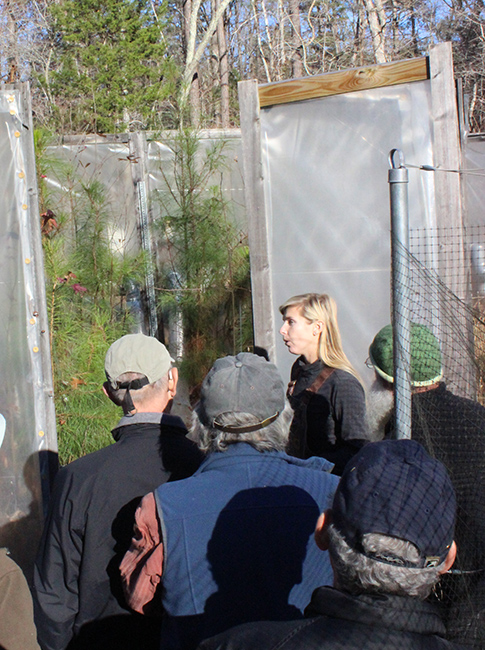
On Dec. 4, we joined the annual tour of research sites in the 7,000-acre forest, led by forest Director Sara Childs and Operations Manager Jenna Schreiber. Nearly two dozen of us learned about water and bugs, climate change and nanoparticle pollution.

Maggie Zimmer opened up the equipment box for her show and tell of the hydrology experiment.

Maggie Zimmer opened up the equipment box for her show and tell of the hydrology experiment.

At the first stop, in the Edeburn Division south of Hillsborough, Nicholas School graduate student Maggie Zimmer showed us a densely instrumented watershed for studying how a raindrop reaches a stream.  A little valley of 130 hectares is studded with wells and dammed by a weir that measures every drop flowing out of the watershed. Zimmer and her thesis advisor Brian McGlynn are trying to get a handle on how a drop of water falling on a leaf or the ground eventually makes its way through several feet of soil and clay, in and around chunks of old rock, to the stream.

It’s not as simple as you think, says Zimmer, who has hand-augured 35 test wells in the study area and spent many dark, wet nights tending to her delicate equipment. For example, the rain gauge measures .01 millimeters at a time!

Across the road from the hydrology lab, we visited a global warming forest built by Jim Clark’s research team and overseen by lab manager Jordan Siminitz.

Jordan Siminitz showed us inside one of the warming forest test chambers.

Jordan Siminitz showed us inside one of the warming forest test chambers.

There are 24 plastic enclosures for studying how temperature increases in the soil might affect the growth of young trees. The warming scenarios were produced by a network of propane-heated pipes under the soil in each enclosure. The funding that built the site and operated it for four years has stopped, but the trees are still there and the team is hopeful they can restart the experiment.

Here and in Harvard Forest, the team was looking at soil temperature increases of 3 degrees or 5 degrees Celsius. The surprising finding out of four years of data was that southern tree species seemed to be more adversely affected by the temperature increase than northern species.

“Long term research like this is really hard to get funding for,” Childs said. But without long term studies, we won’t know much about what to expect from climate change. Incidentally, NC State was conducting a parallel study of ants and warmer soils in the same experimental booths, but they’ll be shutting down this year as well.

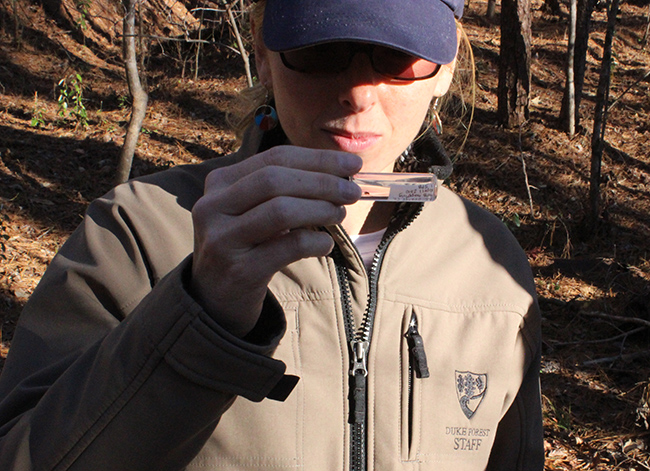
Duke Forest Director Sara Childs checked out a pickled Southern Pine Beetle.

Duke Forest Director Sara Childs checked out a pickled Southern Pine Beetle.

At the next stop, we found nattily uniformed NC Forest Service ranger Philip Ramsey standing next to an elaborate plastic contraption like 10 black funnels in a series leading down to a reservoir of antifreeze at the bottom. It’s a pheromone trap for the Southern Pine Beetle and its predator, the Clerid beetle. All is well with those bugs for now, but the devastating enemy of ash trees, the Emerald Ash Borer, is on the march and due to arrive any month now, Ramsey said, passing around pickled specimens of the bugs for our inspection.

Our last stop was an update on the nanotechnology test site called the mesocosm  facility – 30 boxes filled with water, silt and plant life. They’re meant to mimic a tiny slice of a shoreline ecosystem to see how various nanoparticle materials are taken up by plant and animal life.

Steve Anderson (at right) explained the mesocosm test chambers to the tour group.

Steve Anderson (at right) explained the mesocosm test chambers to the tour group.

Research analyst Steve Anderson from Emily Bernhardt’s lab explained the latest experiments on what happens to all the poisonous stuff infused into anti-bacterial socks and pressure-treated lumber. The good news so far is that nanoparticies don’t seem to get taken up by ecosystems as readily as some had feared.

This isn’t really forest research per se, but where else are you going to put 30 big bunkers of mud, surrounded by an electrified raccoon fence, a super-fine frog fence and a Quonset hut enclosure for the cooler months?

Duke Forest houses 71 research projects at the moment, 16 of them started in just the last year. We’ll look forward to more fun discoveries on next year’s tour!

Follow Duke Forest on Facebook or subscribe to their updates to catch this and other tours.

Karl Leif Bates

Post by Karl Leif Bates

Page 8 of 11

Powered by WordPress & Theme by Anders Norén