Following the people and events that make up the research community at Duke

Students exploring the Innovation Co-Lab

Category: Computers/Technology Page 10 of 20

Martin Brooke: Mentoring Students Toward an X Prize for Ocean Robotics

We know less about the ocean floor than the surface of the moon. As one of the most unexplored areas of the world, multiple companies have begun to incentivize ingenuity towards exploring the oceans. Among these organizations are the Gates Foundation, the National Academy of Sciences, and X Prize.

XPrize team at Duke

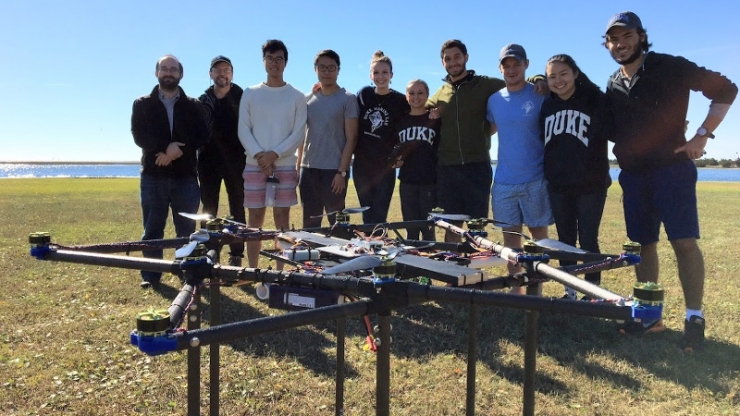
Martin Brooke, second from left, and the student team with their giant drone.

Martin Brooke, an Associate Professor of Electrical and Computer Engineering at Duke, is presently leading a group of students who are working on mapping the ocean floor in an efficient way for the X Prize challenge.

Brooke said “open ended problems where you don’t know what to do” inspire him to do research about ocean engineering and design.

Martin Brooke

Martin Brooke

Collaborating with professors at the Duke Marine Lab that “strap marine sensors on whales” was a simple lead-in to starting a class about ocean engineering a few years ago. His teaching philosophy includes presenting the students with problems that make them think, “we want to do this, but we have no idea how.”

Before working on a drone that drops sensor pods down into the ocean to map the ocean floor, Brooke and his students built a sensor that could be in the ocean for a month or more and take pH readings every five seconds for a previous X Prize challenge.

Addressing the issues that many fisheries faced, he told me that he met an oyster farmer in Seattle who wished that there were pH sensors in the bay because sometimes tides bring in “waves of high pH water into the sound and kill all of the oysters without warning.” Citing climate change as the cause for this rise in pH, Brooke explained how increased carbon dioxide in the air dissolves into the water and raises the acidity. Emphasizing how “there’s not enough data on it,” it’s clear that knowing more about our oceans is beneficial economically and ecologically.

Guest Post by Sofia Sanchez, a senior at North Carolina School of Math and Science

Generating Winning Sports Headlines

What if there were a scientific way to come up with the most interesting sports headlines? With the development of computational journalism, this could be possible very soon.

Dr. Jun Yang is a database and data-intensive computing researcher and professor of Computer Science at Duke. One of his latest projects is computational journalism, in which he and other computer science researchers are considering how they can contribute to journalism with new technological advances and the ever-increasing availability of data.

An exciting and very relevant part of his project is based on raw data from Duke men’s basketball games. With computational journalism, Yang and his team of researchers have been able to generate diverse player or team factoids using the statistics of the games.

Grayson Allen headed for the hoop.

Grayson Allen headed for the hoop.

An example factoid might be that, in the first 8 games of this season, Duke has won 100% of its games when Grayson Allen has scored over 20 points. While this fact is obvious, since Duke is undefeated so far this season, Yang’s programs will also be able to generate very obscure factoids about each and every player that could lead to unique and unprecedented headlines.

While these statistics relating player and team success can only imply correlation, and not necessarily causation, they definitely have potential to be eye-catching sports headlines.

Extracting factoids hasn’t been a particularly challenging part of the project, but developing heuristics to choose which factoids are the most relevant and usable has been more difficult.

Developing these heuristics so far has involved developing scoring criteria based on what is intuitively impressive to the researcher. Another possible measure of evaluating the strength of a factoid is ranking the types of headlines that are most viewed. Using this method, heuristics could, in theory, be based on past successes and less on one researcher’s human intuition.

Something else to consider is which types of factoids are more powerful. For example, what’s better: a bolder claim in a shorter period of time, or a less bold claim but over many games or even seasons?

The ideal of this project is to continue to analyze data from the Duke men’s basketball team, generate interesting factoids, and put them on a public website about 10-15 minutes after the game.

Looking forward, computational journalism has huge potential for Duke men’s basketball, sports in general, and even for generating other news factoids. Even further, computational journalism and its scientific methodology might lead to the ability to quickly fact-check political claims.

Right now, however, it is fascinating to know that computer science has the potential to touch our lives in some pretty unexpected ways. As our current men’s basketball beginning-of-season winning streak continues, who knows what unprecedented factoids Jun Yang and his team are coming up with.

By Nina Cervantes

Opportunities at the Intersection of Technology and Healthcare

What’d you do this Halloween?

I attended a talk on the intersection of technology and healthcare by Dr. Erich Huang, who is an assistant professor of Biostatistics & Bioinformatics and Assistant Dean for Biomedical Informatics. He’s also the new co-director of Duke Forge, a health data science research group.

This was not a conventional Halloween activity by any means, but I felt lucky to be exposed to this impactful research surrounded by views of the Duke forest in fall in Penn Pavilion at IBM-Duke Day.

Erich Huang

Erich Huang, M.D., PhD. is the co-director of Duke Forge, our new health data effort.

Dr. Huang began his talk with a statistic: only six out of 53 landmark cancer biology research papers are reproducible. This fact was shocking (and maybe a little bit scary?), considering  that these papers serve as the foundation for saving cancer patients’ lives. Dr. Huang said that it’s time to raise standards for cancer research.

What is his proposed solution? Using data provenance, which is essentially a historical record of data and its origins, when dealing with important biomedical data.

He mentioned Duke Data Service (DukeDS), which is an information technology service that features data provenance for scientific workflows. With DukeDS, researchers are able to share data with approved team members across campus or across the world.

Next, Dr. Huang demonstrated the power of data science in healthcare by describing an example patient. Mr. Smith is 63 years old with a history of heart attacks and diabetes. He has been having trouble sleeping and his feet have been red and puffy. Mr. Smith meets the criteria for heart failure and appropriate interventions, such as a heart pump and blood thinners.

A problem that many patients at risk of heart failure face is forgetting to take their blood thinners. Using Pillsy, a company that makes smart pill bottles with automatic tracking, we could record Mr. Smith’s medication taking and record this information on the blockchain, or by storing blocks of information that are linked together so that each block points to an older version of that information. This type of technology might allow for the recalculation of dosage so that Mr. Smith could take the appropriate amount after a missed dose of a blood thinner.

These uses of data science, and specifically blockchain and data provenance, show great opportunity at the intersection of technology and healthcare. Having access to secure and traceable data can lead to research being more reproducible and therefore reliable.

At the end of his presentation, Dr. Huang suggested as much collaboration in research between IBM and Duke as possible, especially in his field. Seeing that the Research Triangle Park location of IBM is the largest IBM development site in the world and is conveniently located to one of the best research universities in the nation, his suggestion makes complete sense.

By Nina Cervantes        

Global Health Research from Zika to Economics

Brazil, Kenya and China: this week, the sixth annual Global Health Research Showcase proved that Global Health majors truly represent global interests.

This past summer, Duke PhD student Tulika Singh explored complementary diagnosis techniques for Zika virus pregnant women in Vitoria, Brazil. Zika is difficult to diagnose “because the PCR-based test can only tell if you’ve had Zika virus within about ten days of the infection,” Singh said. “That’s a big problem for enrolling pregnant women into our study on Zika transmission and maternal immunity.”

To combat this issue, Singh and her thesis advisor Sallie Permar trained collaborators to use the whole virion ELISA (WVE) laboratory technique which may reveal if an individual has been exposed to Zika. ELISA detects Zika through testing for the antibodies that most likely would have been produced during a Zika infection. Singh’s work allows the research team to better assess whether women have been exposed to Zika virus during pregnancy, and will ultimately guide Zika vaccine design. 

Master of Science in Global Health candidate Carissa Novak examined why some HPV positive women in Western Kenya are not seeking preventive measures against cervical cancer. All the women diagnosed with HPV were referred to the Country Hospital but only “33 to 42 percent actually sought treatment” leading to Novak’s main research question, “Why did so few women seek treatment?” To answer this question, she sent out quantitative questionnaires to 100 women and then followed up by interviewing 20 of them. She surveyed and interviewed both women who had and had not sought treatment. Her results showed that transportation and cost hinder treatment acquirement and that the women who did seek treatment were often directed to by a health worker or actively trying to prevent cervical cancer. Novak believes that increasing women’s trust and understanding of the health care system will assist in improving the percentage who seek treatment.

In Kunshan, China, Brian Grasso evaluated the development of Kunshan’s health system in relation to its economic development. “Kunshan is now China’s richest county-level city and it used to be a small farm town…My main take away was that economic growth has strengthened Kunshan’s health systems while also creating new health challenges,” Grasso said. What are some of these new health challenges? Some of them include air pollution, increased stress in manufacturing jobs and more car accidents. Grasso determines that other developing health systems should learn from Kunshan that without proper regulations poor health can result in the midst of progress.

Post by Lydia Goff

Cheating Time to Watch Liquids do the Slow Dance

Colorful spheres simulating liquid molecules shift around inside a cube shape

The team’s new algorithm is able to simulate molecular configurations of supercooled liquids below the glass transition. The properties of these configurations are helping to solve a 70-year paradox about the entropy of glasses. Credit: Misaki Ozawa and Andrea Ninarello, Université de Montpellier.

If you could put on a pair of swimming goggles, shrink yourself down like a character from The Magic School Bus and take a deep dive inside a liquid, you would see a crowd of molecules all partying like it’s 1999.

All this frenetic wiggling makes it easy for molecules to rearrange themselves and for the liquid as a whole to change shape. But for supercooled liquids — liquids like honey that are cooled below their freezing point without crystallizing – the lower temperature slows down the dancing like Etta James’ “At Last.” Lower the temperature enough, and the slow-down can be so dramatic that it takes centuries or even millennia for the molecules to rearrange and the liquid to move.

Scientists can’t study processes that last longer than their careers. But Duke chemists and their Simons Foundation collaborators have found a way to cheat time, simulating the slow dance of deeply supercooled liquids. Along the way, they have found new physical properties of “aged” supercooled liquids and glasses.

A droplet rises above a surface of water

Credit: Ruben Alexander via Flickr.

To understand just how slow deeply supercooled liquids move, consider the world’s longest-running experiment, the University of Queensland’s Pitch Drop Experiment. A single drop of pitch forms every eight to thirteen years — and this pitch is moving faster than deeply supercooled liquids.

“Experimentally there is a limit to what you can observe, because even if you managed to do it over your entire career, that is still a maximum of 50 years,” said Patrick Charbonneau, an associate professor of chemistry and physics at Duke. “For many people that was considered a hard glass ceiling, beyond which you couldn’t study the behavior of supercooled liquids.”

Charbonneau, who is an expert on numerical simulations, said that using computers to simulate the behavior of supercooled liquids has even steeper time limitations. He estimates that, given the current rate of computer advancement, it would take 50 to 100 years before computers would be powerful enough for simulations to exceed experimental capabilities – and even then the simulations would take months.

To break this glass ceiling, the Charbonneau group collaborated with Ludovic Berthier and his team, who were developing an algorithm to bypass these time constraints. Rather than taking months or years to simulate how each molecule in a supercooled liquids jiggles around until the molecules rearrange, the algorithm picks individual molecules to swap places with each other, creating new molecular configurations.

This allows the team to explore new configurations that could take millennia to form naturally. These “deeply supercooled liquids and ultra-aged glasses” liquids are at a lower energy, and more stable, than any observed before.

“We were cheating time in the sense that we didn’t have to follow the dynamics of the system,” Charbonneau said. “We were able to simulate deeply supercooled liquids well beyond is possible in experiments, and it opened up a lot of possibilities.”

Two columns of blue and red spheres represent simulations of vapor-deposited glasses.

Glasses that are grown one layer at a time have a much different structure than bulk glasses. The team used their new algorithm to study how molecules in these glasses rearrange, and found that at low temperatures (right), only the molecules at the surface are mobile. The results may be used to design better types of glass for drug delivery or protective coatings. Credit: Elijah Flenner.

Last summer, the team used this technique to discover a new phase transition in low-temperature glasses. They recently published two additional studies, one of which sheds light on the “Kauzmann paradox,” a 70-year question about the entropy of supercooled liquids below the glass transition. The second explores the formation of vapor-deposited glasses, which have applications in drug delivery and protective coatings.

“Nature has only one way to equilibrate, by just following the molecular dynamics,” said Sho Yaida, a postdoctoral fellow in Charbonneau’s lab. “But the great thing about numerical simulations is you can tweak the algorithm to accelerate your experiment.”

Configurational entropy measurements in extremely supercooled liquids that break the glass ceiling.” Ludovic Berthier, Patrick Charbonneau, Daniele Coslovich, Andrea Ninarello, Misaki Ozawa and Sho Yaida. PNAS, Oct. 24, 2017. DOI: 10.1073/pnas.1706860114

The origin of ultrastability in vapor-deposited glasses.” Ludovic Berthier, Patrick Charbonneau, Elijah Flenner and Francesco Zamponi. PRL, Nov. 1, 2017. DOI: 10.1103/PhysRevLett.119.188002

Post by Kara Manke
The Internet of Things: Useful or Dangerous?

The Internet of Things has tons of possibilities and applications, but some of them could be malicious.

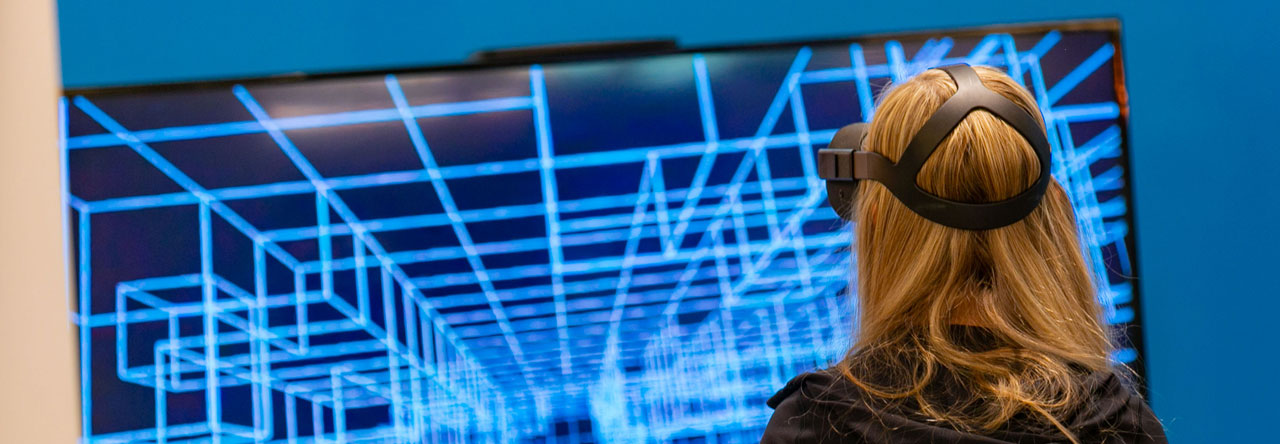
This week, the Duke Digital Initiative (DDI) held an open house in the Technology Engagement Center (TEC) where you could go in and check out the new equipment they’ve installed. They all have one central theme: the Internet of Things (IoT). What is the Internet of Things? It’s pretty simple. The Internet of Things “refers to the interconnectivity of devices on the internet.” In other words, if something can connect to things like wifi, social media, or your phone, it makes it an IoT device!

A classic example of an IoT device I’m sure you’re all familiar with is the Amazon Echo. You could ask it to order you something, look up a word, what the weather is like… you get the idea. Echo and Alexa are just one kind of IoT. We’re also talking lightbulbs, outlets, robots, thermostats…  Eventually your whole house might become an IoT device. The future is here!

Devices such as the Echo Dot, Philips Hue Smart Lightbulb, Samsung Smart Outlet, Meccano Robot, and Swipe-O-Matic are all showcased in the TEC. It’s part of the DDI’s “IoT Initiative” this year to give Duke faculty, staff, and students a better understanding of the power of IoT devices. As one expert on site said, “the devices are everywhere.”

The Co-Lab had actually hacked the Echo Dot and programmed in some of their own commands, so it was responding to questions like “Who is Maria?” and “Where is this place?”

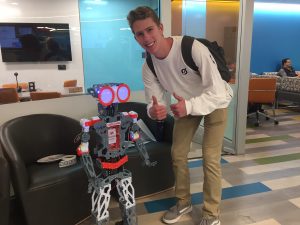
The Meccano Robot (named “Techy”) was fun to mess around with, and a big hit among attendees. He’s more of a consumer-friendly toy, but just by using voice-commands I got him to give me a high-five and even tango.

Me, cheesin’ with Techy

The smart lightbulb was low-key the coolest thing there. By using multiple lights you can customize different “environments” like a TV watching environment or party environment, and the lights will change color/brightness accordingly with just a tap on your phone. The smart outlets were cool, too. They can be controlled remotely from your phone and even have timers set.

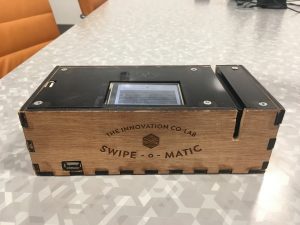
The student-built Swipe-O-Matic added me to the Co-Lab mailing list, just by swiping my Duke card.

One device — the “Swipe-O-Matic”—was actually invented by Duke students, and we used it to add my name to the Co-Lab mailing list just by swiping my Duke Card.

While these devices are all fun and useful, one expert I spoke with noted “there’s lots of consequences to using them—good, and bad.”

As they become more consumer available, if your machine is particularly vulnerable, bad people could hack into parts of your life. Think about a smart door lock. It’s super useful—you can create virtual keys for family members, let someone in remotely, or give your housekeepers access at certain times of the day. However, this could obviously go pretty badly if someone were to hack it and enter your house.

But don’t worry. As technology progresses, IoT devices will eventually be all around us. While security is an issue, these devices have way more good to them than bad. “Snapchat spectacles” are sunglasses that can record video and upload it straight to the Snapchat app. Someone at the TEC had the idea for “smart window blinds” that know when to open and close. Imagine a plant pot that sent you a notification when it needed to be watered. The uses are seemingly endless!

Will SheehanPost by Will Sheehan

Engineering Design Pod: The Newest Innovation Center

You guys have to check out the brand new Engineering Design Pod! What used to be the Blue Express Cafe, this giant oval-shaped room with huge glass windows under the LSRC is now a space for creation.

Duke Engineering Design Pod entrance

Duke Engineering’s new Design Pod for students is in the Levine Science Research Center.

There’s essentially all the equipment in there that an engineer could ever want, organized ever so beautifully in labeled drawers and hung on walls: screwdrivers, nails, hammers, saws, pool noodles… plus, there are scientific-looking tables (a.k.a. workbenches), rolly-stools, extension chords that come down from the ceiling, even TVs… this place is frickin’ awesome!

worktables in Duke Engineering Design Pod

Everything in the Design Pod is on wheels for easy reconfiguration

The “Design Pod” was created alongside Duke’s new engineering design course in order to to foster learning through hands-on experience. Students have tested out the 3D printer to create items such as a skull and even chess pieces. There’s a massive laser printer, foam cutter, panel saw, and more to come. At one end of the  room there are lots of cubbies, used for holding backpacks so they don’t get in the way. In the future, team projects will be stored there, too. Several big whiteboards on wheels are scattered around the room, which students take advantage of to outline their work and draw up ideas. Almost everything is on wheels, in fact, because as Dr. Ann Saterbak explained to me, the pod is “designed to be a flexible space.” It really is a special place, carefully geared toward collaboration and innovation. Just being in there made me want to create something!

UNC chess board

Awkward! One student made a UNC-themed chessboard in Duke’s new Design Pod.

Kyra McDonald, a freshman currently taking the engineering design course, says it’s her favorite class. The class is split up into teams and each team picks from a list of projects that they will pursue for the whole semester — examples include things like a flexible lemur feeder and a drone water sampler. What she likes so much about the class is rather than a typical lecture where you listen and take notes the whole time, this design course is all about working in your team and applying what you know to real-world scenarios.

Dr. Saterbak further developed this point. Although this is her first year at Duke, in her experience students not only get a good sense of what engineers actually do, but also leave with a “concrete, practical thing” which they are proud of and can talk about at job interviews. All the cool features that make up the design pod — the tools, the room, the flexibility — are there so Dr. Saterbak’s previous experience can become a reality for Duke students.

Duke Engineering Design Pod

A 3D printed skull in the Design Pod

Because they’re still in the pre-design phase, the freshman in the class haven’t really needed to use the space to its full potential.

But that will come as soon as the physical creation starts happening. Students in the class will have special access to the design pod off-hours, so get ready because the innovation levels are about to be booming!

Story and Photos By Will Sheehan Will Sheehan

Designing Drugs Aimed at a Different Part of Life’s Code

Individual RNA molecules fluoresce inside a breast cancer cell.

Individual RNA molecules fluoresce inside a breast cancer cell. Credit: Sunjong Kwon, Oregon Health & Science University, via Flickr.

Most drugs work by tinkering with the behavior of proteins. Like meddlesome coworkers, these molecules are designed to latch onto their target proteins and keep them from doing what they need to do.

If a protein is responsible for speeding up a reaction, the drug helps slow the reaction down. If a protein serves as a gatekeeper to a cell, regulating what gets in and what stays out, a drug changes how many molecules it lets through.

But proteins aren’t the only doers and shakers in our bodies. Scientists are finding that strings of RNA — known primarily for their role in shuttling genetic information from nucleus-bound DNA to the cell’s protein-manufacturing machinery — can also play a major role in regulating disease.

A portrait of Amanda Hargrove

Amanda Hargrove is an assistant professor of chemistry at Duke University.

“There has been what some people are calling an RNA revolution,” said Amanda Hargrove, assistant professor of chemistry at Duke. “In some diseases, non-coding RNAs, or RNAs that don’t turn into protein, seem to be the best predictors of disease, and even to be driving the disease.”

Hargrove and her team at Duke are working to design new types of drugs that target RNA rather than proteins. RNA-targeted drug molecules have the potential help treat diseases like prostate cancer and HIV, but finding them is no easy task. Most drugs have been designed to interfere with proteins, and just don’t have the same effects on RNA.

Part of the problem is that proteins and RNA have many fundamental differences, Hargrove said. While proteins are made of strings of twenty amino acids that can twist into myriad different shapes, RNA is made of strings of only four bases — adenine, guanine, cytosine and uracil.

“People have been screening drugs for different kinds of RNA for quite a while, and historically have not had a lot of success,” Hargrove said. “This begged the question, since RNA has such chemically different properties than proteins, is there something different about the small molecules that we need in order to target RNA?”

To find out, graduate student Brittany Morgan and research associate Jordan Forte combed the scientific literature to identify 104 small molecules that are known interact with specific types of RNA. They then analyzed 20 different properties of these molecules, and compared their properties to those of collections of drug molecules known to interact with proteins.

The team found significant differences in shape, atomic composition, and charge between the RNA-active molecules and the protein-active molecules. They plan to use the results to compile a collection of molecules, called a library, that are chosen to better “speak the language” of the RNA-active molecules. They hope this collection of molecules will be more likely to interact with RNA in therapeutically beneficial ways.

“We found that there are differences between the RNA-targeted molecules and the protein-targeted drugs, and some of them are pretty striking,” Hargrove said. “What that means is that we could start to enrich our screening libraries with these types of molecules, and make these types of molecules, to have better luck at targeting RNA.”

Discovery of Key Physicochemical, Structural, and Spatial Properties of RNA-Targeted Bioactive Ligands.” Brittany S. Morgan, Jordan E. Forte, Rebecca N. Culver, Yuqi Zhang and Amanda Hargrove. Angewandte Chemie, Sept. 18, 2017. DOI: 10.1002/anie.201707641

Kara J. Manke, PhDPost by Kara Manke

Students Bring Sixty Years of Data to Life on the Web

For fields like environmental science, collecting data is hard.

Fall colors by Mariel Carr

Fall colors in the Hubbard Brook Experimental Forest, in New Hampshire’s White Mountains.

Gathering results on a single project can mean months of painstaking measurements, observations and notes, likely in limited conditions, hopefully to be published in a highly specialized journal with a target audience made up mostly of just other specialists in the field.

That’s why when, this past summer, Duke students Devri Adams, Camila Restrepo and Annie Lott set out with  graduate students Richard Marinos, Matt Ross and Professor Emily Bernhardt to combine over six decades of data on the Hubbard Brook Experimental Forest into a workable, aesthetically pleasing visualization website, they were really breaking new ground in the way the public can appreciate this truly massive store of information.

The site’s navigation shows users what kinds of data they might explore in beautiful fashion.

Spanning some 8,000 acres of New Hampshire’s sprawling White Mountain National Forest, Hubbard Brook has captured the thoughts and imaginations of generations of environmental researchers. Over 60 years of study and authorized experimentation in the region have brought us some of the longest continuous environmental data sets ever collected, tracking changes across a variety of factors for the second half of the 20th century.

Now, for the first time ever, this data has been brought together into a comprehensive, agile interface available to specialists and students alike. This website is developed with the user constantly in mind. At once in-depth and flexible, each visualization is designed so that a casual viewer can instantly grasp a variety of factors all at the same time—pH, water source, molecule size and more all made clearly evident from the structures of the graphs.

Additionally, this website’s axes can be as flexible as you need them to be; users can manipulate them to compare any two variables they want, allowing for easy study of all potential correlations.

All code used to build this website has been made entirely open source, and a large chunk of the site was developed with undergrads and high schoolers in mind. The team hopes to supplement textbook material with a series of five “data stories” exploring different studies done on the forest. The effects of acid rain, deforestation, dilutification, and calcium experimentation all come alive on the website’s interactive graphs, demonstrating the challenges and changes this forest has faced since studies on it first began.

The team hopes to have created a useful and user-friendly interface that’s easy for anyone to use. By bringing data out of the laboratory and onto the webpage, this project brings us one step further in the movement to make research accessible to and meaningful for the entire world.

Post by Daniel Egitto

New Blogger Will Sheehan: Freshman with a Love of the Outdoors

Hi there! My name is Will Sheehan, and I’m a freshman at Duke. While I’m currently undecided, I plan on studying electrical and computer engineering and possibly double majoring in computer science. I grew up on Maui, Hawaii, but now live with my mom in Austin, Texas. I spend my summers and winters with my dad Will Sheehan by the oceanback on Maui surfing, dirt biking, hiking and more. I like to think that spending so much time in the outdoors has given me a deep appreciation for nature, and in return a fiery passion for sciences like physics and chemistry.

The summer before  junior year I traveled to Beijing, China to live with a host family for a month. Having to speak their language nearly the whole time, I turned to journaling in order to empty my thoughts. They effortlessly spilled onto the page; it felt as if I couldn’t write fast enough, and that my ideas would flee before I could cement them in ink.

I soon found a new love for personal writing. The next summer I interned for a company named ShakaCode, and while I learned the ins and outs of applying Ruby on Rails to website development I blogged about my experience. As soon as school started, my old calculus teacher approached me, saying how he had read my blogWill Sheehan riding a dirt bike and loved my style of writing as well as what I had to say. That year in advanced calculus he had our class use blogs as a way to track our progress in whatever project or research we were pursuing.

Attempting to communicate complex, specialized information is an intriguing challenge that I find satisfying to complete. I have developed this skill not only through my blogging experience but also through tutoring in math the past couple years. While I do plan on pursuing computer science, I am still entirely open to a career in scientific research. Discovering something new has been a dream of mine for as long as I can remember.

Will Sheehan on a cliffI hope that as a part of the Duke Research Blog I get to share new, important findings with our community as I further my own understanding along the way. I see this as a learning opportunity for both myself and those around me, and hope that Duke takes an interest in all that I have to say about the cool stuff they might not normally know about!

Post by Will Sheehan

Page 10 of 20

Powered by WordPress & Theme by Anders Norén