Young people have the power to generate change, whether they know it or not.
At least that was the sentiment expressed by the Director of Polling at the Harvard Institute of Politics, John Della Volpe at a seminar earlier this month. A leading authority on the intersection of young Americans and political influence, Della Volpe discussed the key role Generation Z will play in the 2022 and 2024 elections.
But does Generation Z really have what it takes to change the course of American politics?
“We spend a lot of time talking about Gen Z, and not enough time talking to you,” Della Volpe began as he addressed a crowd of young Duke students. “This is one of the rare occasions where I’m going to be doing most of the talking rather than most of the listening.”
Stanford Researcher Roberta Katz describes Generation Z — those born between 1997 and 2012 — as a highly collaborative cohort with a pragmatic attitude about generational issues like political engagement.
Exit Polls from NBC reveal that Gen Z was responsible for more than 9% of total votes in the 2020 presidential election, with that number only expected to grow. In Georgia and Arizona, young voters turned out to be critical for President Joe Biden’s victory, Della Volpe said.
Exit Polls From NBC show 2020 total votes for Biden compared to Trump, with Generation Z voting for Biden two-to-one.
He urges Gen Z to “remind elected officials that you did change things and that you will continue changing things.” Della Volpe predicts that Gen Z’s choices will also be crucial in the 2022 midterms.
Occupy Wall Street, the election of Trump, the Parkland Shooting, Greta Thunberg, and the killing of George Floyd were five events that Della Volpe believed were crucial in shaping this trajectory, as well as Gen Z’s political view as a whole.
“We have to look collectively at what you as a cohort saw and how that’s affecting you. In fact, I think that’s a far better way to think about our politics than what state you are in.”
The way parents think about bills and taxes, the way that weighs on your shoulders, that’s the way we think about living and dying.
Gen Z woman in conversation with John Della Volpe
“No generation in 70 years has dealt with more chaos, more trauma, more struggle before your brain is even fully developed,” Della Volpe asserted. He maintains that Generation Z is dealing with extremely complex issues much earlier than other generations.
Research from the American Psychological Association bears this out, indicating that Gen Zers are currently the most stressed demographic of people in the United States. They are also significantly more likely to rate their mental health as poor in comparison to other generations.
“I’m very cognizant of not putting any more pressure on you,” said Della Volpe. “You are already doing such a good job of managing yourselves and managing your situation.”
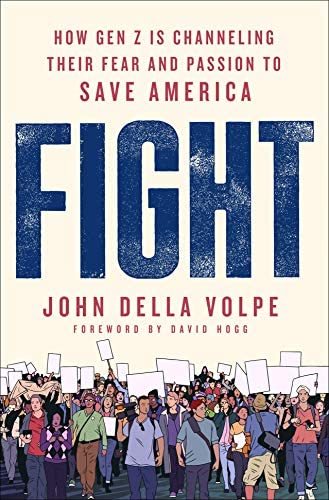
John Della Volpe’s book, published earlier this year.
Generation Z is managing so well, in fact, that Della Volpe argues they are essential to the success of US politics moving forward. In his book ‘Fight: How Generation Z is Channeling Their Fear and Passion to Save America,’ Della Volpe argues that the challenges unique to Gen Z prepare them to take control of their future in this nation.
Thanks to Della Volpe the answer is overwhelmingly clear: Gen Z does have what it takes to turn this nation around. So get out there and vote!
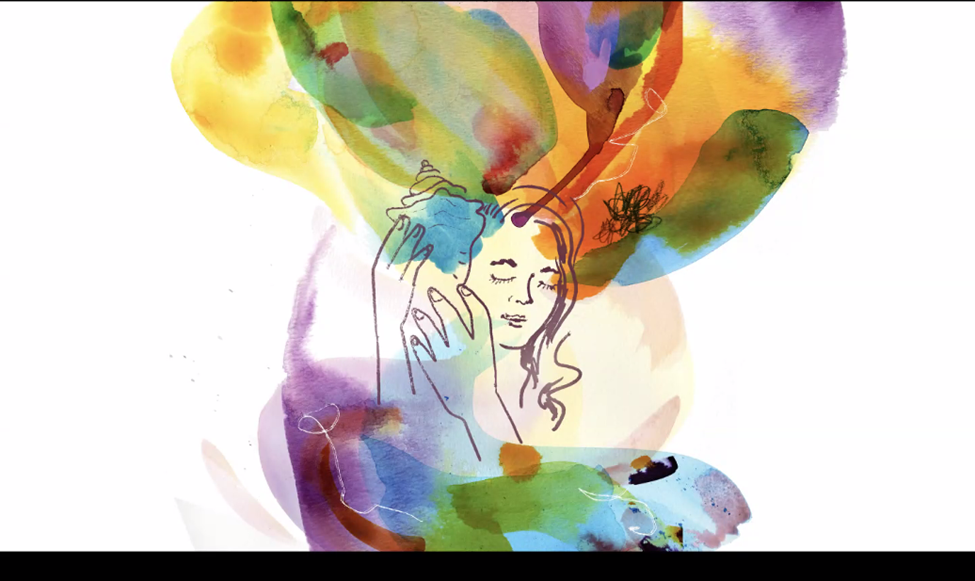
“To me [this image] captures the wonder, the awe, the beauty of sound and the brain that tries to make sense of it,” said professor Nina Kraus, Northwestern University researcher and author of “Of Sound Mind: How Our Brain Constructs a Meaningful Sonic World.”
Stop. What do you hear?
We might not always think about the sounds around us, but our brains are always listening, said Northwestern University professor Nina Kraus.
Kraus, auditory researcher and author of “Of Sound Mind: How Our Brain Constructs a Meaningful Sonic World,” spoke via Zoom to a Duke audience in October. She has published more than four hundred papers on the auditory system in humans and other animals and how it’s affected by conditions like autism, aging, and concussion. She discussed some of her findings and how “the sound mind” affects us in our day-to-day lives.
One of the slides from Kraus’s presentation. We can think of sound as having many “ingredients.”
“I think of the sound mind as encompassing how we think, how we move, how we sense, and how we feel,” Kraus said. We live in a “visually dominated world,” but for hearing people, sound plays an important role in language, music, rhythm, and how we perceive the world.
One of the slides from Kraus’s presentation. The human auditory system involves not just the ears but also several regions of the brain. The “hearing brain” engages movement, cognition, and emotions along with interpreting direct sensory input from all senses.
Kraus discussed the auditory system and how much of what we think of as hearing takes place in the brain. We can think of sound as signals outside the head and electricity as signals inside the head (neural processing). When those two merge, learning occurs, and we can make sound-to-meaning connections.
Another slide from Kraus’s presentation. In an experiment, teaching rabbits to associate a sound with meaning (in this case, more carrots) changed patterns of neuron firing in the auditory cortex, even in individual neurons. “Same sound, same neuron, and yet the neuron responded differently… because now there’s a sound-to-meaning connection,” Kraus said.
Despite how sensitive our neurons and brains are to sound, things can get lost in translation. Kraus studies how conditions like concussions and hearing loss can adversely affect auditory processing. Even among healthy brains, we all hear and interpret sounds differently. People have unique “sonic fingerprints” that are relatively stable over time within an individual brain but differ between people. These patterns of sound recognition are apparent when scientists record brain responses to music or other sounds.
“One of the biological measures that we have been using in human and in animal models,” Kraus said, is FFR (frequency following response) to speech. FFR-to-speech can be used to analyze an individual’s auditory processing system. It also allows scientists to convert brain responses back into sound waves. “The sound wave and the brainwave resemble each other, which is just remarkable.”
One of Kraus’s slides. Technology called frequency following response (FFR) can be used to convert brain waves back into original sound (like a song).
This technology helps reveal just how attuned our brains are to sound. When we hear a song, our brain waves respond to everything from the beat to the melody. Those brain waves are so specific to that particular song or sound that when scientists convert the brain waves back into sound, the resulting music is still recognizable.
When scientists try this on people who have experienced a concussion, for instance, the recreated music can sound different or garbled. Experiments that compare healthy and unhealthy brains can help reveal what concussions do to the brain and our ability to interpret sound. But not everything that affects auditory processing is bad.
Musical training is famously good for the brain, and experiments done by Kraus and other scientists support that conclusion. “The musician signature—something that develops over time—” has specific patterns, and it can enhance certain components of auditory processing over time. Making music might also improve language skills. “The music and language signatures really overlap,” Kraus said, “which is why making music is so good for strengthening our sound mind.” Kids who can synchronize to a beat, for example, tend to have better language skills according to some of the experiments Kraus has been involved with.
Musicians are also, on average, better at processing sound in noisy environments. Musicians respond well in quiet and noisy environments. Non-musicians, on the other hand, respond well in quiet environments, but that response “really breaks down” in noisy ones.
Interestingly, “Making music has a lifelong impact. Making music in early life can strengthen the sound mind when one is seventy or eighty years old.”
A slide from Kraus’s presentation. Musicians tend to be better at processing sounds in noisy environments.
Exercise, too, can improve auditory processing. “Elite division 1 athletes have especially quiet brains” with less neural noise. That’s a good thing; it lets incoming information “stand out more.”
In experiments, healthy athletes also have a more consistent response over time across multiple trials, especially women.
These benefits aren’t limited to elite athletes, though. According to Kraus, “Being fit and flexible is one of the best things you can do for your brain,” Kraus said.
Kraus and her team have a regularly updated website about their work. For those who want to learn more about their research, they have a short video about their research approach and an online lecture Kraus gave with the Kennedy Center.
Nina Kraus with a piano. “Science is a deeply human endeavor,” she said, “and I think we often forget that. It’s made by people.” Photo courtesy of Kraus and colleague Jenna Cunningham, Ph.D.
Exposing young kids to different opinions or asking them to explain their thinking can have surprising benefits, Duke University researchers find.
DURHAM, N.C. — “But that’s not fair!” If you’re a parent or a teacher, you’ve probably heard this countless times.
To most young children, “fair” simply means treating everyone equally. Kids are quick to say they shouldn’t have to go to bed earlier than a sibling, or put up with more chores or homework than a classmate.
But as children get older, they begin to grasp that sometimes, things can be unequal and still be fair — especially when people have different needs, circumstances, or abilities. Up until 8 to 10 years of age, most children aren’t yet capable of such moral subtlety, but a new study shows they can get closer, with help from a surprising source: disagreement.
For preschoolers, a 20-minute conversation with someone who disagrees with them or who asks them to justify their ideas can foster more nuanced moral calculations about what it means to be “fair.”
That’s the key finding from a new Duke University study that examines how children develop their sense of morality.
Many theorists have proposed that a child’s interactions with other people can shape their growing sense of right and wrong. But experiments to pinpoint exactly what kinds of interactions are most helpful have been lacking, said first author Leon Li, who did the research with developmental psychologist Michael Tomasello as part of his PhD in psychology and neuroscience at Duke.
In a study that appeared this summer in the Journal of Experimental Child Psychology, the researchers asked 129 children aged 4 to 5 years to discuss simple moral dilemmas with a puppet and try to make the most fair decision.
In one experiment for example, they asked the children to imagine two boys, one of whom missed breakfast, and decide how to split cookies between them at snack time. In another, the question was whether two girls should get in the same amount of trouble for throwing away someone’s lunch, when one of them mistook it for trash.
No matter what the child decided, afterward the puppet responded by either agreeing or disagreeing, and by either asking the child to explain their reasoning or not. Then the researchers observed how the puppet’s responses affected the child’s thinking in future trials.
They found that children who had previously encountered different points of view, or had to justify their decisions, were more likely to favor the more deserving recipient, rather than fall into “fair must mean equal” thinking.
Li cautions that disagreeing with a child or asking them to justify themselves won’t necessarily make them more honest, or hardworking, or generous.
“Those are other domains of morality, but we only found this in fairness,” Li said. “It’s possible it wouldn’t have an effect with, say, social exclusion” or some other aspect of moral behavior that the team didn’t examine.
But when people ask him, ‘is this how I teach my child to be more virtuous?’ — at least when it comes to fairness — “the answer is yes,” Li said.
CITATION: “Disagreement, Justification, and Equitable Moral Judgments: A Brief Training Study,” Leon Li and Michael Tomasello. Journal of Experimental Child Psychology, July 14, 2022. DOI: 10.1016/j.jecp.2022.105494
In the digital age, we are well-acquainted with “data,” a crouton-esque word tossed into conversations, ingrained in the morning rush like half-caf cappuccinos and spreadsheets. Conceptually, data feels benign, necessary, and totally absorbed into the zeitgeist of the 21st century (alongside Survivor, smartphones, and Bitcoin). Data conjures up the census; white-coat scientists and their clinical trials; suits and ties; NGO board meetings; pearled strings of binary code; bar graphs, pie charts, scatter plots, pictographs, endless excel rows and columns, and more rows and more columns.
However, within the conversation of global health, researchers and laymen alike would more often than not describe data collection, use, and sharing as critical for resource mobilization, disease monitoring, surveillance prevention, treatment, etc. (Look at measles eradication!Polio! Malaria! Line graphs A, B, and C!)
Thanks to the internet, extracting health data is also faster, easier, and more widespread than ever . We have grown increasingly concerned, and rightfully so, about data ownership and data sovereignty.
Who is privy to data? Who can possess it? Can you possess it? As you can see, the conversation quickly becomes convoluted, philosophical even.
Dr. Wendy Prudhomme O’Meara is an associate professor at Duke University Medical School in the Division of Infectious Diseases, visiting professor at Moi University, and the Co-Field Director of Research for AMPATH. Her research focuses on malaria.
Dr. Wendy Prudhomme O’Meara, moderator of the Data as a Commodity seminar on Sept. 29 and associate professor at Duke University Medical School in the Division of Infectious Diseases, discussed bioethical complexities of data creation and ownership within global health partnerships.
“We can see that activities—where data is being collected in one place, removed from the context, and value being extracted from it for personal or financial benefit — has very strong parallels to the kind of resource extraction and exploitation that characterized colonization,” she said in her introductory remarks.
Data, like other raw materials (i.e. coffee, sugar, tobacco, etc.), can be extracted, often disproportionately, from lower-middle income countries (LMICs) at the expense of the local populations. This reinforces unequal power dynamics and harkens to the tenets of colonialism and imperialism.
This observation is exemplified by panelist Thiago Hernandes Rocha’s research which focuses on public policy evaluation and data mining. He acknowledges that global health research, in general, should prioritize the health improvements of the studied community rather than publications or grant funding. This may seem somewhat obvious to you; however, though academic competition often fosters nuances in the field, it also contributes to the commercialization of global health. Don’t be shy, everyone point your finger at Big Pharma!
Though Dr. Rocha’s data mining technique refers to “pattern-searching” and analysis of dense data sets, I find “mining” to be an apt analogy for the exploitative potential of data extraction and research partnerships between higher income countries and LMICs.
Dr. Thiago Hernandes Rocha joins the discussion via Zoom. He is an advisor on health data analysis for the Pan American Health Organization.
Consider the British diamond industry in Cape Colony, South Africa, and the parallels between past colonial mineral extraction and current global health data extraction. Imagine taking a pickaxe to the earth.
Now consider the environmental ramifications of mining, and who they disproportionately affect. Consider the lingering social and economic inequalities. Of course, data is not a mine of diamonds (as your Hay Dayfarm might suggest) nor is it ivory or rubber or timber. It’s less tangible (you can’t necessarily hold it or physically possess it) and, therefore, its extraction also feels less tangible, even though this process can have very concrete consequences.
Data as a power dynamic is a rather recent characterization in academic discourse. Researchers and companies alike have pushed the “open data” movement to increase data availability to all people for all uses. You can see how, in a utopian society, this would be fantastic. Think of the transparency! I’m sure you can also see how, in our non-utopian society, this can be exploited.
Dr. Bethany Hedt-Gauthier, a Harvard University biostatistician and seminar speaker, described herself as “pro ‘open data’ … in a world without power dynamics” — an amendment critical to understanding research as a commodity itself.
She justified her stance by referencing the systematic review of authorship in collaborative health research in Africa that she conducted in collaboration with others in the field. They found that even when sub-Saharan African populations were the main sites of study, when partnered with high-income, elite institutions (like Duke or Harvard), the African authors were significantly less likely to be first or senior authors despite the comparable number of academics on both sides of the partnership. To what can we attribute this discrepancy?
Dr. Bethany Hedt-Gauthier is a biostatistician in health systems research that focuses on the optimization of care and health outcomes in sub-Saharan Africa.
Dr. Hedt-Gauthier describes forms of capital that contribute to this issue, from cultural capital (i.e. credentials) to symbolic capital (i.e. legitimacy) to financial capital; however, she poses colonialism (and its continuity in socioeconomic and political power dynamics today) as the root of this incongruity from which the aforementioned forms of capital bud and flower like poisonous oleander. In recent years, institutions, including Duke, have increased efforts to “decolonize” global health to achieve greater equity, equal participation, and better health outcomes overall.
Dr. Hedt-Gauthier briefly chronicled some of her own research in Rwanda at the start of the COVID-19 pandemic. Within her research partnerships, she recollected slowing down, thoughtfully engaging in two-way dialogue, and posing questions like the following: “Who is involved [in the partnership]?” “Are all parties equally represented in paper authorship?” “If not, how can we share resources to ensure this?” “How can we assure that the people involved in the generation of data are also involved in the interpretation of its results?” “Who has access to data?” “What does co-authorship look like?”
Investing time and energy into multi-country databases, funding collaborative research infrastructures, removing barriers within academia, and training researchers are just some of the methods proposed by the speakers to facilitate equitable partnerships, data sharing and use, and continued global health decolonization.
Dr. Osondu Ogbuoji is an Assistant Research Professor at Duke Global Health Institute (DGHI) and Deputy Director at the Center for Policy Impact in Global Health at DGHI.
Dr. Osondu Ogbuoji, the final panelist, puts it best: “… We should ensure that the people in the room having the discussion about what values the data has should be as diverse as possible and ideally should have all the stakeholders. In our own research, sometimes we think we have an idea of what data to collect, but then we talk to the country partners and they have a totally different idea.”
Though the question of data ownership may feel lofty or intangible, though data legality is confusing, though you may feel yourself adrift in the debate of commodity and capital, the speakers have thrown you a buoy, grab on, and understand that generally:
It is necessary to engage with “data” in a communicative and critical manner; it is necessary to build research partnerships that are synergistic and reciprocal; and, finally, it is necessary to approach global health via these partnerships to advance the field towards greater equity.
Post by Alex Clifford, Class of 2024
Watch the recorded seminar here: https://www.youtube.com/watch?v=wRmFzif8a1c
The list of professions that have been pushed to the brink during the pandemic is ever-expanding. However, the sea change that swept over nursing in the past three years rivals that of almost any occupation, said panelists in a Sept. 28 event hosted by Duke University School of Nursing.
Already one of the most overworked professions, the pandemic only seemed to magnify nursing’s enduring problems, according to panelist and journalist Lauren Hilgers. A few months into the pandemic, nurses around the country began quitting in droves due to both burnout and undervaluation by their employers. As the front lines dwindled, hospitals working at full capacity needed to meet patient demand by any means necessary.
Enter travel nursing agencies, independent staffing organizations that matched nurses from across the country with hospitals dealing with acute labor shortages. Already increasing in popularity in the lead-up to the pandemic, demand for travel nurses in recent times has exploded. As this fundamental change in the make-up of the nursing labor pool occurred, people started to take notice.
In February of 2022, an article was published in the New York Times titled “Nurses Have Finally Learned What They’re Worth”. In the piece, Hilgers chronicles the major trends in the nursing workforce over the past three years. Hilgers describes the unique proposition facing the nurses who chose not to quit: remain as a staff nurse on their current salaries or sign up with a traveling agency and uproot their lives, albeit for higher pay. And the pay bump was substantial. Certain travel nurse jobs paid up to $10,000 a week, many times what staff nurses were earning. These nurses would often stay at a hospital anywhere from a couple of weeks to months, providing much-needed relief to healthcare systems. However, as the practice spread, questions soon began to emerge about the disparities in pay between staff and travel nurses, the sustainability of travel nurse programs, and, moreover, how the American healthcare system enabled travel nursing to rise to such prominence in the first place?
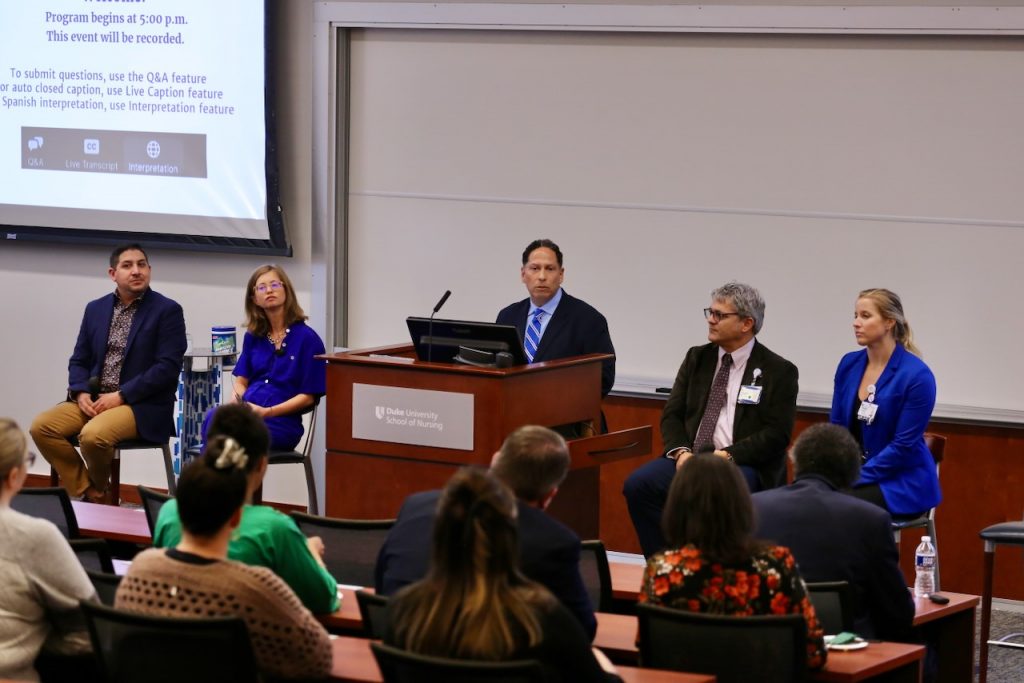
From left to right: Solomon Barraza, Lauren Hilgers, Vincent Guilano-Ramos, Benjamin Smallheer, Carolina Tennyson. Photo by Andrew Buchanan.
“Nursing is the largest segment of the healthcare workforce…yet what we contribute to the health and wellbeing of our country is invisible,” mentioned Dean Ramos at the discussion’s outset.
Smalheer agreed, adding that nurses today are contributing to patient care in ways that were vastly outside of their scope of practice just twenty years ago. A unique combination of technical proficiency, aptitude during crisis response, and ability to provide feelings of care and comfort, Hilgers describes nursing as one of, if not the only, profession in healthcare that considers the “entirety of a patient.”
A frequently cited statistic during the panel presentation referenced results from a Gallup poll indicating that nursing was rated as the most trusted profession for the 20th year in a row. While nurses were always aware of their influence and worth, getting healthcare systems to agree proved to be a much larger effort, one that only grew in importance as COVID-19 progressed.
“The pandemic has hardened us,” explains Smallheer. No longer were nurses willing to tolerate slights against their treatment as a profession. And they had tolerated plenty. Barraza, one of the protagonists of Hilgers’ piece, described the relentless search for purpose amidst constant burnout, especially during the pandemic’s heaviest waves. From finding efficient triage methods during a surge of cases to celebrating patient discharges, Barraza actively sought out ways to be “consistent when there was no consistency.” A charge nurse located in a region with severe labor shortages, Barraza had seen the influx of travel nurses firsthand every week. What ultimately kept him from traveling across the country in the pursuit of a more lucrative job, however, was the relationships he had forged within the hospital. Nurses, students, patients-they had all left an indelible mark on Barraza and enabled him to push through the long and grueling hours. Tennyson reinforced Barraza’s story by claiming that “you can be burnt out and still find value in a profession.” This seemingly contradictory duality may have proved sufficient to retain nurses during the pandemic, but as for long-term solutions, the panelists agree that significant change must occur at a systemic level.
Hilgers (pictured right) spent months speaking to nurses around the country, including Barraza (pictured left). Photo by Andrew Buchanan.
One of the central tensions of Hilgers’ article is that between the hospital and the worker. The explosion of travel nursing during the pandemic was but a manifestation of decades of undervaluation by hospitals of nurses. In order to undo this narrative and enact concrete change, Tennyson argues that nurses must be represented in more interdisciplinary professional spaces, from healthcare administration to policy to business. Hilgers restates this idea more broadly, saying that nurses “need to have a seat at the table” in reshaping the healthcare system post-COVID-19.
Much of this work begins at the level of the educational institution. Smallheer and Tennyson spoke at length about how nurses can better be prepared to navigate the ever-changing healthcare workforce. They both highlighted a few of the Duke School of Nursing’s novel instructional methods, including early exposure to complicated patient cases, extensive practice with end-of-life scenarios, and recognition of overstimulation points in the field. Also important for nurses-in-training and existing nurses, according to all panelists, was collective action. Through supporting state and national nursing associations, writing to local politicians, and speaking to healthcare administrators, they argued that nurses will be better equipped to voice their demands.
Christine Siegler Pearson Building at Duke University School of Nursing
As the panel reached its closing stages, one of the main talking points centered around changing the narrative of nursing as solely a burnout profession. Hilgers in particular remains critical of the portrayal of nurses, and more broadly those involved in care work, in popular media. She strongly advocates for authentic storytelling that including the voices of actual nurses, nurses such as Barraza. Ramos describes Barraza as someone who “represent[s] the best in nursing,” and the panelists maintained a strong desire to see such stories of resilience and passion spotlighted more frequently.
There is no simple formula to reform the nursing profession in the United States. However, through a combination of effective storytelling, more current educational standards, greater interdisciplinary involvement, and collective action, the panelists of the Dean’s Lecture Series firmly believe that lasting change is possible.
With the never-ending news of schools banning books, one has to ask about the history and effectiveness of banned books. Fortunately, the Duke Forever Learning Institute hosted a seminar on the history of banned books in late September and provided examples that showed the ineffectiveness of banned books throughout time.
There was one particular story, however, that caught my eye, and that was the retelling of the history behind a banned book written by a man named Gottschalk. Clare Woods, an associate professor of Classical Studies at Duke, delineated the narrative of Gottschalk’s life from birth to prisoner.
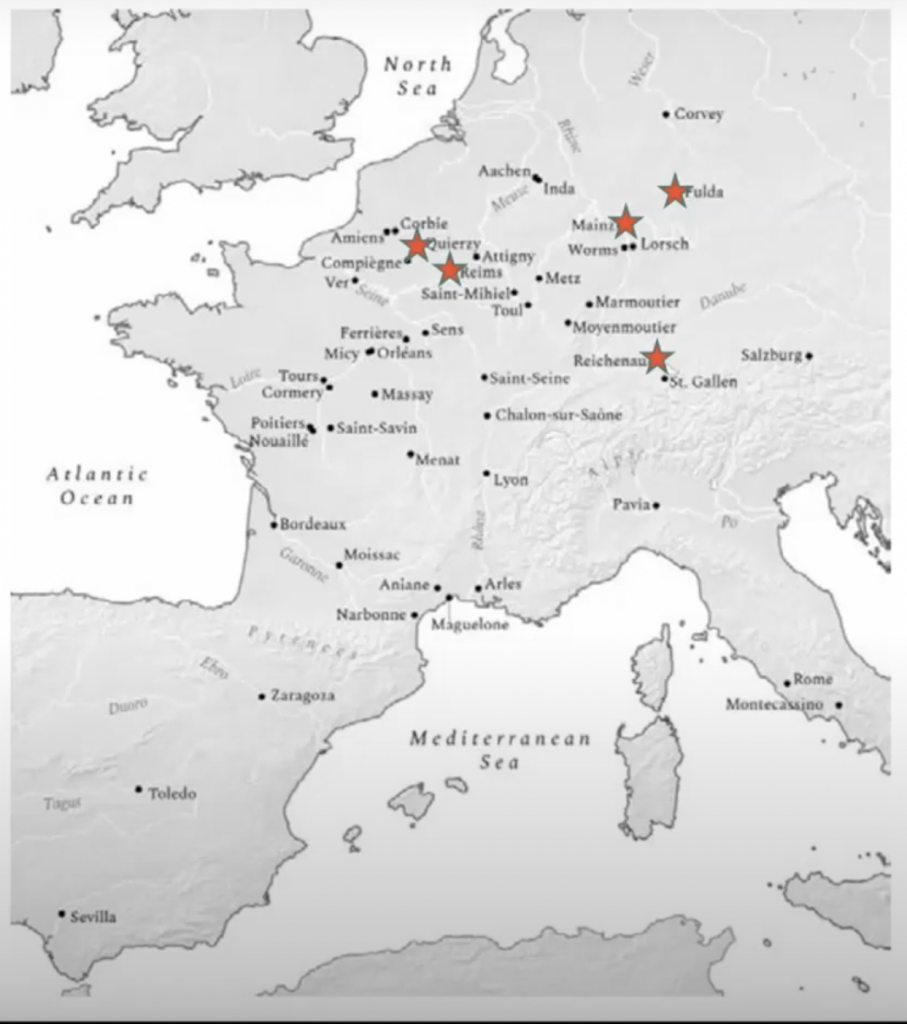
A map containing the monasteries Gottschalk visited. (provided by Dr. Clare Woods)
Gottschalk was born to an aristocratic family around 803 AD and started his academic career when he moved into Fulda, a monastery, to become a monk. However, in 829 AD, Gottschalk left Fulda for reasons based either on the loss of his older brother or the enlightenment he received from the monastery he attended while studying abroad.
Upon leaving Fulda, Gottschalk studied at the monasteries of Corbie and then moved to northern Italy after he received his orientation as a priest. Gottschalk was unusual because monks tended not to move around that much, and monks also tended not to speak about their studies on heretical doctrine. Unfortunately for Gottschalk, he ignored the criticisms from other monks and instead grew confident in his studies to the point where he wrote a book about them.
While receiving hate for his ideas from multiple people, one man from Gottschalk’s past was truly adamant about having Gottschalk punished. This man was named Rabanus (Hrabanus), and he was accused by Gottschalk of coercing Gottschalk’s earlier career as a monk. From that, and with Gottschalk leaving the Fulda, Rabanus developed a personal vendetta against Gottschalk.
This is an excerpt from Gottschalk’s confession, which was provided by Dr. Clare Woods.
Gottschalk, the confident man he was, decided to defend himself at a Synod in Mainz, but it proved unsuccessful because he was condemned by the Synod and banned from the Kingdom of Louis. From there on, things did not improve for Gottschalk because, in the following year, he was brought to a second Synod that was attended by King Charles, who was the brother of King Louis the German. By the end of this Synod, Gottschalk was stripped of his priesthood, sentenced to silence, and imprisoned.
However, even with the punishments Gottschalk personally received and his books being burned, his books were still preserved and influential on others.
This influence seen with Gottschalk’s books after being banned was not an anomaly because that was seen with all banned books throughout history.
Another example was given by Lauren Ginsberg, an associate professor of classical studies, who presented Permussius Cordis, an author who lived under the Roman emperor Tiberius in the 1st century AD.
His story ended in tragedy since his books were included in a mass book burning and he was sentenced to death. However, his book still was able to influence the Roman population due to his daughter Marsha’s vigilance in keeping her father’s book alive.
While I only provided two examples, this pattern of books withstanding their ban is throughout time, and it is being repeated in the present. Across this country, book banning is back in style. In 2018, there were only 347 books that schools formally challenged, but in 2021 it became 1,500.
An example of books that have been banned in multiple schools (Freedman)
While this does put light on our current education system in this country, this is simply a gesture. It does make us think about what children will be learning in schools, but because the books are banned in schools does not mean the information within those books will not reach their target demographic. As seen in history, knowledge always finds a way of spreading, but of course, that is dependent on those who want to expand that knowledge.
At the end of this article, I hope you are reassured that seeing a banned book does not mean it is forever silenced. Instead, I hope that by reading this, you understand that you have all the power to ensure that the words within a book can withstand anything, including time.
Post by Jakaiyah Franklin, Class of 2025
Citation: Freedman, Samuel G. “A Display of Banned or Censored Books at a Bookstore Last October. Over a Recent 9 Month Period More than 1,500 Books Have Been Banned in Schools, Most Featuring Nonwhite Protagonists, Dealing with Racism, or Addressing the LGBTQ Experience.” Los Angeles Times, Los Angeles Times, 27 June 2022, https://www.latimes.com/opinion/story/2022-06-27/book-bans-critical-race-theory-wisconsin. Accessed 10 Oct. 2022.
In recognition of the 50th anniversary of Title IX, which was intended to make sex discrimination in education illegal, a panel of Duke women met on Thursday, September 29 to talk about whether Title IX could change STEM, (Science Technology, Engineering and Math). Unfortunately, the answer was not simple.
But just through the sharing of the statistics relevant to this problem, the stories, and their solutions, one could start to understand the depth of this problem. One takeaway was that all women in STEM, whether they be student, professor, or director, have faced gender discrimination.
The student panelists after a successful forum
Down to the Statistics:
Dr. Sherryl Broverman, a Duke professor of the practice in biology and global health, gave the audience an overview. Of all of Duke’s regular ranked, tenured-track faculty, only 30% are women. In contrast, women make up 60% of the non-tenure track faculty. Dr. Broverman said men are promoted in Duke at a higher frequency. This is especially seen with the associate professor title because, on average, men are associate professors for 4 to 5 years; whereas women are associate professors for up to 9 years.
To give an example, senior Nasya Bernard-Lucien, a student panelist who studied Biomedical Engineering and then Neuroscience informed me that she has had a total of two women professors in her entire STEM career. This is a common pattern here at Duke because taking a STEM class that has a woman professor is as rare as finding a non-stressed Duke student.
Dr. Kisha Daniels (left) and Dr. Whitney McCoy (right)
The Beginning of a Girl’s Career in STEM
This disproportionate demographic of women professors in STEM is not a new occurrence with Duke or the rest of the world because the disproportion of women in STEM can be seen as early as middle school. Two of the student panelists noted that during their middle school career, they were not chosen to join an honors STEM program and had to push their school’s administration when they asked to take more advanced STEM classes.
Dr. Kisha Daniels, an associate professor of the practice in education said on a faculty panel that one of her daughters was asked by her male peers, “what are you doing here?” when she attended her middle school’s honors math class. Gender discrimination in STEM begins in early childhood, and it extends its reach as long as women continue to be in a STEM field, and that is particularly evident here at Duke.
Women in STEM at Duke
Dr. Sherryl Broverman
The last panel of the Title IX @ 50 event was the student panel which consisted of undergraduate and graduate students. Even though they were all from different backgrounds, all acknowledged the gender disparity within STEM classes.
Student Bentley Choi said she was introduced to this experience of gender discrimination when she first arrived at Duke from South Korea. She noted how she was uncomfortable and how it was hard to ask for help while being one of the few women in her physics class. One would have hoped that Duke would provide a more welcoming environment to her, but that is not the case, and it is also not an isolated incident. Across the panel, all of the women have experienced discomfort in their STEM classes due to being one of the few girls in there.
The Future of Title IX
How can Title IX change these issues? Right now, Title IX and STEM are not as connected as they need to be; in fact, Title IX, in the past, has been used to attack programs created to remedy the gender disparity in STEM. So, before Title IX can change STEM, it needs to change itself.
Title IX needs to address that this problem is a systemic issue and not a standalone occurrence. However, for this change to happen, Dr. Whitney McCoy, a research scientist in Child and Family Policy, said it perfectly, “we need people of all backgrounds to voice the same opinion to create policy change.”
So, talk to your peers about this issue because the more people who understand this situation, the chances of creating a change increases. The last thing that needs to occur is that 50 years in the future, there will be similar panels like this one that talk about this very issue, and there are no panels that talk about how we, in the present, fixed it.
The (fictional) story of Moana draws from (true) Polynesian history and seafaring lore
But humans have always been bad at sharing – most wars are fought over territory, land especially. And as time has passed, the things we share as humans has evolved – from oceans and land to the Internet and outer space. So how do you keep things diplomatic? Last Friday, Duke’s Space Diplomacy Lab, co-chaired by Dr. Benjamin Schmitt of Harvard University and Duke’s own Dr. Giovanni Zanalda, hosted a webinar on what space diplomacy can learn from ocean diplomacy. Featuring Dr. Clare Fieseler of the Smithsonian Institution and Dr. Alex Kahl of the National Marine Fisheries Service, the conversation covered everything from zoning to equity to even the lessons we can learn from Indigenous communities.
Sharing data and sharing fish
There are multiple challenges to sharing the world’s waterways. Fieseler did not start out her career studying ocean diplomacy. Initially stationed in the Persian Gulf, building a marine mammal monitoring network, she noticed that the fraught state of politic affairs in the region made it hard to share data on the animals that were washing up on the shore.
Dr. Fieseler presenting
Meanwhile, Kahl, who works in Hawaii as the National Resources Manager at the National Marine Fisheries Service, runs into problems not in sharing data but primarily in sharing fish. “How do you focus on the shared exploitation of a natural resource?” he asked.
Two key themes arose in linking the sharing of the ocean to the sharing of outer space.
First, Fieseler pointed out that engaging scientists can help in transcending politics, something that ocean diplomacy does well. She pointed to efforts to establish a Marine Peace Park between North Korea and South Korea, and that if two of the worlds most polarized countries could come to an agreement in the name of science and human betterment, then “surely other countries can too.”
Second, Kahl remarked, unlike in the ocean, the primary resource in space is, well, space. You need fish to eat to survive – do you need space to survive?
Centering equity
On the topic of whether we really need space in space to survive, Kahl pointed to the significance that many celestial bodies have in cultures here on Earth, such as in Hawaii and the Pacific Islands. Does interfering with these celestial bodies cross a red line for cultures on Earth? It’s worth noting that as Kahl said, with space exploration, “very few people are profiting,” so balancing the interests of people on Earth as well as in space is important.
Dr. Kahl presenting
Fieseler spoke to the need to build equity in space through some sort of formal agreement, similar to the Law of the Sea. But, she says, that might be skipping a few steps. Right now, “many developing countries can’t even afford to go to space.” How can you build equity in a region where not everyone even has a seat at the table? Kahl pointed out that this marginalization impedes discussions on how to share space – something that should be consensus-driven.
Zoning
As Fiesler remarked, zoning of the ocean has been key to a relatively peaceful sharing of this resource for the variety of uses that people have for the sea. A good example of this is the Antarctic Treaty, which zoned different places in Antarctica for scientific use.
Kahl spoke to being a beneficiary of the Antarctic Treaty – “it reduces bureaucratic burdens, and the collective benefits are also increased.” However, he made the point that the slicing and dicing of space, as with anything, could lead to initial tensions.
Science should have a seat at the table
A central theme that ran throughout the conversation was that, as Kahl put it, scientists “rely on each other to level-set the truth” – even in spaces where they might be in the minority, such as in a room of politicians engaging in diplomatic talks.
Fieseler pointed to how in environmental justice work, her Indigenous colleagues were good at taking the initiative – and finding the urgency – to demand a seat at the table. “As scientists, we sit around, thinking that one day the phone will ring and someone will invite me to be a part of the conversation – but that’s not how it works.” Diplomacy will always be a necessity as we aim to navigate sharing the vast resources at our disposal, but many scientists hope that we won’t forget to center the pursuit of the truth as we make decisions.
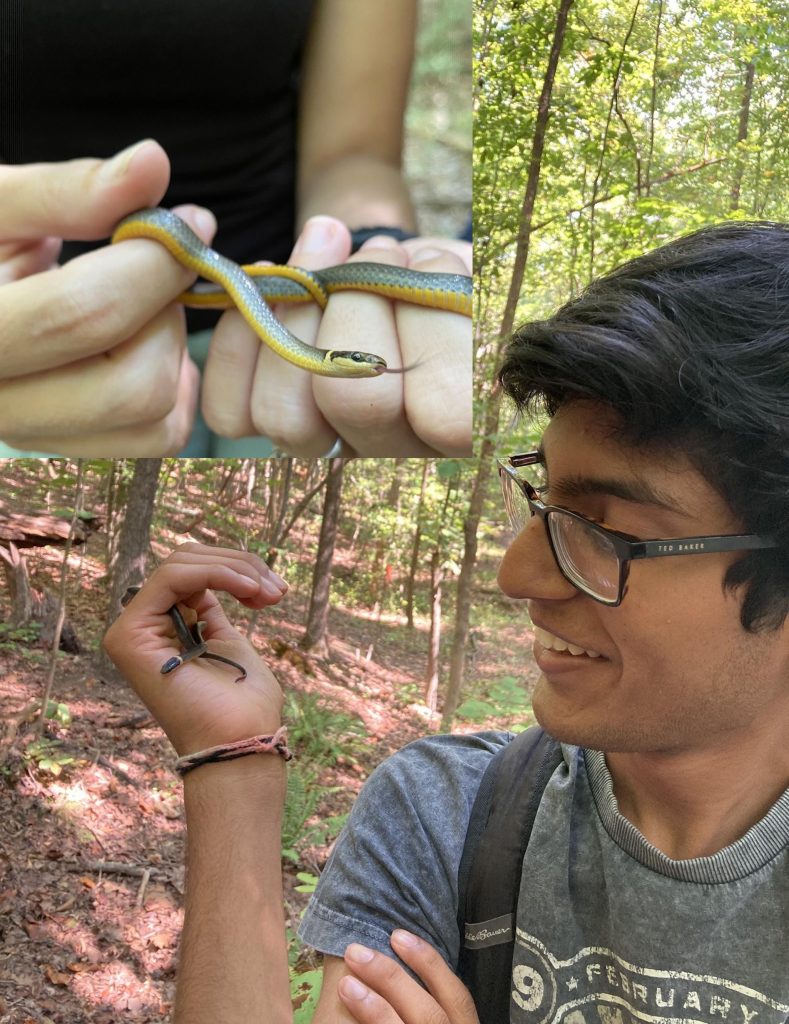
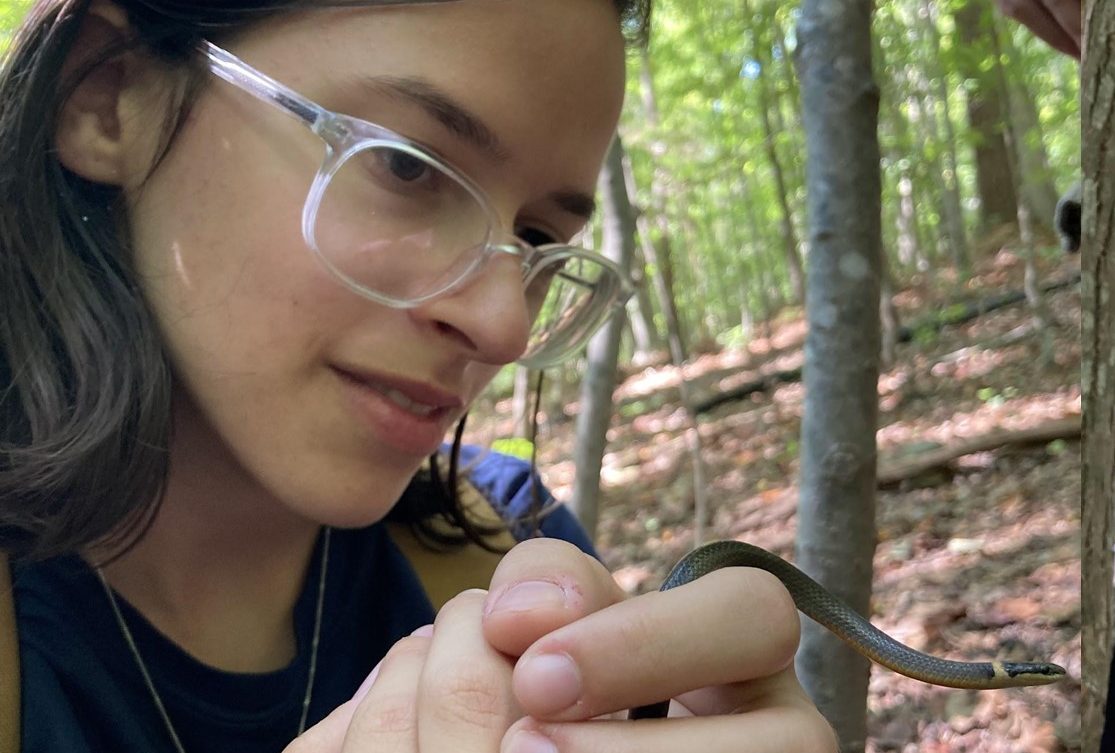
Dhruv Rungta, a member of the Wild Ones club, with a ring-necked snake during a herpetology walk with Dr. Nicki Cagle in the Duke Forest. Upper left: Dr. Nicki Cagle holding a ring-necked snake. Photo by Montana Lee, another Wild Ones member.
On a sunny Friday in September, Dr. Nicki Cagle led a herpetology walk in the Duke Forest with the Wild Ones. The Wild Ones is an undergraduate club focused on increasing appreciation for the natural world through professor-led outings. Herpetology is the study of reptiles and amphibians.
Dr. Cagle is a senior lecturer in the Nicholas School of the Environment at Duke and the Associate Dean of Diversity, Equity, and Inclusion. Along with teaching courses on environmental education and natural history, she is also the science advisor for a citizen science project focused on reptiles and amphibians, or herpetofauna, in the Duke Forest. Volunteers monitor predetermined sites in the Duke Forest and collect data on the reptiles and amphibians they find.
“We get a sense of abundance, seasonality… and how the landscape is affecting what we’re seeing,” Dr. Cagle says. There is evidence that herp populations in the Duke Forest and elsewhere are decreasing.
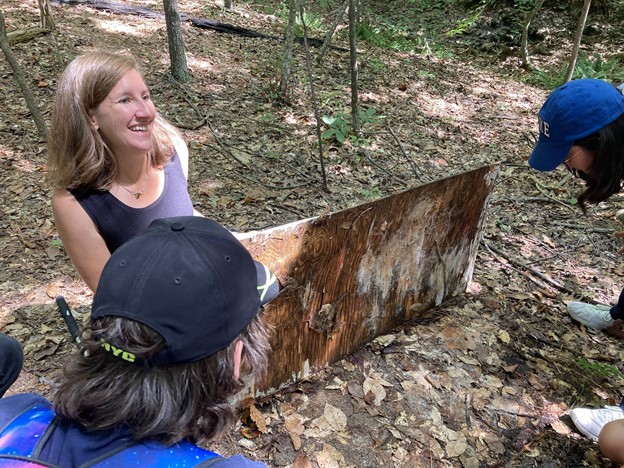
Dr. Nicki Cagle flipping over a cover board with members of the Wild Ones. The cover boards are used to monitor reptiles and amphibians for a citizen science project in the Duke Forest.
The project relies on transects, “a sampling design… where you have a sampling spot at various intervals” along a line of a predetermined length. In this case, the sampling spots are “traps” meant to attract reptiles and amphibians without harming them. Each site has a large board lying on the ground. “Different herps are more likely to be found under different objects,” Dr. Cagle explains, so the project uses both wooden and metal cover boards.
But why would snakes and other herps want to hide under cover boards, anyway? Reptiles and amphibians are “cold-blooded” animals, or ectotherms. They can’t regulate their own body temperature, so they have to rely on their environment for thermoregulation. Snakes might sun themselves on a rock on cold days, for instance, or hide under a conveniently placed wooden board to escape the heat.
Salamanders that use the cover boards might be attracted to the moist environment, while “snakes will tend to go under cover boards either to hide — like if they’re about to molt and they’re more vulnerable — to look for prey, or just to maintain the proper temperature,” Dr. Cagle says.
Citizen scientists typically check the boards once a week and not more than twice a week. Volunteers have to avoid checking the traps too often because of a phenomenon called “trap shyness,” where animals might start avoiding the traps because they’ve learned to associate them with pesky humans flipping the boards over and exposing their otherwise cozy resting places. By checking the traps less frequently, scientists can reduce the likelihood of that and minimize disturbance to the animals they’re studying.
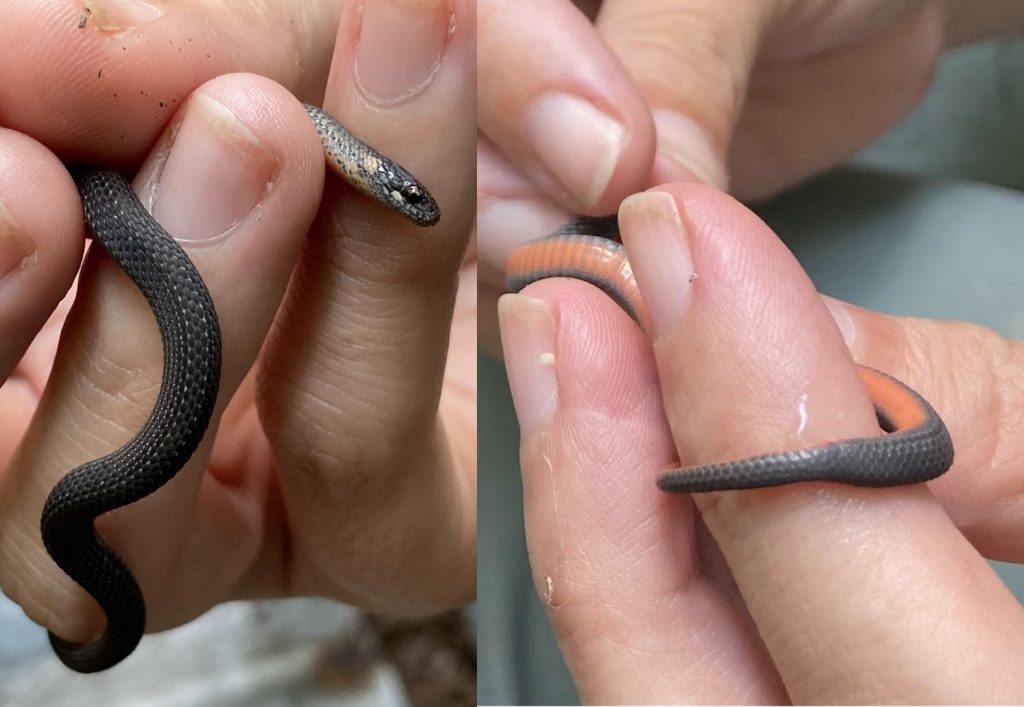
The first snake we saw was a redbelly snake (Storeria occipitomaculata), dark above with a pink stomach.
Dr. Cagle gave the Wild Ones a behind-the-scenes tour of some of the cover boards. Using a special, hooked tool conveniently stashed in a PVC pipe next to the first cover board, we flipped each board over and looked carefully underneath it for slithery movements. We didn’t find any under the first several cover boards.
But then, under a large sheet of metal, we saw a tiny snake squirming around in the leaf litter. There was a collective intake of breath and exclamations of “snake!”
Dr. Cagle captured it and held it carefully in her hands. Snakes, especially snakes as young as this one, can be all too easily crushed. We gathered around to look more closely at the baby snake, a species with the adorable name “worm snake.” It was dark above with a strikingly pink underside. The pink belly is a key field mark of worm snakes. Earth snakes are also found around here and look similar, but they tend to have tan bellies.
After a minute or two, the worm snake made a successful bid for freedom and wriggled back under the board, disappearing from sight almost immediately.
Crossing over a dry “intermittent stream,” which Dr. Cagle describes as “the running-water equivalent of a vernal pool.” A vernal pool is a temporary wetland that is dry for much of the year.
Some of the cover boards revealed other animals as well. We found a caterpillar chrysalis attached to one and several holes — probably made by small mammals — under another.
Whatever made the holes, we can safely assume it wasn’t a snake. According to Dr. Cagle, the term “snakehole” is misleading. Most snakes don’t make their own holes, though some of them do use existing holes made by other animals. One exception is the bull snake, which is known for digging.
We found a young five-lined skink sunning itself on top of one of the metal cover boards. (Thermoregulation!) Juvenile five-lined skinks are colloquially known as blue-tailed skinks, but the name is somewhat misleading — the adults don’t have blue tails at all.
The snakes we were looking for, meanwhile, were often elusive. Some vanished under the leaf litter before we could catch them. Sometimes it was hard to tell whether we were even looking at a snake at all.
“What are you?” Dr. Cagle muttered at one point, crouching down to get a better look at what was either a stick-esque snake or a snake-esque stick. “Are you an animal? Or are you just a wet something?” (Just a wet something, it turned out.)
The Duke Forest is a valuable community resource with a complicated history. “We know that slavery was practiced on at least four properties” in the Duke Forest, Dr. Cagle says, and the forest is located on the traditional hunting grounds of several indigenous peoples. Today, the Duke Forest is used for research, recreation, timber management, and wildlife management and conservation.
Later on, we found at least three young ring-necked snakes (Diadophis punctatus) under different cover boards. One of them was particularly cooperative, so we passed it around the group. (“All snakes can bite,” Dr. Cagle reminded us, but “some have the tendency to bite less,” and this species “has the tendency not to bite.”) Its small, lithe body was surprisingly strong. The little snake wrapped tightly around one of my fingers and seemed content to chill there. A living, breathing, reptilian ring. That was definitely a highlight of my day.
The faint, dark line on this ring-necked snake’s underside (on the bottom of the loop) is the anal vent. Everything below that point (farther from the head) is considered the official tail of a snake.
If you’ve ever wondered if snakes have tails, the answer is yes. The official cut-off point, Dr. Cagle says, is the anal vent. Everything below that is tail. In between flipping over cover boards and admiring young snakes, we learned about other herps. Near the beginning of our walk, someone asked what the difference is between a newt and a salamander.
“A newt is a type of salamander,” Dr. Cagle says, “but newts have an unusual life cycle where they spend part of their life cycle on land… and that is called their eft phase.” As adults, they return to the water to breed.
We learned that copperheads “tend to be fatter-bodied for their length” and that spotted salamanders cross forest roads in large numbers on warm, rainy nights in early spring when they return to wetlands to breed.
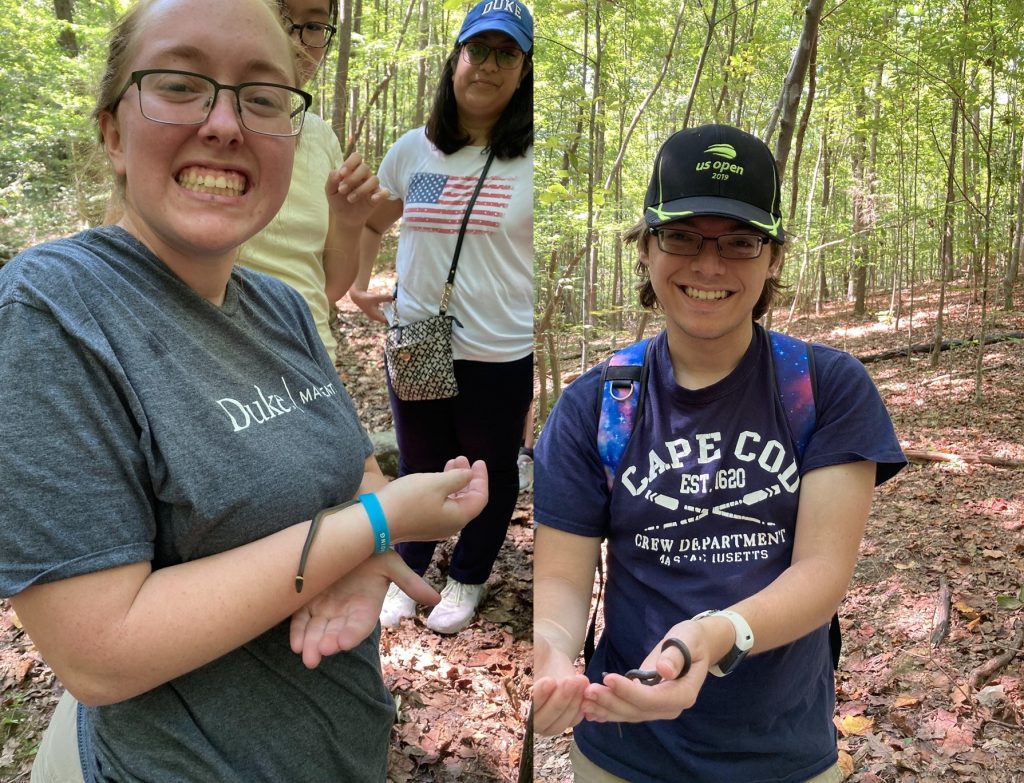
Students holding a ring-necked snake. Above: Kelsey Goldwein holding a ring-necked snake. Below: Emily Courson (left) and Barron Brothers.
Perhaps the most interesting herp fact of the day came near the end of our walk when one of the students asked how you can tell the sex of a snake. Apparently there are two ways. You can measure a snake’s tail (males usually have longer tails), or you can insert a metal probe, blunted at the end, into a snake’s anal vent. Scientists can determine the sex of the snake by how deep the probe goes. It goes farther into the anal vent if the snake is a male. Why is that? Because male snakes have hemipenes — not two penises, exactly, but “an analogous structure that allows the probe to slide between the two and go farther” than it would in a female snake. The more you know…
Looking for snakes on a herpetology outing with Dr. Cagle and the Wild Ones. Photograph by Wild Ones exec.
Disclaimer: Handling wild snakes may result in snake bites. It can also be stressful to the snakes. Furthermore, some snakes in this area are venomous, and it’s probably best to familiarize yourself with those before getting close to snakes rather than afterward. Snakes are amazing, but please observe wildlife safely and responsibly.
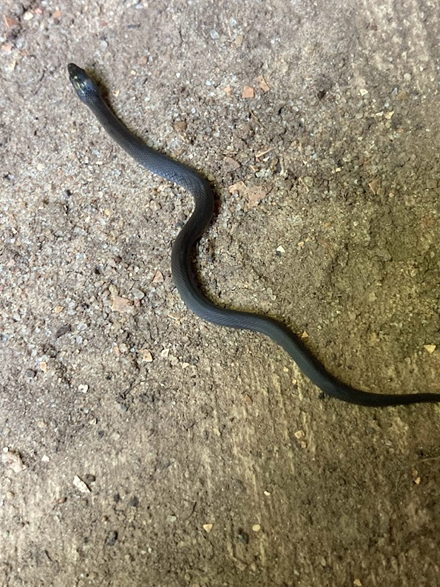
Bonus snake! I saw this adorable fellow on the Duke Campus and thought it was an earthworm at first. Dr. Cagle thinks it might be a rough earth snake. I did not check to see if it had a tan belly.
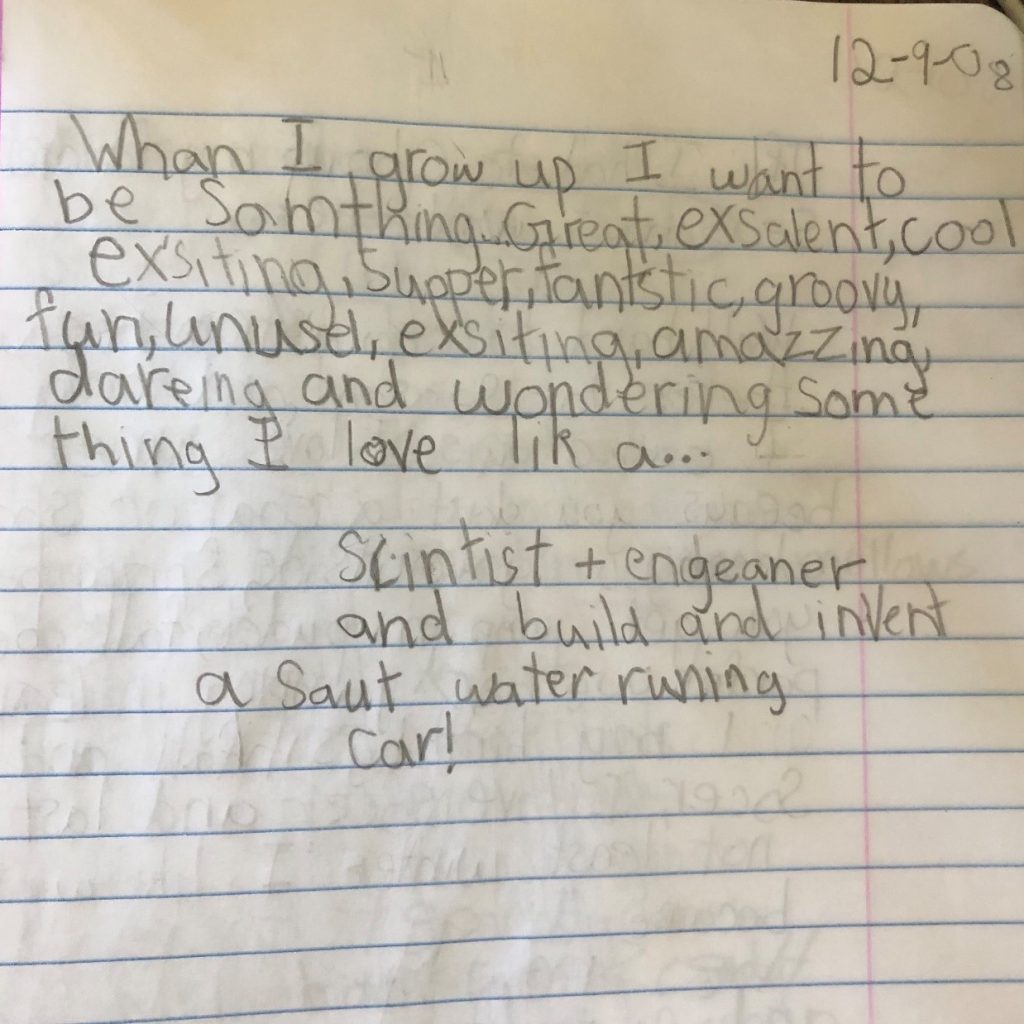
If you asked my eight-year-old self what I wanted to be when I grew up, the answer would have been, resoundingly, “an inventor!” It was around this time that I also decided, with surprising assuredness for a shy second grader, that I would one day build a saltwater-powered car.
I must have heard the idea somewhere, although to this day I don’t quite recall where. Perhaps it was a story on the radio. NPR was a constant background noise in the basement where I spent countless hours playing and tinkering alongside my father in his hobby shop. Or maybe it was buried somewhere in a book or science magazine. They were often stacked in neat piles, filling bookcases in many corners of our house. It also could have floated across the dinner table in conversations between my parents and older siblings. Everyday talk of high school biology and current events seemed light years out of the grasp of my eight-year-old brain.
Kyla Hunter, Duke Engineering 2023.
Regardless of where it came from, the idea stuck. Before I knew what it meant to conduct research or study engineering, I found myself charmed by novel ideas and drawn to the possibility of discovery. For some reason, this “car that runs on salt water” took shelter in my mind and secured itself as the perfect idea: an ingenious invention that was good for the planet. At the time, of course, I never thought about how this whimsical, far-fetched idea was fundamentally tied to my core interests and values. Now, however, as a 21-year-old senior studying mechanical engineering, passionate about renewable energy technology and protecting the planet, it all makes perfect sense.
My interest in engineering is, at its core, a love for creativity, combined with a desire to solve problems. A fondness for physics certainly helps too, but that came much later. As a child, the desire to practice creativity manifested primarily as a love for art. Some of my earliest childhood memories are toiling away at my little table in the corner of the living room, carefully sorting the crayons in my tin Crayola box. Today, I practice creativity in my critical thinking, brainstorming, and implementation of the iterative design process.
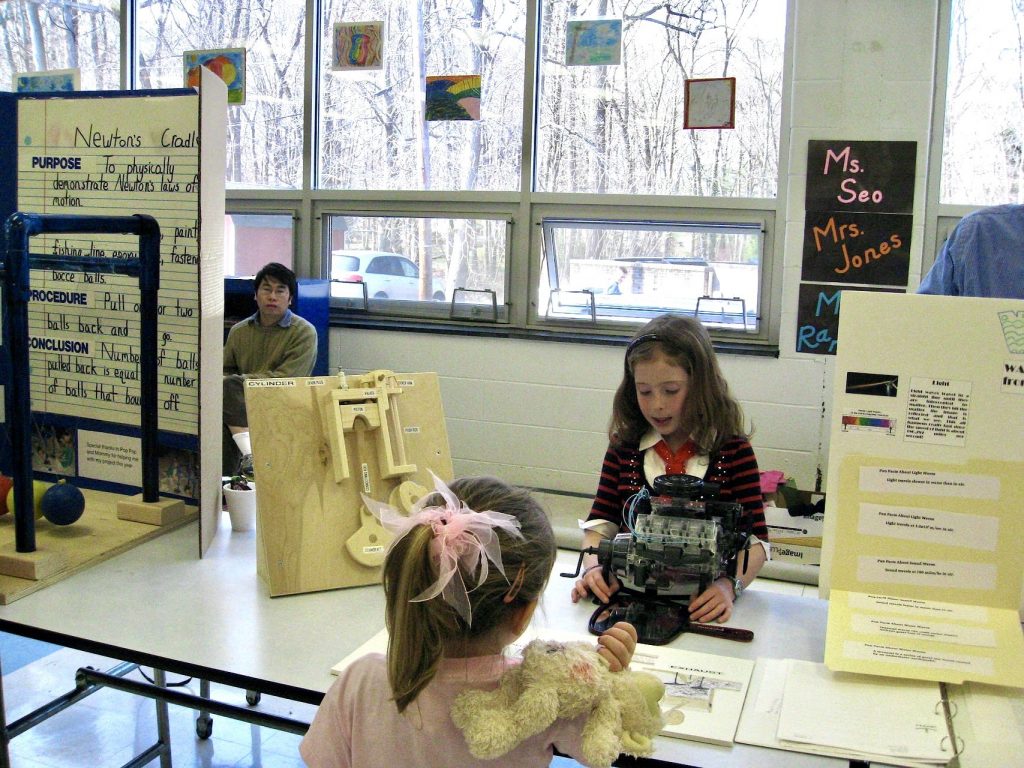
At an elementary school science fair, I presented my model V8 engine and explained how it worked. I was drawn to many different interests before I settled on engineering, but it’s clear that the passion was always there.
The other facet that drew me towards engineering, the desire to solve problems, evolved from an early love for nature and a passion for environmentalism. I remember seeing my grandparents’ devastated home in the aftermath of Hurricane Sandy, and the noticeable decline in pollinators to my mother’s garden. In high school, when I heard the term “environmental engineering,” it was the first time I realized such a field existed. I immediately felt the various pieces of my interests and values click together. There are many ways to be creative and to solve problems, but for me, the combination led down a path towards pursuing engineering.
An entry from my second-grade journal, declaring my dearly held beliefs. In many ways, nothing has changed (including my ability to spell).
Despite the way I’ve laid it out, this is not to say there was a linear path between latching onto an eccentric notion as an eight-year-old, and deciding to pursue my current career as a soon-to-be graduate. Looking back now, I can see the symbolism in this cornerstone of an idea. With hindsight, I recognize why it appealed to different facets of my just-blossoming identity, and the ways in which I returned to it over the next several years. However, this is what is bound to happen when you expose yourself to as many new ideas as possible: one (at least) will catch your attention. The point is not to latch onto the first idea you stumble upon and pursue it relentlessly. The point is to keep an open mind to all ideas – and pay careful attention to the ones that light up inside your brain. The ones that stick in the back of your mind, and continuously pop up at unsuspecting times.
One of my favorite serendipitous moments in life is when, soon after learning something new, that newfound idea pops up somewhere else. It’s like receiving an unexpected gift in the form of previously inaccessible appreciation. Imagine turning over a stone and happening to uncover an insect that you just spent all night studying. It feels purely by chance, but it’s not quite.
The more you expose yourself to new ideas, the more they will appear. You never know when a story you stumble across by accident will move you to action, or lead to something bigger. A magazine I stumbled across by chance led to a research topic of an entire semester. A book I read in high school came up in an interview I had last week. An idea I heard at eight years old about an eco-friendly car perhaps started a life-long captivation with science that led me to become an engineer. Our life is made up of decisions that are based on millions of data points, determined by our history, background, and the types of ideas we surround ourselves with daily.
As a blogger for the Duke Research Blog, my goal is to make it easier for more people to have more exposure to more ideas. Each new idea has the potential to build bridges, whether expanding to new fields, or building upon an existing network of knowledge. Expanding our realm of understanding allows for challenging perspectives and broadening understandings. These are not ideas for the sake of ideas, but for the larger goal of enabling meaningful connections with others.
When more people have access to more ideas, everyone benefits. However, there’s no denying that much of the research going on at Duke is very high-level, usually going unread by much of the student body. Other fascinating content goes unnoticed simply due to the busy lives of Duke students, and the sheer volume of exciting events. (If only we could all be multiple places at once.) My goal is to take ideas – whether overly intimidating or underappreciated—and present them in a way that is more accessible for anyone who is interested.
When I first heard of the idea of salt-water running cars, the idea was just that: an idea. The frenzy began in 2007 when John Kanzius, an American engineer, accidentally discovered how to “burn” salt water while attempting to research a cure for cancer. Today, the QUANT e-Sport Limousine is an all-electric sports car concept that uses an electrolyte flow cell, powered by salt water. It actually works, and was authorized for on-road testing in Germany a few years ago soon after its debut. It is many years from authorization, and it will likely be an even longer time before it is a viable option from an economic standpoint, but the progress is apparent.
Fifteen years since my infatuation with this idea, I can’t help but feel slightly emotionally connected to it. Humans grow up. Ideas do, too. I did not invent the first car that runs on salt water, but I am eternally grateful for every new idea that fuels my curiosity, shapes my values, and expands my current perspectives.