Following the people and events that make up the research community at Duke

Students exploring the Innovation Co-Lab

Category: Climate/Global Change Page 9 of 11

Geography and the Web: A new frontier for data vizualization

A GIS Day earth cake made by the Collegiate Baker

You might be forgiven if you missed GIS Day at The Levine Science Research Center Nov. 18, but it was your loss. Students and faculty enjoyed a delightful geography-themed afternoon of professional panels, lightning talks, and even a geospatial research-themed cake contest.

What is GIS and why is it important?

Geographic information systems (GIS) give us the power to visualize, question, analyze, and interpret data to understand relationships, patterns, and trends in the world around us. Those who work with data and analytics have a responsibility to contribute to this change by helping us make the right decisions for our future. As noted during ESRI’s 2015 User Conference in the video below, “We have a unique ability to impact and shape the world around us. [Yet] for all of our wisdom, our vast intellectual marvels, we still choose a path of unsustainability and continue to make decisions that negatively impact the Earth and ourselves. […]We must accept our responsibility as stewards of the Earth. […] We must apply our best technology, our best thinking, our best values. Now is the time to act. Now is the time for change.”


How does GIS help?

Doreen Whitley Rogers, Geospatial Information Officer for the National Audubon Society, led a lively discussion about GIS and the World Wide Web at Duke’s GIS Day. She said GIS is essential to understand what is happening in the geographic space around us. As GIS becomes increasingly web-based, efficiently distributing the system to other people is crucial in a time when new data about the environment is being created every second.

3D map displaying the height of buildings that birds hit windows

3D map displaying the height of buildings at which birds fly into windows in Charlotte, NC

Rogers and her team are aiming to move authoritative GIS data to web for visualizations and create a centralized system with the potential to change our culture and transform the world. As the technology manager, she is working on bringing the information to people with proper security and integrity.

In order to get people to use GIS data in a generalized way, Rogers needed to implement several core capabilities to assist those integrating GIS into their workflow. These include socializing GIS as a technology to everybody, creating mobile apps to work with data in real time, and 3D maps such as this one of bird-strikes in downtown Charlotte.

Case Studies

ClimateWatch helps us predict the seasonal behaviour plants and animals.

Mobile apps connecting to the GIS platform promise a strong “return on mission” due to the vast number of people using maps on phones. By mobilizing everyone to use GIS and input data about birds and geography in their area, the platform quickly scales over millions of acres. In the Bahamas, an  app allows users to take pictures to support bird protection programs.

ClimateWatch is an app that gives us a better understanding of how bird habitats are affected during temperature and rainfall variations – motivating people to speak up and act towards minimizing anthropogenic climate change. Developed by Earthwatch with the Bureau of Meteorology and The University of Melbourne, the app enables every Australian to be involved in collecting and recording data to help shape the country’s scientific response to climate change.

Virtual simulation of scenic flights as an endangered bird.

Virtual simulation of scenic flights from the perspective of an endangered bird.

Apps such as the 3-D flight map give users the vicarious thrill of cruising through nature landscapes from the view of endangered birds.

With the movements toward cleaning air and water in our communities, our planet’s birds will once again live in healthier habitats. As the Audubon Society likes to say: “Where birds thrive, people prosper.”


For more information about bird-friendly community programs, you can visit Audubon‘s site or send them a message.

Doreen Rogers after her presentation on National GIS day.


To learn more about data visualization in GIS, you can contact Doreen Whitley Rogers via email here.

Anika_RD_hed100_2

Post by Anika Radiya-Dixit

Duke Forestry Celebrates its Roots in 75th Anniversary

Photo Credit: Duke Environment

Duke Forestry started off its 75th anniversary on Oct. 17 with a morning walk in the Duke Forest, for those brave enough to endure the week’s low temperatures. For everyone else, panel discussions were held throughout the day in Environment Hall covering a variety of topics relevant to forestry today, from its importance in modern society to the latest innovations in the field.

Forestry education at Duke began in the 1930s, when the program was established as the Duke School of Forestry. Over the years, the department evolved, and in 1990 the School of Forestry & Environmental Studies combined with the Duke Marine Laboratory to form the symbiosis that is now the Nicholas School of the Environment.

Alumni panel discussions were held by Nick Diluzio, M.E.M’10, M.F.’10, Katie Rose Levin, M.E.M.’12, M.F.’12,  Gary Myers, M.F.’77, and Meyer M. Speary, M.F.’92. The four alums have worked in various sectors of the forestry industry, and had much to share.

Discussions on the importance of forestry included its impact on capital structure and public policy, with Myers explaining how a tax law in 1979 on timberland lowered the government’s tax revenue, Diluzio tackling the importance of ecosystem services beyond the production of paper products, including clean water and carbon, and Rose considering the social benefits of forests.

Orman

Photo by Karduelis via Wikimedia Commons

Diluzio and Rose both talked about the subject of urban forestry, and its increasing relevance in today’s society. Urban forestry can be combined in a variety of ways with cities to help with infrastructure, stormwater management, and even hunger, as Diluzio brought up fruit trees being planted in Atlanta to feed the homeless. Rose discussed how urban forestry can provide a moral value in cities, as a source of recreation and stress management.

On innovation, the panelists agreed that the latest technology centered around data gathering, and its essential role in making informed decisions. Speary discussed the increasing use of drones in managing forest fires and reducing risk for firefighters, from picking up hotspots, to carrying water, smoke modeling, and examining where lightning occurs. Diluzio addressed web-GIS tools, and applying technology from other sectors to forestry.

They’ve changed the old forestry department to the Nicholas School of the Environment, but no matter what happens in forestry technology, Duke will help pave the way, with 75 years of leadership behind its back.

Devin_Nieusma_100By Devin Nieusma, Duke 2019

A fireside chat with Marc Jeuland

Living in Few dorm has its perks, aside from being right beside the bus stop. My faculty-in-residence, Dr. Hwansoo Kim had kindly hosted a reception in his residence, where he invited Dr. Marc Jeuland for a talk about the development of water infrastructure to help improve health. A Chat with Dr. Jeuland
I was immediately captivated when I saw the email invite – as I personally had worked with affordable water filtration, in the developing world, so this was right in my field of interest.

Jeuland is an assistant professor in the Sanford School of Public Policy and the Duke Global Health Institute. He shared his experience working on one of his most recent, major projects, which was of his water infrastructure improvements in Zarqa, Jordan. For a long time, Jordan has been experiencing a water crisis. For the residents of Zarqa, water often has to be purchased from other areas, and then carefully preserved for days, or weeks, and even up to a month. The piped water infrastructure that currently existed in Zarqa was very inefficient, and was a major source of the shortages.

Jeuland, who is an environmental engineer, said that as much as 70 percent of this water can be lost from pipelines as the water reaches the citizens of Zarqa. Jeuland worked to assess inefficiencies within the current water supply systems and tried to design and implement improvements to remedy the faults.

marc-jeuland-headshot

Marc Jeuland is an assisstant professor of global health and public policy

Aside from his work in Zarqa, Jeuland has been involved with countless other projects and studies that have ultimately benefited underserved communities around the world. He has characterized the effects of contaminated groundwater on inhabitants in Rift Valley, Ethiopia and done a detailed analysis of the correlation between water quality and kidney disease in Sri Lanka.

Jeuland’s work shows the real-world applicability of interdisciplinary fields. His work has encompassed the field of not only environmental science, but also behavioral science, economics, and engineering.

For those of you interested in learning more about the interdisciplinary fields of global health and environmental sciences/policy, it would definitely be a great idea to take a look at the classes Jeuland teaches, which include “ENVIRON 538: Global Environmental Health: Economics and Policy” and “GLHLTH 531: Cost Benefit analysis for Health and Environmental Policy”.

It was an honor to get to meet Professor Jeuland. I could tell he was a very busy man. By the time you read this, he is probably off traveling somewhere else in the world, working to improve more lives.

Thabit_Pulak_100By Thabit Pulak, Class of 2018


Marine Lab Hosts 500+ at Open House

In what was a record high turnout, more than 500 people made their way to Pivers Island on Saturday Aug. 1, for the Duke University Marine Lab’s annual open house. Visitors listened to whales, peered at plankton and sea urchin larvae through microscopes, and learned how salinity gradients and wind can drive ocean currents at 16 research stations scattered throughout the campus. Kids of all ages also got to meet horse conchs, pen shell clams, tulip snails, fiddler crabs, slipper snails and other creatures in the marine lab’s touch tanks. “We don’t think of snails as having teeth but they really do; that radula is quite a weapon. It’s like a cross between a chainsaw and a tongue,” said Duke visiting professor Jim Welch. Photos by Amy Chapman-Braun, Nicholas School of the Environment at Duke.

Bringing a Lot of Energy to Research

By Karl Leif Bates

The Duke Energy Initiative‘s annual research collaboration workshop on May 5 was an update on how the campus-wide alliance of more than 130 faculty has been pursuing its goals of making energy  “accessible, affordable, reliable and clean.” In short, they’ve been busy!

energy posters

Energetic discussion swirled around research posters from graduate student projects and Bass Connections. (Photo: Margaret Lillard)

At the afternoon session in Gross Hall, David Mitzi, professor of mechanical engineering and materials science, led a panel of five-minute updates on energy materials including engineered microbes, computational modeling of materials, solar cells built on plastic rather than glass, and a nanomaterial-based sheet of material that would combine photovoltaics with storage on a single film.

Kyle Bradbury, managing director of the new Energy Data Analytics Lab that works with the ‘big data’ folks at iiD and the social scientists at SSRI, led a panel on the lab’s latest projects. As smart meters and Internet-enabled appliances enter the market, energy analysts will be flooded with new data, Bradbury explained. There should be great potential to improve efficiency and provide customers with useful real-time feedback, but first the torrent of information has to be corralled and analyzed.

energy panel

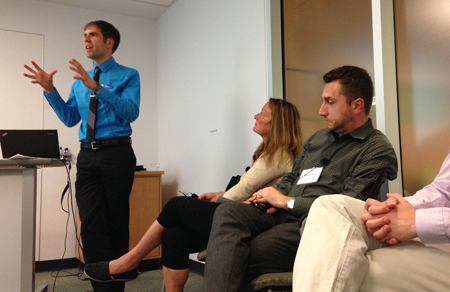
Kyle Bradbury (standing) moderated a data analytics panel with Leslie Collins and Matt Harding (right).

For one example of what big energy data might do, Bradbury and Electrical and Computer Engineering professor Leslie Collins (his former advisor) have done a pilot study to see if computers could be taught to  pick out roof-top solar arrays in satellite photos.  Nobody actually knows how many arrays there are or how much power they’re producing, Collins said. But without too much fussing around, their first visual search algorithm spotted 92 percent of the arrays correctly in some hand-picked images of California neighborhoods. Ramped up and tweaked, such an automated search could begin to identify just how much residential solar there is, where it is, and roughly how much energy it’s producing.

The third group of researchers, moderated by Energy Initiative associate Daniel Raimi, is working on energy markets and policy, including energy systems modeling and the regulation of green house gasses through the Clean Air Act.

Energy Initiative director Richard Newell said there were 1,400 Duke students enrolled in energy-related courses this year. A first round of six seed-funded research projects was completed and seven new projects have been selected. Eight Bass Connections teams in the energy theme were very productive as well, examining smart grids, solar energy and household energy conservation with teams of undergraduates, graduate students and faculty.

Touring Duke's Biggest Laboratory

Sari Palmroth

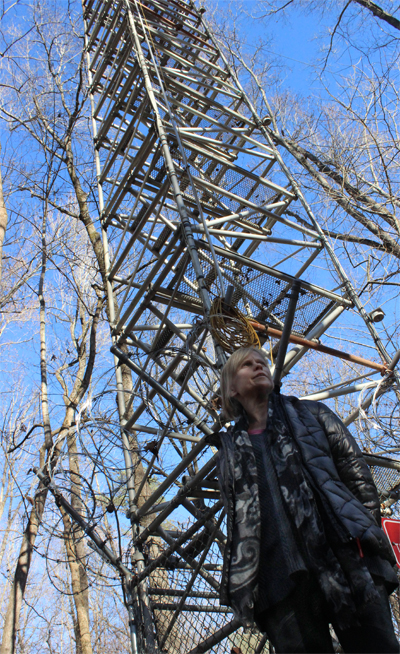
Sari Palmroth and the 130-foot research tower in the Blackwood Division of Duke Forest.

By Karl Leif Bates

You may think of Duke Forest as a nice place to run or walk your dog, but it’s actually the largest research laboratory on campus, and probably the oldest too.

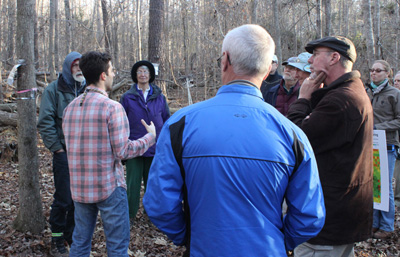
Last week, Duke Forest director Sara Childs and operations manager Jenna Schreiber took about a dozen interested stakeholders on a whirlwind tour to see three active research installations tucked away in areas of Duke Forest the public often doesn’t see.


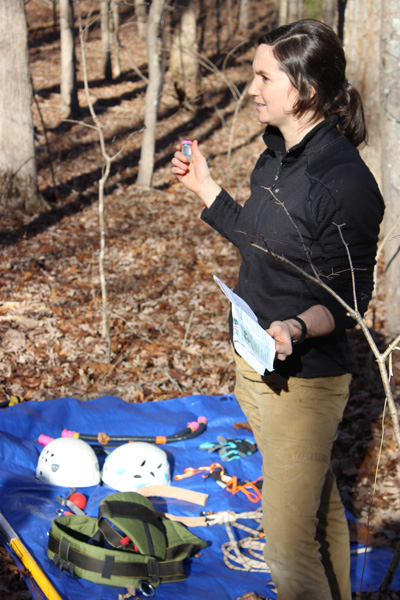
We had to hunt a little to find UNC Biology grad student Jes Coyle in the Korstian division off Whitfield Road, but at least she wasn’t 30 feet up in an oak tree like she usually is. Jes showed the group some of her cool climbing gear while explaining her work on figuring out which part of a lichen, the fungus or the algae, is more responsible for the lichen’s adaptation to microclimates.

She does this by climbing way the heck up into trees to affix little data loggers that track temperature and sunlight at various places on the trunk.

Coyle is looking at 67 lichen species in 54 sampling locations, which is a lot of climbing and a lot of little $50 loggers.

The whole time Jes was talking, we were eyeing her six-foot-tall slingshot and waiting for it to come into play.

Jes Coyle

UNC grad student Jes Coyle shows off her climbing gear.

Indeed it did, as she let three participants, including Sara Childs, have a go at shooting a ball on a fine string over a likely-looking branch to start a climbing rope. (None succeeded.)


Abundant data was the theme at our second stop too, where Sari Palmroth, an associate research professor in the Nicholas School of the Environment, explained how she measures how much water goes into and out of a tree.  Her installation is in the Blackwood Division off Eubanks Road, tucked behind the old FACE experiment.

Standing next to an imposing 130-foot scaffolding tower studded with active and abandoned instruments of all sorts, Palmroth said a square meter of Duke Forest exhales about 700 mm of rainfall a year, which is about half of what falls on it. “How do I know these numbers? Because it’s my job.”

In addition to being a lovely place to get away from the world and sway with the treetops, the tower measures CO2 levels at different heights throughout the canopy.

Sari Palmroth

Palmroth reveals where probes go into a tree trunk.

The tower also hosts a big white box stuffed with wires that capture data streaming in from sensors embedded in the tree trunks all around the tower.

Palmroth and her colleagues are seeing the trees breathe. During the day, when the tiny pores on the underside of their leaves – called stomata — are open and exhaling water and oxygen, roots in the top 40 centimeters of soil are pulling in more water. When the sun sets and the stomata close, then the tree’s deeper roots pull water up to the top level for tomorrow’s drinking.  Unless it doesn’t get cool at night and the stomata don’t completely close, which is the prediction for some climate change scenarios. What then?


Aaron Berdanier

Back in the vans and even deeper into the Blackwood division, we come upon an intrepid young man in a flannel shirt sitting in a sunny spot by the side of the two-track. He’s Aaron Berdanier, a doctoral candidate at Duke who is also looking at water use by taking  automated measurements of 75 trees every minute for four straight years.

His work is part of a larger research project established by Nicholas School professor Jim Clark 15 years ago. Every one of the 14,000 trees in this sloping 20-acre stand of the forest — from spindly saplings to giants —  is labeled and has its data regularly collected by a platoon of undergrads armed with computer tablets.

Other data flows automatically on webs of wiring leading to data loggers situated every few yards. Some of the trees wear a stainless steel collar with a spring that measures their circumference constantly and precisely. They change noticeably both seasonally and by the year, Berdanier says.

The forest is alive and its trees are breathing and pulsing. Berdanier likens his detailed measurement of water consumption to taking a human patient’s pulse. “We’re trying to determine winners and losers under future climate conditions.”

Duke Forest Q&A

Aaron handled a wide-ranging Q&A with the curious visitors as the sun set and the temperature fell.

Joining the Team: Duncan Dodson

duncandodsonHello world! My name is Duncan Dodson. I am a senior from Tulsa, Oklahoma, pursuing a BS in Environmental Science with a focus on Energy and Sustainability. Though my interests and academic pursuits at Duke have shifted over the course of my undergraduate career (I spent over half of it pursuing a mechanical engineering degree), a constant passion has been conservation of the environment. From age six I was involved in the Boy Scouts of America, received my Eagle Scout Award at sixteen, and have been an avid backpacker for five years. I recently co-directed Duke’s experiential education and backpacking based pre-orientation trip, Project WILD, and have been involved with various outdoor and environmental organizations the past three years.

Two things draw me towards exploring environmental issues: the impetus to think selflessly – environmental justice – and the necessity to approach problems on a larger scale – global climate change. Duke and my selective living group Ubuntu have challenged me to explore how we interact with the world around us in both wonderful and destructive ways.

My other budding passion at Duke is education. Challenging knowledge and ideas by informing and listening is a key part of learning. Transitioning from a more homogeneous community in Oklahoma to the vibrant and varied Triangle Area has framed my education in this respect. This is why I applied to write for the Duke Research Blog. Informing others of energy and sustainability research at Duke excites me; having an open forum where exposure to contrary opinions is expected impassions me.

Hopefully my exploration is as intriguing for readers as it is for me!

Four Things You May Not Know about Ecologist E.O. Wilson

By Erin Weeks

Edward O Wilson Red Hills, Aalabama  2010 by Beth Maynor Young 6x9_0

(Photo: Beth Maynor Young)

Edward O. Wilson is one of the most renowned living biologists, the world’s foremost authority on ants, and for a little while at least, a member of the Duke faculty.

Wilson is on campus teaching the first of an annual course, part of a recent partnership between the E.O. Wilson Biodiversity Foundation and Duke’s Nicholas School of the Environment. Feb. 11, he spoke to a sold-out auditorium about “The Diversity of Life,” a lecture that was equal parts awe-inspiring facts, humorous anecdotes from a life in science and call to arms for future generations.

Here are four things the audience learned last night about E.O. Wilson.

1. He’s dabbled in dreams of Jurassic Park. When asked what he thought of de-extinction, the plan to resurrect vanished species using their DNA, Wilson enumerated all the reasons why the efforts may be futile: we have only genetic shreds; the appropriate habitat may be gone; we can’t produce breeding populations from limited DNA.

But then he paused. “I’ll tell you frankly,” he said, “I’d like to see a mammoth.”

2. He made his first scientific discovery as an adolescent. An eye permanently damaged in a fishing accident led the young Wilson to his interest in ants, which he could view up close. One day in his native Alabama, he discovered a ferocious mound-building species he’d never seen before. He didn’t recognize it then, but those were among the first of the destructive red fire ants that would soon invade the entire Southeast, causing billions of dollars of economic and medical damage.

3. The man is 84 and still going strong. Professor Wilson closed his talk with a passage from his newest book, arriving in April, called “A Window on Eternity: A Biologist’s Walk Through Gorongosa National Park.” He’s written two dozen other books, including a foray into fiction at age 80 (the novel, called Anthill, won him the 2010 Heartland Prize for fiction).

4. The future is in nematodes. Or fungi. Or Archaea. Throughout the talk, Wilson reiterated his hopes for young scientists to become the cataloguers and guardians of Earth’s immense biological diversity. Only a fraction of the planet’s estimated species of nematodes, fungi and Archaea are known to science, and “these little things run the world,” he said.

The need for “-ologists” has never been greater, he said.

(Photo: Jared Lazarus)

(Photo: Jared Lazarus)

VIEW THE ENTIRE TALK (YouTube, 1:10 with introductions)

[youtube http://www.youtube.com/watch?v=d-DZ0CUKn2Y?rel=0]

Turtle Sexes are Temperamental

Guest post by Lauren Burianek, doctoral candidate in cell biology

A pair of one-week-old red-eared sliders. The one on the right looks a little cranky. (Tadpole667 via Wikimedia Commons)

A pair of one-week-old red-eared sliders. (Tadpole667 via Wikimedia Commons)

When humans are developing, they snuggle in a warm environment and everything is provided by the mother. The sex of this developing fetus is determined by its individual genetic makeup, particularly the presence of the X and Y chromosomes.

But laid as an egg in a hole on a riverbank, the sex of a red-eared slider turtle is determined by the temperature at which the egg is developed.

At temperatures above 84.6°F, the hatchling will develop into a female, but at lower temperatures, the hatchling will develop into a male. However, at exactly this temperature (called the pivotal temperature), half of the hatchlings will be female and the other half will be male.

Scientists have no idea how temperature affects the sex of the turtle hatchlings, but researchers in Blanche Capel’s lab at Duke are trying to find out.

Red-eared sliders breed in late spring near riverbanks in Louisiana. Researchers carefully collect the eggs from common nesting spots and send the eggs to Duke University. In the Capel lab, graduate student Mike Czerwinski then buries the eggs in sand and places them into incubators at different temperatures. From here, he will analyze the gonads, or sexual organs, of the turtle embryos incubated at the different temperatures.

Grad student Mike Czerwinski in the Capel lab.

Grad student Mike Czerwinski in the Capel lab.

Czerwinski and his colleague Lindsey Mork discovered that when the turtle embryos were incubated at the pivotal temperature, both gonads developed into either testes or ovaries, but rarely did the two gonads develop into one of each.

Then, they incubated the turtle embryos at the pivotal temperature, dissected the two gonads and incubated each of them at different temperatures, either male-developing or female-developing temperatures. Surprisingly, the separated pairs of gonads still attempted to develop into the same sex regardless of the incubation temperature.

Tyrannosaurus Rex may have had temperature-sensitive eggs too. (tlcoles via Wikimedia Commons)

Tyrannosaurus Rex may have had temperature-sensitive eggs too. (tlcoles via Wikimedia Commons)

For example, if one of the gonads incubated in the male-developing temperature readily turned into a testis, the other gonad of the embryo, even though it was incubated in female-developing temperatures, is slower to develop into an ovary than expected, suggesting that it was genetically predisposed to be a testis.

“The results are exciting because it shows that there is a global mechanism beyond temperature dependence that allows for sex determination,” said Czerwinski. “All we’ve known up until now is that temperature is important for these turtles, but now we know that there also has to be a genetic component. Sex determination is so varied between different species, but this might give us insight into how we’re all connected.”

Climate change could definitely be a factor in the survival of these turtles and other temperature-dependent species. After all, the dinosaurs are thought to have exhibited temperature-dependent sex determination.

With increasing temperatures, a higher proportion of hatchlings will be females. Snapping turtles, however, have found a way to combat this – by moving north. The same species of snapping turtles exhibit different pivotal temperatures at different latitudes.

Evolution truly is an amazing process.

Pretty pictures show lemurs responding to changing climate

Guest Post by Sheena Faherty, Biology Graduate Student 

Madagascar’s much-adored and fuzzy lemurs might be “sweated out” of habitats by warming environments under global climate change. Or will they?

A team of researchers at the Duke Lemur Center is employing high-tech heat cameras used in  fire fighting, sports medicine and cancer diagnostics to take “glowing” rainbow pictures of lemurs and their forest surroundings. The results look similar to a child’s coloring project gone rogue.

A mother and baby Coquerel's Sifaka at the Lemur Center in thermograph and visible light. (Leslie Digby)

A mother and baby Coquerel’s Sifaka at the Lemur Center in thermograph and visible light. (Leslie Digby)

This technology, known as infrared thermography, is a camera that allows researchers to detect surface temperatures of lemurs and their hang-outs in the forest—at different depths and heights—and on varying surfaces such as the ground, leaves, and tree trunks.

Combining these data with records of where an animal prefers to spend time, the researchers can begin to determine what temperatures make lemurs most happy.

Leslie Digby, an associate professor in the Department of Evolutionary Anthropology, and her students want to see  how the lemurs are changing their behavior to warm-up on cool days, and cool-down on warm days without having to shiver or sweat.

This sounds rather like a lizard basking on a rock during a sunny day to warm his cold-blooded body up, but lemurs aren’t cold-blooded. They shouldn’t have to do this.

It turns out that even though lemurs are warm-blooded, they can conserve precious energy by channeling their inner Buddha — using sunning behaviors, just like lizards, to fine-tune core body temperatures.

Digby’s team is trying to understand why some species have seemingly restricted territories, even without obvious geographical barriers like mountain ranges or rivers. They suspect temperature plays a part.

“We know that primate species ranges have been very different in the past, so understanding how flexible these animals are, or [are] not, to temperatures can help us understand these larger scale impacts [of changing climate]”, says Digby.

Figuring out how animals respond to alterations in their environment, like rising temperatures, can help scientists anticipate species’ survival in the face of globally changing climates. And knowing which areas of the forest are preferred by lemurs, could help direct conservation efforts, like reforesting parts that have been cut down, or preserving those areas that have not.

Changing temperatures will undoubtedly have major impacts on lemur home ranges in the future, potentially altering them until the animals  are forced into an area outside their thermal limits. By gearing her research toward understanding the thermal tolerances of lemurs, Digby is doing her part to protect the vulnerable lemurs.

A ringtailed lemur striking the classic belly-warming Buddha pose in one of the natural enclosures at Duke Lemur Center. (David Haring)

A ringtailed lemur striking the classic belly-warming Buddha pose in one of the natural enclosures at Duke Lemur Center. (David Haring)

Page 9 of 11

Powered by WordPress & Theme by Anders Norén