Following the people and events that make up the research community at Duke

Students exploring the Innovation Co-Lab

Category: Guest Post Page 9 of 14

Where Memory Meets Imagination

Imagine two scenarios. In the first, one of your close friends is driving down the road when, from behind, they hear the sound of wailing sirens. They pull off onto a side­street and ten minutes later they’re back on the road, holding a fresh speeding ticket. In the second, imagine the exact same scenario, but this time it’s not a close friend, it’s a random person who you know nothing about.

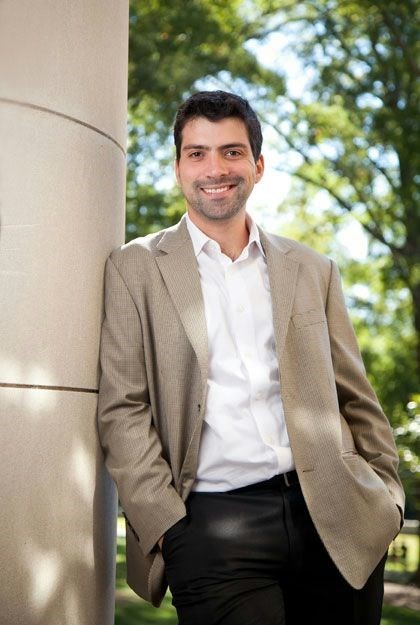
Felipe DeBrigard is an assistant professor of philosophy and a member of the Duke Institute for Brain Sciences. (Les Todd, Duke Photo)

Felipe DeBrigard is an assistant professor of philosophy and a member of the Duke Institute for Brain Sciences. (Les Todd, Duke Photo)

This is the kind of scenario philosophy professor Felipe De Brigard might put someone through for his research. But while asking these questions, he would also be using an MRI machine to measure blood­flow in the brain and using the resulting data to think about philosophy.

De Brigard’s research is mostly concerned with this kind of thinking, the imagination of possibilities which never happened, but which ​could​ have happened. How many times have you wished you could change something about yourself? “Oh, if only I were two inches taller!?”

The way the brain does this, and what it means, are exactly what De Brigard is thinking about. For the example of speeding tickets, he’s found that in the first scenario, in which, your friend gets a ticket, the imagination activates parts of the brain which are also connected to autobiographical memory. It’s almost like you’re remembering something that happened to yourself.

But in the second scenario, the one with the stranger, he’s found something very different. The imagination activates parts of the brain which are connected to “semantic memory,” the memory of hard facts and data. This process is far more logical, he says.

What does this mean? That’s where the philosophy comes in. He says that memory is not a perfect window into the past, but instead “really good at allowing you to recall what could have been.”

The question which he’s asking now is how similar memory and imagination are and how they interact. It’s opening up new and exciting avenues for research. Research which can only be investigated using De Brigard’s bold, interdisciplinary approach to the mind.

JoeWiswellGuest Post by Joe Wiswell, a senior at the North Carolina School of Science and Math

Fighting Malaria with Economics, Coordination

At the Duke Global Health Institute, their academic base is relatively small; only 375 students have completed global health programs at Duke since 2008. But their partnerships span much farther than the Duke campus.

Randall Kramer (left) is Deputy Director of the Duke Global Health Institute and a Professor of Resource and Environmental Economics in the Nicholas School

Randall Kramer (left) is Deputy Director of the Duke Global Health Institute and a Professor of Resource and Environmental Economics in the Nicholas School

Malaria researcher Randall Kramer, the Deputy Director of the Duke Global Health Institute, maintains a network of Priority Partnership Locations (PPLs), so that Duke students can have sustained learning experiences through fieldwork. The network puts Duke’s global health students into communities where these PPLs are based.

Kramer’s own research is on the environmental economics that dictate the success of global initiatives to fight malaria. Kramer highlighted a two-prong approach that he has found to be highly effective in preventing the spread of malaria. The first aspect is prevention; if the disease-carrying mosquitoes cannot reach a host, humans cannot become infected with malaria. Techniques like the employment of bed nets and insecticide spraying inside houses of rural African and Asian villages have proven to be very effective in the prevention of infection. However, these methods are not 100% effective so some infections will occur even when there is excellent prevention activity.

Kramer and colleagues have worked with universities and government officials in Tanzania and Uganda to develop a comprehensive framework for assessing the full range of health, social and environmental risks and benefits associated with alternative malaria control strategies.

Kramer and colleagues have worked with universities and government officials in Tanzania and Uganda to assess malaria control strategies.

The second aspect of fighting malaria is in treatment after infection. In the United States, infections are easily treatable with medications, but in low-income rural communities, one of the biggest problems is the lack of trained medical workers to diagnose malaria and administer medication. There are some drugs that have been very effective in eliminating the malaria parasite once introduced to the human body, , but there still remains a struggle with regard to drug availability and  lack of human resources.

Kramer is pleased with the changes in malaria treatment and prevention over the past twenty years, during which malaria related deaths in the world have dropped significantly. But he said there is still a long ways to go before malaria no longer remains a serious health concern. One of the biggest problems that Kramer identified has been the lack of coordination between organizations targeting malaria prevention and treatment. He praised the current organizations in their efforts and funding to help the cause, but suggested that if the organizations were better coordinated, their efforts would save even more lives.

One organization he identified as a great contributor to ending malaria was the Bill and Melinda Gates Foundation, which has poured millions of dollars into research towards a vaccine for malaria. Kramer is hopeful that nearly complete control of malaria can be achieved in coming decades. He also believes that helping Duke students gain experience in low resource settings will increase their understanding of the global health challenges and solutions.

fawcett_100Guest Post by Ben Fawcett, a senior at the North Carolina School of Science and Math

An Unconventional Career Map

Landscape ecologist Jennifer Swenson has a very special set of skills that come from having an “unconventional academic trajectory.”

JenniferSwenson

Jennifer Swenson is an associate professor of the practice in geospatial analysis at the Nicholas School of the Environment

Her diverse and interesting career began at UC Santa Barbara, where she chose to learn about International Relations and Geography. “I wanted to be versatile and globally aware,” she said. Undergraduate school is where she learned the geography techniques she now uses in her research,  and received stacks of reading for international relations.

After this, Swenson spent three years giving bicycle tours, working at a ski resort, and other jobs, until she went on a conservation trip to Ecuador to work for an NGO (non-governmental organization). She was able to use her geospatial techniques (GIS) to map trails and land cover change in Ecuadorian national parks, and also to evaluate forest corridors for an endangered species of monkey.

Connectivity between habitat remnants for critically endangered primate, Callicebus oenanthe, in San Martin, Peru. Presented at the 2nd Simposio de Primatologia en el Peru (Iquitos, November 2013) & at the Remote Sensing forConservation Symposium (London, May 2014) Schaffer-Smith, Swenson, Bóveda-Penalba, Murrieta-Villalobos

Connectivity between habitat remnants for critically endangered primate, Callicebus oenanthe, in San Martin, Peru. Presented at the 2nd Simposio de Primatologia en el Peru (Iquitos, November 2013) & at the Remote Sensing forConservation Symposium (London, May 2014) Schaffer-Smith, Swenson, Bóveda-Penalba, Murrieta-Villalobos

She learned many things, including how to manage a lab, and also became fluent in Spanish thanks to the total immersion. “It’s just another barrier,” she says, to have to use English. Plus, it is useful for reading papers that haven’t been translated.

“Everyone should learn a second or third language and have the opportunity to be immersed in that country.”

After this she went back to graduate school and got a Ph.D. in forest science at Oregon State.

Swenson’s research at Duke is often about conservation or biodiversity, and occasionally ecosystem studies. She is still using her special skills to try to do the greatest good.

“Its great to work towards that, but sometimes its hard to detect that you are doing change,” she says. “I still keep trying to forge ahead and do whatever I can for the environment. In the end, all those students that we train and send out will do great things, and that’s how we have the greatest impact for the environment.”

CalebCaton_100Guest Post by Caleb Caton, a senior at the North Carolina School of Science and Math

Checking in on Air Pollution — With an Expert!

I had the pleasure of meeting and interviewing Duke Professor Junfeng “Jim” Zhang, an avid environmental health researcher who has done amazing work on air pollution research. Because of my own interest in air pollution and its adverse health effects, I began by trying to grasp Dr. Zhang’s work through his detailed scientific explanations of his projects, such as looking at the human health effects of nano-technology.

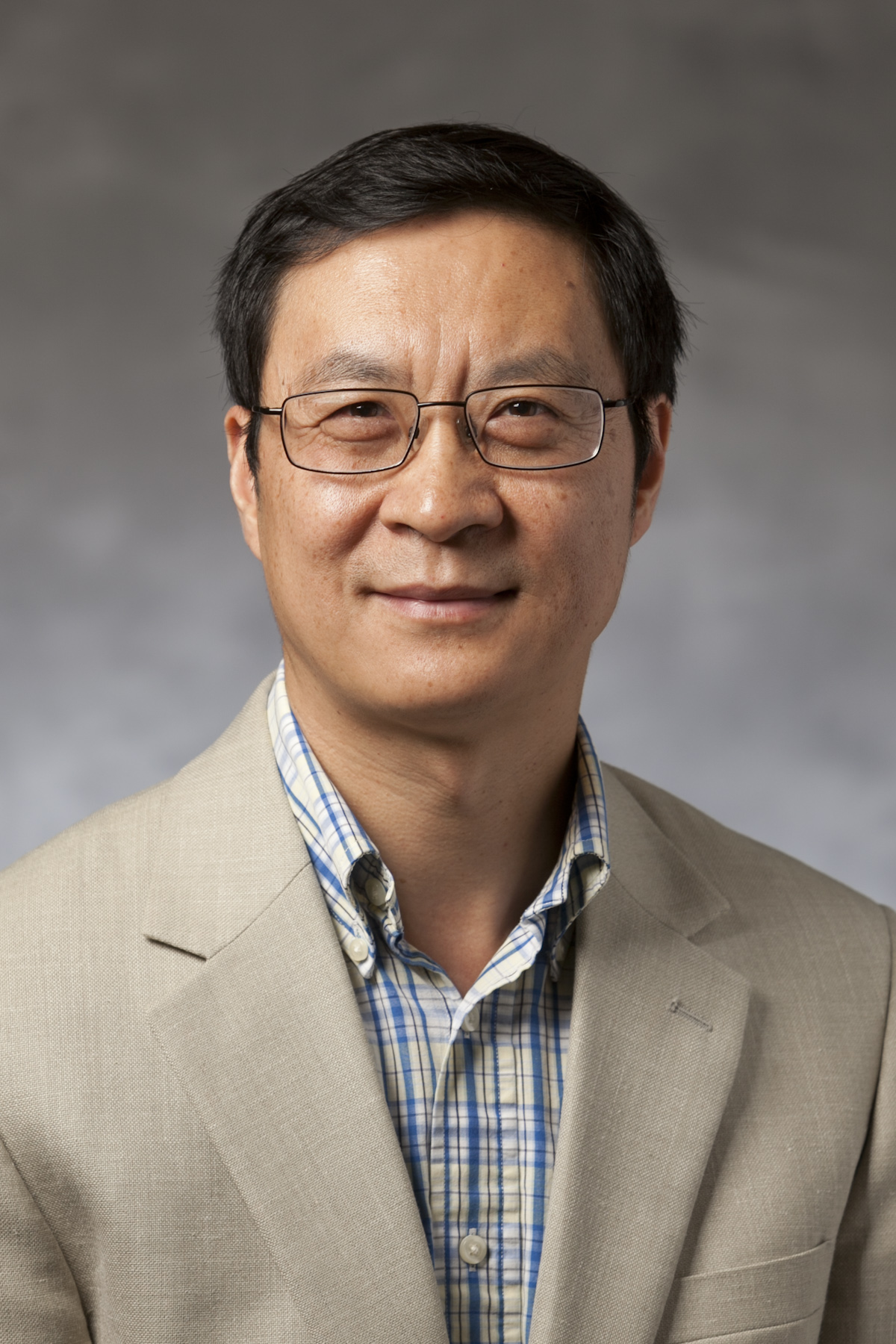
Junfeng (Jim) Zhang is a professor of global and environmental health in the Nicholas School and the Duke Global Health Institute

Junfeng (Jim) Zhang is a professor of global and environmental health in the Nicholas School and the Duke Global Health Institute

From my reading on the projects I was interested in, I did not expect Zhang to be able to step back and capture the importance of his research in simple terms because his projects were quite complicated (such as testing human health effects due to chemically altered diesel fuel). However, it turned out that Zhang is well-versed in communicating both crucial details of his research and the overall meaning for human health.

The most captivating aspect of my interview with Zhang was our discussion of his contribution to the 2007 Nobel Peace Prize, which was awarded to the Intergovernmental Panel on Climate Change. Dr. Zhang essentially concluded that burning and replanting trees is not necessarily carbon-neutral, disproving the common view that replanting burned trees is always carbon-neutral. His arguments really sold the importance of his research to me and I very quickly agreed with his views on the consequences of his research.

My interview with Zhang also revealed just how important scientific research is in adding evidence and findings to support a side on the growing global issues of environmental pollution and protection. It really amazed me how researchers play such a crucial supportive role in not only protecting the world’s environment, but advancing the quality of human life.

UPDATE – Professor Zhang spoke with BBC about air pollution in China. Read the story here.

PeterChengGuest Post by Peter Cheng, a senior at the North Carolina School of Science and Math.

Improving Machine Learning With an Old Approach

Computer scientist Rong Ge has an interesting approach to machine learning. While most machine learning specialists will build an algorithm which molds to a specific dataset, Ge builds an algorithm which he can guarantee will perform well across many datasets.

Rong Ge is an assistant professor of computer science.

Rong Ge is an assistant professor of computer science.

A paper he wrote as a postdoc at Microsoft Research,  Escaping From Saddle Points — Online Stochastic Gradient for Tensor Decomposition, describes how a programmer can use the imprecision of a common machine learning algorithm, known as stochastic gradient descent, to his advantage.

Normally this algorithm is used to speed up a slow learning process by only approximating the correct solution rather than working harder to get precision; however, Ge and his colleagues found that the small amount of “noise” created by the algorithm can be the saving grace of an algorithm which would otherwise be trapped by its own perfectionism.

“This algorithm is not normally used for this purpose,” Ge says, “It is normally used as a heuristic to approximate the solution to a problem.”

Noise allows the algorithm to escape from something called a “saddle point” on the function which the stochastic gradient is trying to optimize, which looks sort of like a sine wave. Ge describes gradient descent as being like a ball rolling down a hill. When on the slope of the hill it always seeks the lowest point, but if it is at a saddle point, a high point on a “ridge” between two different slopes, it will not start rolling.

Stochastic gradient descent remedies this problem by jostling the ball enough to start it rolling down one of the slopes. But one cannot be sure which way it will roll.

The results he has obtained relate to a certain branch of machine learning known as unsupervised learning. One common problem from unsupervised learning is “clustering,” in which the algorithm attempts to find clusters of points which are similar to each other while different from the other points in the set. The algorithm then labels each of the clusters which it has found, and returns its solution to the programmer.

A key requirement for the final result of the algorithm to be correct is that the two slopes end at low points of equal depth, which represent optimal solutions. Often two solutions will appear different at first glance, but will actually represent the same set of clusters, different only because the labels on clusters were switched. Ge said one of the hardest parts of his process was designing functions that have this property.

These results are guaranteed to hold so long as the dataset is not provided by someone who has specifically engineered it to break the algorithm. If someone has designed such a dataset the problem becomes “NP hard,” meaning that there is little hope for even the best algorithms to solve it.

Hopefully we will see more growth in this field, especially interesting results such as this which find that the weaknesses associated with a certain algorithm can actually be strengths under different circumstances.

GraysonYork

GraysonYork

Guest post by Grayson York, a junior at the North Carolina School of Science and Math

Mapping the Pathways of Least Resistance

Cancer is a notoriously slippery target. It can assume multiple genetic identities, taking a different pathway whenever it needs to dodge the latest treatment. A recent study found that just a single, tiny tumor can contain more than a million distinct mutations, priming it for resistance.

A series of brain-scans on one patient whose brain tumor bounced back repeatedly despite surgery, chemotherapy and radiation. (Fujimaki T et al. “Effectiveness of interferon-beta and temozolomide combination therapy against temozolomide-refractory recurrent anaplastic astrocytoma.” doi:10.1186/1477-7819-5-89)

A series of brain-scans on one patient whose tumor (white) bounced back repeatedly despite surgery, chemotherapy and radiation. (Fujimaki T et al. “Effectiveness of interferon-beta and temozolomide combination therapy against temozolomide-refractory recurrent anaplastic astrocytoma.” doi:10.1186/1477-7819-5-89)

So, while one treatment might be able to wipe out most of the cancer cells, the few that remain with the right genetic makeup will go on to forge a resistance.

Such resistance is a huge problem and one of the reasons that cancer is on its way to becoming the number one killer disease in the United States. By the end of this year, cancer will kill nearly 600,000 Americans and millions more around the world.

Kris Wood, Ph.D., spoke about the challenges of combating cancer drug resistance at the Basic Science Day on Nov. 16. The annual event brought together faculty, staff, trainees, and students to celebrate basic science research and to encourage collaborations. During the day, attendees heard TED-length talks from faculty members studying a wide range of topics, from vocal learning to asexual reproduction.

“My lab is most interested in the basic question of what are the things that cancer cells can do that allow them to survive in what should be toxic environments created by drug treatments,” said Wood, an assistant professor of pharmacology and cancer biology. “By understanding how cancer cells survive in drug environments, we might be able to both predict those patients who will respond well and respond poorly to treatments, and also design combination therapies that could work more effectively.”

Kris Wood is an assistant professor of pharmacology and cancer biology.

Kris Wood is an assistant professor of pharmacology and cancer biology.

Wood said that knowing that so many different genetic alterations can lead to resistance might make researchers wonder what chances they have of ever stopping a tumor.

But he thinks there is reason to be optimistic, because these myriad mutations seem to function by altering a discrete set of pathways. In turn, many of these pathways seem to create the same kinds of effects in cells – chiefly, fueling growth and shirking death. Targeting the effects that enable resistance could bring about better ways to treat cancers.

For example, half of melanomas are driven by mutations in a gene called BRAF. Wood began to map out the different drug resistance pathways that are controlled by the BRAF signaling molecule. He found that many of these pathways converge on another signaling molecule called MYC, which is known to promote cell proliferation.

When Wood blocked MYC in drug-resistant melanoma cells, he found that it could make them sensitive to further rounds of chemotherapy. He also found that suppressing MYC in melanoma cells before treatment could dramatically delay the time that it takes for resistance to emerge.

Mutant tumor cells (brown) in a brain metastisis of malignant melanoma. BRAF is stained. (Image by Jensflorian via Wikimedia Commons.)

Mutant tumor cells (brown) in a brain metastisis of malignant melanoma. BRAF is stained. (Image by Jensflorian via Wikimedia Commons.)

“MYC is a complicated beast, and there are lots of things it can do,” said Wood. “I think there are some promising strategies for inhibiting MYC, which could lead to intelligent therapies that target resistance.”

Broadfoot_100Guest post by Marla Vacek Broadfoot Ph.D.

Celebratory Bottles Mark the March of Time

The 50th anniversary of the Triangle University Nuclear Laboratory (TUNL) November 6-8 was a homecoming of sorts for hundreds of alumni, faculty and friends.

On the eve of the anniversary party, Chris Gould of NC State inspecting the trophy case at TUNL.

On the eve of the anniversary party, Chris Gould of NC State inspected the trophy case at TUNL.

For half a century, the three Triangle universities have collaborated seamlessly on nuclear physics experiments using particle accelerators and other equipment too large and expensive for one university to effectively use on its own.

Key milestones in the lab’s history are marked by a dusty rank of empty champagne bottles marching across the top of a power supply cabinet in the basement lab.

Each trophy bottle records a moment of celebration, when faculty, researchers, technicians, and students gathered to savor an achievement made possible by years of working all hours of the day and night to design, build, measure, adjust, repair, monitor, and make sense of equipment and experiments. Each is labeled, typically in Wite-Out correction fluid, with a date and the event.

“The bottles represent technical milestones that either created new research opportunities at TUNL or increased the competitiveness of TUNL’s research activities in specific areas,” said Calvin Howell, who is a Duke professor and the director of TUNL.

December 29, 1968, the first beam of 30 MeV after two years of construction and assembly.

December 29, 1968, Roberson’s handwriting celebrates the first beam of 30 MeV, marking the end of two years of construction and assembly and the beginning of 50 years of science.

Russell Roberson, Duke professor emeritus and one-time TUNL director, started the tradition. On Sunday, December 29, 1968, TUNL physicists successfully coaxed a beam of particles out of the new equipment, marking the completion of  two years of constructing a new building behind Duke’s physics building and installing enormous equipment purchased with a $2.5 million grant from the Atomic Energy Commission.

“It was a pretty big deal to have that beam and it seemed like we ought to remember when we did it,” Roberson said.

Graduate student Chris Gould had just driven from Philadelphia to Duke between Christmas and New Year’s day to deliver a piece of equipment with colleague Steve Shafroth, who was beginning his TUNL career at UNC. “We arrived in the evening,” remembered Gould, who is now a professor of physics at NC State. “And came upon a bibulous celebration in the control room where bottles of Cold Duck were being cooled down with liquid nitrogen and drunk out of paper cups.”

Six months later, Gould began his career at TUNL.

In the coming years, they would collide this type of beam (and others) with targets of various compositions in their quest to unlock the secrets of subatomic structure and forces.

Here are a few trophies from over the years:

Worth Seagondollar

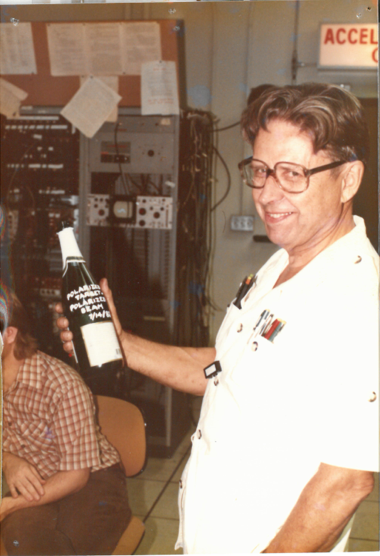
July 14, 1983 – “Polarized Target – Polarized Beam.” Worth Seagondollar, chair of physics at N.C. State. (Courtesy of David Haase, NCSU)

May 13, 1979 – “First pulsed polarized n”

In the mid-1970s, TUNL began producing polarized neutron beams, in which the neutrons were all spinning in the same direction. Knowing the spin direction of the particles in the beam made for more precise interpretation of the data when the beam hit the target. This bottle from 1979 marked a further enhancement—the beam was pulsed so that the speed of the neutrons in the beam could be calculated.

July 8, 1980 – “First data taken with the VAX”

TUNL was the first nuclear lab to take data with the new 32-bit VAX computer from the Digital Equipment Corporation. TUNL physicists built an operating system to go along with it, which was used by many other labs around the world. In fact, Gould and Roberson traveled to China and Saudi Arabia to help labs there set up the same system. (Before the VAX, TUNL “borrowed” computer power from the high-energy physics group at Duke, via cables that ran through a 4” pipe between the two labs.)

May 15, 1992 – “Lamb Shift Polarimeter Bump Bump Bump”

TUNL faculty and students designed a device called a “Lamb shift spin-filter polarimeter” that would characterize the distribution of spin directions of the particles in a polarized beam almost instantly — a task that had previously taken hours. “We had just collected the first spectrum which proved that the Lamb-shift polarimeter could be used to determine the beam polarization in the predicted way,” recalled UNC professor Tom Clegg. “It was a night for high-fives and celebration. We joyously popped the cork on this bottle late on Friday evening after a very difficult week.”

"Bump Bump Bump" signified three distinct signals from the new Lamb shift spin-filter polarimeter.

1992 “Bump Bump Bump”

October 26, 2006 – “First Beam Extracted from Booster”

TUNL operates the world’s most powerful Compton gamma-ray source, called HIGS (which stands for high intensity gamma-ray source). The gamma rays are produced in a free electron laser ring, which is housed in a 52,000-square-foot building adjacent to the original TUNL facility on Duke’s campus. In 2006, TUNL scientists added a booster ring called a synchrotron to increase the intensity of gamma rays that could be produced. Scientists from all over the world use the facility for experiments involving gamma rays at energies of 10 million to 100 million electron volts (MeV).

Mary-Russell RobersonGuest post by Mary-Russell Roberson

Four-Fifths of a Banana is Better than Half

Fractions strike fear in the hearts of many grade schoolers – but a new study reveals that they don’t pose a problem for monkeys.

Even as adults, many of us struggle to compute tips, work out our taxes, or perform a slew of other tasks that use proportions or percentages. Where did our teachers and parents go wrong when explaining discounts and portions of pie? Are our brains simply not built to handle quantitative part-whole relationships?

Lauren Brent macaques

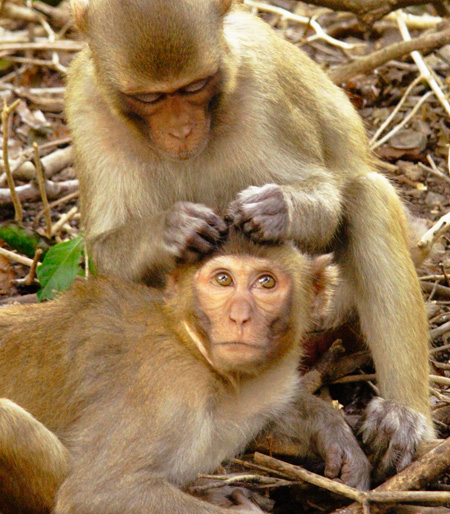
Fractions and logical relationships are some of the things a wild macaque might think about while grooming and being groomed. (image copyright Lauren Brent)

To try to answer these questions, my colleagues and I wanted to test whether other species understand fractions. If our fellow primates can reason about proportions, our minds likely evolved to do so too.

In our study, which appears online in the journal Animal Cognition, Marley Rossa (Trinity 2014), Dr. Elizabeth Brannon, and I asked whether rhesus monkeys (Macaca mulatta) are able to compare ratios.

We let the monkeys play on a touch-screen computer for a candy reward. First we trained them to distinguish between two shapes that appeared on the screen: a black circle and a white diamond. When they touched the black circle, they heard a ding sound and received a piece of candy. But when they touched the white diamond, they heard a buzz sound and did not get any candy. The candy-loving monkeys quickly developed a habit of choosing the rewarding black circle.

http://www.free-training-tutorial.com/math-games/fraction-matching-equivalent1.html

Fractions example taken from sheppardsoftware.com

Next we introduced fractions. We showed two arrays on the screen, each with several black circles and white diamonds. The monkeys’ job was to touch the array having a greater ratio of black circles to white diamonds. For example, if there were three black circles and nine white diamonds on the left, and eight black circles and five white diamonds on the right, the monkey needed to touch the right side of the screen to earn her candy (8:5 is better than 3:9).

We didn’t always make it so easy, though. Sometimes both arrays had more black circles than white diamonds, or vice versa. Sometimes the array with the higher black-circle-to-white-diamond ratio actually had fewer black circles overall. They needed to find the largest fraction of black circles. For example, if there were eight black circles and 16 white diamonds on the left (8:16), and five black circles and six white diamonds on the right (5:6), the correct answer would be the latter, even though there were more black circles on the left side. That is how we made sure that monkeys were paying attention to the relative numbers of shapes in both arrays.

The monkeys were able to learn to compare proportions. They chose the array with the higher black-circle-to-white-diamond ratio about three-quarters of the time. Impressively, when we showed them new arrays with number combinations they had never seen before, the monkeys still tended to select the array with the better ratio.

Our results suggest that monkeys understand the magnitude of ratios. They also indicate that monkeys might be able to answer another type of question: analogies. These four-part statements you may have seen on standardized tests take the form “glove is to hand as sock is to foot.”

This kind of reasoning requires not only recognizing the relationship between two items (glove and hand) but also how that relationship compares with the relationship between the other two items (sock and foot). Understanding the relationships between relationships — that is, second-order relationships — was believed to require language, making it possibly a uniquely human ability. But in our study, monkeys successfully determined the relationship between two fractions – each one a relationship between two numbers – to make their choices.

If monkeys can reason about ratios and maybe even analogies, our minds are likely to have been set up with these skills as well.

The next step for this line of research will be to figure out how best to employ these in-born abilities when teaching proportions, percentages, and fractions to human children.

CITATION: “Comparison of discrete ratios by rhesus macaques (Macaca mulatta)” Caroline B. Drucker, Marley A. Rossa, Elizabeth M. Brannon. Animal Cognition, Aug. 19, 2015. DOI: 10.1007/s10071-015-0914-9

SAMSUNG CAMERA PICTURES

Guest post by graduate student Caroline B. Drucker. Caroline is curious about both the evolutionary origins and neural basis of numerical cognition, which she currently studies in lemurs and rhesus monkeys.

Marine Lab Hosts 500+ at Open House

In what was a record high turnout, more than 500 people made their way to Pivers Island on Saturday Aug. 1, for the Duke University Marine Lab’s annual open house. Visitors listened to whales, peered at plankton and sea urchin larvae through microscopes, and learned how salinity gradients and wind can drive ocean currents at 16 research stations scattered throughout the campus. Kids of all ages also got to meet horse conchs, pen shell clams, tulip snails, fiddler crabs, slipper snails and other creatures in the marine lab’s touch tanks. “We don’t think of snails as having teeth but they really do; that radula is quite a weapon. It’s like a cross between a chainsaw and a tongue,” said Duke visiting professor Jim Welch. Photos by Amy Chapman-Braun, Nicholas School of the Environment at Duke.

Hugs Before Drugs – The Price of Emotional Neglect

Every exhausted parent can be tempted to check out at times, especially when the little ones are testing limits.

A happy child, presumably not neglected, buried in sand. (D. Sharon Pruitt via Wikimedia Commons)

A happy child, presumably not neglected, buried in sand. (D. Sharon Pruitt via Wikimedia Commons)

But when moments of autopilot become months or years, that is considered emotional neglect and it’s strongly linked to the subsequent development of clinical depression in children. Ahmad Hariri’s lab at Duke studies emotional neglect, defined as a caregiver consistently overlooking signs that a child needs comfort or attention, even for something positive.

“Early in life, during infancy, an emotional neglectful parent would regularly be unresponsive and uninvolved with their child,” said Jamie Hanson, a postdoctoral researcher in Hariri’s group. “In early childhood, parents would be clearly unengaged in playing with the child, showing little to no affection during interactions.”

In a study published online in Biological Psychiatry, Hanson, Hariri and their collaborator Douglas Williamson of the University of Texas Health Sciences Center San Antonio, found that the more emotional neglect the children had experienced in their lives, the less responsive their brain was to a reward (winning money in a card game). They had scanned the brains of 106 children between 11 and 15 years of age, and then again two years later.

The scientists focused on the ventral striatum, a brain area known to fire up in response to positive feedback. This region is thought to play a role in optimism and hopefulness, and its dysfunction has been associated with depression. The team wondered: Are the kids with dulled ventral striatum activity more likely to have symptoms of depression? They were.

Ahmad Hariri

Ahmad Hariri

Depression rates start to rise around 15 or 16 years of age, and that’s why the team focused on this age. The cohort of kids they studied were part of Williamson’s Teen Alcohol Outcomes Study (TAOS), and Hanson and Hariri hope to continue following them.

In a different cohort called the Duke Neurogenetics Study, Hariri’s team has found that the responsiveness of the ventral striatum and the amygdala — another area that handles life stress — may help predict how likely young adults are to develop problem drinking in response to stress or to engage in risky sexual behavior.

Being able to identify the children or young adults who are at risk for depression and anxiety is a tall order. But the possibility that we could one day funnel extra support to these individuals and help them avoid a lifetime of medicines and therapy is what keeps Hariri and his team going.

Personally, as a parent, I’m excited see what the Hariri group will do next. During our interview, I couldn’t help running a few scenarios by him and Hanson. Am I emotionally neglecting my toddler if she’s having a tantrum and I have to leave the room or I’ll scream?

“You can have a bad week,” said Hariri, who is also a dad. “You’re not ruining your kid.”

KellyRae_Chi_100Guest post by Kelly Rae Chi, a Cary-based freelance writer who covers brain science for Duke Research.

Page 9 of 14

Powered by WordPress & Theme by Anders Norén