Following the people and events that make up the research community at Duke

Students exploring the Innovation Co-Lab

Category: Animals Page 16 of 19

Biology Junior Plays Tag with Hawaiian Seals

Guest Post By Emma Weitzner, T’15

I came to the Duke Marine Lab as a student during the spring semester of 2013, where I was first introduced to the Hawaiian monk seal in an independent study project working with Kenady Wilson, a PhD candidate in Dr. Andy Read’s lab.

The project involved analysis of Crittercam video footage. My job in the spring was to go through all of the Crittercam footage that had been obtained over the past year, which comprised six seals inhabiting three of the Main Hawaiian Islands, and score the video data using a set rubric. The aim of the analysis was to observe how many fish the seals were passing versus capturing.
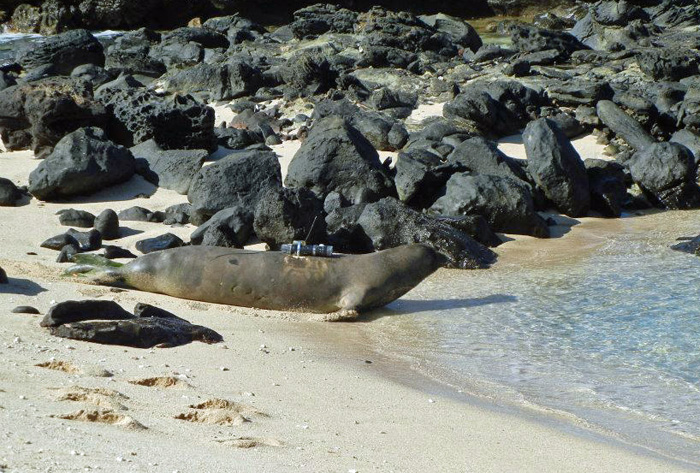
A monk seal newly fitted with a crittercam heads back into the surf.

A monk seal newly fitted with a crittercam heads back into the surf.

Hawaiian monk seals are critically endangered, but myths held by local Hawaiians are inhibiting conservation and recovery efforts. My results indicated that seals are eating a mere fraction of the prey items that they come into contact with, which is important information that can be used to quell local Hawaiians’ fears that these animals are depleting fish resources at and unsustainable rate.

This summer I was fortunate enough to be able to accompany my advisor into the field and travel to Hawaii. We worked with a team of NOAA scientists, veterinarians, and National Geographic photographers to deploy Crittercams onto the backs of monk seals on the islands of Molokai and Kauai.

The field work was intense, but it was an outstanding introduction into the kind of work I want to continue doing. On Molokai we would walk over 8 miles a day checking beaches for seals that were resting, and if we found a good candidate, we would restrain the seal, lightly sedate it, and then collect a variety of biomedical samples followed by the attachment of the Crittercam and other tags using a 10-minute epoxy.  We tagged two seals on Molokai over the three days.
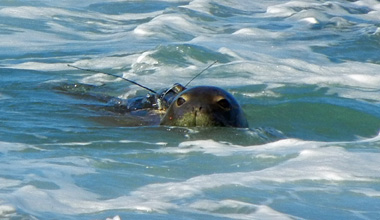
The crittercam on this seal's back sees everything the animal sees as it swims and hunts.

The crittercam on this seal’s back sees everything the animal sees as it swims and hunts.

In Kauai, the field work involved driving to different beaches to check for seals, and relying on a vast network of volunteers to inform us of any seal sightings. On our first day we were able to deploy a camera. The vet tech was unable to make it to this deployment, so I got to step in and help the vet prep the seal for sedation, assist in the collection of samples, and help restrain the seal during the attachment of the camera. It was a little nerve-wracking but also really exciting!

On our last night in Kauai, we went to a community meeting where the head of the NOAA monk seal research program gave a presentation about monk seals in an attempt to dispel some of the myths held by the locals, including, “seals aren’t native to the Main Hawaiian Islands,” “the seals eat their weight in fish every day,” and “the government is transporting seals here.” The information given at the presentation seemed to enlighten most of the people there, so more deployments of Crittercams and increased dissemination of the information they provide will hopefully help local community members and other stakeholders become aware of the actual impact of monk seals on the Hawaiian ecosystem, and lead to more widespread and successful conservation and recovery efforts.

It was a truly incredible two weeks in which I got to handle three critically endangered animals, meet a team of fascinating professionals in my dream career, and see the beautiful sights of Hawaii! I will continue working with Kenady throughout my next two years at Duke, and I look forward to completing my senior thesis on monk seals and the analysis of their future Crittercam footage!

New App May Help Protect Wild Dolphins

By Ashley Yeager

A screenshot from a new app, the Nai'a Guide, which provide info about eco-friendly dolphin-watching tours in Hawai'i. Credit: Demi Fox, Lenfest.

A screenshot from a new app, the Nai’a Guide, which provide info about eco-friendly dolphin-watching tours in Hawai’i. Credit: Demi Fox, Lenfest.

Traveling to Hawai’i sometime soon?

If so, you’re probably excited to experience spinner dolphins in the wild. If not, you can still dream about it. And now, there’s an app for that.

Scientists at Duke’s Marine Lab in Beaufort, N.C. have released the Nai’a Guide — a new iPad app that teaches users about wild Hawai’i spinner dolphins and how to see the animals without harming them. Tourists can use the app to plan an eco-friendly tour to experience the dolphins.

“If we can harness the power presented by mobile technology for conservation and responsible tourism, we have the chance to reach a wide audience and really make a difference for these animals,” says Demi Fox, a postgraduate researcher at the Lenfest Ocean Program who developed the app, along with Duke marine biologist Dave Johnston.

Nai’a is the Hawaiian word for dolphin. The Nai’a Guide explores the biology and ecology of spinner dolphins with photos, videos and sound clips. It also describes sustainable dolphin-based tourism practices outlined NOAA’s Dolphin SMART program.

With the Nai'a Guide, users can learn about spinner dolphins and their habits. Credit: Demi Fox, Lenfest.

With the Nai’a Guide, users can learn about spinner dolphins and their habits. Credit: Demi Fox, Lenfest.

Designed by Fox and developed by an online company called Kleverbeast, the Nai’a Guide also connects tourists with sustainable tour operators so everyone can make more responsible decisions when going to see spinners.

“The principles advocated within the Naia Guide could also be useful for dolphin-based tourism in other places, and with other species. Many of these best practices are generalizable,” Johnston says.

He and other scientists are concerned about human interaction with wild dolphins and other species worldwide. In Hawai’i, the main concern is that spinner dolphins rest during the day in the same shallow bays that people use for snorkeling, kayaking and swimming. Many tourists misinterpret the dolphins’ close proximity and curiosity for playfulness and try to swim with and even ride the animals while they are sleeping.

Intense and consistent human interactions could affect the dolphins’ health over time, Johnston says. The negative effects may also threaten the animals, a resource the state uses to draw tourists to the islands. As a result, he and colleagues at Murdoch University’s Cetacean Research Unit have been tracking spinner populations and monitoring their interaction with people in the Hawai’i island bays.

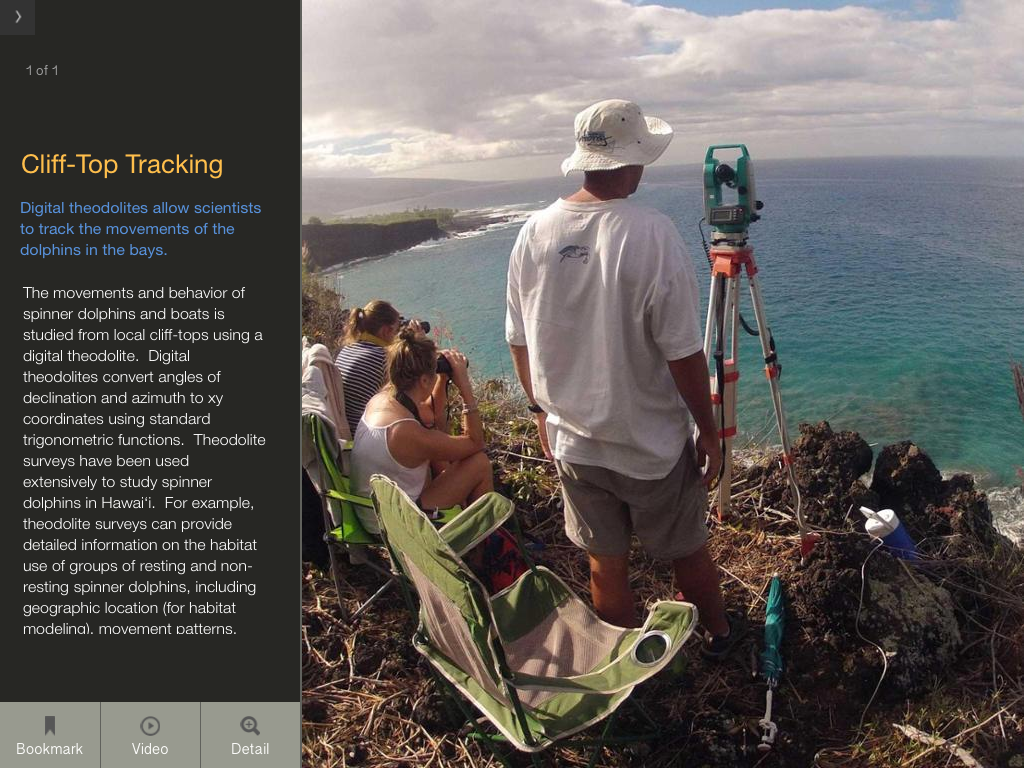
Researchers study dolphins in boats and high on the cliffs of Hawai'i Island, which is covered in the new app. Credit: Demi Fox, Lenfest.

Researchers study dolphins in boats and high on the cliffs of Hawai’i Island, which is covered in the new app. Credit: Demi Fox, Lenfest.

Scientists “can do all the science in the world, but until we share our findings broadly and in an accessible way, we will not effect serious change,” Fox says. She included the team’s research in the app so users can better understand researchers’ concerns about human-dolphin interactions and can make more informed decisions when choosing a dolphin tour.

“My hope is that the app will serve as an ecological conscience,” she says.

The app, available in Apple’s iTunes Store, can also be found on Twitter @NaiaGuide and on its website, http://www.naiaguide.org.

Early Primate Leaping Set Stage for Human Airtime

By Ashley Yeager

From primate ancestors that leaped like a dwarf lemur is where we got our ability to jump, a new study suggests. Photo courtesy of Mireya Mayor.

Primate ancestors that leaped like a dwarf lemur may be where we got our ability to jump, a new study suggests. (Photo courtesy of Mireya Mayor and Shaquille O’Neal).

Over a puddle, up to the basket, off the high dive — we all take leaps from time to time.

Now, new research suggests that this acrobatic lifestyle began far back in our evolution, when the earliest primates were first emerging on Earth.

“What this study suggests to us is that a very unusual and impressively acrobatic lifestyle jumping through the trees set us on the road to evolving many of features we recognize today in primates, including humans,” says Duke evolutionary anthropologist Doug Boyer.

Boyer and colleagues measured the ankle bones of 73 living and 38 extinct species of primates and found that throughout primate evolution, even our earliest ancestors were developing the bone structure to support long jumps. The results appear July 3 in PLoS ONE.

From the data, the scientists concluded that the ankle mechanics for better leaping in primates began to evolve around 55-60 million years ago. Boyer says natural selection seemed to favor a lifestyle of increasingly acrobatic locomotion in trees, including leaping long distances rapidly between branches.

Scientists had previously noticed that exceptional leapers had unusually elongated ankles. Boyer’s study, however, is the first to simultaneously test for effects of both body mass and behavior on ankle-bone elongation.

The team found a trade-off between body mass and ankle elongation. At larger body masses, ankles were proportionally shorter regardless of behavior. Yet, among animals of similar body size, the leapers had proportionally longer ankles, Boyer says. This was true among even fairly large primates, a contradiction to scientists’ earlier view that there was no behavioral benefit of ankle elongation for bigger animals.

The study is also the first to look at incremental evolutionary changes leading from our earliest primate ancestors to all the modern living forms. Whether leaping was an important behavior for the earliest primates has been controversial.

From their fossil data, Boyer and colleagues could see that early primates were not specialized leapers. “For the most part many of them were generalists, clamoring around on trees, jumping around now and then, but possibly preferring to scamper rather than make huge leaps,” he says.

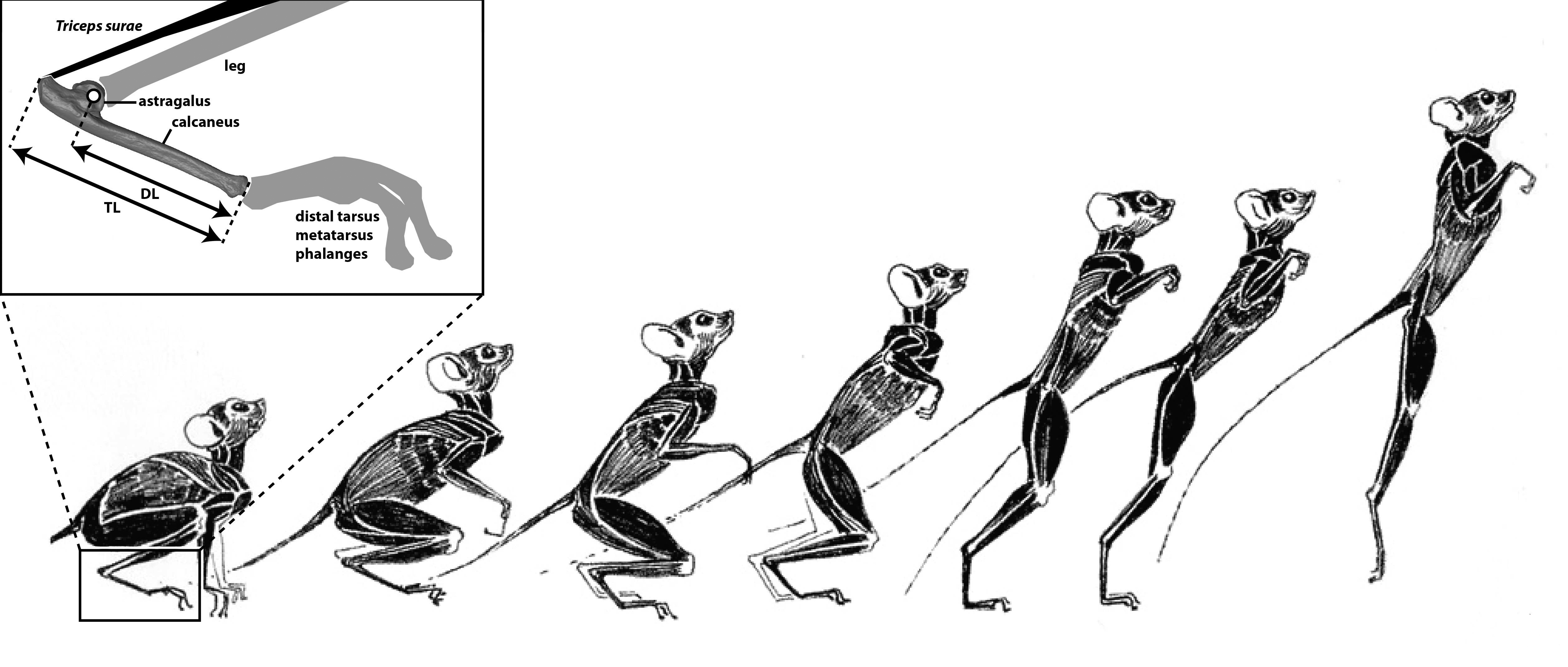
The ankle bone serves a fulcrum to launch leapers' into the air. The longer the lever, the better the jump, in most cases. Credit: Doug Boyer, Duke.

The ankle bone serves a fulcrum to launch leapers’ into the air. The longer the lever, the better the jump, in most cases. Credit: Doug Boyer, Duke.

This particular conclusion was not new. But the researchers’ approach — looking at incremental evolution — allowed them to see more of a change. “The earliest primates were already better leapers than their ancestors, and the data show their descendents became even better yet,” he explains.

The measurements also suggest that initial elongation of the bones for specialized leaping evolved two independent times in primates – once in lemur ancestors and once in the ancestor of tarsiers, monkeys, apes and other anthropoids like us.

The study didn’t directly address human leaping, and it doesn’t mean humans with longer ankles are better leapers. But, Boyer notes, it’s not out of the range of possibility.

Citation: “Evolution and allometry of calcaneal elongation in living and extinct primates.” Boyer, D. et al. July 3, 2013. PLoS ONE. doi: 10.1371/journal.pone.0067792

Grey Seal's Travels Hint at Animal's Unknown Habits

By Ashley Yeager

This juvenile male grey seal swam up onto a North Carolina beach recently, surprising locals. Image courtesy of: StarNews Online.

This juvenile male grey seal swam up onto a North Carolina beach recently, surprising locals. Image courtesy of: StarNews Online.

On May 23, visitors to Carolina Beach met an unexpected guest — a male grey seal.

The 300-plus-pound juvenile was somewhat of a surprise to North Carolinians, since his typical habitat ranges from the coastal waters of Canada and extend south to about New Jersey. It is the first time a grey seal has been seen as far south as the Carolinas.

But the seal’s southern swim wasn’t too surprising to Duke marine biologist Dave Johnston.

“Things have been weird with seals for the last ten years or so. We’ve been seeing more harp, hooded and grey seals much farther south, usually the males,” he says.

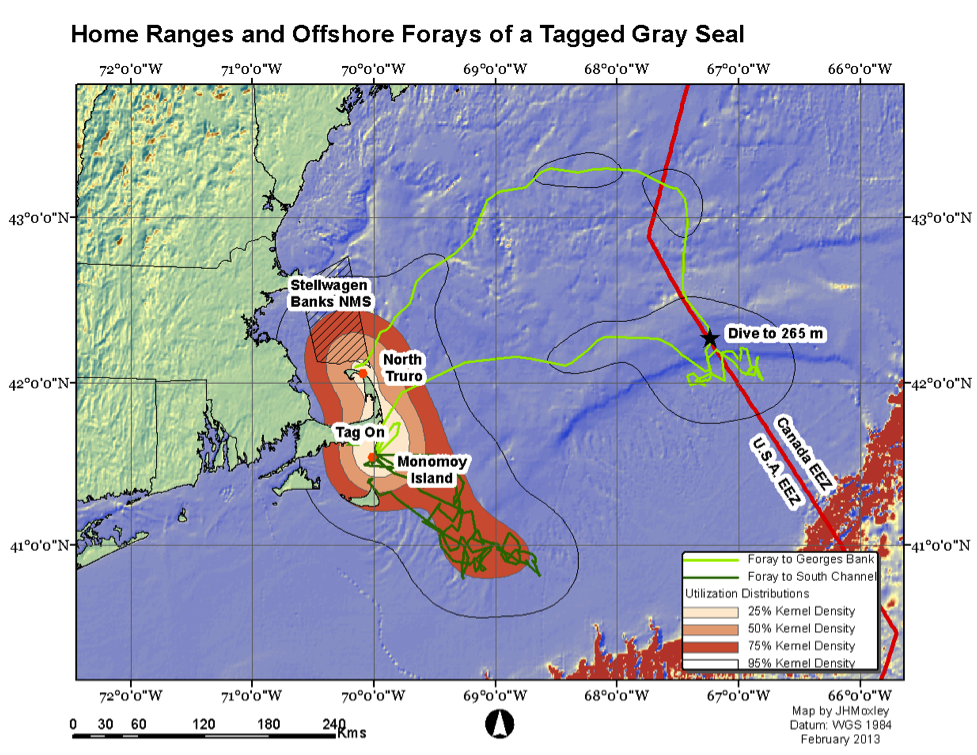
To track seals’ travel patterns, Johnston and his colleagues have started attaching cell-phone enabled GPS tags to the animals in the Cape Cod region. They tagged their first grey seal, Bronx, last summer and from his transmissions alone have learned where the creatures like to hang out, how deep they can dive and just how far they can swim.

Bronx has covered the equivalent of the land area of Massachusetts and Connecticut combined during his swims. He’s explored below the ocean depths nearly 900 feet — a little more than a tenth of a mile, and he’s even made an international trip, crossing into Canadian waters.

But Bronx swims mostly in the waters near Cape Cod and Nantucket Islands, Johnston says.

Grey seals like Bronx have had a rough history in the region. In the 1800s, humans hunted and killed the entire population living in the Gulf of Maine. For a long time, there were few or no sightings of the animals. But since 1972, grey seals have been protected under the Marine Mammal Protection Act and are now returning in larger numbers to the shores of what was once their native habitat.

This map shows where a GPS tagged seal, Bronx, has swum since last summer. Image courtesy of Dave Johnston, Duke.

This map shows where a GPS tagged seal, Bronx, has swum since last summer. Image courtesy of Dave Johnston, Duke.

Some Cape Cod locals aren’t too happy about that. The seals come ashore in large groups, disrupting beach access in certain areas, and they leave behind their waste. They get caught up with fishermen’s gear and try to steal their catch, and the seals aren’t the friendliest marine mammals.

“People like dolphins. They tend not to like seals as much,” Johnston says, explaining that grey seals are smart, excellent predators and can be aggressive towards humans. “They can be loud and obnoxious, and they will bite,” he says.

That’s a challenge for both the seals and residents of the Cape Cod.

Part of the tagging effort is to increase people’s understanding of how grey seals interact with the ocean environment surrounding Cape Cod, and it could possibly explain why some of the animals are swimming as far south as the Carolinas.

The team is heading to the Cape Cod in early June to attach tags to seven more grey seals. The goal is ultimately to use the tracking data to improve the relationship between humans and seals there, Johnston says.

Fossil Primate Director Becomes a Fossil Primate Himself

Gregg Gunnell directs the fossil primate division of the Duke Lemur Center.

Gregg Gunnell directs the fossil primate division of the Duke Lemur Center.

By Karl Leif Bates

A newly discovered 25 million-year-old monkey fossil has been named for Gregg Gunnell, director of the Duke Lemur Center’s Division of Fossil Primates.

The thing is, Nsungwepithecus gunnelli, might turn out to be a pig. “It might be a ‘porky-pithecus,’ ” Gunnell said with a laugh.  “Early monkeys and early pigs looked remarkably alike.”

The fossil, from southwestern Tanzania, consists of a single molar. But it displays nine characteristics that would distinguish it from other Old World monkeys, according to Nancy Stevens, a paleontologist at Ohio University in Athens, Ohio who was the lead author on a paper about the discovery in Nature.

Gunnell’s monkey was found at a site in the Rukwa Rift Basin along with another new monkey fossil, Rukwapithecus fleaglei, for which scientists have a jaw and three teeth.  It too has nine distinguishing features.

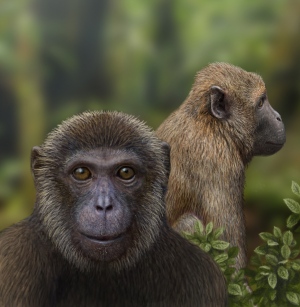
An artist's conception of the two newly named 25.2 million year old fossil monkeys described in Nature. (credit: Mauricio Anton)

An artist’s conception of the two newly named 25.2 million year old fossil monkeys described in Nature. Gregg Gunnell is the guy on the right. (credit: Mauricio Anton)

Gunnell said Stevens named the monkey after him to honor his role in helping her become a paleontologist. When Stevens was an undergraduate at Michigan State University, and Gunnell worked in the museum at the University of Michigan, he took Stevens and her now-husband and co-author Patrick O’Connor along on archaeological digs in Wyoming. Apparently the lessons stuck.

N. gunnelli is actually Gunnell’s third species. He was earlier honored by the naming of a bat and an extinct tillodont, which was, he reluctantly explains, a rather pig-like little animal.

“I’m hoping that this pig really is a monkey — that’ll improve my self-image,” he said.

Hope for Understanding Ourselves Goes to the Dogs

By Ashley Yeager

Brian Hare and Evan MacLean, co-directors of Duke's Canine Cognition Center, play with Lilu, a labradoodle. Credit: Ashley Yeager, Duke.

Brian Hare and Evan MacLean, co-directors of Duke’s Canine Cognition Center, play with Lilu, a labradoodle. Credit: Ashley Yeager, Duke.

Lilu, a beautiful brown poodle-labradoodle mix, couldn’t sit still. Scents of pizza and peanut butter dog treats and the sights of new people easily distracted her.

The ADD behavior could be one trait that made her fail out of service-dog training.

“Six out of every ten dogs wash out of service training. But it’s hard right now for scientists to understand why,” said Duke evolutionary anthropologist Evan MacLean, co-director of the university’s Canine Cognition Center.

He, along with biological anthropologist Brian Hare and geneticist Misha Angrist spoke about ‘Genes, Brains and Games’ in man’s best friend as part of the Science and Society Journal Club on April 26.

MacLean and Hare explained that dogs have taken on many jobs in human society, acting as everything from pets, to our eyes and ears to being like coal-mine canaries searching for hidden bombs and missing people.

“Dog vocations require different sets of cognitive skills,” MacLean said. He studies military dogs, looking for traits that make them more suited for service tasks than pets like Lilu.

MacLean would ultimately like to identify the genetic components that underlie the characteristics suited for each type of job that a dog might do.

Scientists are interested in correlating dogs’ cognitive traits to their associated genes because the animals are “the most exquisite example of artificial selection,” Angrist said.

In Portuguese water dogs, for example, just six substitutions in individual DNA bases of the dogs explain variations in body size. In humans, nearly every gene could factor into height. It’s the same challenge that makes understanding human cognition and intelligence difficult at the genetic level.

Of course, defining cognition and intelligence at the conceptual level isn’t so clear cut either. “It’s so hard for people, journalists and the general public, to understand multiple intelligences,” Hare said.

He explained that at a basic level, cognition is the ability to make inferences, and that when we think of intelligence we think of IQ and standardized tests. These tests, however, measure only one type of intelligence. They don’t measure the ability to empathize, to verbalize a new idea or to put two completely separate ideas together to form a new one, which are other, important facets of intelligence, or really multiple intelligences.

At the Canine Cognition Center, and through the citizen science website Dognition, Hare and MacLean use standardized tests to study the variation in dogs’ intelligence. The tests, unlike the SAT or ACT, “cast a wide net across skills sets dogs could use for different vocations,” Hare said.

Dogs like Lilu, he added, are “really the hope of the world” for understanding cognition.

Students Create Multimedia Ocean Conservation Text

By Ashley Yeager

This screenshot shows one of the opening page of of Johnston's new iBook. Image courtesy of Dave Johnston, Duke.

This screenshot shows one of the opening pages of a chapter in Johnston’s new iBook. Image courtesy of Dave Johnston, Duke.

Duke marine biologist Dave Johnston and his students are back in business on iTunes.

They’ve just released The View From Below, a free iBook for middle school students and teachers that uses multimedia and classroom exercises to discuss overfishing, marine debris, climate change, invasive species and other issues related to marine conservation.

This is Johnston’s second digital textbook. His first was Cachalot, an iPad textbook covering the latest science of marine mammals like whales, dolphins and seals. Experts contributed the text, images and open-access papers.

The View From Below, however, is a bit different.

Undergraduate students in Johnston’s Marine Conservation Service Learning class wrote the book using Apple’s iBooks authoring tool. Johnston and Tom Schultz, Director of the Marine Conservation Molecular Facility at Duke’s Marine Lab, edited it.

“There are a lot of people exploring the use of the iBooks platform for student-generated content, among other development platforms,” Johnston says. “I don’t think we’ve seen many that focus on marine science yet though, and I’m pretty sure it’s the first marine conservation textbook written by students on the iTunes store.”

Johnston says the class chose to use the iBooks software because the technology is free, easy to use and provides “great templates to get things going quickly.” The software also works well because Duke’s Marine Lab has an iPad loaner program, making the tablet the platform of choice for developing and testing the textbook.

The middle school that the service learning class works with also has access to iPads for students and instructors, so the audience was there for the iPad format, Johnston adds.

His students chose to write the book as the class project to spur learning and discussion about some of the most serious problems facing Earth’s oceans.

“As the text indicates, all life on earth is ultimately supported by the ocean, so we need to take care of it,” he says.

Activist targets inner child not 'target audience'

By Ashley Yeager

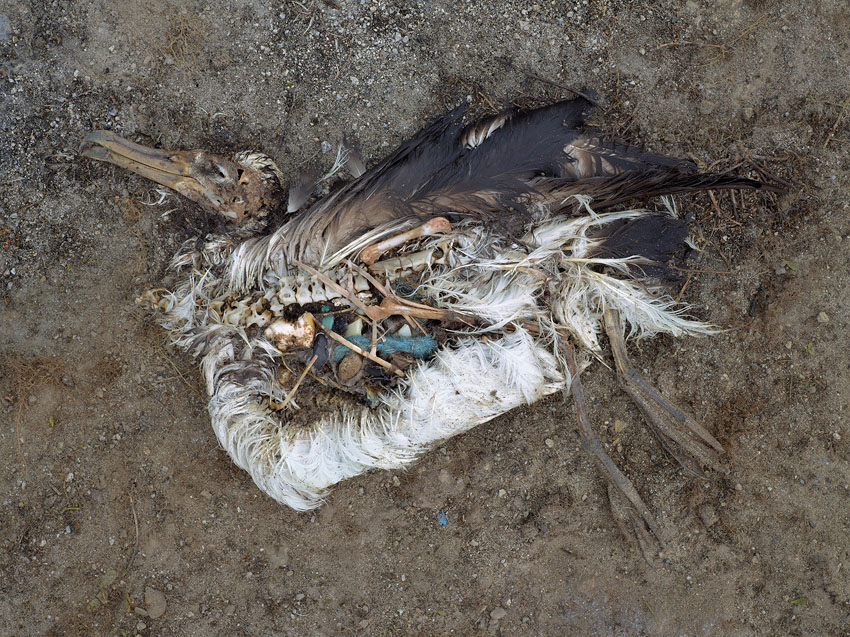
A baby albatross carcass full of plastic “food.” Credit: Chris Jordan.

When artist Chris Jordan works on a photograph or film, he doesn’t think about his audience. He said he thinks the phrase “target audience” is a disrespectful, manipulative business concept.

“I want to be as authentic as possible with my work,” Jordan said, explaining that each of his pieces instead taps into that “universality in us that we all carry, a deep appreciation for the abiding beauty of our world and the miracle of our own lives.”

An environmental activist as well as an artist, Jordan is challenging others to target that universality too as they convey messages about the issues that affect the planet.

Jordan spoke March 1 as part of a working group to discuss questions about how environmentalists, neuroscientists and artists can work together to better communicate about issues affecting the planet. The Nicholas School of the Environment and the Duke Institute for Brain Sciences sponsored the discussion.

Duke ecologist Nicole Heller moderated the discussion, opening it with the idea that scientists are frustrated with their inability to communicate with politicians and the public about the environment.

“In the ’70s, yucky or scary images might have worked, but now they don’t. That’s no longer appealing. We need different kinds of imagery to reach across people’s biases,” Heller said. She invited Jordan to speak because of his reputation for being able to move audiences from diverse backgrounds and education levels.

“Second graders are some of the most passionate and responsive to these issues,” Jordan said, adding that perhaps the best thing we can do is to appeal to an individual’s inner child – that curious spirit we have to understand how the world works.

One example of this approach is the film Jordan is working on to explore the mating dance of albatrosses on Midway Atoll in the Pacific Ocean. He’s photographed dead baby albatrosses, whose stomachs are full of plastic trash their parents fed to them because they mistake the plastic for food. The work was to make people aware of the plastic vortex, or Great Pacific Garbage Patch, swirling beyond the horizon and therefore beyond our conscious concern.

Jordan decided to capture the wonder of the albatrosses as they mate, rather than just their rotting carcasses, hoping to feed his audiences — no matter their background — with life, rather than depress them with death.

“Like the albatross, we first-world humans find ourselves lacking the ability to discern anymore what is nourishing from what is toxic to our lives and our spirits. Choked to death on our waste, the mythical albatross calls upon us to recognize that our greatest challenge lies not out there, but in here,” Jordan writes on his Web site.

What makes humans so unique?

By Pranali Dalvi
Human and chimpanzees are very similar genetically despite the stark differences in their outward appearances. So it must be just a very small portion of human genes that are responsible for everything from our upright posture to our ability to sing. What makes humans so unique?

On Jan. 14, Duke Professor of Biology Greg Wray spoke about his group’s work on the genetic and molecular processes that contribute to our uniquely human physiology and brains as a part of the Computational Biology and Bioinformatics Seminar Series.

“Humans are not the best model organisms since there is a limit to what you can do genetically and mentally. You can’t really make a human knockout (but sometimes, nature makes it for you),” Wray said.

Still, humans are immensely important to study for practical reasons. We have uniquely human courses of disease in part due to our physiological, cognitive, and mechanical properties. Also, we’re just intrinsically curious about our own bodies.

According to Wray, the answer to human uniqueness is our regulome, the genes, mRNAs, proteins, and metabolites that regulate which genes are turned on when.

This graph shows the two major shifts in diet (meat-rich diet and grain-based diet) that likely contributed to our divergence from chimpanzees and thus differential gene expression. Source: Greg Wray

One prevailing hypothesis is that human forerunners likely began diverging from chimps about 2 million years ago when we took on a meat-rich diet in the savannah. The ancestors of chimpanzees retreated to the rainforest to eat a diet consisting mostly of fruits. Our meat-rich diet seems to coincide with an increase in brain size. And today we metabolize fats much differently than chimpanzees.

Wray’s lab studied the effects of dietary changes on five tissue samples – the cerebral cortex and cerebellum of the brain, liver, fat, and skeletal muscle. What seems to have changed in chimps versus humans are genes related to neural functioning, development, and metabolism. For instance, 31 of 61 genes involved in insulin signaling are operated differently in chimps and humans. These differences in gene expression may also explain why humans are uniquely susceptible to diet-related illnesses like type II diabetes.

On the other hand, genes involved in the transcription, translation and replication of DNA, RNA processing and protein localization haven’t changed in chimps versus humans.

Fat cells also behave differently in humans versus chimps. Wray’s lab took adult stem cells from adipose tissue in both chimps and humans and challenged them with either more oleic acid (the main fatty acid in a meat-heavy diet) or more linoleic acid (the dominant fatty acid in a grain-based diet). The enzymes involved in fatty acid synthesis were more common in human adipose tissues. Wray believes that the increased fatty acid synthesis is probably responsible for building and fueling a larger human brain.

Another major shift in diet occurred during the agricultural revolution, which introduced omega-6 fatty acids into our diet along with pro-inflammatory compounds. Wray explains that the increase in grains from the shift in diet likely contributes to chronic pro-inflammatory diseases in humans, such as atherosclerosis.

“Understanding our metabolic history from an evolutionary context can potentially give us insight into some pretty prominent health concerns,” says Wray.

Grad Student Sees Yawning Gap in Animal Welfare

by Ashley Mooney

Sometimes a middle-school nickname becomes a career.

Graduate student Jingzhi Tan, yawned loudly during a quiet class in middle school in China, garnering the nickname Hippo. So now he’s at Duke, studying yawning behaviors in bonobos.

Jingzhi “Hippo” Tan is a graduate student working on bonobos’ love of strangers.

So-called ‘contagious yawning’ has been found in many species besides humans and other great apes, including baboons, monkeys and dogs. Tan found that bonobos are more likely to yawn along with strangers than they are to yawn with animals they already know. (They also prefer to share food with strangers first.)  In the future, he hopes to do a similar study with chimpanzees, but must first modify the structure of the experiment.

“The bonobo study that we just did is technically unethical to do with chimps—you can’t put two strange chimps together because they’re going to kill each other,” Tan said. “Later we’re trying to develop a task that is chimp-friendly and we’re going to use it for comparison between a variety of species.”

His studies on great apes, he said, will hopefully reveal more about the human mind and aid wildlife conservation efforts.

Tan noted that there is no better way of understanding the human mind than studying its evolution. Through his studies, Tan hopes to uncover the constraints of human problem-solving abilities, which will help solve problems relating to conservation.

“There is a gap between people who want to conserve nature versus people who are making decisions and policies. Usually what they do is alienate each other,” Tan said. “You can’t actually do something unless you really understand the mind of people.”

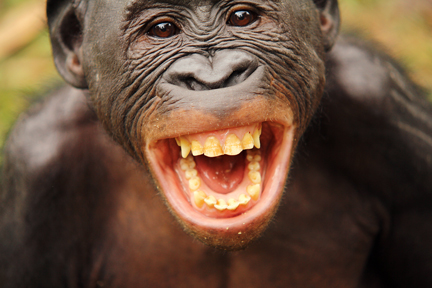
Likasi, a resident of the Lola ya Bonobo sanctuary in Kinshasa, where Hippo does his work. (Jingzhi Tan)

As an undergraduate at Peking University, Tan studied under the only cognitive evolution professor in all of China. He is now the first Chinese person to study great apes in Africa.

Tan said he is concerned that chimps are apparently being illegally exported to China, where they end up in the entertainment industry. Tan said there is one reality show that features three chimps—dressed in human clothes—choosing fruit at a supermarket. Another pair of infant chimps were forced into a fake wedding, complete with a wedding dress, and received national media attention.

China needs stronger animal welfare laws, Tan said. “Going back to the big picture, in the next decade, if you want to help bonobos in Africa or any other animals in Africa, we have to get China involved. Right now it’s just completely empty and blank.”

Page 16 of 19

Powered by WordPress & Theme by Anders Norén