Following the people and events that make up the research community at Duke

Students exploring the Innovation Co-Lab

Category: Animals Page 10 of 19

Lemur Poop Could Pinpoint Poaching Hotspots

DNA detective work aims to map the illegal pet lemur trade in Madagascar

Local business owners in Madagascar sometimes use ring-tailed lemurs to sell photo ops to tourists. Tourists visiting the country can easily support the illegal pet lemur trade unknowingly by paying to touch or have their picture taken with a lemur. Photo courtesy of the Pet Lemur Survey project (www.petlemur.com)

Businesses in Madagascar sometimes use ring-tailed lemurs to sell photo ops to tourists. Tourists visiting the country can easily support the illegal pet lemur trade unknowingly by paying to touch or have their picture taken with a lemur. Photo courtesy of the Pet Lemur Survey project (www.petlemur.com)

When Tara Clarke went to Madagascar this summer, she packed what you might expect for a trip to the tropics: sunscreen, bug spray. But when she returned seven weeks later, her carry-on luggage contained an unusual item: ten pounds of lemur droppings.

“That’s a lot of poop,” Clarke said.

A visiting assistant professor of evolutionary anthropology at Duke, Clarke and colleagues are analyzing DNA from lemur feces to pinpoint poaching hotspots in Madagascar’s pet lemur trade.

Pet lemurs are illegal in Madagascar, the only place on Earth where lemurs — the world’s most endangered primates — live in the wild.

More than 28,000 lemurs were taken from the wild and kept as pets on the island between 2010 and 2013 alone, surveys suggest.

Many pet lemurs are captured as babies, separated from their mothers and sold for less than two dollars apiece to hotels and restaurants to lure tourists, who pay to touch the animals and have their photo taken with them.

Anyone caught removing lemurs from the forest, selling them, or keeping them without a government permit can be fined and sentenced to up to two years in jail. But the laws are difficult to enforce, especially in remote villages, where rural poverty is common and law enforcement personnel may be few.

Clarke (left) and LaFleur (right) co-direct a nonprofit called Lemur Love that aims to protect ring-tailed lemurs and their habitat in southern Madagascar. Follow them at https://www.facebook.com/lemurloveinc/.

Primatologists Tara Clarke (left) and Marni LaFleur (right) co-direct a nonprofit called Lemur Love that aims to protect ring-tailed lemurs and their habitat in southern Madagascar. Follow them at https://www.facebook.com/lemurloveinc/.

In 2011, Malagasy officials began confiscating pet ring-tailed lemurs, the most popular species in the pet lemur trade, and handing them over to a non-governmental organization in southwestern Madagascar called Renalia, home of the Lemur Rescue Center.

About two dozen ring-tailed lemurs are currently being rehabilitated there in the hopes that many of them will one day be reintroduced to the wild.

But rounding up all the lemurs held illegally in private hands and taking them in would be nearly impossible, Clarke said. “There just isn’t a facility big enough, or the funding or the manpower.”

If we can figure out where the animals are being taken from the forest, Clarke said, we might be able to target those poaching hotspots and try to prevent them from becoming pets in the first place through education and outreach initiatives.

Ring-tailed lemurs live in southern Madagascar, an island nation off the coast of Africa. Map by Alex Dunkel.

Ring-tailed lemurs live in southern Madagascar, an island nation off the coast of Africa. Map by Alex Dunkel.

This summer, Clarke and biological anthropologist Marni LaFleur of the University of California, San Diego began collecting baseline samples of ring-tailed lemur poop from national parks and protected areas around southern and southwestern Madagascar, where ring-tailed lemurs live in the wild. They also collected samples from 19 ex-pets at the Lemur Rescue Center.

The samples are being shipped to the Primate Molecular Ecology Laboratory at Hunter College in New York for analysis.

There, with help from lab director Andrea Baden, the team will use DNA extracted from the wild samples to build a map of variation in ring-tailed lemur genes across their range.

By analyzing the DNA of the ex-pets housed at the Lemur Rescue Center and comparing it with their map, the researchers hope to pinpoint or rule out where the animals were first taken from the wild.

In addition to collecting feces, Clarke and LaFleur also worked with local guides to count ring-tailed lemurs in their natural habitat and estimate how many are left.

The pet trade isn’t the only threat to lemur survival. Over the past 40 years, logging, slash-and-burn agriculture, and charcoal production have reduced forest cover in southwestern Madagascar by nearly half.

“Their habitat is disappearing,” said Clarke, who has conducted field research in Madagascar since 2004.

Their 2016 census suggests that fewer than 2000 ring-tailed lemurs remain in the wild — a significant decline compared with the last census in 2000, when ring-tailed lemurs were estimated based on satellite images to number more than 750,000.

In every town the researchers visited they also passed out hundreds of posters about the illegal pet lemur trade as part of a nationwide education campaign called “Madagascar’s Treasure: Keeping Lemurs Wild,” which aims to raise interest in protecting the few wild populations that remain.

Lemur protection programs such as theirs can also benefit other threatened wildlife that share the lemurs’ forest habitat, such as the giant-striped mongoose and the radiated tortoise.

Keeping lemurs as pets isn’t unique to Madagascar. “There are thousands of lemurs in private hands in the U.S. too,” said Andrea Katz, curator at the Duke Lemur Center. Every year, the Duke Lemur Center gets phone calls from people in the U.S. looking for answers to questions about their pet lemurs’ health or behavioral problems.

“In some states it’s legal to have a pet lemur,” Clarke said. “You can find them online. You can find them in pet stores. A lot of times what happens is they reach sexual maturity and they get aggressive, and that’s when people call a zoo or a sanctuary.”

“Because you can see ring-tailed lemurs in zoos and movies people don’t think that they need our help. They don’t believe that they’re endangered. We’re trying to change that view,” Clarke said.

This research was supported by grants from the Margot Marsh Biodiversity Foundation and Conservation International’s Primate Action Fund.

These crowned lemurs are among more than 30 of the roughly 100 known lemur species in Madagascar that are affected by the pet lemur trade. Explore interactive data visualizations of pet lemur sightings in Madagascar by species, date and location at http://www.petlemur.com/data-visualization.html. Photo courtesy of the Pet Lemur Survey project (www.petlemur.com)

These crowned lemurs are among more than 30 of the roughly 100 known lemur species in Madagascar that are affected by the pet lemur trade. Explore interactive data visualizations of pet lemur sightings in Madagascar by species, date and location at http://www.petlemur.com/data-visualization.html. Photo courtesy of the Pet Lemur Survey project (www.petlemur.com)

Robin Smith


Post by Robin A. Smith

In Sync

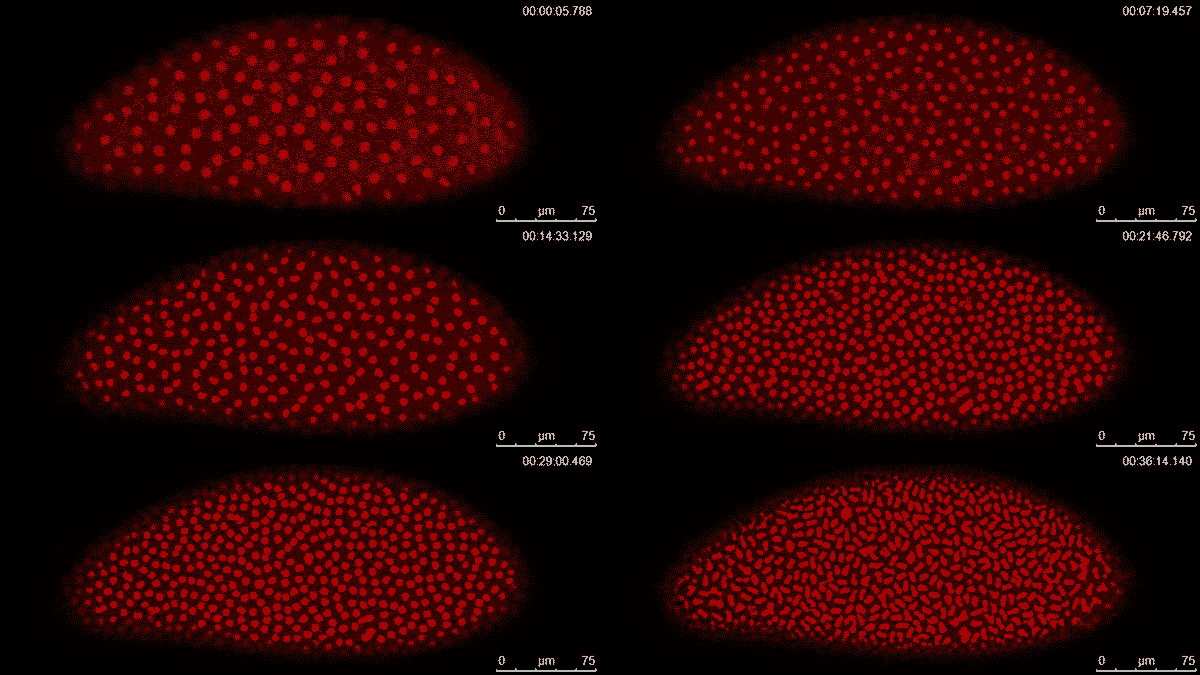
DiTalia2The dividing red spots in this time-lapse video belong to a busily developing fruit fly embryo. A fruit fly egg can divide into some 6,000 cells in just two hours —  faster division than cancer tumors. To watch them action, graduate student Victoria Deneke and assistant professor Stefano Di Talia tagged the nuclei with a protein that glows red. In a recent study, they show that the cells coordinate their rapid divisions via waves of protein activity that spread across the embryo. The waves help ensure that all the cells enter the next stage of development at the same time.

Duke graduate student Victoria Deneke has been awarded an international student research fellowship from the Howard Hughes Medical Institute.

Duke graduate student Victoria Deneke has been awarded an international student research fellowship from the Howard Hughes Medical Institute.

Starting September 2016, Deneke became one of 20 graduate students from 14 countries selected for an international student research fellowship from the Howard Hughes Medical Institute.

Three-year fellowship is designed to support outstanding international graduate students studying in the United States who are ineligible for fellowships or training grants through U.S. federal agencies.

Born in El Salvador, Deneke earned her undergraduate degree in chemical engineering from the University of Notre Dame before joining Stefano Di Talia’s at Duke in 2013.

Fellows must be nominated by their institution; participation is by invitation only. Deneke is only the second student at Duke to receive an HHMI International Student Research Fellowship since the program was established in 2011.

CITATION:  “Waves of Cdk1 Activity in S Phase Synchronize the Cell Cycle in Drosophila Embryos,” Victoria Deneke, Anna Melbinger, Massimo Vergassola and Stefano Di Talia. Developmental Cell, August 2016. http://dx.doi.org/10.1016/j.devcel.2016.07.023

Why Testing Lemur Color Vision is Harder Than it Looks

Elphaba the aye-aye is not an early riser. A nocturnal primate with oversized ears, bulging eyes and long, bony fingers, she looks like the bushy-tailed love child of a bat and an opossum.

She would much rather sleep in than participate in Duke alum Joe Sullivan’s early morning vision tests.

“I can’t blame her,” said Sullivan, who graduated from Duke in 2015.

Elphaba is one of 14 aye-ayes at the Duke Lemur Center in Durham, North Carolina, where researchers like Sullivan have been trying to figure out if these rare lemurs can tell certain colors apart, particularly at night when aye-ayes are most active. But as their experiments show, testing an aye-aye’s eyesight is easier said than done.

Elphaba the aye-aye takes a vision test at the Duke Lemur Center in Durham, North Carolina. She’s getting encouragement from student researcher Joe Sullivan and technician Jennifer Templeton. Photo by David Haring.

Elphaba the aye-aye takes a vision test at the Duke Lemur Center in Durham, North Carolina. She’s getting encouragement from student researcher Joe Sullivan and technician Jennifer Templeton. Photo by David Haring.

Aye-ayes don’t see colors as well as humans do. While we have genes for three types of color-sensing proteins in our eyes, aye-ayes and most other mammals have two, one tuned to blue-violet light and another that responds to green.

In all animals, the eyes’ color-detecting machinery depends on medium to bright light. In a version of “use it or lose it,” the genes responsible for color vision in some nocturnal species have decayed over time, such that they see the world in black and white.

But in aye-ayes, research shows, the genes for seeing colors remain intact, and scientists at Duke and elsewhere are trying to understand why.

One possibility is the aye-aye’s color vision genes are mere leftovers, relics passed down from daylight-loving ancestors and no longer useful to aye-ayes today.

Or, the genes may have been preserved because color vision gives aye-ayes an edge. Wild aye-ayes live by eating fruit, nuts, nectar and grubs in the rainforests of Madagascar. Wouldn’t an animal that could distinguish the blue fruits of a favorite snack like the Traveler’s palm from the green of the surrounding foliage have an advantage?

Understanding what aye-ayes can see is no easy feat. One of the most common tests for colorblindness, the Ishihara, requires the subject to recognize and identify numbers hidden within a patch of colored dots of different sizes and brightness.

Aye-ayes don’t read numbers, so Sullivan tests for color vision using food and colored cards.

The first tests were simple enough. In a dimly lit enclosure, a trainer held up two cards: a white card and a black one.

Each time the aye-ayes chose the white card over the black one by reaching out and touching it with their hand, the animal got a peanut.

Even animals with no color vision can tell white from black, so Sullivan was confident they’d ace the test. But aye-ayes aren’t programmed to please. Just getting them to sit still, instead of running around their enclosure, was a challenge.

One aye-aye, 29-year-old Ozma who was born in the wild in Madagascar, never got the hang of even the most basic task, a warmup involving a single white card.

“That’s when I realized that aye-ayes don’t always play by my rules,” said Sullivan, who started working at the Duke Lemur Center as an undergraduate research intern in 2012.

After four months and 200 trials, all five of the aye-ayes in Sullivan’s study started picking the white card more often than not, with Merlin, Elphaba and Grendel passing the test at least 70 percent of the time.

Norman and Ardrey tended to reach for the card on their left, no matter what the color.

Sullivan isn’t giving up. Still working at the Duke Lemur Center post-graduation, now he’s trying to see if aye-ayes can distinguish a purplish card from a green one, in brighter light more similar to dawn or dusk.

So far, Merlin and Grendel are getting it right just over half the time, leaving Sullivan still unsure if the aye-ayes are choosing the cards by their colors or by some other cue.

“I came in thinking that the aye-ayes were going to play nice and do everything I wanted. That was so wrong,” Sullivan said. “Still, they’ve been very good sports.”

How do you give a lemur a vision test? Photo by David Haring, Duke Lemur Center.

How do you give a lemur a vision test? Photo by David Haring, Duke Lemur Center.

Post by Robin A. Smith Robin Smith

3-D Movies of Life at Nanoscale Named Best Science Paper of the Year

If you’ve ever wanted to watch a killer T cell in action, or see human cancer make new cells up-close, now is your chance.

A collection of 3-D movies captured by Duke biology professor Dan Kiehart and colleagues has won the 2015 Newcomb Cleveland Prize for most outstanding paper in the journal Science.

The paper uses a new imaging technique called lattice light-sheet microscopy to make super high-resolution three-dimensional movies of living things ranging from single cells to developing worm and fly embryos.

https://www.youtube.com/watch?v=fwzIUnKNw0s

Cutting-edge microscopes available on many campuses today allow researchers to take one or two images a second. But the lattice light-sheet microscope, co-developed by 2014 Nobel Prize winner Eric Betzig, lets researchers take more than 50 images a second, and in the specimen’s natural state, without smooshing it under a cover slip.

You can watch slender antennae called filopodia extend from the surface of a human cancer cell, or tiny rods called microtubules, several thousand times finer than a human hair, growing and shrinking inside a slide mold.

Daniel Kiehart and former Duke postdoctoral fellow Serdar Tulu made a video of the back side of a fruit fly embryo during a crucial step in its development into a larva.

Chosen from among nominations submitted by readers of Science, the paper has been viewed more than 20,000 times since it was first published on October 24, 2014.

The award was announced on February 12, 2016, at an award ceremony held during the annual meeting of the American Association for the Advancement of Science (AAAS) in Washington, D.C.

Winners received a commemorative plaque and $25,000, to be shared among the paper’s lead authors Eric Betzig, Bi-Chang Chen, Wesley Legant and Kai Wang of Janelia Farm Research Campus.

Read more: “Lattice light-sheet microscopy: Imaging molecules to embryos at high spatiotemporal resolution,” Chen, B.-C., et al. Science, October 2014. DOI:10.1126/science.1257998


Post by Robin A. Smith Robin Smith


One Small Worm, One Duke Senior, and One Big Conference

Duke senior Grace Lim isn’t grossed out by the innards of the tiny worm C. elegans. In fact, she finds them beautiful.

As a researcher in the David Sherwood Lab, she peers inside the transparent 1-millimeter creature under a microscope, watching for “cell invasion” — a process that occurs when one type of cell literally bursts into an area occupied by another type of cell.

Version 2

Grace Lim presenting the results of her research at the AAAS Annual Meeting on Saturday.

Last weekend, the aspiring developmental biologist had the opportunity to take her work to the national stage when she presented at the Student Poster Competition as part of the annual AAAS meeting in Washington, D.C.

“It’s been really exciting,” said Lim. “The researchers here are experts and it is great to learn about their projects. At the same time, I’ve met scientists from all different fields who have asked questions and provided insights that I didn’t expect.”

Cell invasion plays a key role in organism growth and development, Lim said. For example, a fertilized egg will use cell invasion to implant itself into the uterine wall. However, cell invasion can also occur in less desirable processes, like cancer and other diseases.

In her work, Lim created C. elegans mutants that lacked specific genes related to cell invasion. She then observed whether uterine cells in the growing mutants could still invade tissue in the vulva — a key milestone in the growth of the developing larva.

C. elegans is a good system to study because it is transparent, so you can watch these biological processes happening under a microscope,” she said.

C_elegans

The tiny transparent C. elegans. Photo courtesy of the National Human Genome Research Institute

Her experiments uncovered four new genes that appear to regulate cell invasion in C. elegans. In addition to presenting at the conference, Lim will also be writing up these results as an honors thesis.

Lim, who wants to pursue a graduate degree in biology after finishing up at Duke, says her favorite part of working in the Sherwood lab has been interacting with the graduate students. “We work together to come up with creative ways to solve problems, which is something you don’t always get to do in class,” she said.

And her favorite part of working with C. elegans?

“They have this amazing ability to control their metabolism,” she said. “We grow these worms in petri dishes, and when the plate fills up and they run of out food, they just stop growing. But if you take a few and put them on a new plate they grow again, as if nothing had happened.”

Post by Kara Manke

Kara J. Manke, PhD

A Dead Parrot? Not Yet. But It Could Sure Use Your Help

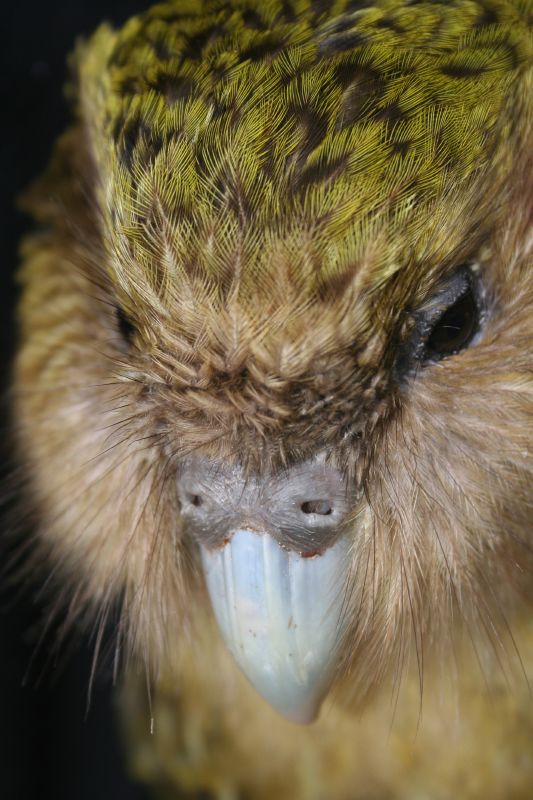
An international team of gene sequencing scientists, including some at Duke, want to sequence the genomes of all living kakapo — a critically endangered flightless parrot of New Zealand – while there are still 125 of them left in the world.

Kakapo (Strigops_habroptilus)

A one-year-old Kakapo named Pura on Codfish Island in 2005, by Mnolf, via Wikimedia Commons.

This is the first project aiming to sequence every member of a given species. The scientists and their collaborators are hoping the public can help through a crowd-funding effort. They hope to raise $45,000 US and are a little more than halfway there. With just 2 and a half months left, you can help write the end to this story.

Four years ago, Duke research specialist Jason Howard picked up a children’s book from the library to read to his 6-year-old daughter. It was about the kakapo (Strigops habroptilus), a flightless, nocturnal parrot that smells like honey.

Howard works in the Duke lab of neurobiologist Erich Jarvis, a Howard Hughes Medical Investigator who is co-leading a massive, ongoing effort to sequence the genomes of all 10,000 bird species. So, Howard’s library book pick was not exactly random. (In fact, he was sequencing the parakeet genome at the time.)

This sweet face belongs to Felix the Kakapo, photographed in 2006 by Brent Barrett (originally posted to Flikr - via Wikimedia Commons)

This sweet face belongs to Felix the Kakapo, photographed in 2006 by Brent Barrett (originally posted to Flikr – via Wikimedia Commons)

But as Howard read about efforts to save this beloved — and rapidly aging — bird population, he asked his daughter whether she thought he should make the kakapo’s genome a priority. (To which she said, “Yes, daddy, do it!”)

Howard was able to obtain a DNA sample from the kakapo, a feat in itself, and get a rough draft of the sequence. “But the sequencing technology [three years ago] wasn’t as good then and it was a lot more expensive,” he said.

He wanted to get a higher quality genome and study genomes of individuals, in part because there are so few kakapo left. Because this bird is among the most ancient species of parrot, it would also give Jarvis’s lab a better understanding of the evolution of vocal learning and speech imitation, where many of their studies focus.

Advances in genome sequencing even in the past year have already answered the group’s wish for a more-detailed kakapo genome. Jarvis’s lab completed the genome of a kakapo named Jane; their so-called ‘reference’ genome will allow them to more simply and inexpensively piece together the sequences of other individual kakapo. They just needed the funds to do more.

As luck would have it, molecular ecologist Bruce Robertson, an associate professor at the University of Otago, Andrew Digby of the New Zealand Department of Conservation and David Iorns of the Genetic Rescue Foundation approached Howard, while he was working on Jane’s genome, about funding and crowdsourcing a project to sequence all of the remaining kakapo. “I had never dreamed of doing all 125,” Howard said.

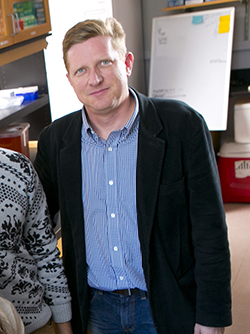
Jason Howard Duke

Jason Howard

Conservation efforts that started in the 1980s have already employed breeding strategies to boost dwindling population, but with individual genomes in hand, the group will be able to understand which kakapo harbor genetic susceptibility to specific diseases and to more effectively breed them to produce offspring with more robust immune systems. (One day, scientists might even be able to modify disease-vulnerable genes using gene-editing technology.) The genomes will also allow them to investigate any genetic causes of low fertility in these birds, which mate only intermittently.

Kakapo currently reside in the wild on just two of New Zealand’s small islands, because human-introduced predators, including cats and dogs, ran them off the mainland.

Kakapo Recovery has access to museum samples of deceased birds from areas where they are now extinct, including some from nearly 200 years ago. If the project is well-funded, they can tap into these museum specimens to get a better understanding of the various island populations and possible clues about their demise.

As of February 15, the team’s crowdfunding effort has reached more than 150 backers, but they would like to see more make a donation. To learn more about kakapo, check out Kakapo Recovery and Genetic Rescue Foundation.

Please stick around and watch a male Kakapo named Scirocco acting inappropriately as Stephen Fry narrates. (BBC-TV)

[youtube https://www.youtube.com/watch?v=9T1vfsHYiKY]


KellyRae_Chi_100Post by Kelly Rae Chi

Middle Schoolers Ask: What's it Like to be a Scientist?

PostdocsWhen a group of local middle schoolers asked four Duke postdocs what it’s like to be a scientist, the answers they got surprised them.

For toxicologist Laura Maurer, it means finding out if the tiny silver particles used to keep socks and running shirts from getting smelly might be harmful to your health.

For physics researcher Andres Aragoneses, it means using lasers to stop hackers and make telecommunications more secure.

And for evolutionary anthropologist Noah Snyder-Mackler, it means handling a lot of monkey poop.

The end result is a series of short video interviews filmed and edited by 5th-8th graders in Durham, North Carolina. Read more about the project and the people behind it at http://sites.duke.edu/pdocs/, or watch the videos below:

Five Duke Papers Crack the Altmetric 100

The numbers are in, and five papers with Duke authors cracked the Top 100 Altmetric scores for 2015.

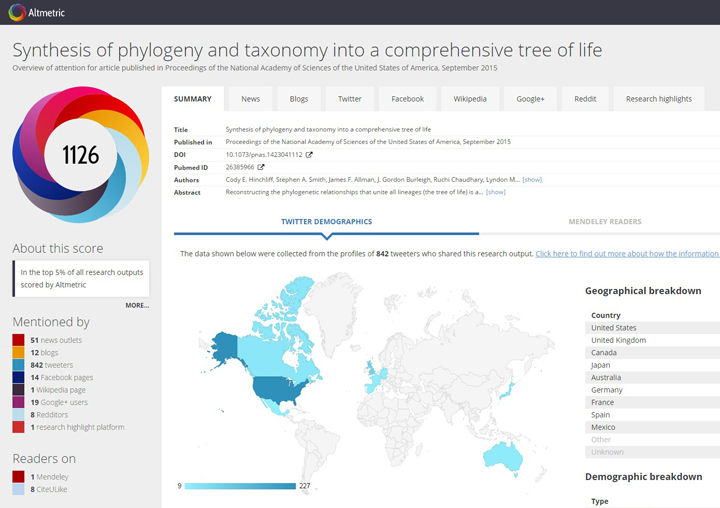
Example of an Altmetric analysis.

Example of an Altmetric analysis.

Yeah, it all seems a little gimmicky and meta, but the scores can be useful. Altmetric (to which Duke has an institutional membership) combines multiple counts of news stories, social media chatter and professional citations on an academic paper to give it a single score. Obviously, the system’s greatest strength is comparing this to other Altmetric scores, but it’s actually a lot of fun.

Duke’s biggest score – a very impressive Altmetric 2294 – came in at #5 on the list. “Estimating the reproducibility of psychological science” attracted a lot of attention in Science, spawning 74 news stories and nearly 2,000 tweets. Postdoctoral researcher Nina Strohminger of the Kenan Institute for Ethics is one of the authors from 125 institutions on the paper that suggests psychology has some housekeeping to do.

At number 28 with an Altmetric of 1,279, came “Global, regional and national incidence, prevalence, and years lived with disability for 301 acute and chronic diseases and injuries in 188 countries, 1990-2013 (here comes the colon!): a systematic analysis for the Global Burden of Disease Study 2013.” This Lancet paper, backed by the Bill and Melinda Gates Foundation, is every bit as massive and important as its title. Among its thousands of authors is our own Terrie Moffitt. It garnered 39 news stories and 1400 tweets and has already been incorporated into nine Wikipedia entries.

A companion paper with another big title for another big study, “Global, regional, and national age-sex specific all-cause and cause-specific mortality for 240 causes of death, 1990-2013: a systematic analysis for the Global Burden of Disease Study 2013,” came in at #36 on the list with an Altmetric of 1180. Its authors might be jealous of #28, but it’s mostly the same folks! Eighty people saw fit to post this one on Facebook and 60 on Google+.

Two papers out of the now-defunct NSF think-tank the National Evolutionary Synthesis Center (NESCent) rounded out our top 100 at #72 and #87.

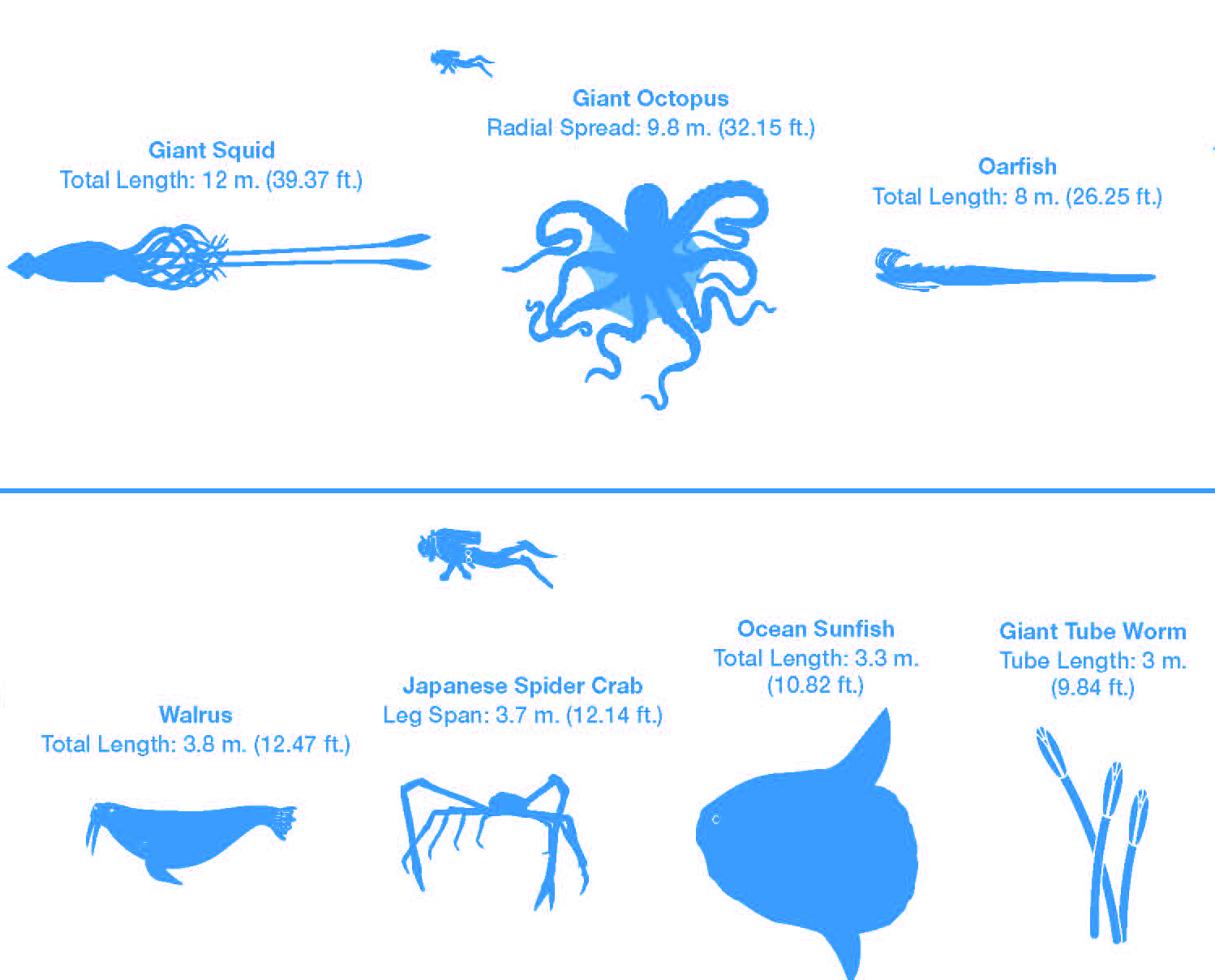
What are the largest ocean giants?

What are the largest ocean giants?

Craig McClain of NESCent and Duke Biology led “Sizing Ocean Giants,” an analysis that tries to get the right dimensions on a bunch of intimidating ocean creatures including the giant clam and the colossal squid (which turns out to be only a third the size of the less impressively named giant squid). The paper’s Altmetric of 954 was led by 24 news stories, 24 blog posts and almost 900 tweets. McClain also leads a very popular marine science blog “Deep Sea News” which probably aided the story’s social presence.

Number 87 was “Synthesis of phylogeny and taxonomy into a comprehensive tree of life,” which included Karen Cranston of NESCent and Duke Biology. This hugely ambitious effort to draw a tree of life for the whole planet at once earned an Altmetric of 895 by garnering 21 news stories, 12 blogs and nearly 900 tweets. And it too has been incorporated into Wikimedia – once so far.

It’s a brave new world out there in academic publishing.

Karl Leif Bates

Post by Karl Leif Bates


Dam Good Research on Invasive Beavers in Patagonia

gp-AlejandroPietrek-1

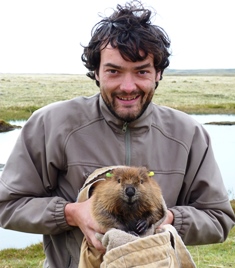
Alejandro Pietrek and a subject of his research. Photo by Duke Forward.


For three years, Duke student Alejandro Pietrek has bravely grappled with some unusual marauders of the forests and steppes of Patagonia: invasive beavers. A biology graduate student, Pietrek recently presented his dissertation on the “Demography of invasive beavers in the heterogeneous landscapes of Patagonia.” Pietrek has studied over two dozen colonies of beavers in order to answer three questions:

  • “How do differences between habitats affect the demography of invaders?”
  • “How does density dependence affect the abundance and distribution of invaders post-establishment?”
  • “How can we manage biological invasions?”

Pietrek began by explaining how the furry rodents started ravaging the natural habitat of Patagonia, beginning with 20 beavers intentionally introduced into the forests of Tierra del Fuego in 1946. By the late 1960s, the growing colonies spread to the continent.

Today there are an estimated 100,000 individuals in Patagonia, disrupting the regional habitats and destroying biodiversity.

The biologist tackled his first question via quantitative science. “Very simply mathematical models have shown that speed of invasion is determined by two main things: population growth rate and movement,” he said. How the different habitats of Patagonia affected this invasion was what he worked to find out, by measuring colony size and the number of kits. Pietrek directly observed 25 colonies in each habitat over three years, using binoculars and seemingly endless patience. “It was very fun,” he said. He found that steppe habitats tended to have higher numbers of beavers and kits compared to forest.

Beaver Dam - Tierra del Fuego National Park, Argentina - Photograph by Anne Dirkse via Wikimedia Commons

Beaver Dam – Tierra del Fuego National Park, Argentina – Photograph by Anne Dirkse via Wikimedia Commons

Pietrek believed that the answer to the first question was counterintuitive, and he explored the possible reason in the second, where he figured the cause to be density dependence, as beavers in the steppe were more likely to survive in higher populations, and thus were dependent on living in large colonies for survival. In the forest, colony size wasn’t as important to the survival of the beavers. Pietrek found that as population density increased, the animals’ choice of landform changed: with denser numbers, the beavers were more likely to choose u-shaped valleys and plains than canyons. He noted the importance of identifying the preferred habitat of beavers, as it may allow easier detection of the presence of the invasive species.

Finally, Pietrek applied his findings toward the management of biological invasions. “One thing we can do is to build a model to predict the spread of beavers,” he said. He observed that beavers spread on average 7.8 km per year, though he also used individual-based models as well in order to track juvenile beavers. He found that young beavers tended to disperse and form new colonies, and formed another model in order to track this dispersal pattern. Juvenile beavers will first search for mates within their original colonies, only moving along if none can be found. These findings make for easier tracking of beavers across the landscape, allowing for easier management of their population growth.

2015-09-03 17.36.37 


Post by Devin Nieusma, Duke 2019

Science a waste of money? “Wastebook” misses big picture

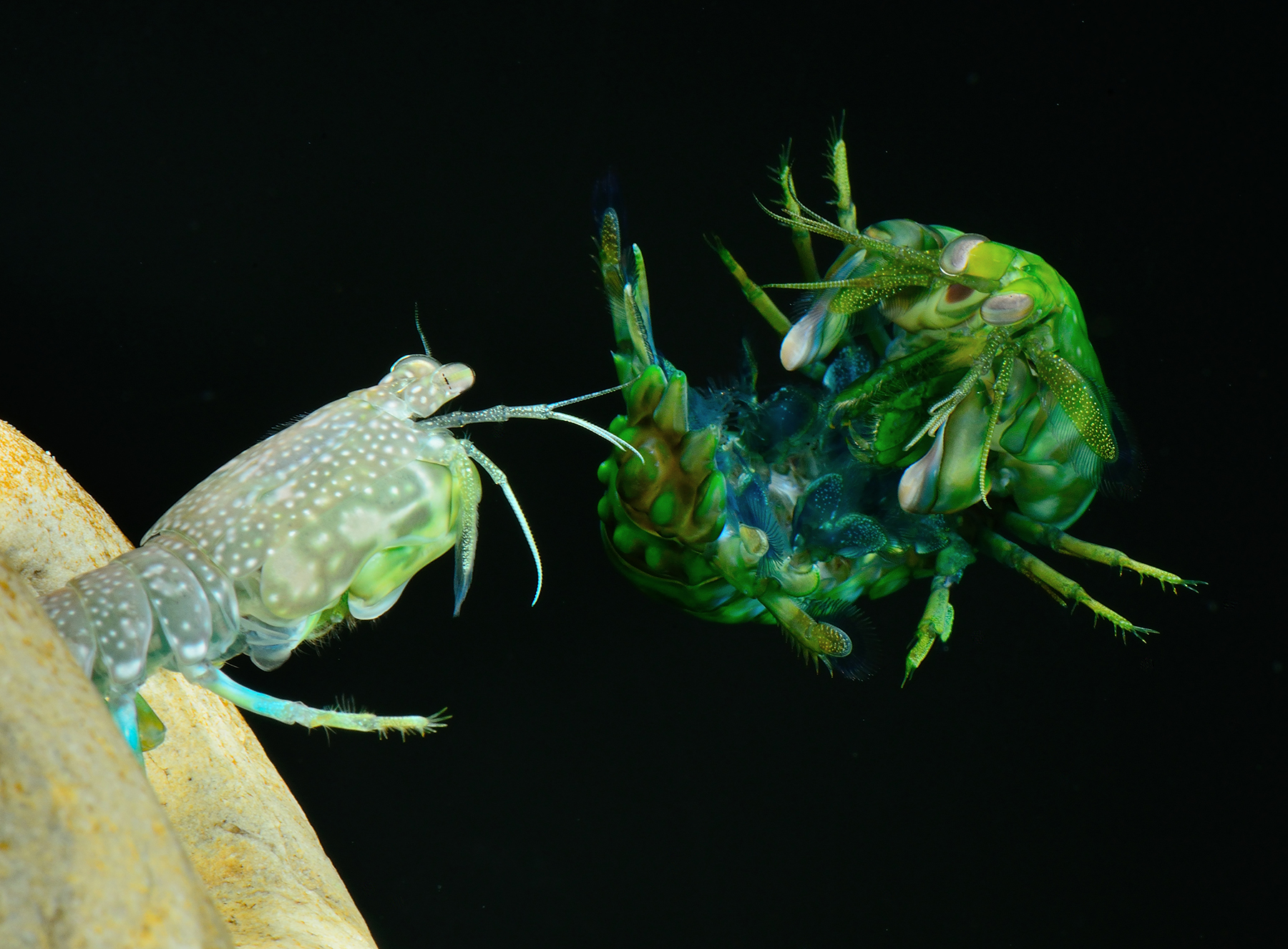
Duke biologist Sheila Patek explains the big picture behind a recent study on sparring mantis shrimp. Photograph by Roy Caldwell.

Duke biologist Sheila Patek explains the big picture behind a recent study on sparring mantis shrimp. Photograph by Roy Caldwell.

Sheep in microgravity. An experiment involving a monkey in a hamster ball on treadmill. These are among more than 100 descriptions of what Senator Jeff Flake, Republican of Arizona, deems wasteful federal spending in “Wastebook: The Farce Awakens,” released on Tuesday, Dec. 8. The latest in a series originally launched by retired Senator Tom Coburn, each “Wastebook” targets a range of federally-funded projects, many of them science-related, which the authors declare a waste of taxpayers’ money.

But what do the researchers behind these projects have to say? We asked Duke biologist Sheila Patek, whose work on fighting mantis shrimp was singled out in Flake’s latest report, to tell us her side of the story:

“What do we stand to learn from basic research on mantis shrimp? It turns out, a lot,” Patek said.

“First, mantis shrimp strike with weapons operating at the same acceleration as a bullet in the muzzle of a gun, yet they achieve high performance without explosive materials. They use a system based on muscles, springs and latches and neutralize their opponents with impact-resistant armor. This research helps us understand how animals survive when they have lethal weapons at their disposal but do not actually kill the opponent — something that could change the way we look at future defense systems,” Patek said.

“Second, these crustaceans have properties of extreme acceleration that are of great interest to military and manufacturing engineers. Mantis shrimp use a toothpick-sized hammer that can break snail shells in water that humans can only break with a larger hammer in air. Their small, lightweight hammer resists fracture over thousands of uses. Our research has already led to the development of novel engineered materials that resist impact fracture, based directly on mantis shrimp hammers,” Patek said.

“Third, mantis shrimp do something else that humans cannot: strike in water at the speed of cars on a major highway without causing cavitation, a phenomenon that occurs in systems with rapid motion (like propellers) where implosive bubbles emit heat, light and sound with energy sufficient to wear away steel. Naval engineers have been trying to solve this problem since the invention of the submarine. When we understand how mantis shrimp avoid cavitation during the rotation phase of their strikes while effectively using cavitation during their impact phase, the knowledge will undoubtedly improve the capabilities of ships, submarines, torpedoes and other machines,” Patek said.

“Research that helps us understand and apply the mechanics and evolutionary diversity of natural systems to create a better and safer society for all of us is a wise investment for this country.”

RobinSmith_hed100Post by Robin A. Smith, Senior Science Writer

Page 10 of 19

Powered by WordPress & Theme by Anders Norén