Research Blog

Following the people and events that make up the research community at Duke

Students exploring the Innovation Co-Lab

Beauty is in the Ear of the Beholder Too

Just the suggestion that an African-American person is of mixed-race heritage makes that person more attractive to others, research from Duke University concludes.

Reece_imageThis holds true even if the people in question aren’t actually of multiracial heritage, according to the peer-reviewed study, published in the June 2016 issue of Review of Black Political Economy.

The simple perception of exoticism sways people to see multiracial blacks as better-looking, says study author Robert L. Reece, a doctoral candidate in sociology at Duke.

“Being exotic is a compelling idea,” Reece says. “So people are attracted to a certain type of difference. It’s also partially just racism – the notion that black people are less attractive, so being partially not-black makes you more attractive.”

Reece used data from the National Longitudinal Study of Adolescent Health. He examined the results of in-person interviews of 3,200 black people conducted by people of varying races. The interviewees were asked a series of questions that included their racial backgrounds. The questioners then ranked each person’s attractiveness on a scale of 1 to 5, with 1 being the least attractive and 5 being the most attractive. The interviewees who identified as mixed race were given an average attractiveness rating of 3.74; those who identified as black were given a 3.47 score – a statistically significant difference that points to the power of perception, Reece says. (The study controlled for a number of factors such as gender, age, skin tone, hair color and eye color)

“Race is more than we think it is,” he says. “It’s more than physical characteristics and ancestry and social class. The idea that you’re a certain race shapes how people view you.”

And attractiveness matters. Previous research has drawn correlations between physical beauty and professional success.

Robert Reece is a doctoral candidate in sociology at Duke.

Robert Reece is a doctoral candidate in sociology at Duke.

Reece’s findings bolster a viewpoint that lighter-skinned blacks are considered more physically striking than their darker-skinned counterparts. But his research also found that blacks with darker skin who identified as mixed-race were considered better looking than those with lighter skin who identified simply as black. This further emphasizes the power of suggestion, Reece says; being told a person is of mixed race – regardless of what that person looks like – makes them appear more attractive.

“It’s a loaded cognitive suggestion when you say ‘I’m not just black, I’m also Native American, for example,” Reece says. “It changes the entire dynamic.”

Reece tackled this topic to examine the connection between multiraciality and “color,” he says.

“People tend to assume that historical multiraciality is at least partially responsible for the broad range of color among black people,” he says. “I’ve even noticed some people in black communities casually using the terms “mixed” and “light skinned” interchangeably. So I wanted to begin an empirical investigation into the contemporary links between the two and how they combine to shape people’s life experiences. Attractiveness is one part of that.”

Ferreri_100Guest post by Eric Ferreri

Taking Math Beyond the Blackboard

https://youtu.be/cZVxTeUeez8

Most days, math graduate student Veronica Ciocanel spends her time modeling how frog eggs go from jelly-like blobs to tiny tadpoles having a well-defined front and back, top and bottom. But for a week this summer, she used some of the same mathematical tools from her Ph.D. research at Brown to help a manufacturing company brainstorm better ways to filter nasty-smelling pollutants from industrial exhaust fumes.

Math professor Ryan Pellico of Trinity College took a similar leap. Most of his research aims to model suspension bridges that twist and bounce to the point of collapse. But he spent a week trying to help a defense and energy startup devise better ways to detect landmines using ground-penetrating radar.

Ciocanel and Pellico are among more than 85 people from across the U.S., Canada and the U.K. who met at Duke University June 13-17 for a five-day problem-solving workshop for mathematicians, scientists and engineers from industry and academia.

The concept got its start at Oxford University in 1968 and has convened 32 times. Now the Mathematical Problems in Industry workshop (MPI) takes place every summer at a different university around the U.S. This is the first time Duke has hosted the event.

The participants’ first task was to make sense of the problems presented by the companies and identify areas where math, modeling or computer simulation might help.

One healthcare services startup, for example, was developing a smartphone app to help asthma sufferers and their doctors monitor symptoms and decide when patients should come in for care. But the company needed additional modeling and machine learning expertise to perfect their product.

Another company wanted to improve the marketing software they use to schedule TV ads. Using a technique called integer programming, their goal was to ensure that advertisers reach their target audiences and stay within budget, while also maximizing revenue for the networks selling the ad time.

“Once we understood what the company really cared about, we had to translate that into a math problem,” said University of South Carolina graduate student Erik Palmer. “The first day was really about listening and letting the industry partner lead.”

Mathematicians Chris Breward of the University of Oxford and Sean Bohun of the University of Ontario Institute of Technology were among more than 80 people who met at Duke in June for a week-long problem-solving workshop for scientists and engineers from industry and academia.

Mathematicians Chris Breward of the University of Oxford and Sean Bohun of the University of Ontario Institute of Technology were among more than 80 people who met at Duke in June for a week-long problem solving workshop for scientists and engineers from industry and academia.

For the rest of the week, the participants broke up into teams and fanned out into classrooms scattered throughout the math and physics building, one classroom for each problem. There they worked for the next several days, armed with little more than caffeine and WiFi.

In one room, a dozen or so faculty and students sat in a circle of desks in deep concentration, intently poring over their laptops and programming in silence.

Another team paced amidst a jumble of power cords and coffee cups, peppering their industry partner with questions and furiously scribbling ideas on a whiteboard.

“Invariably we write down things that turn out later in the week to be completely wrong, because that’s the way mathematical modeling works,” said University of Oxford math professor Chris Breward, who has participated in the workshop for more than two decades. “During the rest of the week we refine the models, build on them, correct them.”

Working side by side for five days, often late into the night, was intense.

“It’s about learning to work with people in a group on math and coding, which are usually things you do by yourself,” Ciocanel said.

“By the end of the week you’re drained,” said math graduate student Ann Marie Weideman of the University of Maryland, Baltimore County.

For Weideman, one of the draws of the workshop was the fresh input of new ideas. “Everyone comes from different universities, so you get outside of your bubble,” she said.

“Here people have tons of different approaches to problems, even for things like dealing with missing data, that I never would have thought of,” Weideman added. “If I don’t know something I just turn to the person next to me and say, ‘hey, do you know how to do this?’ We’ve been able to work through problems that I never could have solved on my own in a week’s worth of time.”

Supported by funding from the National Science Foundation and the industry partners, the workshop attracts a wide range of people from math, statistics, biostatistics, data science, computer science and engineering.

monday_groupMore than 50 graduate students participated in this year’s event. For them, one of the most powerful parts of the workshop was discovering that the specialized training they received in graduate school could be applied to other areas, ranging from finance and forensics to computer animation and nanotechnology.

“It’s really cool to find out that you have some skills that are valuable to people who are not mathematicians,” Pellico said. “We have some results that will hopefully be of value to the company.”

On the last day of the workshop, someone from each group presented their results to their company partner and discussed possible future directions.

The participants rarely produce tidy solutions or solve all the problems in a week. But they often uncover new avenues that might be worth exploring, and point to new approaches to try and questions to ask.

“We got lots of new ideas,” said industry representative Marco Montes de Oca, whose company participated in the MPI workshop for the second time this year. “This allows us to look at our problems with new eyes.”

Next year’s MPI workshop will be held at the New Jersey Institute of Technology in Newark.

Robin SmithPost by Robin A. Smith

Fledgling Physicists Embark for the LHC

For physics student Hannah Glaser, taking off for a summer of hands-on research at the world’s largest particle collider is both exciting and terrifying.

But, Glaser says, joining the thousands of scientist at work at the Large Hadron Collider (LHC) also feels a lot like going home.

“It’s such a huge relief to finally be in a group of people who who are interested in the same exact kind of problems that you are,” said Glaser, a rising junior at Virginia Tech. “It really is just this ridiculous nerdy feeling when you finally meet a group of people who have the same obsession with math and science.”

LHC_Students-1

Undergraduate physicists embarking for a summer at the LHC, posed in front of a map of CERN and neighboring town St. Genis hand-drawn by physics professor Al Goshaw. From left: Wei Tang (Duke), Ifeanyi Achu (Southern Methodist University), Spencer Griswold (Clarkson University), Elisa Zhang (Duke), Emily Stump (Williams College) and Hannah Glaser (Virginia Tech).

Glaser is among six undergraduates — two from Duke and four from other institutions — who will be working alongside Duke scientists at the LHC’s ATLAS experiment this summer. Each will tackle a bite-sized piece of the immense particle physics project, primarily by helping to analyze the massive amounts of data generated by the collider.

“Just going to CERN will be a mind-blowing experience,” said Ifeanyi Achu, a junior at Southern Methodist University, at an orientation event at Duke last week. “I’m looking forward to getting a window into what life could be like as a physics researcher.”

Before setting off for CERN, the group spent the month of June with other REU students on Duke’s campus, learning the basics of quantum mechanics and Root, a software platform used CERN and other particle accelerators around the world.

In addition to grappling with complex physics, the students also had to prepare for the more practical aspects of spending six weeks abroad – like the fact that they will be living in the French town of St. Genis while working in Switzerland, requiring that they regularly cross the border and navigate among two or more currencies and languages.

However, the thrill of spending time with some of the world’s biggest experiments should make the travel anxiety worth it.

ATLAS

Duke student Wei Tang hopes to get a picture with a giant LHC detector while working at CERN this summer. (Credit: CERN)

“I’m definitely looking forward to taking a picture with a giant detector,” said Wei Tang, a Duke junior majoring in physics and computer science.

As members of the ATLAS experiment, The Duke high-energy physics team hopes to spot particles or forces not predicted by the Standard Model of physics, the theoretical framework that currently forms the basis of our physical understanding of the universe. New particles or forces could provide clues to solving some of the mysteries that remain in physics, such as what is the nature of dark matter.

“This is probably the most exciting year for the LHC,” said Duke physicist Al Goshaw, who will be onsite advising the students for part of the summer. “Data taken in this run really offers an extraordinary opportunity to look for physics beyond the standard model because it is the first time the LHC is operating at its full potential. It really could be the discovery run, and we are excited to be involved in that.”

But even if new discoveries aren’t made this summer, the students are still thrilled to be a part of the experiment.

“To know that you have done just a tiny bit of science at CERN – it’s just a dream come true for anyone interested in particle physics,” Glaser said.

Kara J. Manke, PhD

Post by Kara Manke

Cracking a Hit-and-Run Whodunit — With Lasers

The scratch was deep, two feet long, and spattered with paint flecks. Another vehicle had clearly grazed the side of Duke graduate student Jin Yu’s silver Honda Accord.

But the culprit had left no note, no phone number, and no insurance information.

Pump-Probe-Microscope-Pigment

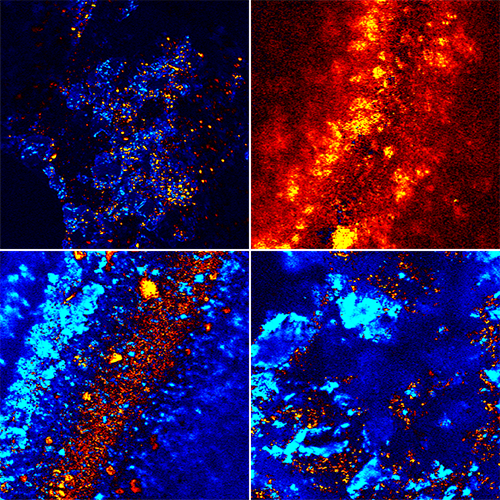
Duke graduate student Jin Yu used laser-based imaging to confirm the source of a large scratch on the side of her car. Paint samples from an undamaged area on her Honda Accord (top left) and a suspected vehicle (top right) gave her the unique pump-probe microscopy signatures of the pigments on each car. The damaged areas of the Honda (bottom left) and the suspected vehicle on right (bottom right) show pigment signatures from both vehicles.

The timing of the accident, the location of the scratch, and the color of the foreign paint all pointed to a likely suspect: another vehicle in her apartment complex parking lot, also sporting a fresh gash.

She had a solid lead, but Yu wasn’t quite satisfied. The chemistry student wanted to make sure her case was rock-solid.

“I wanted to show them some scientific evidence,” Yu said.

And lucky for her, she had just the tools to do that.

As a researcher in the Warren Warren lab, Yu spends her days as scientific sleuth, investigating how a laser-based tool called pump-probe microscopy can be used to differentiate between individual pigments of paint, even if they appear identical to the human eye.

The team is developing the technique as a way for art historians and conservators peer under the surface of priceless paintings, without causing damage to the artwork. But Yu thought there was no reason the technique couldn’t be used for forensics, too.

“The idea popped into my mind — car paint is made up of pigments, just like paintings,” Yu said. “So, if I can compare the pigments remaining on my car with the suspected car, and they match up, that would be a pretty nice clue for finding the suspected car.”

Using a clean set of eyebrow tweezers, Yu carefully gathered small flecks of paint from her car and from the suspected vehicle and sealed them up inside individual Ziploc bags. She collected samples both from the scratched up areas, where the paint was mixed, and from undamaged areas on both cars.

She left a note on the car, citing the preliminary evidence and stating her plan to test the paint samples. Then, back at the lab, she examined all four samples with the pump-probe microscope. Unlike a standard optical microscope, this device illuminates each sample with a precisely timed series of laser pulses; each pigment absorbs and then re-emits this laser light in a slightly different pattern depending on its chemical structure, creating a unique signature.

Optical-Microscope-and-Note

After finding the gash on her Accord (top left), Yu left a note (top right) on the car that she suspected of having caused the accident. Under an optical microscope, samples from damaged areas on the cars show evidence of the same two kinds of paint (bottom). Yu used pump-probe microscopy to confirm that the pigments in the paint samples matched.

The samples from the undamaged areas gave her the characteristic pigment signatures from both of the two vehicles.

She then looked at the paint samples taken from the scratched areas. She found clear evidence of paint pigment from the suspected car on her Honda, and clear evidence of paint pigment from her Honda on the suspected car. This was like DNA evidence, of the automotive variety.

Fortunately, the owner of the suspect vehicle contacted Yu to confess and pay to have her car fixed, without demanding the results of the paint analysis. “But it was reassuring to have some scientific evidence in case she denied the accident,” Yu said.

Yu says she had no interest in forensic science when she started the investigation, but the experience has certainly piqued her curiosity.

“I had never imagined that I can use pump-probe microscopy for forensic science before this car accident happened,” Yu said. “But I think it shows some interesting possibilities.”

Kara J. Manke, PhD

Post by Kara Manke

LHC Reboot Promises Piles of New Data for Duke Physicists

Undeterred by a recent weasel incursion, CERN announced last week that the Large Hadron Collider (LHC) is back up and running for the 2016 season, smashing protons together at nearly the speed of light and creating exotic forms of matter in the debris.

Back at Duke, students and professors collaborating on LHC’s ATLAS experiment are eager to see if the 2016 run provides any hint of surprising new physics.

“It’s a really exciting time,” said Duke graduate student Douglas Davis. “Hopefully something comes out of this new data that we aren’t expecting.”

ATLAS_VP1_event_display_stable_beam_run297041_evt59057181_2016-04-24T05-41-50

CERN’s Large Hadron Collider (LHC) creates exotic forms of matter by smashing together protons that are traveling at nearly the speed of light. This image depicts a collision detected by the LHC’s ATLAS Experiment, which Duke physicists collaborate on, during beam commissioning in April. (Credit: CERN)

Since the early 1970s, physicists have relied on the Standard Model of physics to explain all the most basic bits of matter in the universe and the forces through which they interact. And it has performed remarkably well at describing all of the curious new particles the LHC has created, from the magnificent Higgs Boson to that quirky pentaquark spotted last year.

But the Standard Model can’t quite explain everything. For instance, it cannot reconcile gravity – the force whose existence we verify every time we knock over a coffee mug or drop a pen – or dark matter, which physicists know exists from observations of twisted galaxies in the cosmos.

Med_ATLAS_VP1_event_display_first_stable_beam_collisions_13TeV_many-vertices_run296942_evt34013839_2016-04-23T10-51-30_v4

One of the early proton-proton collisions with recorded by ATLAS on 23 April 2016. The picture shows the very inner core of the ATLAS detector where the two beams of proton bunches from the LHC collide . In this event the colliding protons give birth to ten primary interactions, shown in white. The reconstructed tracks of the particles produced in those interactions are drawn in yellow. (Credit: CERN)

During the upcoming run, the Large Hadron Collider will be operating at its full design capacity, smashing proton bunches at energies of  13 TeV (trillion electron-volts), which is almost twice the collision energy it was capable of during the 2009 to 2013 “Run 1” that discovered the Higgs.

For the 2016 re-boot, they have also increased the “luminosity” of the beams, narrowing the size of the proton bunches to boost the number of collisions per pass by five or six times – resulting in five to six times more data.

To a particle physicist, more energy and more data means a better chance of finding anomalies in the Standard Model that could lend credence to alternate theories, like supersymmetry or string theory, or point in an entirely new direction all together.

“Anything that is even a hint of something new or non-expected these days gets everyone abuzz.” said Davis. “Everyone is waiting on pins and needles for something to happen.”

Most of the excitement in the physics world is currently over a “bump” at 750 GeV observed during the 2015 run. If confirmed, this signal could mean the discovery of a completely new particle that is six times heavier than the Higgs. But, it could also just be a statistical fluctuation.

“There is a huge amount of excitement now because soon after start-up in a few months, we should be able to determine whether that bump is real or not,” said physics Professor Mark Kruse, who leads Duke’s ATLAS team. “I’m right on the fence for whether it could be real or not real, but would probably bet that it’s not. It certainly doesn’t belong to the standard model, but unfortunately it also doesn’t fit very nicely into any of the favored contenders to replace the standard model.”

Med_JiveXML_296942_34013839-YX-RZ-RZ-2016-04-26-22-18-43

A view of the proton collision debris field looking down the beam line (left) and from the side of the beam line (bottom right). On the top right, a zoomed-in view of the proton interaction region, showing the locations where they collide (white squares) and the reconstructed tracks. (Credit: CERN)

The Duke team won’t be focusing all its energy there. Kruse says they have researchers working on a wide variety of projects, from searching for new dark matter candidates to closely analyzing rare Standard Model events.

Davis plans to employ an analysis technique called AIDA, originally developed by Kruse, his advisor, and Kruse’s first graduate student, Sebastian Carron. Davis will use the technique to search for anomalies in a rare Standard Model process that produces two top quarks along with a Z or W boson.

And even if everything works out just as the Standard Model predicts, Davis still thinks the fact that we can collect this data at all is still pretty impressive.

“It may seem kind of boring to see everything work exactly as the Standard Model says it should, but at the same time it’s like – man, this was written down in the seventies and they probably would never have dreamed of being able to observe all this,” said Davis. “But so far, it works perfectly.”

Kara J. Manke, PhD

Post by Kara Manke

Turning Duke Experiences into Science Fair Gold

Do we each have our own story about science fair? Mine is about that time my grandpa and I set fire to my parents’ garage while testing out the new corn stove we had built together. We were looking into cleaner fuels. It was a small fire, easily squelched, fortunately.

Katherine Yang presenting her poster

Katherine Yang presenting her poster

But in the rite of passage that is the science fair, two Duke-mentored high schoolers are not embarking on half-baked projects with non-scientific relatives like mine, but are instead blazing new trails in science with all of the high-end equipment and faculty mentoring that Duke has to offer.

Katherine Yang and Alisa Cui, of the North Carolina School of Science and Mathematics in Durham, are presenting their results in Phoenix this week in Intel’s International Science and Engineering Fair (ISEF), a prestigious annual science fair that convenes 1,700 of the best and brightest STEM students from around the world

Working in Qiu Wang’s group, Yang has discovered a potential new drug to treat cancer, focusing on a protein targeted called CARM1, which is known to cause breast and prostate cancers to grow uncontrollably.

Yang’s new molecule blocks CARM1. What’s more, in the process of narrowing her list of five candidates, she developed a new cell-based test that can inform the development of future screening tools for other CARM1 inhibitors.

Cui has worked in Jorg Grandl’s lab on the mechanism by which a family of proteins called Piezo ion channels allow cells to detect mechanical touch and eventually become desensitized to repeated stimulation and shut off. By recording the electrical activity of cells that express one type of Piezo, Cui determined that the channels do not use a particular type of shutdown mechanism that researchers had previously thought. Now, the group will move on to test another major mechanism.

NCSSM_Alisa Cui

Alisa Cui and her award-winning project.

On Friday, it was announced that Alisa had won a fourth place grand award in Cellular and Molecular Biology, which includes a $500 prize.

“I am very impressed by the impact Alisa made,” said Grandl, who is a member of the Duke Institute for Brain Sciences. “The data she collected helped starting a completely new line of research,” in understanding how these channels deal with repeated stimulations, such as vibrations.

Growing up, I was oblivious to the existence of international science fairs but my own experiences ignited a lifelong love for science. I can only hope that these young ladies felt something similar.

KellyRae_Chi_100Guest Post by Kelly Rae Chi

Sandcastles of Stars Make Stable Structures

Sandcastles are not known for their structural stability; even the most steadfast seaside fortresses won’t survive a crashing wave or a bully’s kick.

But what if, instead of round grains of sand, you built your castle from tiny stars?

Duke graduate student Yuchen Zhao tests the stability of a tower made from six-armed stars or “hexapods.”

Duke graduate student Yuchen Zhao has spent the last year studying such “sandcastles of stars” — towers crafted from hundreds of six-armed stars or “hexapods” which bear a remarkable resemblance to the jacks you might have played with as a kid.

To build these towers, Zhao simply pours the stars into a hollow tube, and then removes the tube. But unlike columns of sand, these towers stand on their own, stay up when shaken, and can even bear up to twice their own weight.

“When you remove the support, you see that the star particles have really jammed together!” said Zhao. “Nobody understands exactly how this rigidity comes about.”

Sand is a classic example of a granular material, and like other types of granular materials — rice, flour, marbles, or even bags of jacks — it sometimes pours like a liquid, and other times “jams” up, forming a rigid solid.

The physics of jamming has been well-studied for round and spherical particles, says Duke physics professor Bob Behringer, an expert on granular materials who advises Zhao. But much less is understood about jamming in particles with more complex shapes, like hexapods.

“As soon as you move away from spheres, you can create jammed systems at the drop of a hat,” said Behringer. “People think they understand these systems, but there are still a lot of outstanding questions about how they behave: how do they break? Or how do they respond to shear stress?”

These questions aren’t only interesting to physicists, Behringer says. Architects Karola Dierichs and Achim Menges, collaborators on the project, are experimenting with using custom-designed granular materials, from hexapods to hooks, to create structures like walls and bridges.

Similar to a sandcastle or a bird’s nest, structures made this way can be porous, light, recyclable and even adaptable.

“One of their big ideas is, can you actually design a structure that could build itself or be constructed at random, rather than designing something very precise?” said Zhao.

Zhaos says that the first goal of his project was simply to explore the physical limits of towers built from hexapods. To do so, he constructed towers out stars ranging in size from 2 to 10 centimeters and made from two different materials. For each combination, he investigated how high he could build the tower before it collapsed. He then subjected the towers to various stressors, including vibration, tilting, and added weight.

One of the most surprising findings, Zhao said, was that the friction between the particles — whether they were made of smooth acrylic or rougher nylon — had the biggest impact on the stability of the towers. He also noted that when these towers collapse, they don’t just fall over in a heap, they fall apart in a series of mini avalanches.

CT-Scan of jacks

A 3D illustration of a tower of stars reconstructed from CT-scan data. The red dots indicate the points of contact between the stars. Image courtesy of Jonathan Barés.

The team has published this initial study, which they hope will be used as a “handbook of mechanical rules” to improve the design of aggregate structures, in a special edition of the journal Granular Matter.

As a next step in the experiment, Zhao and collaborator Jonathan Barés are using a CT scanner in the Duke SMIF lab to take detailed 3D pictures of the “skeletons” of these structures. With the data, they hope to find a better understanding of how all the individual contacts between stars add up to a stable tower.

“It is amazing to see how these particles can make stable structures capable of supporting big loads,” said Jonathan Barés, who is a former Duke postdoc. “Just changing a small property of the particles — their ability to interlock — creates a dramatic change in the behavior of the system.”

CITATION: “Packings of 3D stars: stability and structure.” Yuchen Zhao, Kevin Liu, Matthew Zheng, Jonathan Barés, Karola Dietrichs, Achim Menges, and Robert P. Behringer. Granular Matter, April 11, 2016. DOI: 10.1007/s10035-016-0606-4

Kara J. Manke, PhD

Post by Kara Manke

Post-Game Roundup from the Brain Teaser Bowl

Duke claims another top ten finish in North America’s most prestigious math competition

DURHAM, N.C. — The Blue Devils may have lost in the Sweet 16 during March Madness 2016, but a Duke team crushed more than 500 other schools in the NCAA tournament of the math world, known by mathletes as the Putnam, claiming a top ten finish for the 22nd time since 1990.

Left to right, Trung Can, Feng Gui, Professor David Kraines, Tony Qiao and Alex Milu are pictured in front of the Math/Physics Building. Can, Gui, Qiao and Milu are the top four Duke finishers in the annual Putnam Competition. Their combined rankings carried Duke to a tenth place finish overall. Photo by Megan Mendenhall, Duke Photography.

Left to right, Trung Can, Feng Gui, Professor David Kraines, Tony Qiao and Alex Milu are pictured in front of the Math/Physics Building. Can, Gui, Qiao and Milu are the top four Duke finishers in the annual Putnam Competition. Their combined rankings carried Duke to a tenth place finish overall. Photo by Megan Mendenhall, Duke Photography.

Alex Milu ’16, Tony Qiao ’17, Trung Can ’18 and Feng Gui ’18 scored higher than 90 percent of the 4,275 undergraduates who competed in this year’s event. More than a dozen other Duke students also competed in this year’s contest. The results of the 76th annual competition were announced this month.

Named after an 1882 Harvard graduate, the William Lowell Putnam Mathematical Competition is the most prestigious college-level math contest you have probably never heard of.

Every year on the first Saturday in December, thousands of students from across the U.S. and Canada compete in a grueling six-hour exam to see who can be the Steph Curry of math.

Contestants in the annual Putnam Competition have six hours to solve 12 problems.

Contestants in the annual Putnam Competition have six hours to solve 12 problems.

Armed with nothing more than pencil and paper, their task is to solve 12 brain bending math problems. No laptops, no course notes.

“These are not problems that textbook learning will help you much with,” said associate professor of mathematics David Kraines, who has coached Duke’s Putnam teams for much of the past 25 years.

“Knowing anything beyond calculus or linear algebra is really not a help,” Kraines said. Instead, coming up with solutions requires an “ability to think abstractly and outside the box.”

“We have A+ students who don’t do well at all in this competition, and others who don’t get great grades for one reason or another, and who become Putnam stars,” Kraines said.

“You have to think more creatively than you do in class,” said Feng Gui, who finished among the top 8 percent and competed in similar competitions as a high school student in China.

One question gave the sequence of numbers 6,16,27,36…, and asked the competitor to prove or disprove that there is some number in the sequence whose base 10 representation ends with 2015.

“Most of the questions don’t have numerical answers,” Kraines said. “They say ‘prove this,’ or ‘show that.’ To do well you have to justify your solution mathematically.”

A perfect score on the 12-question test is 120 points, but the grading is so tough that almost two thirds of this year’s Putnam contestants got zero points. Only one in five contestants correctly solved even one problem.

“It was a little tougher than usual,” said Alex Milu of Bucharest, Romania, a Karsh Scholar who took the Putnam for the fourth time this year and was named Honorable Mention for scoring in the top two percent, or 54th out of 4,275 students.

Calculators wouldn't have been much help in tackling the test questions from this year's Putnam Competition.

Calculators wouldn’t have been much help in tackling the test questions from this year’s Putnam Competition.

For Trung Can, a former gold medalist from Vietnam in the annual International Math Olympiad (IMO), the world math championship for high schoolers, math competitions like the Putnam are an opportunity to “meet people who share the same passion. Those friendships can last a lifetime,” said Can, who will help lead a training camp for high school students in Vietnam this July.

The Blue Devils competed sporadically in the Putnam in the 1970s and 80s, but Duke’s first top ten win was in 1990, when a three-person Duke team finished in second place behind Harvard.

That year, Kraines persuaded the department to start offering a half-credit problem-solving seminar in the fall to prepare students for the competition. Each week they focus on a different topic. One week it might be number theory, the next week geometry or combinatorics the week after that. “We entice them with pizza,” Kraines said.

Around the same time, Duke also started making a concerted effort to attract top math students the same way college sports recruiters attract basketball stars.

“I was able to get on the scholarship committee and we started actively recruiting,” Kraines said. “It worked. We got some fantastic kids.”

What followed was a 15-year run of near-continuous top three finishes. Since 1990, Duke Putnam teams have ranked No. 1 in North America three times, No. 2 twice, and No. 3 six times.

Duke’s Putnam champs don’t burn benches to mark major victories, but they do celebrate in other ways.

Hanging proudly in the math department lounge are some of the retired jerseys of the five Duke students who have placed among the top five highest-ranking individual finishers, known as “Putnam Fellows,” a distinction shared by several Fields Medal winners and Nobel laureates in physics.

The No. 2 jersey of 2002 Putnam winner Melanie Wood is among them, a reminder of the last time a Duke student finished among the top five individual spots.

A scrapbook in Kraines’ office contains dozens of newspaper clippings and other keepsakes from Duke’s earliest wins, including a congratulatory letter from former NC Governor Jim Hunt.

Kraines plans to retire from teaching next year after 45 years at Duke, but this won’t be his last Putnam. “It’s been a very good experience. I don’t plan to leave,” Kraines said.


Post by Robin A. Smith Robin Smith


Curiosity Takes Center Stage at Visible Thinking 2016

Whether traipsing through the Duke Forest in search of a specific species of moss, using tiny scissors to dismember fruit fly larvae, or spicing up learning styles with celebrity memes and puppies, the quest for knowledge has led Duke students to some interesting pastimes.

Students

Inquisitive students shared their research stories with peers at Visible Thinking 2016

On April 20, those inquisitive students and their faculty mentors gathered to share their stories at Visible Thinking 2016, the annual poster session showcasing undergraduate research from across Duke’s campus.

More than 130 presentations extended to all three floors of the Fitzpatrick/CIEMAS Atrium and featured research subjects spanning from monkey flowers and color-changing chemicals to cardinal numbers and the death of Odysseus.

“As researchers, we are all working on problems that we find fascinating,” said Nina Sherwood, associate professor of the practice in the biology department and advisor to two of the student presenters. “There’s an appeal to seeing others get bitten by the same research bug and feeling that same excitement!”

Atrium

Over 130 posters lined all three levels of the Fitzpatrick/CIEMAS atrium during Visible Thinking on Wednesday.

Duke junior Ben Brissette’s passion to help people with mental and physical disabilities couldn’t be contained in just one project, so he did two.

The neuroscience major split his time between Sherwood’s biology lab, where he bred fruit flies and dissected their babies in search of nervous system abnormalities, and the library, where he surveyed recent literature on special education reform.

Brissette said the two approaches – one quantitative and reductionist, the other qualitative and complex – gave him a more nuanced perspective on the issue of disability.

And he had to learn to take each at its own pace.

“With a literature review, if you want to read for forty hours straight you can,” he said. “But if you are working with flies, you abide by their schedule.”

Brissette wasn’t the only student pulling double duty on Wednesday. Junior Logan Beyer bounced between two posters as well; one on her psychology research, examining differences the brain’s response to noise in typical children and children with autism spectrum disorder, and the other on her work with the Thompson Writing Program, designing a website to help students with learning disabilities tackle the writing process.

DSC_0753

Two students ponder a research question during a quiet moment at the event.

Junior Abi Amadin became curious about her research subject while entering data for a large survey on stress as part of her work study position in the Department of Community and Family Medicine. What caught her eye was a measure called the household Confusion, Hubbub, and Order Scale CHAOS. Chaos in the home is a factor that can negatively impact childhood development.

So Amadin asked if she could analyze some of the data for herself, and found some interesting results: in the families surveyed, household measured chaos was correlated not with income or the number of people in a household, as expected, but with the number of children in the household.

“It was interesting to see the process that you go through in research – first posing a question, and then figuring out how to analyze it.” said Amadin. “I definitely learned a lot.”

According to Sherwood, students aren’t the only ones who learn from the experience.

“Undergraduates researchers are great because they bring fresh eyes and a fresh outlook,” Sherwood said. “From them we get some questions that are naïve, and others that are quite profound, but both force us to think and talk about our work in a bigger context.”

Kara J. Manke, PhD

Post by Kara Manke

Ghost Hunters: Duke Physicists Track the Changeable Neutrino

One kilometer below the surface of Mount Ikeno in Japan lies Super-Kamiokande, the largest neutrino detector of its kind in the world. This 12-story, cylindrical chamber holds 50,000 tons of water and is lined with over 11,000 tubes that spot the bursts of light emitted when high-energy neutrinos collide with matter.

Nearly 20 years ago, experiments at Super-K and elsewhere revealed that neutrinos can oscillate or change “flavor,” a discovery which proved that the ghostly particles have mass and upended their role in the Standard Model of physics. Since then, Duke physicists Kate Scholberg and Chris Walter have used the massive detector to further explore the nature of these neutrino oscillations, seeking to pin down how and when they change their flavors and what this might mean for our understanding of physics.

SuperK

Within the massive Super-Kamiokande neutrino experiment in Japan, researchers travel by boat to check individual photomultiplier tubes that detect bursts of light created when neutrinos interact with water. Credit: Kamioka Observatory, Institute for Cosmic Ray Research, The University of Tokyo.

On Wednesday, Scholberg and Walter, along with Duke neutrino physicist Phillip S. Barbeau, will tell the story of neutrino oscillations in a talk titled, “Hunting Ghosts, How a 50,000-ton underground detector revealed the changeable nature of the neutrino and altered our view of the Universe,” presented as part of the Natural sciences in the 21st century colloquium.

In preparation for the talk, Scholberg spoke with colloquium organizer Rotem Ben-Shachar about the nature of neutrinos, what makes them so hard to catch, and what they have teach us about the origins of matter in our universe.

What is a neutrino?

Neutrinos, sometimes known as “ghost particles,” are among the known “elementary” particles: unlike atoms, they are not made up of anything smaller. Neutrinos are special because they are neutral, meaning they have no electric charge, and they interact extremely weakly with matter. They also have very tiny masses: a neutrino has no more than about 1/500,000 the mass of an electron. Because of their tiny masses, neutrinos travel at speeds close to the speed of light. Neutrinos come in three “flavors”: electron, muon and tau.

Why are neutrinos so hard to catch?

Neutrinos only interact only via the weak force — this is one of the four known forces, the others being gravity, electromagnetism, and the strong force which holds atomic nuclei together.  As you might guess from the name, the weak force is really feeble, and that means that neutrinos hardly ever interact with matter at all.  Mostly they just pass right through things without leaving any trace. Once in a while, they do interact, leaving a charged particle that you can detect. In order to “catch” a neutrino — to detect the interaction — you need either a huge number of neutrinos, or an enormous detector, or preferably both. For example, Super-Kamiokande is gigantic, but we see only about ten high-energy neutrinos per day in the detector.  On the surface of the Earth, cosmic radiation can easily swamp a signal this slight, so neutrino detectors are often built underground where they are shielded from cosmic radiation.

When we can catch a neutrino, what do we learn from it?

dukebanner

Duke scientists suspended inside the Super-K detector.

Particle physicists like us try to understand the basic nature of matter and energy: our goal is to learn what the universe is made of, and how its constituents interact with one another. We’re also interested in cosmology — the history and evolution of the entire universe. It’s essential to understand the fundamental physics in order to understand what happened after the Big Bang, and why the universe looks as it does today. For instance, nobody understands why the universe is made primarily of matter and not antimatter, which has properties very much like matter, but with opposite charge. The study of neutrinos can give insight into many questions like this one.

What specifically we learn with a neutrino detector depends on the source of neutrino, the type of neutrino, and how far the neutrinos travel.  For instance, at Super-K we can detect neutrinos that come from collisions of cosmic rays, high energy particles from outer space, with the upper atmosphere. These neutrinos travel through the Earth: some of them go a short distance, and some of them travel all the way from the other side of the Earth. What we observe is that neutrinos change from one flavor to another as they travel — it turns out that this can only happen if neutrinos have mass.

The 2015 Nobel prize in physics was awarded for discovery of neutrino oscillations by the Super-Kamiokande and Sudbury Neutrino Observatory experiments. Why was this discovery so important?

The discovery that neutrinos oscillate as they travel — they change their flavor — told us that neutrinos have non-zero mass. This is a really fundamental piece of information. It completely changes the role neutrinos play in the Standard Model of particle physics, and in fact we still don’t know exactly how to fit neutrinos with mass into the picture; how to do this depends on whether neutrinos and antineutrinos are really the same particles or not.

Neutrino mass also matters for cosmology. Since neutrinos have mass, we know they make up some of the unknown “dark matter” of the Universe, but we also now know that neutrinos can only make up a small fraction of the dark matter.  Exactly *how* the neutrinos oscillate also matters, as this depends on fundamental parameters of nature.

SK-NueCand

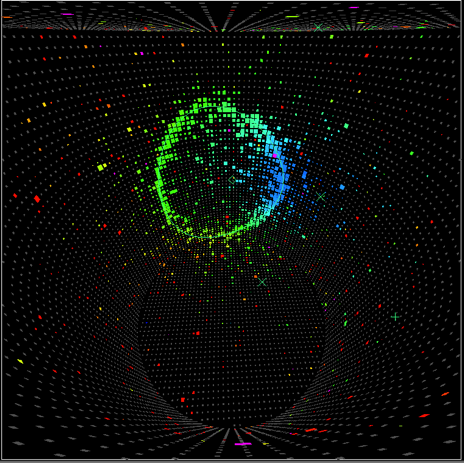
A 3-D display of a candidate electron-neutrino event in the Super-Kamiokande detector. Each of the colored dots represents a detector that was hit by the light created when the electron neutrino interacted with the detector.

How does your research build on the discovery of neutrino oscillations?

The discovery of oscillations in atmospheric and solar neutrinos by Super-K and SNO has now been confirmed by multiple other experiments, and we’ve made tremendous progress over the past 20 years in refining our understanding of neutrino oscillations. An experiment we are involved in at Duke, T2K (“Tokai to Kamioka”), sends a beam of high-energy neutrinos from an accelerator a distance of 300 km to Super-K.  This experiment has discovered new oscillation properties of neutrinos and will continue to take data over the next several years.

But there are still big questions out there about neutrinos — we have three neutrinos, but we don’t know if we have two heavier ones and one light one, or two light ones and a heavy one, which matters for the big picture. We don’t know if oscillations of neutrinos and antineutrinos happen differently. We don’t know if neutrinos and antineutrinos are really the same particles.  The answers to these questions may help us understand the origin of matter.  A next-generation beam experiment, DUNE, will send a beam of neutrinos 1300 kilometers from Fermilab to South Dakota and may answer some of these questions — and if we are lucky, we’ll also catch a burst of neutrinos from a supernova.

The Natural sciences in the 21st century colloquium will be held Wednesday, April 13 at 4:30 PM in Duke’s Gross Hall, room 107.

Kara J. Manke, PhD

Post by Kara Manke

Page 66 of 111

Powered by WordPress & Theme by Anders Norén