This is the sixth and final 2019 post written by students at the North Carolina School of Science and Math as part of an elective about science communication with Dean Amy Sheck.
Dr. Patrick Codd is the Director of the Duke Brain Tool Laboratory and an Assistant Professor of Neurosurgery at Duke. Working as a neurosurgeon and helping with the research and development of various neurosurgical devices is “a delicate balance,” he said.
Patrick Codd
Codd currently runs a
minimally invasive neurosurgery group. However, at Massachusetts General
Hospital, he used to run the trauma section. When asked about which role was
more stressful, he stated “they were both pretty stressful” but for different
reasons. At Mass General, he was on call for most hours of the day and had to
pull long shifts in the operating room. At Duke, he has to juggle surgery,
teaching, and research and the development of new technology.
“I didn’t know I was
going to be a neurosurgeon until I was in college,” Codd said. Despite all of
the interesting specialties he learned about in medical school, he said “it was
always neurosurgery that brought me back.”
Currently, he is
exclusively conducting cranial surgery.
Neurosurgeon U.S. Air Force Maj Jonathan Forbes,looks through loupes as he performs brain surgery at the Bagram Air Field in Afghanistan, Oct. 10, 2014.
Though Dr. Codd has earned
many leadership positions in his career, he said he was never focused on advancement.
He simply enjoys working on topics which he loves, such as improving minimally
invasive surgical techniques. But being in leadership lets him unite other
people who are interested in working towards a common goal in research and
development. He has been able to skillfully bring people together from various
specialties and help guide them. However, it is difficult to meet everyone’s
needs all of the time. What is important for him is to be a leader when he
needs to be.
Dr. Codd said there are typically five to eight research papers necessary in to lay the groundwork for every device that is developed. However, some technologies are based on the development of a single paper. He has worked on devices that make surgery more efficient and less minimally invasive and those that help the surgical team work together better. When developing technologies, he tries to keep the original purpose of the devices the same. However, many revisions are made to the initial design plans as requirements from the FDA and other institutions must be met. Ironically, Dr. Codd can’t use the devices he develops in his own operating room because it would be a conflict of interest. Typically other neurosurgeons from across the country will use them instead.
This is the fifth of six posts written by students at the North Carolina School of Science and Math as part of an elective about science communication with Dean Amy Sheck.
Research is a journey full of uncertainty in which scientists have to construct their own path, even if they’re unsure of what the end of the journey actually is. Despite this unpredictability, researchers continue their journey because they believe their work will one day drive their fields forward. At least, that’s why Kate Meyer Ph.D. says she has investigated something called m6A for several years.
Kathryn Meyer, Ph.D.
“Virtually every study that I have ever been part of had
some frustrations involved because everything can fall apart in just one
night,” Meyer said. “Despite all the frustrations you might have, you are still
in the research because you know that at the end of the day, you will get new
knowledge that is worthy to your field, or perhaps to the world.”
N6-methyladenosine (or m6A) is a modification to one of the four main bases of RNA – adenosine. Because RNA plays a significant role as a bridge between genetic information and functional gene products, modifications in RNA can alter how much of a certain product will be produced, which then controls how our cells and eventually our whole body functions.
The idea of this tiny but powerful modification was first proposed in the 1970s. But scientists struggled to find where m6A was located in the cell before research Meyer made a major contribution to as a trainee was published in 2012. Combining a newly developed antibody that could recognize m6A and gene sequencing techniques that became more accessible to the researchers, Meyer’s work led to the first method that can detect and sequence all of the m6A regions in a cell.
m6A’s interaction with a neuron, as depicted on Dr. Meyer’s laboratory site.
Meyer’s work was transformative research. Her method allowed
laboratories around the world to investigate what regulates m6A and what its
consequences are. Meyer said this first study which ignited m6A field is one of
her most prideful moments as a researcher.
Significant progress has been made since 2012, but there are still lots of questions that need to be answered. Currently, Meyer’s research team is investigating the relationships between m6A and various neurological issues. She believes that regulation of m6A controls the expression, or activity level, of various genes in the brain. As such, m6A may play an important role in neurodegenerative diseases and memory.
Author Jun Hee Shin, left, and Kate Meyer in her lab.
As an assistant professor of both biochemistry and neurobiology at Duke, Meyer is definitely one of the most important figures in the m6A field. Despite her many accomplishments, she said she had experienced and overcome many frustrations and failures on her way to the results.
This is the fourth of several posts written by students at the North Carolina School of Science and Math as part of an elective about science communication with Dean Amy Sheck.
Dr. Giny Fouda’s research focuses on
infant immune responses to infection and vaccination.
Her curiosity about immunology arose during her fourth year of medical school in Cameroon, when she randomly picked up a book on cancer immunotherapy and was captivated. Until then, she conducted research on malaria and connected it to her interest in pediatrics by studying the effects of the parasitic disease on the placentas of mothers.
Genevieve Giny Fouda M.D., Ph.D.
As a postdoctoral fellow at Duke, she
then linked pediatrics and immunology to begin examining mother to child
transmission of disease and immunity.
Today she is an M.D. and a Ph.D. and a
member of the Duke Human Vaccine Institute. She’s an assistant professor in
pediatrics and an assistant research professor in the Department of Molecular Genetics
and Microbiology at Duke University School of Medicine.
Based on the recent finding that children of HIV-positive mothers are more susceptible to inheriting the disease, Fouda believes that it is important to understand how to intervene in passive immunity transmissions in order to limit them. Children and adults recover from diseases differently and uncovering these differences is important for vaccine development.
This area of research is personally important to her, because she learned from her service in health campaigns in Central Africa that it is much easier to prevent disease than to treat.
Babies!
However, she believes that it is important to recognize that research is a collaborative experience with a team of scientists. Each discovery is not that of an individual, but can be accredited to everyone’s contribution, especially those whose roles may seem small but are vital to the everyday operations of the lab.
At the Duke Human Vaccine Institute, Fouda enjoys collaborating as a team and contributing her time as a mentor and trainer of young scientists in the next generation.
Outside of the lab, Fouda likes to spend time reading books with her daughter, traveling, decorating and gardening. If there was one factor that improve how science in immunology is conducted, she would stress that preventing disease is significantly cheaper than treating those that become infected by it.
Dr. Fouda has made some remarkable progress in the field of disease treatment with her hard working and optimistic personality, and I know that she will continue to excel in her objectives for years to come.
This is the third of several posts written by students at the North Carolina School of Science and Math as part of an elective about science communication with Dean Amy Sheck.
Beneath Duke University’s Perkins library,
an unassuming, yet fiercely original approach to video games research is
underway. Tied less to computer science and engineering than you might expect,
the students and faculty are studying games for their effects on players.
I was introduced to a graduate researcher who
has turned a game into an experiment. His work exists between the humanities,
psychology, and computer science. Some games, particularly modern ones, feature
complex economies that require players to collaborate as often as they compete.
These researchers have adapted that property to create an economics game in
which participants anonymously affect the opportunities – and setbacks – of
other players. Wealth inequality is built in. The players’ behavior, they hope,
will inform them about ‘real-world’ economic decisions.
Shai Ginsburg playing
At the intersection of this
interdisciplinary effort with games, I met Shai Ginsburg, an associate professor in the
department of Asian and Middle Eastern studies who studies video games and
board games the way other humanities professors might study Beowulf.
For example, he is able to divide human history
into eras of games rather than of geopolitics.
“Until recently, games were not all that
interactive,” he says. “Video games are, obviously, interactive, but board
games have evolved, too, over the same period of time.” This shift is
compelling because it offers us new freedoms in the way we express human
experience.
A new gaming suite at Lawrence Tech University in Southfield, Mich. (LTU/Matt Roush)
“The fusion of storytelling and
interactivity in games is very compelling,” Ginsburg says. “We haven’t seen
that many games that handle issues like mental illness,” until more recently,
he points out. The degree of interactivity in a video game grants a player a
closeness to the narrative in the areas where writing, music, and visual art
alone would be restricted. This closeness gives game designers – as artists –
the freedom to explore themes where those artistic restrictions also hinder
communication.
However, Dr. Ginsburg is not a game
historian; the time that a game feature evolved is far less relevant to him than
how its parent game affects players. “We tend to focus on the texts that
interest us in a literature class,” he says, by way of example. He studies the
games that interest him for the play opportunities they provide.
One advantage of using games as a medium
to study their effects on people is that, “the distinction between highbrow and
lowbrow is not yet there,” Ginsburg says. In painting, writing, and plenty of
other mediums, a clear distinction between “good” and “bad” is decided
simultaneously by communities of critics and consumers. Not so, in the case of
games.
“I look at communities as a measure of the effectivity of the game less than for itself,” Ginsburg notes. “I think the question is ‘how was I reacting?’ and ‘why was I reacting in such a way?’” he says. Ginsburg’s effort seeks to reveal the mechanisms that give games their societal impact, though those impacts can be elusive. How to learn more? “Play lots of games. Play different kinds of games. Play more games.”
This is the second of several posts written by students at the North Carolina School of Science and Math as part of an elective about science communication with Dean Amy Sheck.
As an occasional volunteer at a local children’s museum, I
can tell you that children take many different approaches to sharing. Some will
happily lend others their favorite toys, while others will burst into tears at
the suggestion of giving others a turn in an exhibit.
For Rita Svetlova Ph.D. at the Duke Empathy Development Lab, these behaviors aren’t just passing observations, they are her primary scientific focus. In November, I sat down with Dr. Svetlova to discuss her current research, past investigations, and future plans.
Margarita Lvovna Svetlova
Originally from Russia, Svetlova obtained an M.A. from
Lomonosov Moscow State University in Moscow before earning her Ph.D in
developmental psychology from the University of Pittsburgh. She later worked as
a post-doctoral researcher at the Max Planck Institute for Evolutionary
Anthropology in Leipzig, Germany.
Now at Duke University as an assistant research professor of psychology and neuroscience and the principal investigator in the Empathy Development Lab, Svetlova looks at the development of ‘prosocial’ behavior in children — behaviors such as sharing, empathy, and teamwork.
Svetlova credits her mentor at the University of Pittsburgh,
Dr. Celia Brownell, for inspiring her to pursue child psychology and
development. “I’ve always been interested in prosociality, but when I was in
Russia I actually studied linguistics,” she says. “When I moved to the U.S., I
changed paths partly because I’ve always wanted to know more about human
psychology. The reason I started studying children is partly because I was
interested in it and partly because I met Dr. Brownell. I branched out a little
bit, but I generally found it interesting.”
An unsuccessful sharing experience. (From Awkward Family Photos)
Although her passion for childhood development research
began in Pittsburgh, Svetlova has
embraced her role as a Duke researcher, most recently tackling a scenario that
most academically-inclined readers are familiar with — a partner’s failure to
perform in a joint-commitment — in a co-authored May 2017 paper titled
“Three-Year-Olds’ Reactions to a Partner’s Failure to Perform Her Role in a
Joint Commitment.”
In
the study, 144 three-year-olds were presented with a common joint commitment
scenario: playing a game. For one third of the children, the game ended when
their partner defected, while another third of the test group had a partner who
didn’t know how to play. The final third
of the group saw the game apparatus break. Svetlova looked at how the
children’s reactions varied by scenario: protesting defectors, teaching the
ignorant partner, and blaming the broken apparatus. The results seem to suggest
that three-year-olds have the ability to evaluate intentions in a joint
commitment.
Another
paper Svetlova co-authored, titled “Three- and 5-Year-Old Childrens’ Understanding
of How to Dissolve a Joint Commitment,” compared the reactions of three- and
five-year-olds when a puppet left a collaborative game with either permission,
prior notification, or suddenly without prior notification. If the puppet left
without warning, three-year-old subjects protested more and waited longer for
the puppet’s return, but both age groups seemed to understand the agreement implicit
in a joint commitment.
These
joint commitments are only a small fraction of the questions that Svetlova
hopes to address.
“A
longitudinal study of prosociality would be amazing,” she says. “What I’m
interested in now is the intersection of fairness understanding and
in-group/out-group bias. What I am trying to look into is how children
understand their in-group members vs. out-group members and whether there’s
something we can do to make them more accepting of their out-group members.”
“Another
one I am interested in is the neural basis of empathy and prosocial behavior. I
haven’t started yet, but I’m planning a couple of studies on looking into the
brain mechanisms of empathy in particular,” Svetolova says. “We plan to scan
children and adults while experiencing an emotion themselves and compare that
brain activation to the brain activation while witnessing someone experiencing
an emotion, the question being ‘do we really feel others’ emotions as our
own?’”
Svetlova
also expressed her interest in the roles that gender, culture, and upbringing
play in a child’s development of prosociality.
I
had to ask her why teenagers seemed to “regress” in prosociality, seemingly
becoming more selfish when compared to their childhood selves.
“I would distinguish between self-centered and selfish,” she assured me. “You are not necessarily selfish, it’s just that during teenagehood you are looking for your place in the world, in the ‘pack.’ That’s why these things become very important, other’s opinions about you and your reputation in this little group, people become very anxious about it, it doesn’t mean that they become selfish all of a sudden or stop being prosocial.” She added, “I believe in the good in people, including teenagers.”
This is the first of several posts written by students at the North Carolina School of Science and Math as part of an elective about science communication with Dean Amy Sheck.
Claudia Gunsch, the Theodore Kennedy distinguished associate professor in the department of civil and environmental engineering, wants to know how to engineer a microbial community. An environmental engineer with a fascination for the world at the micro level, Gunsch takes a unique approach to solving the problem of environmental pollution: She looks to what’s already been done by nature.
Claudia Gunsch, Ph.D.
Gunsch and her team seek to harness the power of microbes to create living communities capable of degrading contamination in the environment.
“How can you engineer that microbial community so the
organisms that degrade the pollutant become enriched?” she asks. “Or — if
you’re thinking about dangerous pathogenic organisms — how do you engineer the
microbial community so that those organisms become depressed in that particular
environment?”
The first step, Gunsch says, is to figure out who’s there.
What microbes make up a community? How do these organisms function? Who is
doing what? Which organisms are interchangeable? Which prefer to live with one
another, and which prefer not living with one another?
“Once we can really start building that kind of framework,”
she says, “we can start engineering it for our particular purposes.”
Yet identifying the members of a microbial community is far
more difficult than it may seem. Shallow databases coupled with vast variations
in microbial communities leave Gunsch and her team with quite a challenge.
Gunsch, however, remains optimistic.
Map of U.S. Superfund Sites (2013)
“The exciting part is that we have all these technologies
where we can sequence all these samples,” she says. “As we become more
sophisticated and more people do this type of research, we keep feeding all of
this data into these databases. Then we will have more information and one day,
we’ll be able to go out and take that sample and know exactly who’s there.”
“Right now, it’s in its infancy,” she says with a smile.
“But in the long-term, I have no doubt we will get there.”
Gunsch is currently working on Duke’s Superfund Research
Center designing bioremediation technologies for the degradation of polycyclic
aromatic hydrocarbon (PAH) contamination. These pollutants are extremely
difficult to break down due to their tendency to stick strongly onto soil and
sediments. Gunsch and her team are searching for the right microbial community
to break these compounds down — all by taking advantage of the innate
capabilities of these microorganisms.
A photo montage from Dr. Gunsch’s lab page.
Step one, Gunsch says, has already been completed. She and
her team have identified several different organisms capable of degrading PAHs.
The next step, she explains, is assembling the microbial communities — taking
these organisms and getting them to work together, sometimes even across
kingdoms of life. Teamwork at the micro level.
The subsequent challenge, then, is figuring out how these
organisms will survive and thrive in the environment they’re placed in, and
which microbial seeds will best degrade the contamination when placed in the
environment. This technique is known as “precision bioremediation” — similar to
precision medicine, it involves finding the right solution in the right amounts
to be the most effective in a certain scenario.
“In this particular case, we’re trying to figure out what
the right cocktail of microbes we can add to an environment that will lead to
the end result that is desired — in this case, PAH degradation,” Gunsch says.
Ultimately, the aim is to reduce pollution and restore
ecological health to contaminated environments. A lofty goal, but one within
sight. Yet Gunsch sees applications beyond work in the environment — all work dealing
with microbes, she says, has the potential to be impacted by this research.
“If we understand how these organisms work together,” she says, “then we can advance our understanding of human health microbiomes as well.”
“Lightning is
like a dangerous animal that wants to go places. And you can’t stop it,” smiled
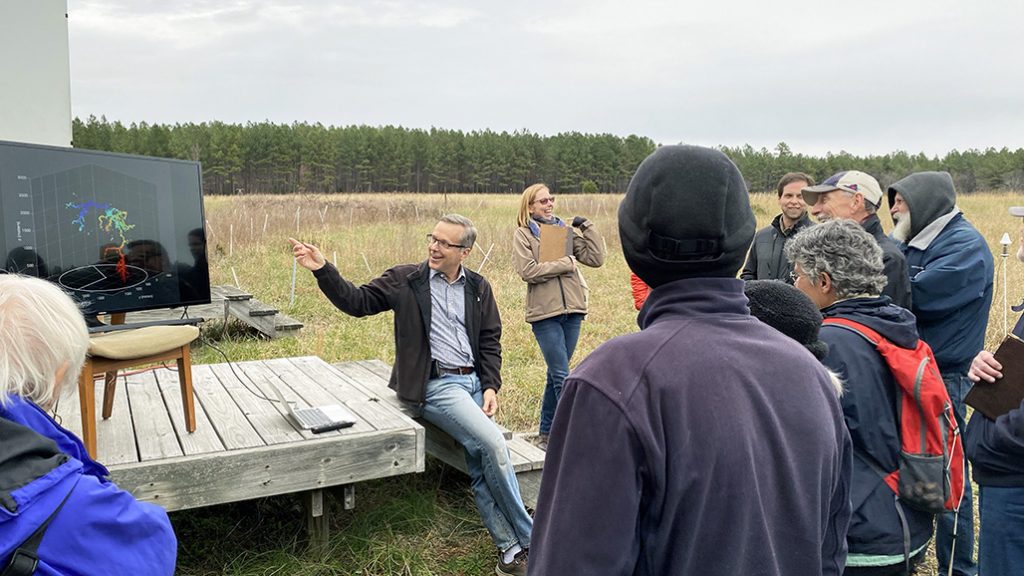
Steve Cummer, Ph.D. as he gestured to the colorful image on the widescreen TV
he’d set up outside his research trailer in an open field in Duke
Forest.
Cummer, the William H. Younger Professor of electrical and computer engineering at Duke, is accustomed to lecturing in front of the students he teaches or his peers at conferences. But on this day, he was showing spectacular videos of lightning to curious members of the public who were given exclusive access to his research site on Eubanks Road in Chapel Hill, about 8 miles west of campus.
Steve Cummer shows a time-lapse video of lightning to the visitors on the annual Duke Forest Research Tour in the Blackwood Division of the Duke Forest.
More than two dozen members of the community had signed up for a tour of research projects in the Blackwood Division of Duke Forest (which recently expanded), a research-only area that is not normally open to the public. Cummer’s research site was the last stop of the afternoon research tour. The tour also covered native trees, moths and geological features of the Blackwood Division with biologist and ecologist Steve Hall, and air quality monitoring and remote sensing studies with John Walker and Dave Williams, from the U.S. Environmental Protection Agency.
The Hardwood Tower in the Blackwood Division is used for air quality monitoring and remote sensing studies. Researchers frequently climb the 138 foot tall tower to sample the air above the tree canopy.
Cummer’s
research on lightning and sprites (electrical discharges associated with
lightning that occur above thunderstorm clouds) sparked a lively question and
answer session about everything from hurricanes to how to survive if you’re
caught in a lightning storm. (Contrary to popular belief, crouching where you
are is probably not the safest solution, he said. A car is a great hiding spot
as long as you don’t touch anything made of metal.)
Cummer kept his
tone fun and casual, like a live science television host, perched on the steps
of his research trailer, referring to some of the scientific equipment spread
out across the field as “salad bowls,” “pizza pans” and “lunar landers,” given
their odd shapes. But the research he talked about was serious. Lightning is
big business because it can cause billions of dollars in damage and insurance
claims every year.
An ash tree (Fraxinus spp.) being examined by one of the visitors on the Duke Forest Research tour. Blackwood Division ash trees are showing signs of the highly destructive emerald ash borer invasion.
Surprisingly little is known about lightning, not even how it is first formed. “There are a shocking number of things,” he said, pausing to let his pun sink in, “that we really don’t understand about how lightning works. Starting with the very beginning, nobody knows exactly how it starts. Like, really the physics of that.” But Cummer loves his research and has made some advances in this field (like devising more precise sensor systems), “When you’re the first person to understand something and you haven’t written about it yet or told anyone about it… that’s the best feeling.”
The Duke Forest hosted 49 research projects last year, which —with less than half of the projects reporting—represented over a million dollars of investment in Duke Forest-based work.
“The Duke Forest is more than just a place to walk and to jog. It’s an outdoor classroom. It’s a living laboratory. It’s where faculty and teachers and students of all ages come to learn and explore,” explained Sara Childs, Duke Forest director.
The Duke Forest offers their research tour every year. Members of the public can sign up for the email newsletter to be notified about future events.
Nothing excites Heather Gordon like old Duke Forest archives do. (“Forestry porn,” she calls it.) Except maybe the question of whether a copy is inherently worse than its original. Or the fear of unperceived existence and dying into oblivion. Or a lot of things, actually.
Gordon, a visiting artist at Duke’s Rubenstein Arts Center, is blending data and art through origami folding patterns. She doesn’t usually fold her designs into three-dimensional figures (“I hate sculptures”), but the outcome is nevertheless just as—perhaps even more—exciting that way.
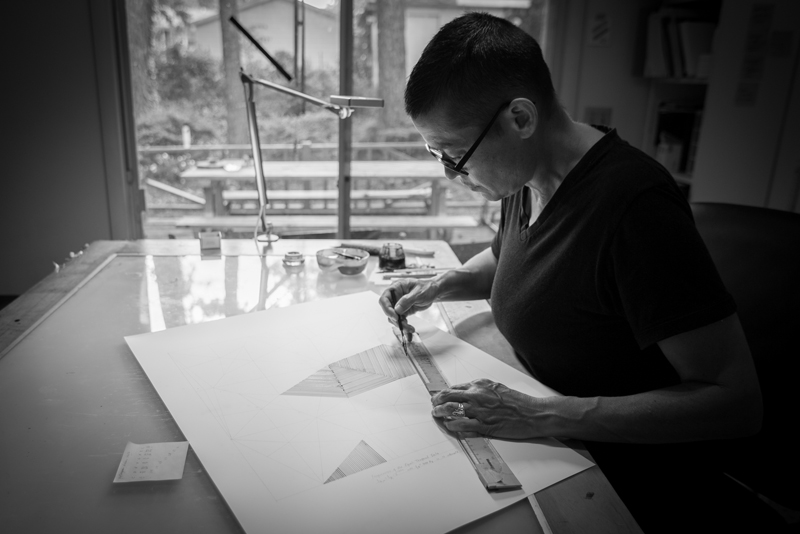
Heather Gordon, visiting artist at the Rubenstein Arts Center. Photo by Michelle Lotker
Gordon happened to stumble upon the idea simply by proceeding through day-to-day life. Namely, she found herself growing increasingly frustrated by online security questions. “They’re always asking stupid things like ‘what’s your favorite pet’s name?’, and I can’t remember what I put 10 years ago,” she said. (And Gordon says she loves all her pets equally.)
Instead, she thought that data visualizations could make for a much more effective security protocol by making use of personal data that only the individual in question would know and remember. “A shape could define you,” she said.
Most recently at the Ruby, Gordon worked with the David M. Rubenstein Rare Book & Manuscript Library and the Duke University Archives to collect old photographs, spreadsheets, letters, and other documents that would contribute to her arts project. Gordon says she knew it was something she had to do when she found an archived letter addressed to Duke’s Dr. Clarence Korstian reading, “Thanks very much for the two shipments of twigs.”
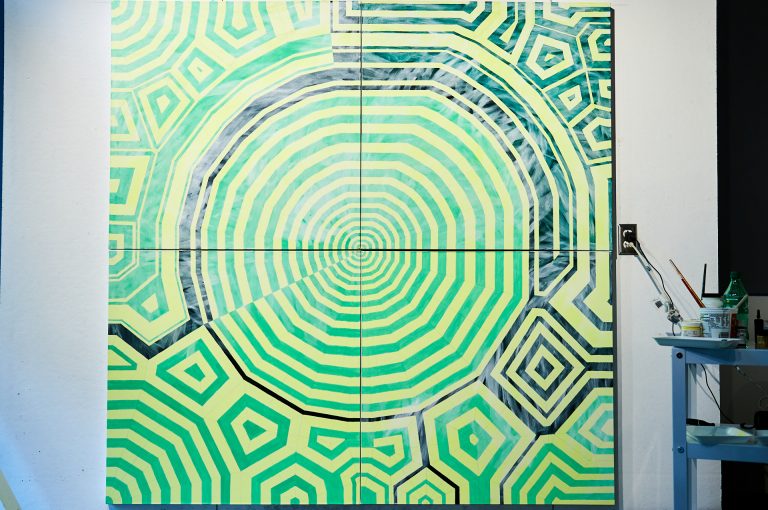
But what was most artistically compelling to Gordon was the light intensity data. Using the documented entries and calculations, she noticed that there were four quadrants in each plot, with 10 readings in each quadrant. Given this, Gordon used a compass to create a series of concentric arcs reminiscent of ripples in a pond. The final product put all four quadrants together to create a painting.
This pattern was derived from archival data on light intensity in the Duke Forest. Photo by Robert Zimmerman
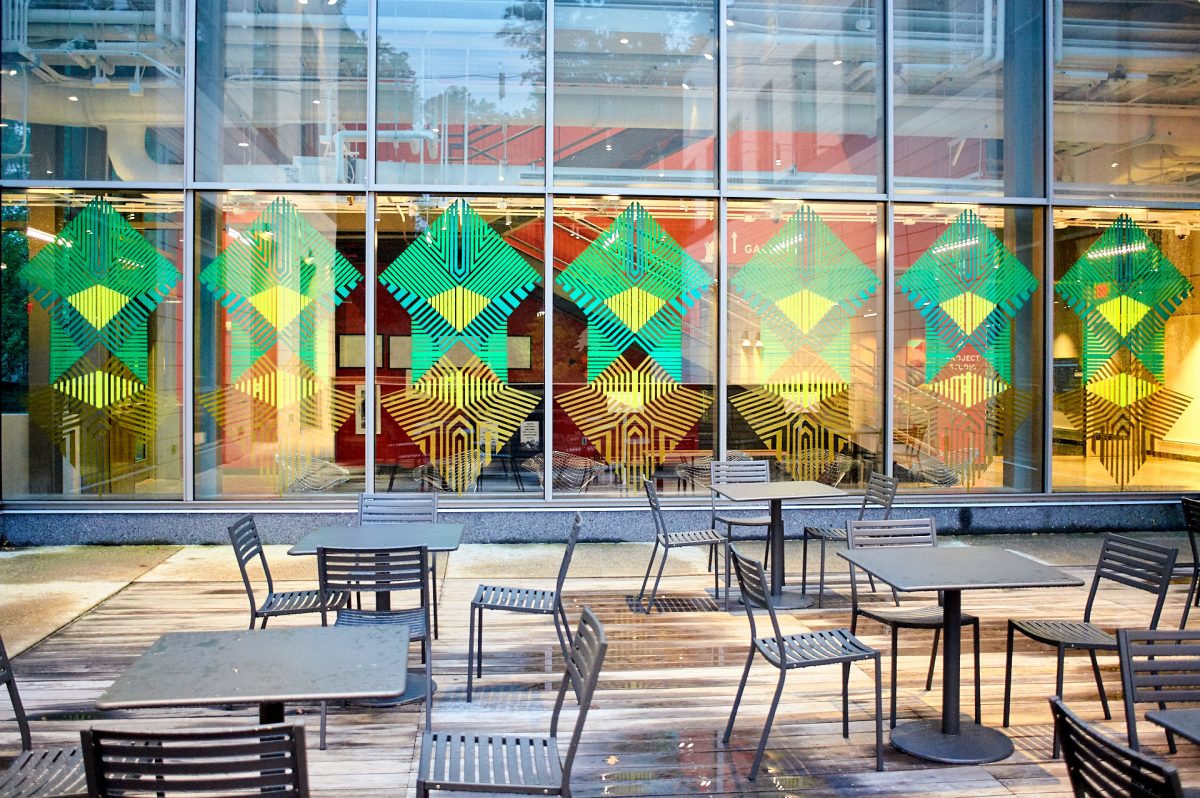
The second half of the Ruby project is directly linked to its title, UNLESS. Inspired by Dr. Seuss’ The Lorax, Gordon took the word “UNLESS,” converted each letter into its respective ASCII value, and mapped those numbers into a tree pattern. As in The Lorax, she hoped to tackle issues of resource management and climate change and the idea that unless something is done, climate collapse remains imminent.
For the final product, Gordon used tape to display the tree patterns in colored stripes onto the glass windows of the Ruby. The trees will remain on display into Spring 2020.
Gordon’s UNLESS on display at the Rubenstein Arts Center. Photo by Robert Zimmerman
Yet Gordon’s portfolio neither begins nor ends with UNLESS.
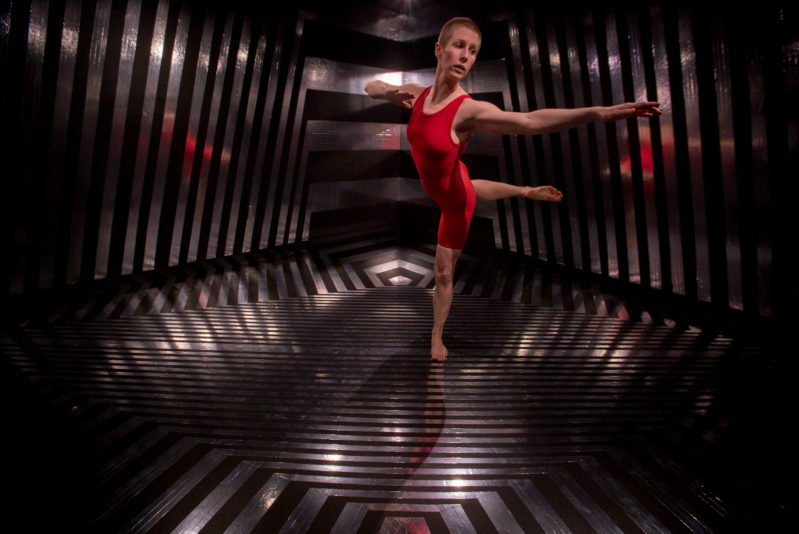
For instance, she’s created an installation called ECHO, inspired by an old personal project of mapping a series of mostly failed “intimate communications” over the course of a year. “I realized I was just seeing what I wanted to see,” Gordon said, reflecting on the project. And thus ECHO was born as an examination of self-awareness, reflection, and authenticity.
The installation itself used strips of mirror tape in a pattern derived from dates of correspondence with Gordon’s close friends. With dancer Justin Tornow, she also put on a dance performance within the space. Unintentionally, ECHO also became a case study in the perception of copies versus originals; a hundred or so audience members chose to crowd around a tiny door to watch Tornow dance, even though the exact same performance was being broadcast live on TVs just a few feet away.
Tornow’s dance performance. Photo courtesy of Heather Gordon
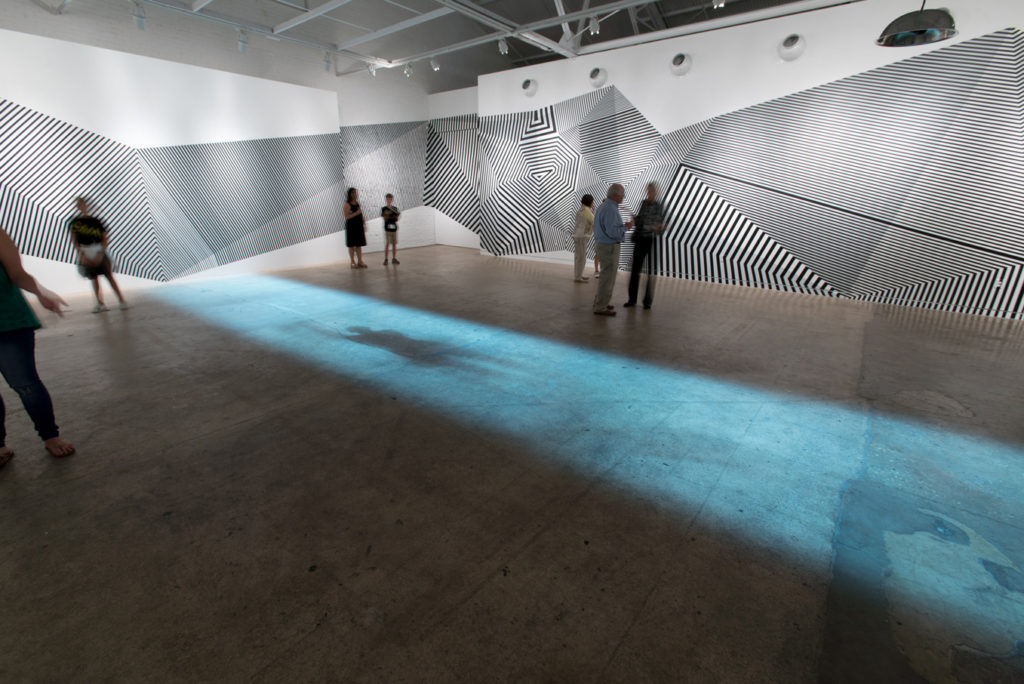
In another project, titled And Then The Sun Swallowed Me, Gordon revisits a childhood fear: “I was obsessed with the idea that the sun could go into supernova at any moment, and you wouldn’t know,” she explained. Even now, a similar panic persists. “I’m afraid of unperceived existence,” Gordon said. “No one will know about me 3,000 years later, and I stress about it.”
The folding pattern was made using the atomic radii of elements in suns that are capable of supernovas. Wrapped in black tape around the walls of a large room, the installation is explosive. In the center, a projection shows a swimmer swimming, though moving neither forward nor backward. It’s a Sisyphian swimmer, Gordon explains, forced to go through the motions but unable to find purpose.
And Then The Sun Swallowed Me, featuring a projected Sisyphian swimmer. Photo courtesy of Heather Gordon
Gordon finds connections where most people can’t. There has long existed a gap between the sciences and the arts, but she seems to suggest that there need no longer be. And she also somehow manages to blend philosophy and existentialism quite gracefully with humor, youthfulness, and creativity.
In essence, Gordon knows that there’s a lot in this world that’s worth freaking out over, but she handles it quite expertly.
My mom’s calling—we talk every day. She asks me if I’ve eaten, and I complain about the usual: essays, exams, horrifying clumps of hair on the shower floor.
Bob Inglis, former Congressman and speaker at the Change My Mind Symposium during Duke Energy Week.
I sit on the steps of the chapel, a warm yellow against a silent sky. Durham is chilly tonight. Cloudy, starless, I feel rain coming. My fingers — naked, against my phone and ear —fare worst, somewhere between cold and numb. They crave my pocket’s warmth, and I tell my mother goodbye.
“Wait, Mom, before I go, did you see the climate change report?”
And with a single sentence, cordial relations are over, and little things like “familial love” fall away. Constructed arguments become a battle of volume. Mom, if we don’t do anything, millions will die. But, Jeremy, she says, climate change is natural — and these summits, they’re PR moves, politicians don’t actually care.In the ring, it’s Me vs. Mother, Ali vs. Frazier, Democrat vs. Republican. An hour in, I’ve forgotten the cold — hell, I’m sweating in self-righteous anger.
Enter Bob Inglis, former US Congressman and 1981 Duke alumnus. Inglis represented South Carolina’s 4th House district, one of the reddest regions in the nation. Initially, he wasn’t so hot on global warming himself. “For years, I was in Congress saying climate change was nonsense,” he says, laughing. “I didn’t know anything about it except that Al Gore was for it.
But what changed his mind?
“Inglis 2.0,” as he calls it, began with his son in 2004, who pushed him to adopt greener policies. Next was the increasing body of evidence that proved climate change undeniable. But it would take a spiritual awakening to transform Inglis’s views. On a snorkeling trip to the Great Barrier Reef, Inglis met oceanographer Scott Heron. The two were kindred spirits, and in Heron’s conservation work, Inglis saw a love for God. For Inglis, “Conservation became loving God and loving people,” he says.
Inglis addresses free-enterprise solutions to climate change (Source: Duke University Energy Initiative)
In 2009, he introduced the “Raise Wages, Cut Carbon Act” designed to curb global warming. Central to the bill was a carbon tax, which puts a price on carbon-based fuel use. Voter backlash was swift. “They were having a Tea Party— and I was specifically uninvited,” Inglis chuckles. In the 2010 election, he was soundly defeated in a primary race against Trey Gowdy, largely in response to the carbon tax.
But Inglis didn’t stop there. In 2012, he founded republicEn, an organization that promotes free enterprise solutions to global warming. republicEn targets a right-wing audience—those most hesitant to accept global warming.
The core of republicEn is its online community. Thousands of members convene in local events and write letters to Congress advocating a carbon tax solution. Dedicated spokespeople also tour the nation to promote the need for conservative leadership. Both benefit from republicEn’s media wing, which gives conservative voices a platform for climate change.
Inglis firmly believes that conservative solutions are key to fighting climate change. Citing the explosion of smartphones, he poses a question: would the cell phone industry have grown as rapidly had it been intensely regulated? He doubts it. Similarly, he sees free market solutions as the fastest way to slow global warming.
republicEn has no set timeline, no five-year plan. But Inglis is hopeful: “You weren’t there when we marched in Selma, but you can be there when we solve climate change.”
The British explorer George Dennis once wrote, “Vulci is a city whose very name … was scarcely remembered, but which now, for the enormous treasures of antiquity it has yielded, is exalted above every other city of the ancient world.” He’s correct in assuming that most people do not know where or what Vulci is, but for explorers and historians – including Duke’s Bass Connections team Smart Archaeology – Vulci is a site of enormous potential.
As a dig site, Vulci is extremely valuable for the information it can give us about the Etruscan and Roman civilizations – especially since the ruins found at Vulci date back beyond the 8th century B.C.E. On November 20th, Professor Maurizio Forte, of the Art, Art History and Visual Studies departments at Duke as well as Duke’s Dig@Lab, led a talk and interactive session. He summarized the Smart Archaeology teams’ experience this past summer in Italy as well as allowing audience members to learn about and try the various technologies used by the team. With Duke being the first university with a permit of excavation for Vulci in the last 60 years, the Bass Connections team set out to explore the region, with their primary concerns being data collection, data interpretation, and the use of virtual technology.
Trying out some of the team’s technologies on November 20th (photo by Renate Kwon
The team, lead by Professor Maurizio Forte, Professor Michael Zavlanos, David Zalinsky, and Todd Barrett, sought to be as diverse as possible. With 32 participants ranging from undergraduate and graduate students to professionals, as well as Italian faculty and student members, the team flew into Italy at the beginning of the summer with a research model focused on an educational approach of practice and experimentation for everyone involved. With a naturally interdisciplinary focus ranging from classical studies to mechanical engineering, the team was divided, with people focusing on excavation in Vulci, remote sensing, haptics, virtual reality, robotics, and digital media.
Professor Maurizio Forte
So what did the team accomplish? Well, technology was a huge driving force in most of the data collected. For example, with the use of drones, photos taken from an aerial view were patched together to create bigger layout pictures of the area that would have been the city of Vulci. The computer graphics created by the drone pictures were also used to create a video and aided in the process of creating a virtual reality simulation of Vulci. VR can be an important documentation tool, especially in a field as ever-changing as archaeology. And as Professor Forte remarked, it’s possible for anyone to see exactly what the researchers saw over the summer – and “if you’re afraid of the darkness of a cistern, you can go through virtual reality instead.”
An example of one of the maps created by the teamThe team at work in Vulci
In addition, the team used sensor technology to get around the labor and time it would take to dissect the entire site – which by the team’s estimate would take 300 years! Sensors in the soil, in particular, can sense the remnants of buildings and archaeological features up to five meters below ground, allowing researchers to imagine what monuments and buildings might have looked like.
One of the biggest takeaways from the data the team collected based on discovering remnants of infrastructure and layout of the city was of the Etruscan mastery of water, developing techniques that the Romans also used. More work was also done on classification of Etruscan pottery, tools, and materials based on earlier work done by previous researchers. Discovering decorative and religious artifacts was also impactful for the team, because as Professor Forte emphasized, these objects are the “primary documentation of history.”
But the discoveries won’t stop there. The Smart Archaeology team is launching their 2019-2020 Bass Connections project on a second phase of their research – specifically focusing on identifying new archaeological sites, analyzing the landscape’s transformation and testing new methods of data capturing, simulation and visualization. With two more years of work on site, the team is hopeful that research will be able to explain in even greater depth how the people of Vulci lived, which will certainly help to shine a light on the significance of the Etruscan civilization in global history.