Following the people and events that make up the research community at Duke

Students exploring the Innovation Co-Lab

Category: Physics Page 4 of 11

Hidden No More: Women in STEM reflect on their Journeys

Back when she was a newly-minted Ph.D., Ayana Arce struggled to picture her future life as an experimental physicist. An African American woman in a field where the number of black women U.S. doctorates is still staggeringly small, Arce could not identify many role models who looked like her.

“I didn’t know what my life would look like as a black postdoc or faculty member,” Arce said.

But in the end, Arce – an associate professor of physics at Duke who went on to join the international team of physicists who discovered the Higgs Boson in 2012 — drew inspiration from her family.

“I looked to the women such as my mother who had had academic careers, and tried to think about how I could shape my life to look something like that, and I realized that it could be something I could make work,” Arce said.
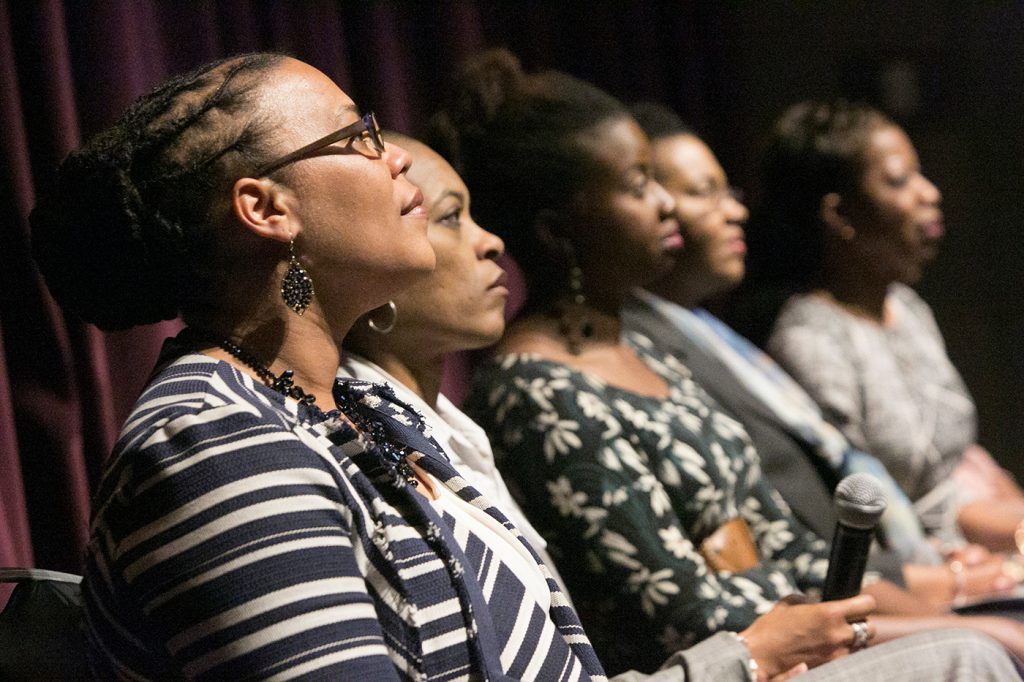
Adrienne Stiff-Roberts, Fay Cobb Payton, Kyla McMullen, Robin Coger and Valerie Ashby on stage at the Hidden Figures No More panel discussion.

Adrienne Stiff-Roberts, Fay Cobb Payton, Kyla McMullen, Robin Coger and Valerie Ashby on stage at the Hidden Figures No More panel discussion. Credit: Chris Hildreth, Duke Photography.

Arce joined five other African American women faculty on the stage of Duke’s Griffith Film Theater March 23 for a warm and candid discussion on the joys and continuing challenges of their careers in science, technology, engineering and math (STEM) fields.

The panel, titled “Hidden Figures No More: Highlighting Phenomenal Women in STEM,” was inspired by Hidden Figures, a film which celebrates three pioneering African American women mathematicians who overcame racial segregation and prejudice to play pivotal roles in NASA’s first manned space flight.

The panel discussion was spearheaded by Johnna Frierson, Director of the Office of Diversity and Inclusion at the Pratt School of Engineering, and co-sponsored by the Duke Women’s Center. It was followed by a free screening of the film.

Though our society has made great strides since the days depicted in the film, women and minorities still remain under-represented in most STEM fields. Those who do pursue careers in STEM must overcome numerous hurdles, including unconscious bias and a lack of colleagues and role models who share their gender and race.

“In my field, at some of the smaller meetings, I am often the only black woman present at the conference, many times I’m the only black person at all,” said Adrienne Stiff-Roberts, an Associate Professor of Electrical and Computer Engineering at Duke. “In that atmosphere often it can be very challenging to engage with others in the way that you are supposed to, and you can feel like an outsider.”

Valerie Ashby and Ayana Arce onstage at the Hidden Figures No More panel discussion

Valerie Ashby and Ayana Arce shared their experiences. Credit: Chris Hildreth, Duke Photography

Stiff-Roberts and the other panelists have all excelled in the face of these challenges, making their marks in fields that include physics, chemistry, computer science, mechanical engineering and electrical engineering. On Thursday they shared their thoughts and experiences with a diverse audience of students, faculty, community members and more than a few kids.

Many of the panelists credited teams of mentors and sponsors for bolstering them when times got tough, and encouraged young scientists to form their own support squads.

Valerie Ashby, Dean at Duke’s Trinity College of Arts and Sciences, advised students to look for supporters who have a vision for what they can become, and are eager to help them get there. “Don’t assume that your help might come from people who you might expect your help to come from,” Ashby said.

The importance of cheerleading from friends, and particularly parents, can never be overestimated, the panelists said.

“Having someone who will celebrate every single positive with you is a beautiful thing,” said Ashby, in response to a mother seeking advice for how to support a daughter majoring in biomedical engineering. “If your daughter is like many of us, we’ll do 99 great things but if we do one wrong thing we will focus on the one wrong thing and think we can’t do anything.”

Women in STEM can also be important and powerful allies to each other, noted Kyla McMullen, an Assistant Professor of Computer and Information Science at the University of Florida.

“I have seen situations where a woman suggests something and then the male next her says the same thing and gets the credit,” McMullen said. “That still happens, but one thing that I see help is when women make an effort to reiterate the points made by other women so people can see who credit should be attributed to.”

With all the advice out there for young people who are striving to succeed in STEM – particularly women and underrepresented minorities – the panelists advocated that everyone to stay true to themselves, above all.

“I want to encourage everyone in the room – whether you are a budding scientist or woman scholar – you can be yourself,” Ashby said. “You should make up in your mind that you are going to be yourself, no matter what.”

Kara J. Manke, PhD

Post by Kara Manke

Young Scientists, Making the Rounds

“Can you make a photosynthetic human?!” an 8th grader enthusiastically asks me while staring at a tiny fern in a jar.

He’s not the only one who asked me that either — another student asked if Superman was a plant, since he gets his power from the sun.

These aren’t the normal questions I get about my research as a Biology PhD candidate studying how plants get nutrients, but they were perfect for the day’s activity –A science round robin with Durham eighth-graders.

Biology grad student Leslie Slota showing Durham 8th graders some fun science.

After seeing a post under #scicomm on Twitter describing a public engagement activity for scientists, I put together a group of Duke graduate scientists to visit local middle schools and share our science with kids. We had students from biomedical engineering, physics, developmental biology, statistics, and many others — a pretty diverse range of sciences.

With help from David Stein at the Duke-Durham Neighborhood Partnership, we made connections with science teachers at the Durham School of the Arts and Lakewood Montessori school, and the event was in motion!

The outreach activity we developed works like speed dating, where people pair up, talk for 3-5 mins, and then rotate. We started out calling it “Science Speed Dating,” but for a middle school audience, we thought “Science Round-Robin” was more appropriate. Typically, a round-robin is a tournament where every team plays each of the other teams. So, every middle schooler got to meet each of us graduate students and talk to us about what we do.

The topics ranged from growing back limbs and mapping the brain, to using math to choose medicines and manipulating the different states of matter.

The kids were really excited for our visit, and kept asking their teachers for the inside scoop on what we did.

After much anticipation, and a little training and practice with Jory Weintraub from the Science & Society Initiative, two groups of 7-12 graduate students armed themselves with photos, animals, plants, and activities related to our work and went to visit these science classes full of eager students.

First-year MGM grad student Tulika Singh (top right) brought cardboard props to show students how antibodies match up with cell receptors.

“The kids really enjoyed it!” said Alex LeMay, middle- and high-school science teacher at the Durham School of the Arts. “They also mentioned that the grad students were really good at explaining ideas in a simple way, while still not talking down to them.”

That’s the ultimate trick with science communication: simplifying what we do, but not talking to people like they’re stupid.

I’m sure you’ve heard the old saying, “dumb it down.” But it really doesn’t work that way. These kids were bright, and often we found them asking questions we’re actively researching in our work. We don’t need to talk down to them, we just need to talk to them without all of the exclusive trappings of science. That was one thing the grad students picked up on too.

“It’s really useful to take a step back from the minutia of our projects and look at the big picture,” said Shannon McNulty, a PhD candidate in Molecular Genetics and Microbiology.

The kids also loved the enthusiasm we showed for our work! That made a big difference in whether they were interested in learning more and asking questions. Take note, fellow scientists: share your enthusiasm for what you do, it’s contagious!

Another thing that worked really well was connecting with the students in a personal way. According to Ms. LeMay, “if the person seemed to like them, they wanted to learn more.” Several of the grad students would ask each student their names and what they were passionate about, or even talk about their own passions outside of their research, and these simple questions allowed the students to connect as people.

There was one girl who shared with me that she didn’t know what she wanted to do when she grew up, and I told her that’s exactly where I was when I was in 8th grade too. We then bonded over our mutual love of baking, and through that interaction she saw herself reflected in me a little bit; making a career in science seem like a possibility, which is especially important for a young girl with a growing interest in science.

Making the rounds in these science classrooms, we learned just as much from the students we spoke to as they did from us. Our lesson being: science outreach is a really rewarding way to spend our time, and who knows, maybe we’ll even spark someone who loves Superman to figure out how to make the first photosynthesizing super-person!

Guest post by Ariana Eily , PhD Candidate in Biology, shown sharing her floating ferns at left.


Acoustic Metamaterials: Designing Plastic to Bend Sound

I recently toured Dr. Steven Cummer’s lab in Duke Engineering to learn about metamaterials, synthetic materials used to manipulate sound and light waves.

Acoustic metamaterials recently bent an incoming sound into the shape of an A, which the researchers called an acoustic hologram.

Acoustic metamaterials recently bent an incoming sound into the shape of an A, which the researchers called an acoustic hologram.

Cummer’s graduate student Abel Xie first showed me the Sound Propagator. It was made of small pieces that looked similar to legos stacked in a wall. These acoustic metamaterials were made of plastic and contained many winding pathways that delay and propagate, or change the direction, of sound waves. The pieces were configured in certain ways so they could design a sound field, a sort of acoustic hologram.

These metamaterials can be configured to direct a 4 kHz sound wave into the shape of a letter ‘A’. The researchers measured the outgoing sound wave using a 2D sweeping microphone that passed back and forth over the A-shaped sound like a lawnmower, moving to the right, then up, then left, etc. The arrangement of metamaterials that reconfigures sound waves is called a lens, because it can focus sound waves to one or more points like a light-bending lens.

Xie then showed me a version of the acoustic metamaterials 10 times smaller that propagated ultrasonic (40 KHz) sound waves. He told me that since 40 kHz was well out of the human range of hearing, it could be a viable option for the wireless non-contact charging of devices like phones. The smaller wave propagator could direct inaudible sound waves to your device, and then another piece of technology called a transfuser would convert acoustic energy into electrical energy.

This structure, with a microphone in the middle, can perform the "cocktail party" trick that humans can -- figuring out where in the room a sound is coming from.

This structure with a microphone in the middle can perform the “cocktail party” trick that humans can — picking out once voice among many.

Now that the waves have been directed, how do we read them? Xie directed me to what looked like a plastic cheesecake in the middle of the table. It was deep and beige and was split into many ‘slices.’ Each slice was further divided into a unique honeycomb of varying depth. The slices were separated from each by glass panes. This directed the soundwaves across the unique honeycomb of each slice towards the lone microphone in the middle. A microphone would be able to recognize where the sound was coming from based on how the wave had changed while it passed over the different honeycomb pattern of each slice.

Xie described the microphone’s ability to distinguish where a sound is coming from and comprehend that specific sound as the “cocktail party effect,” or the human ability to pick out one person speaking in a noisy room. This dense plastic sound sensor is able to distinguish up to three different people speaking and determine where they are in relation to the microphone. He explained how this technology could be miniaturized and implemented in devices like the Amazon Echo to make them more efficient.

Dr. Cummer and Abel Xie’s research is changing the way we think about microphones and sound, and may one day improve all kinds of technology ranging from digital assistants to wirelessly charging your phone.

Frank diLustro

Frank diLustro is a senior at the North Carolina School for Science and Math.


3D-Printable Material Sets Terminator’s Eyes Aglow

Pumpkins just not cutting it for you this year?

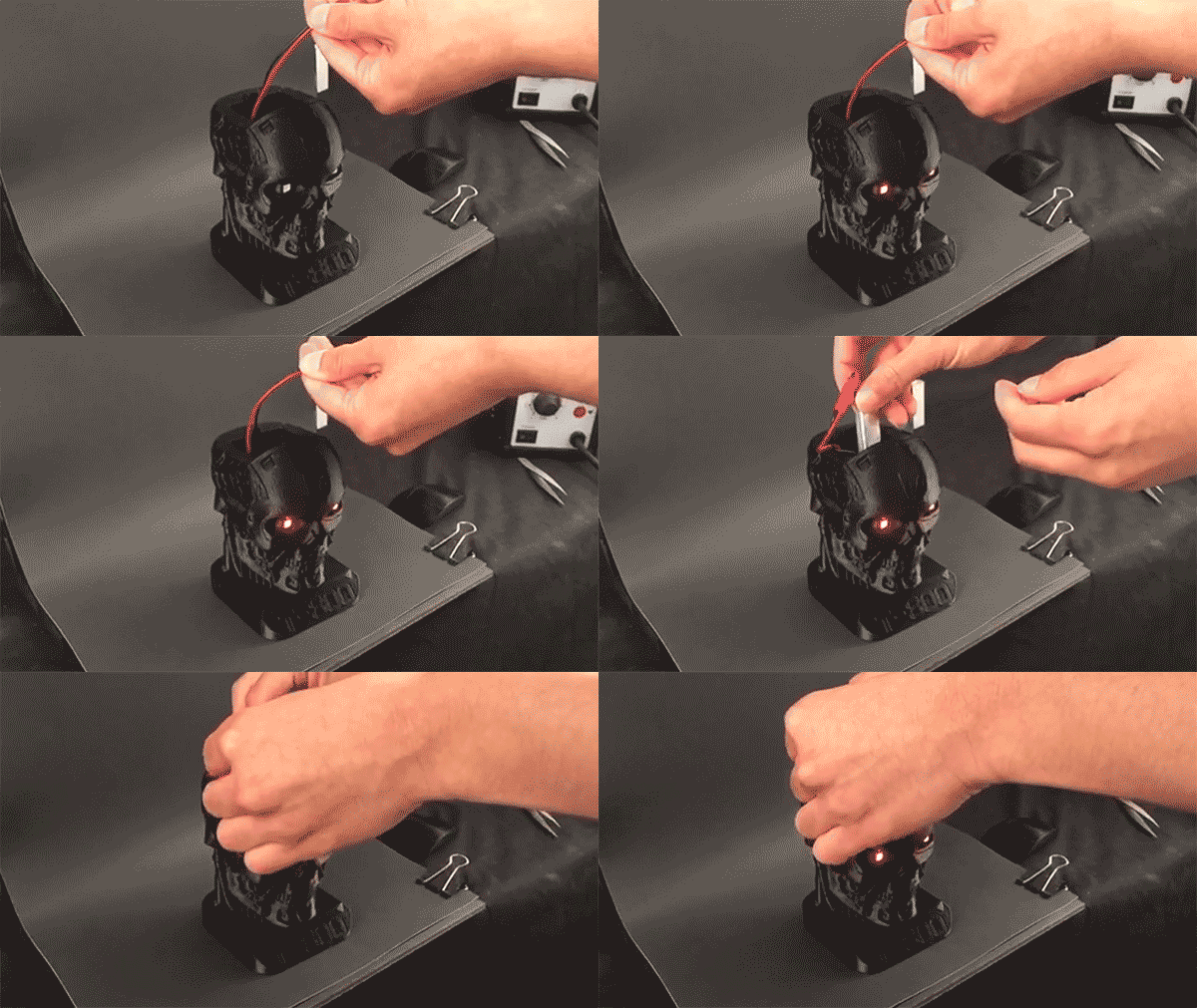
If you want a unique, hand-made Halloween decoration – and happen to have access to a 3D printer – Duke graduate student Patrick Flowers has just the project for you: this 3D-printed Terminator head, complete with shining, blood-red eyes.

[youtube https://www.youtube.com/watch?v=llDaqaicGGk]

Flowers, a PhD candidate in Benjamin Wiley’s lab, is not spending his time studying early eighties action flicks or the Governator’s best break-out roles. Instead, he and his labmates are working hard to brew up highly-conductive, copper-based materials that can be 3D printed into multilayer circuits – just like the one powering this Terminator’s glowing LED eyes.

Their latest copper concoction, which they have named “Electrifi,” is about 100 times more conductive than other materials on the market. The team has a taken out a provisional patent on Electrifi and also started a company, named Multi3D, where 3D-printing aficionados can purchase the material to include in their very own devices.

Micro CT scan of the 3D Terminator head

This X-ray view of Terminator’s head, collected with Duke SMIF’s Micro CT scanner, shows the embedded 3D circuit powering his LED eyes.

Creating a conductive, 3D-printable material is a lot trickier than just throwing some copper into a printer and going to town, Flowers said.

“Copper is really conductive originally, but if you try to extrude it out of a hot nozzle like you have to do in order to do this 3D printing, then it quickly loses all its properties,” Flowers said. And conductive materials that can stand the heat, like silver, are too expensive to use on any sort of scale, he added.

To bring the benefits of 3D printing to the world of electric circuits, Flowers and his labmates are experimenting with mixing copper with other materials to help it stay conductive through this extrusion process.

“This lab has a long history of working with copper – copper nanowires, copper particles, copper nanoparticles – so we’ve got a lot of little tricks that we use to maintain the conductivity,” Flowers said.

The team is currently testing the limits of their new material and plans to publish their findings soon. In the meantime, Flowers is busy exploring the other capabilities of Electrifi — outside of plastic android noggins.

“The circuit inside this guy is really simple, but it does show the capabilities of the material: it is embedded, it shows that I can go down, over, up, out, and go to a couple of eyes,” Flowers said. “Now I want to expand on that and show that you can make these really complicated embedded structures that have multiple layers and multiple components, other than just LEDs.”

adding_battery

Kara J. Manke, PhD

Post by Kara Manke

Girls Get An Eye-Opening Introduction to Photonics

14711502_10153733048287100_3205727043350847171_o

Demonstration of the Relationship between Solar Power and Hydrogen Fuel. Image courtesy of DukeEngineering.

Last week I attended the “Exploring Light Technologies” open house hosted by the Fitzpatrick Institute for Photonics, held to honor International “Introduce a Girl to Photonics” Week. It was amazing!

I was particularly enraptured by a MEDx Wireless Technology presentation and demonstration titled “Using Light to Monitor Health and View Health Information.” There were three “stations” with a presenter at each station.

At the first station, the presenter, Julie, discussed how wearable technologies are used in optical heart rate monitoring. For example, a finger pulse oximeter uses light to measure blood oxygen levels and heart rates, and fitness trackers typically contain LED lights in the band. These lights shine into the skin and the devices use algorithms to read the amount of light scattered by the flow of blood, thus measuring heart rate.

At the second station, the presenter, Jackie, spoke about head-mounted displays and their uses. The Google Glass helped inspire the creation of the Microsoft Hololens, a new holographic piece of technology resembling a hybrid of laboratory goggles and a helmet. According to Jackie, the Microsoft Hololens “uses light to generate 3D objects we can see in our environment.”

14589884_10153733048602100_2715427782090593871_o

Using the Microsoft Hololens. Image courtesy of DukeEngineering.

After viewing a video on how the holographic technology worked, I put on the Microsoft Hololens at the demonstration station. The team had set up 3D images of a cat, a dog and a chimpanzee. “Focus the white point of light on the object and make an L-shape with your fingers,” directed Eric, the overseer. “Snap to make the objects move.” With the heavy Hololens pressing down on my nose, I did as he directed. Moving my head moved the point of light. Using either hand to snap made the dog bark, the cat meow and lick its paws, and the chimpanzee eat. Even more interesting was the fact that I could move around the animals and see every angle, even when the objects were in motion. Throughout the day, I saw visitors of all ages with big smiles on their faces, patting and “snapping” at the air.

Applications of the Microsoft Hololens are promising. In the medical field, they can be used to display patient health information or electronic health records in one’s line of sight. In health education, students can view displays of interactive 3D anatomical animations. Architects can use the Hololens to explore buildings. “Imagine learning about Rome in the classroom. Suddenly, you can actually be in Rome, see the architecture, and explore the streets,” Jackie said. “[The Microsoft Hololens] deepens the educational experience.”

14707854_10153733048632100_7506613834348839624_o

Tour of the Facilities. Image courtesy of DukeEngineering.

Throughout the day, I oo-ed and aw-ed at the three floors-worth of research presentations lining the walls. Interesting questions were posed on easy-to-comprehend posters, even for a non-engineer such as myself. The event organizers truly did make sure that all visitors would find at least one presentation to pique their interest. There were photonic displays and demonstrations with topics ranging from art to medicine to photography to energy conservation…you get my point.

Truly an eye-opening experience!

Post by Meg Shiehmeg_shieh_100hed

LHC Reveals No New Physics Yet, but Duke Scientists Stay the Hunt

For particle physicists, “expect the unexpected” is more than just a catchy tagline.

Duke scientists on the Large Hadron Collider’s (LHC’s) ATLAS collaboration are on the hunt for hints of the unexpected: new, undiscovered particles or forces that could point to theories beyond the remarkably accurate, yet clearly incomplete, Standard Model of physics.

IMG_0721_crop

The Duke physics team at CERN this summer, gathered in front of a model of one of the LHC’s superconducting electromagnets. (Left to right: Ifeanyi Achu, Emily Stump, Elisa Zhang, Hannah Glaser, Wei Tang, Spencer Griswold, Andrea Bocci, Minyu Feng, Shu Li and Al Goshaw).

But the tsunami of new data coming out of the LHC’s current run, which began May of this year, has yet to provide any promising clues. Notably, at the ICHEP conference in Chicago, ATLAS collaboration members presented new results showing that an intriguing “bump” observed in 2015 data — speculated to be the first evidence of a completely new particle six times the mass of the Higgs — was likely just a statistical fluctuation in the data.

“It was quite amazing,” said Duke physics professor Al Goshaw, a member of the ATLAS collaboration. “With this new data there should have been a very clear signal, and there is nothing. It’s just absolutely gone.”

Goshaw has spent much of the summer at CERN, leading a team of undergraduate and graduate scientists crunching the numbers on the new data. Undeterred by the results presented in Chicago, he says the Duke team is still hard at work searching for other massive new particles.

“Our plan is to take the full data set collected in 2016 and extend the search for a new force-carrying particle up to much higher energies,” Goshaw said. “The search will go up to about 25 times the mass of the top quark or 35 times the mass of the Higgs.” They aim to have the results of this analysis ready by early 2017.

Why all the interest in tracking down these massive new particles?

ATLAS-CONF

Particle and energy spray recorded following a high-energy proton-proton collision event at the LHC in May. (Credit: CERN)

Goshaw says there are a myriad of alternative theories to the standard model, so many that trying to test specific predictions of individual models would be prohibitively time-consuming.

“But there is one prediction which they almost all make, and that is that there should be additional massive particles beyond those contained in the standard model,” Goshaw said. “So a generic way to search is to look for the new forces which are indicated by a force carrier, a massive new particle.”

The new data, collected at higher energies than the 2010-2012 run and with higher “brightness” or luminosity than the 2015 run, gives physicists the best chance yet of spotting an elusive new particle.

However, it’s not always looking at a plot and looking for a little bump, Goshaw says. Physicists, including the Duke team, are also utilizing the new data to perform highly precise tests of the standard model.

“The precision tests are really trying to find cracks in the standard model,” Goshaw said. “There could be particles that are so massive that we cannot detect them, but they may appear as subtle deviations in standard model predictions.”

But for now, the tried-and-true still holds. “It is quite extraordinary that, with these beautiful tests, everything is still described by the standard model,” Goshaw said.

Kara J. Manke, PhD

Post by Kara Manke

Fledgling Physicists Embark for the LHC

For physics student Hannah Glaser, taking off for a summer of hands-on research at the world’s largest particle collider is both exciting and terrifying.

But, Glaser says, joining the thousands of scientist at work at the Large Hadron Collider (LHC) also feels a lot like going home.

“It’s such a huge relief to finally be in a group of people who who are interested in the same exact kind of problems that you are,” said Glaser, a rising junior at Virginia Tech. “It really is just this ridiculous nerdy feeling when you finally meet a group of people who have the same obsession with math and science.”

LHC_Students-1

Undergraduate physicists embarking for a summer at the LHC, posed in front of a map of CERN and neighboring town St. Genis hand-drawn by physics professor Al Goshaw. From left: Wei Tang (Duke), Ifeanyi Achu (Southern Methodist University), Spencer Griswold (Clarkson University), Elisa Zhang (Duke), Emily Stump (Williams College) and Hannah Glaser (Virginia Tech).

Glaser is among six undergraduates — two from Duke and four from other institutions — who will be working alongside Duke scientists at the LHC’s ATLAS experiment this summer. Each will tackle a bite-sized piece of the immense particle physics project, primarily by helping to analyze the massive amounts of data generated by the collider.

“Just going to CERN will be a mind-blowing experience,” said Ifeanyi Achu, a junior at Southern Methodist University, at an orientation event at Duke last week. “I’m looking forward to getting a window into what life could be like as a physics researcher.”

Before setting off for CERN, the group spent the month of June with other REU students on Duke’s campus, learning the basics of quantum mechanics and Root, a software platform used CERN and other particle accelerators around the world.

In addition to grappling with complex physics, the students also had to prepare for the more practical aspects of spending six weeks abroad – like the fact that they will be living in the French town of St. Genis while working in Switzerland, requiring that they regularly cross the border and navigate among two or more currencies and languages.

However, the thrill of spending time with some of the world’s biggest experiments should make the travel anxiety worth it.

ATLAS

Duke student Wei Tang hopes to get a picture with a giant LHC detector while working at CERN this summer. (Credit: CERN)

“I’m definitely looking forward to taking a picture with a giant detector,” said Wei Tang, a Duke junior majoring in physics and computer science.

As members of the ATLAS experiment, The Duke high-energy physics team hopes to spot particles or forces not predicted by the Standard Model of physics, the theoretical framework that currently forms the basis of our physical understanding of the universe. New particles or forces could provide clues to solving some of the mysteries that remain in physics, such as what is the nature of dark matter.

“This is probably the most exciting year for the LHC,” said Duke physicist Al Goshaw, who will be onsite advising the students for part of the summer. “Data taken in this run really offers an extraordinary opportunity to look for physics beyond the standard model because it is the first time the LHC is operating at its full potential. It really could be the discovery run, and we are excited to be involved in that.”

But even if new discoveries aren’t made this summer, the students are still thrilled to be a part of the experiment.

“To know that you have done just a tiny bit of science at CERN – it’s just a dream come true for anyone interested in particle physics,” Glaser said.

Kara J. Manke, PhD

Post by Kara Manke

Cracking a Hit-and-Run Whodunit — With Lasers

The scratch was deep, two feet long, and spattered with paint flecks. Another vehicle had clearly grazed the side of Duke graduate student Jin Yu’s silver Honda Accord.

But the culprit had left no note, no phone number, and no insurance information.

Pump-Probe-Microscope-Pigment

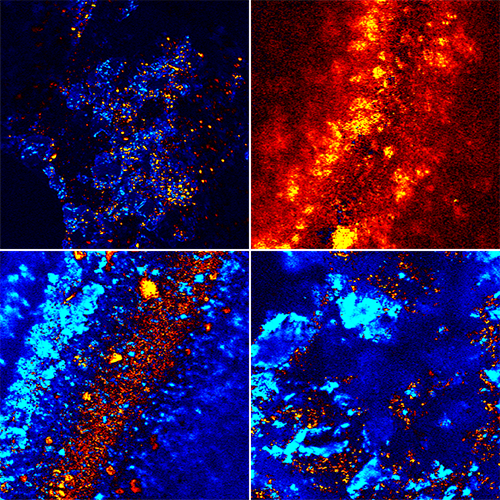
Duke graduate student Jin Yu used laser-based imaging to confirm the source of a large scratch on the side of her car. Paint samples from an undamaged area on her Honda Accord (top left) and a suspected vehicle (top right) gave her the unique pump-probe microscopy signatures of the pigments on each car. The damaged areas of the Honda (bottom left) and the suspected vehicle on right (bottom right) show pigment signatures from both vehicles.

The timing of the accident, the location of the scratch, and the color of the foreign paint all pointed to a likely suspect: another vehicle in her apartment complex parking lot, also sporting a fresh gash.

She had a solid lead, but Yu wasn’t quite satisfied. The chemistry student wanted to make sure her case was rock-solid.

“I wanted to show them some scientific evidence,” Yu said.

And lucky for her, she had just the tools to do that.

As a researcher in the Warren Warren lab, Yu spends her days as scientific sleuth, investigating how a laser-based tool called pump-probe microscopy can be used to differentiate between individual pigments of paint, even if they appear identical to the human eye.

The team is developing the technique as a way for art historians and conservators peer under the surface of priceless paintings, without causing damage to the artwork. But Yu thought there was no reason the technique couldn’t be used for forensics, too.

“The idea popped into my mind — car paint is made up of pigments, just like paintings,” Yu said. “So, if I can compare the pigments remaining on my car with the suspected car, and they match up, that would be a pretty nice clue for finding the suspected car.”

Using a clean set of eyebrow tweezers, Yu carefully gathered small flecks of paint from her car and from the suspected vehicle and sealed them up inside individual Ziploc bags. She collected samples both from the scratched up areas, where the paint was mixed, and from undamaged areas on both cars.

She left a note on the car, citing the preliminary evidence and stating her plan to test the paint samples. Then, back at the lab, she examined all four samples with the pump-probe microscope. Unlike a standard optical microscope, this device illuminates each sample with a precisely timed series of laser pulses; each pigment absorbs and then re-emits this laser light in a slightly different pattern depending on its chemical structure, creating a unique signature.

Optical-Microscope-and-Note

After finding the gash on her Accord (top left), Yu left a note (top right) on the car that she suspected of having caused the accident. Under an optical microscope, samples from damaged areas on the cars show evidence of the same two kinds of paint (bottom). Yu used pump-probe microscopy to confirm that the pigments in the paint samples matched.

The samples from the undamaged areas gave her the characteristic pigment signatures from both of the two vehicles.

She then looked at the paint samples taken from the scratched areas. She found clear evidence of paint pigment from the suspected car on her Honda, and clear evidence of paint pigment from her Honda on the suspected car. This was like DNA evidence, of the automotive variety.

Fortunately, the owner of the suspect vehicle contacted Yu to confess and pay to have her car fixed, without demanding the results of the paint analysis. “But it was reassuring to have some scientific evidence in case she denied the accident,” Yu said.

Yu says she had no interest in forensic science when she started the investigation, but the experience has certainly piqued her curiosity.

“I had never imagined that I can use pump-probe microscopy for forensic science before this car accident happened,” Yu said. “But I think it shows some interesting possibilities.”

Kara J. Manke, PhD

Post by Kara Manke

LHC Reboot Promises Piles of New Data for Duke Physicists

Undeterred by a recent weasel incursion, CERN announced last week that the Large Hadron Collider (LHC) is back up and running for the 2016 season, smashing protons together at nearly the speed of light and creating exotic forms of matter in the debris.

Back at Duke, students and professors collaborating on LHC’s ATLAS experiment are eager to see if the 2016 run provides any hint of surprising new physics.

“It’s a really exciting time,” said Duke graduate student Douglas Davis. “Hopefully something comes out of this new data that we aren’t expecting.”

ATLAS_VP1_event_display_stable_beam_run297041_evt59057181_2016-04-24T05-41-50

CERN’s Large Hadron Collider (LHC) creates exotic forms of matter by smashing together protons that are traveling at nearly the speed of light. This image depicts a collision detected by the LHC’s ATLAS Experiment, which Duke physicists collaborate on, during beam commissioning in April. (Credit: CERN)

Since the early 1970s, physicists have relied on the Standard Model of physics to explain all the most basic bits of matter in the universe and the forces through which they interact. And it has performed remarkably well at describing all of the curious new particles the LHC has created, from the magnificent Higgs Boson to that quirky pentaquark spotted last year.

But the Standard Model can’t quite explain everything. For instance, it cannot reconcile gravity – the force whose existence we verify every time we knock over a coffee mug or drop a pen – or dark matter, which physicists know exists from observations of twisted galaxies in the cosmos.

Med_ATLAS_VP1_event_display_first_stable_beam_collisions_13TeV_many-vertices_run296942_evt34013839_2016-04-23T10-51-30_v4

One of the early proton-proton collisions with recorded by ATLAS on 23 April 2016. The picture shows the very inner core of the ATLAS detector where the two beams of proton bunches from the LHC collide . In this event the colliding protons give birth to ten primary interactions, shown in white. The reconstructed tracks of the particles produced in those interactions are drawn in yellow. (Credit: CERN)

During the upcoming run, the Large Hadron Collider will be operating at its full design capacity, smashing proton bunches at energies of  13 TeV (trillion electron-volts), which is almost twice the collision energy it was capable of during the 2009 to 2013 “Run 1” that discovered the Higgs.

For the 2016 re-boot, they have also increased the “luminosity” of the beams, narrowing the size of the proton bunches to boost the number of collisions per pass by five or six times – resulting in five to six times more data.

To a particle physicist, more energy and more data means a better chance of finding anomalies in the Standard Model that could lend credence to alternate theories, like supersymmetry or string theory, or point in an entirely new direction all together.

“Anything that is even a hint of something new or non-expected these days gets everyone abuzz.” said Davis. “Everyone is waiting on pins and needles for something to happen.”

Most of the excitement in the physics world is currently over a “bump” at 750 GeV observed during the 2015 run. If confirmed, this signal could mean the discovery of a completely new particle that is six times heavier than the Higgs. But, it could also just be a statistical fluctuation.

“There is a huge amount of excitement now because soon after start-up in a few months, we should be able to determine whether that bump is real or not,” said physics Professor Mark Kruse, who leads Duke’s ATLAS team. “I’m right on the fence for whether it could be real or not real, but would probably bet that it’s not. It certainly doesn’t belong to the standard model, but unfortunately it also doesn’t fit very nicely into any of the favored contenders to replace the standard model.”

Med_JiveXML_296942_34013839-YX-RZ-RZ-2016-04-26-22-18-43

A view of the proton collision debris field looking down the beam line (left) and from the side of the beam line (bottom right). On the top right, a zoomed-in view of the proton interaction region, showing the locations where they collide (white squares) and the reconstructed tracks. (Credit: CERN)

The Duke team won’t be focusing all its energy there. Kruse says they have researchers working on a wide variety of projects, from searching for new dark matter candidates to closely analyzing rare Standard Model events.

Davis plans to employ an analysis technique called AIDA, originally developed by Kruse, his advisor, and Kruse’s first graduate student, Sebastian Carron. Davis will use the technique to search for anomalies in a rare Standard Model process that produces two top quarks along with a Z or W boson.

And even if everything works out just as the Standard Model predicts, Davis still thinks the fact that we can collect this data at all is still pretty impressive.

“It may seem kind of boring to see everything work exactly as the Standard Model says it should, but at the same time it’s like – man, this was written down in the seventies and they probably would never have dreamed of being able to observe all this,” said Davis. “But so far, it works perfectly.”

Kara J. Manke, PhD

Post by Kara Manke

Sandcastles of Stars Make Stable Structures

Sandcastles are not known for their structural stability; even the most steadfast seaside fortresses won’t survive a crashing wave or a bully’s kick.

But what if, instead of round grains of sand, you built your castle from tiny stars?

Duke graduate student Yuchen Zhao tests the stability of a tower made from six-armed stars or “hexapods.”

Duke graduate student Yuchen Zhao has spent the last year studying such “sandcastles of stars” — towers crafted from hundreds of six-armed stars or “hexapods” which bear a remarkable resemblance to the jacks you might have played with as a kid.

To build these towers, Zhao simply pours the stars into a hollow tube, and then removes the tube. But unlike columns of sand, these towers stand on their own, stay up when shaken, and can even bear up to twice their own weight.

“When you remove the support, you see that the star particles have really jammed together!” said Zhao. “Nobody understands exactly how this rigidity comes about.”

Sand is a classic example of a granular material, and like other types of granular materials — rice, flour, marbles, or even bags of jacks — it sometimes pours like a liquid, and other times “jams” up, forming a rigid solid.

The physics of jamming has been well-studied for round and spherical particles, says Duke physics professor Bob Behringer, an expert on granular materials who advises Zhao. But much less is understood about jamming in particles with more complex shapes, like hexapods.

“As soon as you move away from spheres, you can create jammed systems at the drop of a hat,” said Behringer. “People think they understand these systems, but there are still a lot of outstanding questions about how they behave: how do they break? Or how do they respond to shear stress?”

These questions aren’t only interesting to physicists, Behringer says. Architects Karola Dierichs and Achim Menges, collaborators on the project, are experimenting with using custom-designed granular materials, from hexapods to hooks, to create structures like walls and bridges.

Similar to a sandcastle or a bird’s nest, structures made this way can be porous, light, recyclable and even adaptable.

“One of their big ideas is, can you actually design a structure that could build itself or be constructed at random, rather than designing something very precise?” said Zhao.

Zhaos says that the first goal of his project was simply to explore the physical limits of towers built from hexapods. To do so, he constructed towers out stars ranging in size from 2 to 10 centimeters and made from two different materials. For each combination, he investigated how high he could build the tower before it collapsed. He then subjected the towers to various stressors, including vibration, tilting, and added weight.

One of the most surprising findings, Zhao said, was that the friction between the particles — whether they were made of smooth acrylic or rougher nylon — had the biggest impact on the stability of the towers. He also noted that when these towers collapse, they don’t just fall over in a heap, they fall apart in a series of mini avalanches.

CT-Scan of jacks

A 3D illustration of a tower of stars reconstructed from CT-scan data. The red dots indicate the points of contact between the stars. Image courtesy of Jonathan Barés.

The team has published this initial study, which they hope will be used as a “handbook of mechanical rules” to improve the design of aggregate structures, in a special edition of the journal Granular Matter.

As a next step in the experiment, Zhao and collaborator Jonathan Barés are using a CT scanner in the Duke SMIF lab to take detailed 3D pictures of the “skeletons” of these structures. With the data, they hope to find a better understanding of how all the individual contacts between stars add up to a stable tower.

“It is amazing to see how these particles can make stable structures capable of supporting big loads,” said Jonathan Barés, who is a former Duke postdoc. “Just changing a small property of the particles — their ability to interlock — creates a dramatic change in the behavior of the system.”

CITATION: “Packings of 3D stars: stability and structure.” Yuchen Zhao, Kevin Liu, Matthew Zheng, Jonathan Barés, Karola Dietrichs, Achim Menges, and Robert P. Behringer. Granular Matter, April 11, 2016. DOI: 10.1007/s10035-016-0606-4

Kara J. Manke, PhD

Post by Kara Manke

Page 4 of 11

Powered by WordPress & Theme by Anders Norén