Following the people and events that make up the research community at Duke

Students exploring the Innovation Co-Lab

Category: Guest Post Page 12 of 14

A Made-to-Order Materials Menu

Guest Post by Ken Kingery, Pratt School of Engineering

If you think ordering a drink from Starbucks can be a tall order, try picking out the right material for a new product or experiment. An iced, half-caff, four-pump, sugar-free, venti cinnamon dolce soy skinny latte may be a mouthful, but there are hundreds of thousands of known—and unknown—compounds to choose from, each with their own set of characteristics.

Screenshot of the AFLOW library search interface. The software combs through four giant databases of chemical compounds.

Screenshot of the AFLOW library search interface. The software combs through four giant databases of chemical compounds.

For example, take the family of materials Bi2Sr2Can-1CunO2n+4+x, or bismuth strontium calcium copper oxide for short, if you can call it that. These compounds have the potential to change the world because of their ability to become superconducting at relatively high temperatures. But each sibling, cousin or distant relative has its own physical variations…so how to choose which to pursue?

Thanks to Stefano Curtarolo and his research group, now there’s an app for that.
Curtarolo leads a collection of research groups from seven universities specializing in something they call materials genomics. The group—called the AFLOW consortium—uses supercomputers to comb databases for similar structures and builds theoretical models atom-by-atom to predict how they might behave.

With help from several members of the consortium, Pratt School of Engineering postdocs Cormac Toher, Jose Javier Plata Ramos and Frisco Rose, along with Duke student Harvey Shi, have spent the past few months building a system that combs through four materials databases. Users can choose the elements and characteristics they want a material to have—or not to have—and the website will play matchmaker.

Want a two-element compound containing either silicon or germanium—but not gallium—that is stable enough to withstand high temperatures? Not a problem. How about an electric insulator made from transition metals with a certain crystal structure? AFLOW has you covered.

Stefano Curtarolo

Stefano Curtarolo is a professor of mechanical engineering and materials science at Duke

One of the four databases searched by the program draws from an international collection of compounds with structures known from experimentation. The other three contain single- double- or triple-element compounds, and are not limited to previously explored materials. Through their molecule-building algorithms, the AFLOW consortium is constantly adding prospective materials to these four libraries.

The search engine currently can sort through more than 622,000 known and unknown compounds, and more than 1,000 new ones are added each week. Curtarolo, a professor of materials science and physics, hopes that the open-source program will continue to grow in materials and searchable characteristics to help scientists connect to their ideal material. To see how it works for yourself, take it for a test drive here.

As for an equivalent database of coffee drinks, that has yet to be built. So if you’re looking through AFLOW for a hot, lactose-free drink featuring 150 to 200 mg of caffeine and less than 200 calories made with beans from South America, you’re out of luck.
Shedding Light on Careers Beyond Academia  

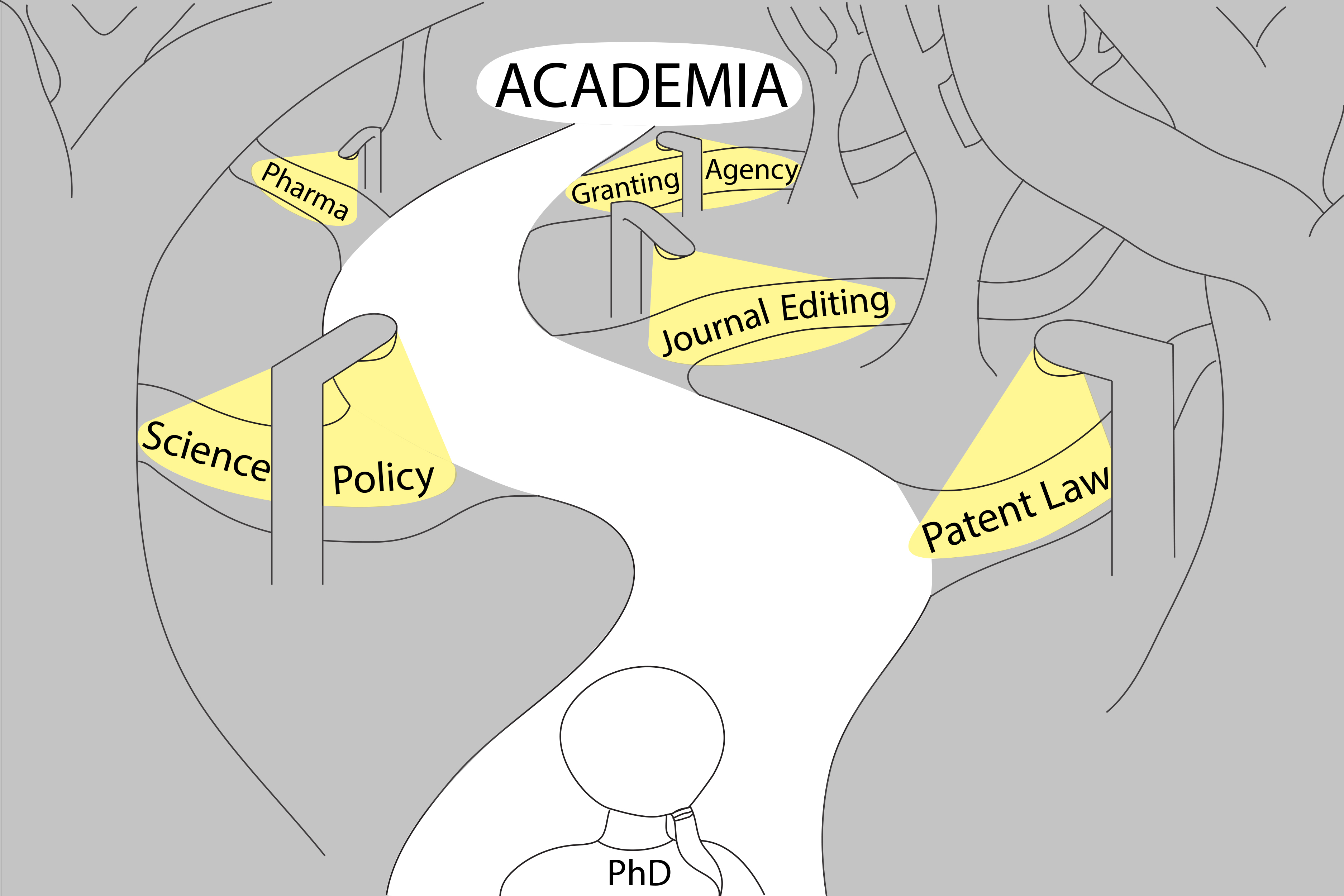
Grad school can seem like walking down a well-lit path in an otherwise dark forest. It’s easy to see the academic path, but who knows what might happen if you step off of it? (Illustration: Ted Stanek)

Grad school can seem like walking down a well-lit path in an otherwise dark forest. It’s easy to see the academic path, but who knows what might happen if you step off of it? (Illustration: Ted Stanek)

Guest post from Ted Stanek, PhD candidate in neurobiology

The Duke Institute for Brain Sciences’ Beyond Academia panel on Oct. 30 tried to illuminate the many career paths available to PhDs and spread hope rather than dread in the minds of Triangle area graduate students.

There has been a flood of articles recently about the increase in competition in the academic world for tenure-track faculty positions and federal funding. They all harped on the perils of staying in academia and the tragedy of being a PhD student or postdoc in such a climate.

Many of these stories focus on the terrifying choice that all PhDs and postdocs face at various points in their career: whether or not they want to stay on the academic track. The alternative feels like jumping off of a cliff, and many people complain that programs which accept more PhD students than there are academic jobs available are effectively pushing students towards that cliff.

Ted Stanek

Ted Stanek is a PhD student in neurobiology.

In the face of this negative outlook for PhDs, the Duke Institute for Brain Sciences recently provided welcome insight into the variety of non-academic careers that may lie in a PhD’s future. Beyond Academia was a day-long workshop consisting of five groups of 3-4 panelists discussing their own career trajectories, what their careers are like, and how they prepared to achieve such positions. Each panelist had a neuroscience or biomedical science PhD, and each had found a successful and fulfilling career outside of the academic niche.

“There are no ‘alternative careers’,” Katja Brose, Senior Editor of Neuron, emphasized in her keynote address.  “There are just careers.”

Workshop panelists revealed just how many careers were available to PhDs. A major point reinforced during the event was that you are never “stuck” on the academic track. You have the option of changing careers every step of the way – even after you’ve reached the level of tenured faculty.

Switching career paths, however, is a daunting task – a common reason why many PhD students go straight into a postdoc. It’s easy to see how the skills that you learn as a graduate student will transfer to skills you can use as a postdoc, and then as a young faculty.

Elizabeth Brannon, a professor of psychology & neuroscience who organized the seminar, pointed out in her welcoming speech that PhD students have limited access to professionals outside of academia, making it difficult to even identify non-academic careers that may interest them, let alone prepare for them.

While many of these careers beyond academia do require some type of preparation, this preparation may simply consist of pursuing your interests while completing your PhD. Writing or editing for your lab, starting up a journal club, and participating in university or professional organizations are all great ways to boost your resume and develop your interests.

Perhaps the hardest part of preparing for any career, academic or otherwise, is undergoing that initial period of self-reflection necessary to identify what skills you possess in your current position, what interests you about your job, and how your life values might impact your career.

“The point at which your skills, interests, and values overlap determines your career sweet spot,” Brose said.

Do you especially enjoy the administrative aspects of academia? Maybe grant management is the way to go. How about actually conducting experiments to discover new biological mechanisms? Perhaps working in a pre-clinical lab for a pharmaceutical company is the place for you. What if you love writing – either the spinning of a story (science writer/freelancer), or writing down the scientific facts with precise and accurate language (medical writer)? Are you interested in new biological technology (intellectual property and patent law)? Or helping to change laws about science (science policy)? Maybe you just love reading papers and debating where they should be published (journal editor).

All of these positions highly value PhDs in particular, no matter what the specifics of your thesis are. Every PhD in the brain and behavioral sciences, whether molecular, systems, or behavioral, develops what career advisors call transferable skills. These highly valued “super powers” as one panelist put it, include being able to communicate technical topics to a diverse audience, working with team members, learning a large amount of information quickly and effectively, being resilient in the face of unexpected adversity, and thinking critically to solve complex problems. The overwhelming message from Beyond Academia was that no matter where you end up, after you get your PhD you can find a career that will make you happy and fulfilled.

To me, it seems like pursuing a PhD is a lot like walking down a well-lit path in an otherwise dark forest. It’s easy to see the next step along the path to academia, but who knows what might happen if you step off of it?

Thanks to Beyond Academia, that forest is now a little brighter.

Beyond Academia was  presented by the Duke Institute of Brain Sciences, the Graduate Admitting Program in Cognitive Neuroscience, the Neurobiology Graduate Program, and the Duke Psychology & Neuroscience Graduate Program.  This event was organized by  Elizabeth Brannon and Richard Mooney, with help from Tanya Schrieber, and moderated by Duke graduate students Caroline Drucker, Rosa Li, Marissa Gamble, and Vanessa Puñal.

Futurity Research News Site Turns Five

Guest Post by David Jarmul

Futurity.Org, a website that has shared Duke’s research news with millions of readers around the world, is celebrating its fifth anniversary this week.

(Credit: Paul Albertella/Flickr)

(Credit: Paul Albertella/Flickr)

Launched in 2009, Futurity has since recorded 12 million visits and 16 million page views. Among the approximately 10,000 stories it has published are recent Duke offerings on baboon behavior, the treatment of hepatitis C, species extinction and smoking rates among immigrants.

Michael Schoenfeld, Duke’s vice president for public affairs and government relations, helped launch the site, which presents research from 62 leading universities in the United States and other countries in a colorful, non-technical format designed to reach wider audiences.

“When we started Futurity five years ago we hoped to create a new channel to those interested in thoughtful stories about university research,” Schoenfeld said. “That has tfuturity.org logourned into a very successful venture in digital media, and helped create a model collaboration among the top universities in the world.”

Karl Bates, director of research communications for the Office of News and Communications (and editor of this blog), serves as the university’s “bureau chief” for Futurity, working with researchers and communicators across the campus to identify newsworthy stories. He then works with the Futurity editorial team, based at the University of Rochester, to present the stories on Futurity’s website and social media channels on Facebook, Twitter and Google+.

Schoenfeld, who continues to chair Futurity’s governing board, said the site hopes to build on its success and is considering expanding into new arenas to keep pace with the rapidly changing media landscape.

Can Research Help Students Avoid Bad Decisions?

By Kelly Rae Chi

Of all the freshman arriving at Duke next week — coming from far and wide to take challenging courses, navigate new living arrangements, make and break friendships  — who will thrive?

What is it about a person that gives him or her the ability to cope with the stress of college better than somebody else?

2012_MoveIn

Duke researchers are examining the student experience to better understand how and when to prevent substance abuse problems.

That’s what a small crowd of basic researchers and clinicians wondered aloud this week during a Grand Rounds mini-retreat introducing Duke’s new Center On Addiction and Behavior Change (CABC).

In particular, the CABC and affiliates are interested in the mental health issues students bring to campus, what happens when they get here, and what can be done at the institutional level to steer them toward healthful choices.

Last year, trustees of The Duke Endowment approved a $3.4 million, four-year grant to help Duke and three other schools toward this goal.  The CABC’s charge is to study prevention, early intervention and treatment of addiction with an eye toward public policy development and community outreach at Duke.

The center’s co-director Timothy Strauman, a professor of psychology and neuroscience, said 30-40% of students enter college having been diagnosed with a mental health issue. Many attack life on campus with a “work hard, play hard” attitude, to their possible detriment, he added.

The question is whether the university can change the student experience to prevent maladaptive behaviors, like binge drinking, that have become all too common on college campuses.  Researchers attending the mini-retreat offered a range of suggestions for helping students thrive, from changing or eliminating fraternities, to incorporating resilience themes into student orientation activities, to pairing students with mentors.

“The goals of CABC are not just about research and patient care, it’s also about re-engineering how the university works,” Strauman said. “If we can do that, we will have been a success.”

More broadly, the CABC, administered by the Duke Institute for Brain Sciences, aims to better understand addiction and behavior disorders through basic and translational research and to convert that knowledge into prevention, early intervention and treatment. With CABC, Duke is poised to improve the health of the community, said the center’s co-director Edward Levin, a Duke professor of psychiatry and behavioral sciences.

The student resiliency project is just one way forward: The center also hopes to integrate services with employee health, and participate in other forms of local outreach.

To accomplish these goals, researchers from a range of research areas in addiction and behavior are now meeting to brainstorm and share resources. At the mini-retreat, for example, John Looney, M.D., a physician in the department of psychiatry and behavioral sciences, shared his expertise as director of Duke’s Consortium for the Study of the American College Student. He also invited the CABC and other researchers to access the program’s survey database about college students (largest of its kind in the world), which includes data on substance abuse.

Lab develops cheaper, faster cancer vaccine

Sarah Avery, Duke Medicine News and Communications

In the 20 years since a group of Duke University researchers pioneered the use of RNA-loaded dendritic cells as cancer vaccines, they and many others have shown that this is a safe and effective way to induce tumor-specific immune responses.

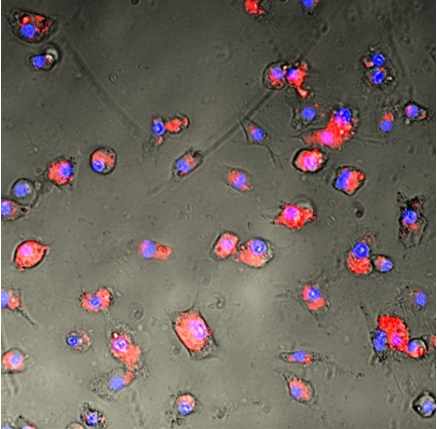
Florescence microscopy image of mouse dendritic cells with mRNA-loaded blood cells.

Florescence microscopy image of mouse dendritic cells with mRNA-loaded blood cells.

But the approach has had drawbacks – primarily in the amount of time and money it takes to develop the cells.

Now the researchers, led by Smita K. Nair, Ph.D., associate professor in the Department of Surgery, are moving the science forward with new findings that could significantly improve the utility of this promising therapy.

Appearing in the June 2014, issue of the Journal Advanced Healthcare Materials, Nair and colleagues demonstrate that a tumor vaccine can be formulated by loading RNA into whole blood cells directly after a blood draw without the need for any form of cell culture.

This overcomes the major impediments. The original approach required harvesting cells from the patient via leukapheresis – a step that relies on special equipment and highly trained technicians – to generate dendritic cells from the cellular population. Then the cells were loaded with RNA and injected back into the patient. The process took up to nine days.

Using the new method, the team can create vaccines in less than two hours.

“The therapeutic benefit in mice immunized with mRNA-loaded whole blood cells and those immunized with mRNA-loaded dendritic cells (the gold-standard for cell-based vaccines) was comparable,” Nair said. “This new approach has the potential to be an effective substitute to existing cell-based vaccinations. It could also cut costs for treatment and speed clinical translation of cell-based mRNA tumor vaccines.”

Nair said pre-clinical studies using human blood cells are continuing, with clinical trials on the near horizon.

Teachers Look to 'Alice' for Help

Guest Post by Leah Montgomery, NC Central University

With technology and computer science among the fastest growing fields of study today, it’s a wonder there are so few computer science classes in public middle and high schools.

Florida teacher Chari Distler’s message to a Duke classroom full of her middle and high school teaching colleagues was a promising one: They can get a new generation of kids interested in computer science.

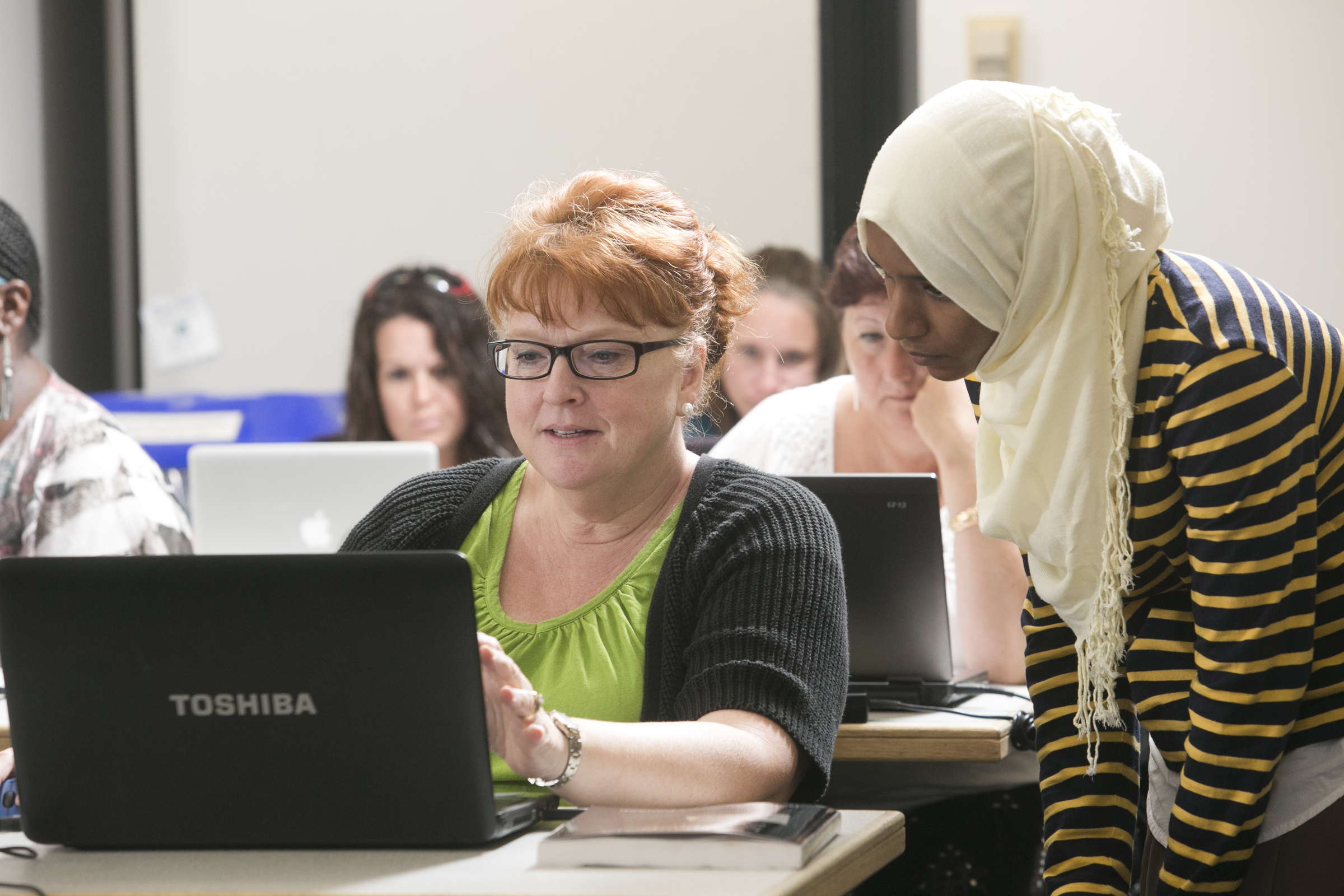
School teachers from all over the country learned programming at Duke this summer.

School teachers from all over the country learned programming at Duke this summer.

All they have to do is follow Alice.

Alice is a 3D virtual worlds programming environment that offers an easy way to create animations for games and storytelling. Since 2008, Duke Professor Susan Rodger has led a two-week summer program training teachers to use Alice to help promote computer literacy among young students.

“What we’re trying to do is teach middle school and high school teachers, in all disciplines, how to program and then help them to integrate it into their discipline,” said Rodger. “The teachers will then expose students to what computer science is. The idea is that if they know what it is then they might choose it as a career when they go to college.”

Distler attended her first Adventures in Alice Programming session at Duke two years ago and returned this week to advise this year’s class on how she implemented the program in her classes.

She said one of her students from North Broward Preparatory School won second place in the annual Alice contest for his animated 45-second video titled “From Rags to Riches.”

Audrey Toney, an instructional coach for teachers in the North Carolina New Schools network, said she learned about Alice through a teacher who wanted to add programming to her curriculum.

“It gives students computational thinking and critical thinking and offers another way to present other than PowerPoint and Prezi,” said Toney.

Toney wants to challenge her professional development students to use Alice to replicate a design of a robotic arm that will lift and unload boxes. The program will allow students to budget money, price the cost of parts and code the robot’s movements.

During the first week of the workshop, teachers get familiar with the Alice software through interactive activities. Teachers created worlds with flying dragons, flipping princesses and annoyed Garfields.

The teachers worked together on learning Alice programming. (Les Todd, Duke Photography)

The teachers worked together on learning Alice programming. (Les Todd, Duke Photography)

In week two, teachers learned about the use of 3-D imaging in the classroom at the Duke Immersive Virtual Environment (DiVE). The teachers also started creating their own Alice-based lesson plans this week. New Jersey high school teacher Kenneth McCarthy said he found his inspiration in the Sunday paper.

“I was thumbing through the Sunday paper and saw Garfield,” said McCarthy, who teaches algebra two and a beginner programming class . “It just looked like something that could be easily used with Alice.”

McCarthy is familiar with Alice, having used the program last year when his students participated in the Hour of Code, an initiative that challenges students and teachers to learn programming in one hour.

“I think the traditional thought was that you have to know algebra two (and other higher mathematics) to learn this, but Alice can be used in elementary schools,” said McCarthy.

Rising Duke senior Samantha Huerta was a workshop assistant for Susan Rodger for nine weeks this summer, helping develop workshop materials and finding ways to integrate computer science into math and other subjects.

“I wasn’t exposed to any type of computer science growing up,” said Huerta. “This is a field that isn’t going to go away, and we need to have more diversity. As a female Latina, I am a double minority and it is my hope to continue researching and bringing diversity to this field.”

Medical Historian Finds Dr. Harris

Guest Post by Leah Montgomery, NC Central University

Medical historian Margaret Humphreys discovered Dr. Joseph Dennis Harris in a handwritten report from the Civil War. She was looking through the United States Sanitary Commission papers during her year at the “clubhouse” — the National Humanities Center (NHC) in Research Triangle, NC.

“When I began my research, he was an unknown figure in the history of Civil War medicine,” Humphreys said. “The fact that I was able to reconstruct his life history beginning with this enigmatic reference is a tribute to the modern tools of digitization, search engines and librarians especially, in the rediscovery of minority figures. Ancestry.com proved especially helpful.”

The historical display, "Binding Wounds, Pushing Boundaries," appears at the Medical Center Library through July 19.

The historical display, “Binding Wounds, Pushing Boundaries,” appears at the Medical Center Library through July 19.

Humphreys, the Josiah Charles Trent Professor of the History of Medicine and Professor of Medicine at Duke University, recently shared the story of this pioneering African-American physician in a Medical Center Library lecture as part of “Binding Wounds, Pushing Boundaries: African Americans in Civil War Medicine” an exhibition on display in the medical library through July 19.

Harris was born in North Carolina to free-colored father Jacob Harris, and mulatto mother Charlotte Dismukes Harris in 1833. At age 17, Harris and his mother migrated to Cleveland, Ohio from Fayetteville, NC.

After farming and working as a blacksmith as a young adult, Harris later studied chemistry and surgery at the Medical Department of the Western Reserve College.

From Cleveland, Harris went on to get an MD diploma from a medical college in Keokuk, Iowa.

Margaret Humphreys MD is also a PhD historian.

Margaret Humphreys MD is also a PhD historian.

During the Civil War, Harris was an acting assistant surgeon at Balfour Hospital in Portsmouth, VA, where he oversaw a ward of about 100 black patients, Union troops and freemen. He was later assigned to two more wards of equivalent size.

In 1865, Harris sought a commission as a Union surgeon but failed to do so due to lack of opportunity. He instead became a physician in Freedmen’s bureau hospitals in Virginia.

Humphreys’ eyes lit up as she quickly read through the papers.

In the spring of 1869, Harris was nominated for lieutenant governor of Virginia, attaining 99,600 votes. It was not enough to win however; he also failed in a bid for a US Senate seat when he received just two of the 32 state legislature votes.

Humphreys said Harris’ genuine character, relentless determination and intellectual capabilities helped to set the standard for African-American medicine.

“Harris is a person whose action in the 1850’s mattered, his actions in reconstruction mattered; (his work) is a continuum, the lives were a continuum,” said Humphreys.

Humphreys is the President of the American Association for the History of Medicine and the author of “Marrow of Tragedy: The Health Crisis of the American Civil War” (Johns Hopkins University Press, 2013), which examines the history of medicine during the American Civil War.

The six-banner traveling exhibition now on display in the library was developed by the Exhibition Program at the National Library of Medicine. It features African-American men and women who served as surgeons and nurses during the American Civil War and the impact of their service on the existing ideas of race and gender, expanding the limitations of the role of African Americans in America.

Dr. Humphreys’ presentation was co-sponsored by the Duke University Medical Center Library & Archives and the History of Medicine Collections in the David M. Rubenstein Rare Book & Manuscript Library.

Interfaith Groups Build Bridges Praying Together

By Eric Ferreri, News & Communications

Organizations are turning to prayer to help bridge differences among employees, according to a new study involving a Duke University graduate student.

The study finds that interfaith group prayer serves as a “bridging cultural practice” within multi-faith groups studied by three researchers including Brad Fulton, a PhD student in Duke’s sociology department.

Interfaith prayer builds bridges if diversity is acknowledged and accepted. (iStock photo)

Interfaith prayer builds bridges if diversity is acknowledged and accepted. (iStock photo)

The study, published this month in the American Sociological Review, consists of data from a national study of multi-faith community organizing groups.

Interfaith group prayers took place in about 75 percent of the diverse gatherings analyzed over two years. Those prayers are considered a “bridging cultural practice,”  a way to help people of disparate backgrounds find common ground.

Fulton acknowledged that prayer doesn’t work for all groups or organizations. But bridging practices aren’t just religious in nature. Some could involve food, sports or other activities. And he believes organizations that focus on the similarities of their people but ignore differences aren’t realizing the full benefits of diversity.

“It is risky to simply assume that people from diverse backgrounds will automatically work well together,” he said. “More diversity tends to correspond with more challenges. But organizations tend to be more effective when they engage, rather than avoid, the varied backgrounds represented in their workforce.”

Fulton is one of three co-authors of the paper along with Ruth Braunstein of the University of Connecticut and Richard L. Wood from the University of New Mexico.

Primary funding for the national study was provided by Interfaith Funders, along with secondary grants from the Hearst Foundation, Society for the Scientific Study of Religion, Religious Research Association, the Louisville Institute, and Duke University.


Science Under Pressure

Guest post by Lauren Burianek, doctoral candidate in cell biology

The basement of the Duke Clinic (called Duke South by everyone around here) seems like the last place you’d expect to dive for treasure, but researchers and physicians at the Center for Hyperbaric Medicine and Environmental Physiology are doing just that – diving for a better understanding of the human body.

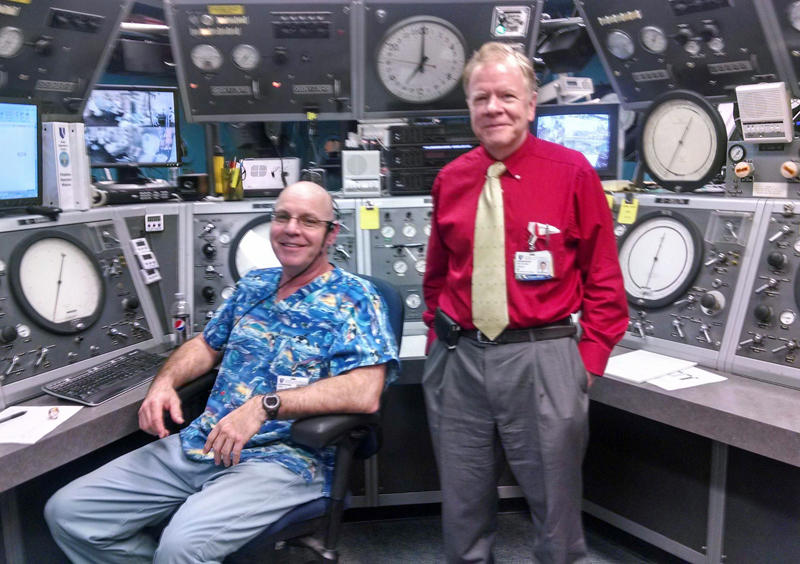
Medical Director Rich Moon (standing) and chamber engineer Eric Schinazi at the controls of the hyperbaric chambers.

Medical Director Rich Moon (standing) and chamber engineer Eric Schinazi at the controls of the hyperbaric chambers.

The $10 million facility was built in 1968 to study the effects of diving, altitude, and compressed gasses on human physiology.  It features seven large steel chambers capable of simulating the high pressure of 1,000 feet below sea water to the low pressure of 100,000 feet above sea level. To put that into perspective, 1000 feet is the deepest the Smithsonian exploratory submersible, DROP, can dive, and 100,000 feet above sea level is considered to be “near-space” (with the peak of Mt. Everest at a measly 30,000 feet).

The deadly physiology of atmospheric pressure first came to light during construction of the Brooklyn Bridge in New York and the Eads Bridge in St. Louis in the late 1800s. High pressure tunnels were designed to keep the water out as footings were set in river beds, but the pressure also dissolved gas molecules in the blood streams of tunnel workers. When they emerged from the pressurized conditions, the gas would bubble out of solution like a freshly opened can of soda, causing life-threatening conditions, including damage to the organs and lungs, and killing about a quarter of the workers.

A news photo of workers in the Lincoln Tunnel under construction in the mid-1930s.

A news photo of workers in the Lincoln Tunnel under construction in the mid-1930s.

A couple decades later, a decompression chamber was used during the building of the Lincoln Tunnel under the Hudson River to slow the depressurization and reduce the chance of injury. This change reduced the deaths relating to decompression from 25% to almost 0%.

Similarly, SCUBA divers must carefully watch their rate of ascent; otherwise, they too might experience what is now known as decompression sickness or the “bends.”

The Hyperbaric facility at Duke is dedicated to researching exactly how the human body deals with these extreme pressures.

The interior of one of the hyperbaric chambers. The stickers are souvenirs of decades of research projects.

The interior of one of the hyperbaric chambers. The stickers are souvenirs of decades of research projects.

Rich Moon, the Medical Director of the facility, has been working there since 1979. “It’s really interesting to learn how the lungs work when you have millions more molecules in there than you’re supposed to,” Moon says. “At high pressures, some macromolecules change conformation, and that can affect even simple things, like how your hemoglobin binds to oxygen.”

In addition to research, the facility is used to treat  hospital patients on a regular basis. Patients with carbon monoxide poisoning undergo hyperbaric (high pressure) oxygen treatment. Because carbon monoxide binds tightly to blood cells, an increase in pressure releases the carbon monoxide so the blood cells can bind oxygen again.

Patients with necrotic wounds benefit from hyperbaric oxygen therapy to increase blood flow to the area of the injury.

A physician is always on call at the facility to handle emergencies,  including SCUBA divers with decompression sickness who are rushed to Durham for treatment.

The research projects relate to diving and altitude and are funded largely by the U.S. Navy. One project is focused on the interaction of nitrogen with neurotransmitters during diving. At high pressures, nitrogen can dissolve into the bloodstream and act as an anesthetic, leading to what is known as nitrogen narcosis. Understanding the mechanism behind nitrogen narcosis may give insight into how to treat and prevent this from happening to divers in extreme situations.

Click on the image to see a large panoramic of the control panel and one of the  steel tanks. (Photo by Eric Schinazi)

Click on the image to see a large panoramic of the control panel and one of the steel tanks. (Photo by Eric Schinazi)

Volunteer Network Shouldn't be Stranded and Dying

measurements on a dead dolphin (Photo: Susan Farley)

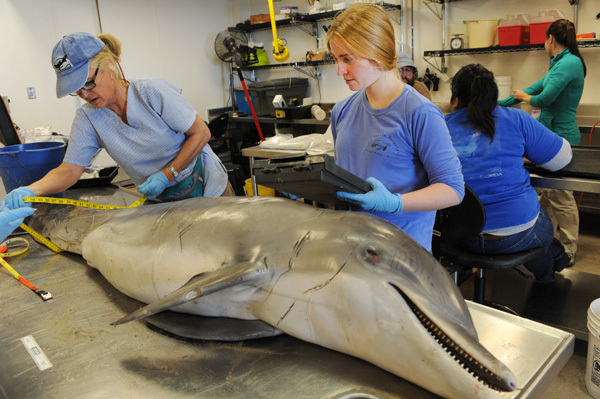
During a lab necroscopy, Dr. Vicky Thayer (left) takes measurements on a dead dolphin as student Samantha Emmert records the data. (Photo: Susan Farley)

Guest Post by Samantha Emmert, a Biology and Evolutionary Anthropology undergraduate at the Duke Marine Lab

The rolling sand dunes and gentle waves of Emerald Isle are so picturesque that I almost forget why I am there: to conduct a necropsy (autopsy on a non-human) on a stranded bottlenose dolphin. Vicky and I have been searching for the animal for about an hour now, driving up and down the beach. Suddenly, I catch a whiff of rotting flesh. Great! We’ve found it!

During my year at the Duke Marine Lab, I am volunteering for the North Carolina Central Coast Marine Mammal Stranding Network. This is no normal year for the network and others like it on the east coast. In the last seven months, 1081 bottlenose dolphins have stranded between New York and Florida. This magnitude of strandings is almost ten times the average, and has therefore been declared an “Unusual Mortality Event” by the National Oceanic and Atmospheric Administration. The cause of these deaths? Morbillivirus, the disease family that includes human measles.

For Independent Study credit I have been collecting data about the stranded dolphins and comparing them to data from 1987-88, the last and only other time there was a morbillivirus Unusual Mortality Event affecting bottlenose dolphins. I have found that this event is following the patterns of 87-88 almost exactly, particularly in terms of the sex and age of dolphins, and when and where they are stranding. These patterns may be a strong indicator for the path of future events.

Dolphin strandings in the area are reported to Dr. Vicky Thayer, the network’s coordinator and a Duke alumna (M.E.M. 1982, Ph.D. 2008). Vicky then calls her volunteers, such as myself, to assist in a response. Today, the dolphin was freshly dead and in good shape for a full necropsy. As Vicky assesses the dolphin for signs of human interaction, I sharpen knives and prepare vials to hold tissue samples. I put on my boots, coveralls, and gloves (things are about to get bloody). Together, Vicky and I peel back blubber and slice through flesh in order to reach the organs that are most impacted by morbillivirus: the lungs, associated lymph nodes, and spinal cord.

This Unusual Mortality Event is not the only problem that the network has been facing this year. Their federal funding for the upcoming year was not renewed.

Many marine mammal rescue networks, such as this one, rely on the John H. Prescott Marine Mammal Rescue Assistance Grant Program, established under amendments to the Marine Mammal Protection Act. However, the number of networks that received awards declined from 39 in 2012 to 12 in 2013. Only two of those 2013 recipients are in the geographic range affected by the dolphin mortality, compared to 13 in 2012. Particularly during a time when they are busiest, the loss of funding has been a huge stress for the networks.

Samantha climbs out of a freshly dug beach grave for yet another dead dolphin.

Samantha and Vicky got to this dolphin just before town workers buried it on the beach and were able to get their tissue samples.

Throughout the necropsy, several fishermen stop by to ask what we are doing. They’ve been fishing on this beach for decades and are aware of the increased occurrence of strandings in the area. It is vital to us that they understand the importance of reporting stranded animals.

“As top predators in coastal waters, these animals are sentinels of ocean health. When they wash ashore in unprecedented numbers, we should direct our attention and funding to learn as much as we can about the cause,” Vicky explains while taking apart the carcass.

We reach the lungs and, sure enough, they are discolored and covered in lesions. We cut chunks from the lung, lung lymph node, and spinal cord and I squish them into small vials. They will be sent to a lab in California to be tested for morbillivirus. The data we record and samples we take will be useful for the many researchers interested in this event across the nation.

It is hard to say what will become of the NC Central Coast Marine Mammal Stranding Network and others like it. Without renewed funding in the 2014 year, Vicky will be unable to continue the network and stranding response will stop in this area. Valuable data for long-term research on stranded animals will be lost. Live-stranded animals will die on beaches unaided. In order to protect and conserve these beloved species, the Prescott Grant and other funding sources must be made more readily available.

Page 12 of 14

Powered by WordPress & Theme by Anders Norén