Following the people and events that make up the research community at Duke

Students exploring the Innovation Co-Lab

Category: Computers/Technology Page 14 of 20

Spice up learning with interactive visualizations

Hannah Jacobs is a Multimedia analyst at the Duke Wired! Lab who aims to change learning the humanities from A to B, much to the excitement of students and faculty packed into the Visualization Friday Forum on Oct. 16. Using visualization as a tool to show connections between space, time, and culture, she hopes to augment the humanities classroom by supplementing lecture with interactive maps and timelines.


BlackAndWhite

Colorful


The virtual maps created for Professor Caroline Bruzelius’ Art History 101 course were built using Omeka’s plugin Neatline, a “geotemporal exhibit builder that allows [the user] to create beautiful, a complex, maps, image annotations, and narrative sequences” such as the Satellite view below.


Demo Neatline visualization


Using the simple interface, Jacobs created a syllabus with an outline of units and individual lectures, each course point connected to written information, point(s) on the map, and period or span on timeline.


Syllabus using Neatline interface


Jacobs also implemented clickable points on the map to display supplementary information, such as specific trade routes used of certain raw materials, video clips, and even links to recent pertinent articles. With such an interface, students are better able to understand how the different lectures move backward and forward in time and make connections with previously learned topics.


Supplementary video clips


For the Art History 101 class,Professor Bruzelius assigned her students a project in which they use Neatline to map the movement of people and materials for a specific culture. One student graphed the Athenian use and acquisition of timber accompanied by an essay with hyperlinks to highlight various parts of the map; another visualized the development of Greek coinage with mapped points of mining locations.


Visualization accompanied by essay

Displaying development of Greek coinage


The students were excited to use the interactive software and found that they learned history more thoroughly than by completing purely paper assignments. Their impressive projects can be viewed on the Art History website.

As we continue to create interactive visualizations for learning, students in the future may study space, time, and culture using a touchscreen display like the one below.


Interactive learning of the future

Interactive learning of the future


hjaccobs

Hannah joined the Wired! Lab in September 2014 after studying Digital Humanities at King’s College London. Previously, she obtained a BA in English/Theatre from Warren Wilson College, and she worked at Duke’s Franklin Humanities Institute from 2011-2013 before departing for London.


Post written by Anika Radiya-Dixit

From Idea to Impact: Salman Azhar Brings Silicon Valley Mentality to Duke

An idea cannot be inherently good or bad, argues Salman Azhar, Entrepreneur in Residence, Associate Professor of Computer Science, and alumnus of Duke University. Instead, the success of an idea hinges on the steps an entrepreneur takes in the conversion from an idea to a plan.

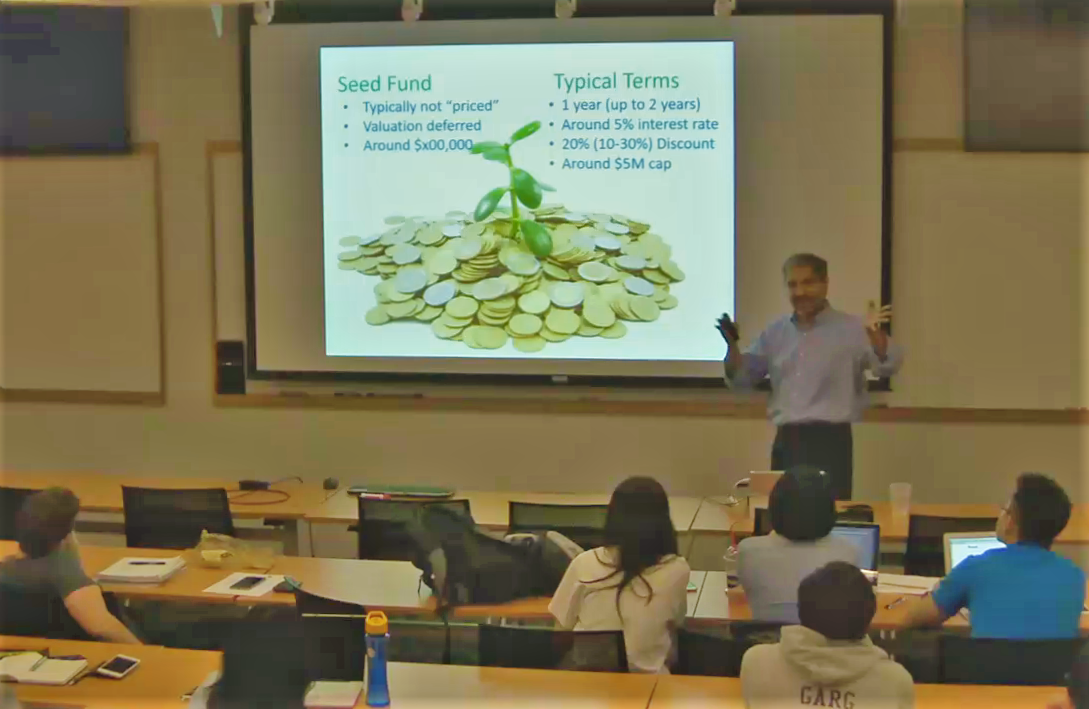
On October 14, Azhar explained to students the evolution of a tech start-up from the idea phase to conception.

facebook-vs-myspaceAzhar emphasized implementation details over the idea itself, citing the example of MySpace and Facebook: neither is conceptually better than the other, yet today, only Facebook stands successful.

Azhar introduced the Duke students to the Silicon Valley mindset, a set of conventions and pieces of advice to make it in the competitive world of start-ups. Azhar himself has expertise in the entrepreneurial round, citing his two successful start-ups. Now he has chosen to dedicate his time to giving back and encouraging the future generation of young people to put their ideas into action.

Azhar began his talk by probing students to consider motivation, to ask themselves at their cores why they should join the start-up world. He urges, “Don’t lie down” and work for established companies like IBM, Microsoft, or even Google– rather, try something on your own. Azhar points out that the challenges involved at a start-up exceed in scope those one might otherwise face, which may be limited to converting functional specifications into code.

“Brand yourself,” he said. Create an image of yourself, just as Apple creates one for its products. A brand, he notes, is a representation of one’s unique view of the world. The creation of a brand, ironically enough, ought to come from a certain degree of introspection. Such introspection should additionally serve to seek out complementary partners with whom to start a company.

Screen Shot 2015-10-15 at 1.39.32 PMIn a guidebook-like manner, Azhar outlined the major  concerns of a start-up process, including bringing an idea to pitch, obtaining funding and defining an exit strategy.

He emphasized the three rules for start-ups: 1. Don’t use your own money, 2. Don’t use your own money, and 3. Don’t use your own money.

He used Swyp, a start-up for alternative payment, to demonstrate examples of technical risks and business risks. In regard to the latter, he questions, “Why will the people pick your company?” And even, “Why will they make a decision?” challenging one to think about how to create a product  compelling enough to move consumers to act.

After doling out tips on approaching investors for funding and  explaining funding rounds, Azhar again returned to the question of the practicality of ideas. With respect to a decision between selling the startup or going public in an IPO, Azhar asserts that the only reason to go for an acquisition is if you run out of ideas, or if someone else can execute your idea better than you can.

Thus, Azhar presents the creation of start-ups as idea management, if you will. Only with such a practical approach can one hope for the survival of his idea in the rough and tumble of Silicon Valley.

By Olivia Zhu Olivia_Zhu_100

Duke co-hosts THInC: Triangle Health Innovation Challenge

Blue Devils and Tar Heels may be rivals on the court, but there is little doubt they can be partners in research and innovation.

DSC_0937

Participants broke into teams, and spent the weekend working on their solutions.

Last weekend, the Duke School of Medicine Innovation and Entrepreneurship Activity Group and the Carolina Health Entrepreneurship Initiative jointly organized the first ever Triangle Health Innovation Challenge (THInC), a 48-hour ‘hackathon’  that brought together students, clinicians, engineers, and business people from around the Triangle to collaborate on solving problems in healthcare and medicine.

The organizers wanted to tap into the collective knowledge of the Triangle to tackle healthcare problems in novel ways, and to engage individuals who did not necessarily see themselves as healthcare innovators.

“We realized that the Triangle has an immense pool of academic, clinical, and technical talent, but these groups of people rarely interact,” said co-organizer Tanmay Gokhale, an M.D./Ph.D. student in Biomedical engineering at Duke. “We wanted to bring them all into the same room and empower them to make a difference in healthcare.”

DSC_0991

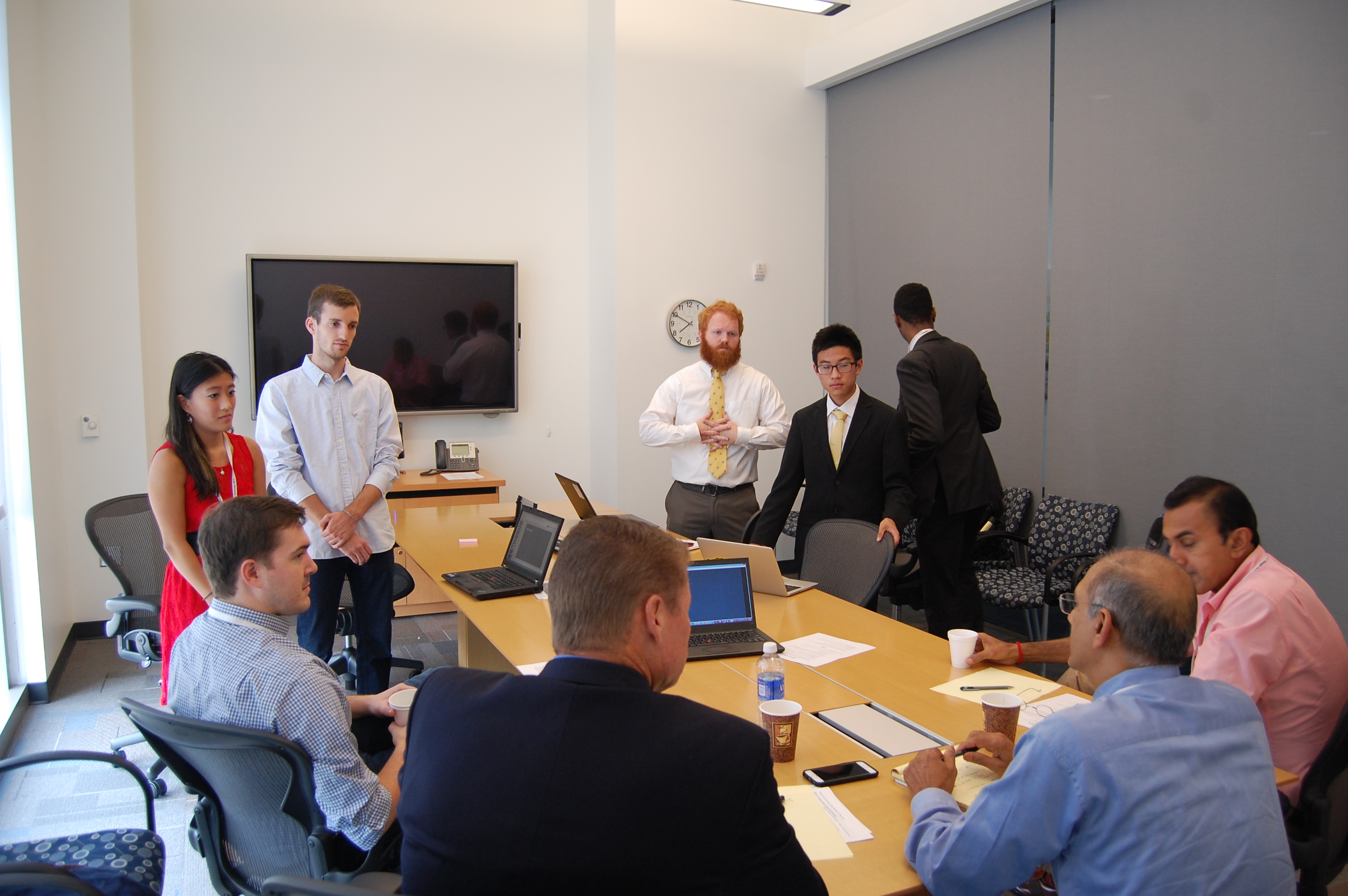
Teams had the chance to meet with mentors, who advised them on their ideas and business strategies.

On Friday, the first evening of the event, 127 participants pitched 44 different healthcare problems, proposed 25 solutions, and broke into 15 teams that were, for the most part, interdisciplinary and involved members from across the Triangle.

Many Pratt School of Engineering students, both undergraduate and graduate, participated in the event, and several were members of  winning teams.

Each team worked through the weekend, designing and creating a product that delivered on a proposed solution. The projects ranged from evaluating treatment and clinic options for patients through a mobile app, to informing future patients by crowdsourcing opinions and advice from people who had experienced similar medical situations.

IMG_2786

Teams, judges, and audience members gathered in the Trent Semans Center for Health Education on Sunday afternoon for the final presentations.

The ingenuity and quality of the solutions that were presented on Sunday afternoon was stunning; each team had drawn from their own firsthand experiences with the shortcomings and challenges of the healthcare system to deliver targeted, nuanced products that tackled meaningful issues.

In a time-cap of three minutes, each team presented the fruits of their weekend of hacking, and were judged not only on their creativity and technical complexity, but also on clinical and business feasibility. Four winners were awarded $13,000 in cash and credits to work with the API (programming interface) of Validic, a Durham company that collects de-identified patient data from medical devices, wearables and apps.

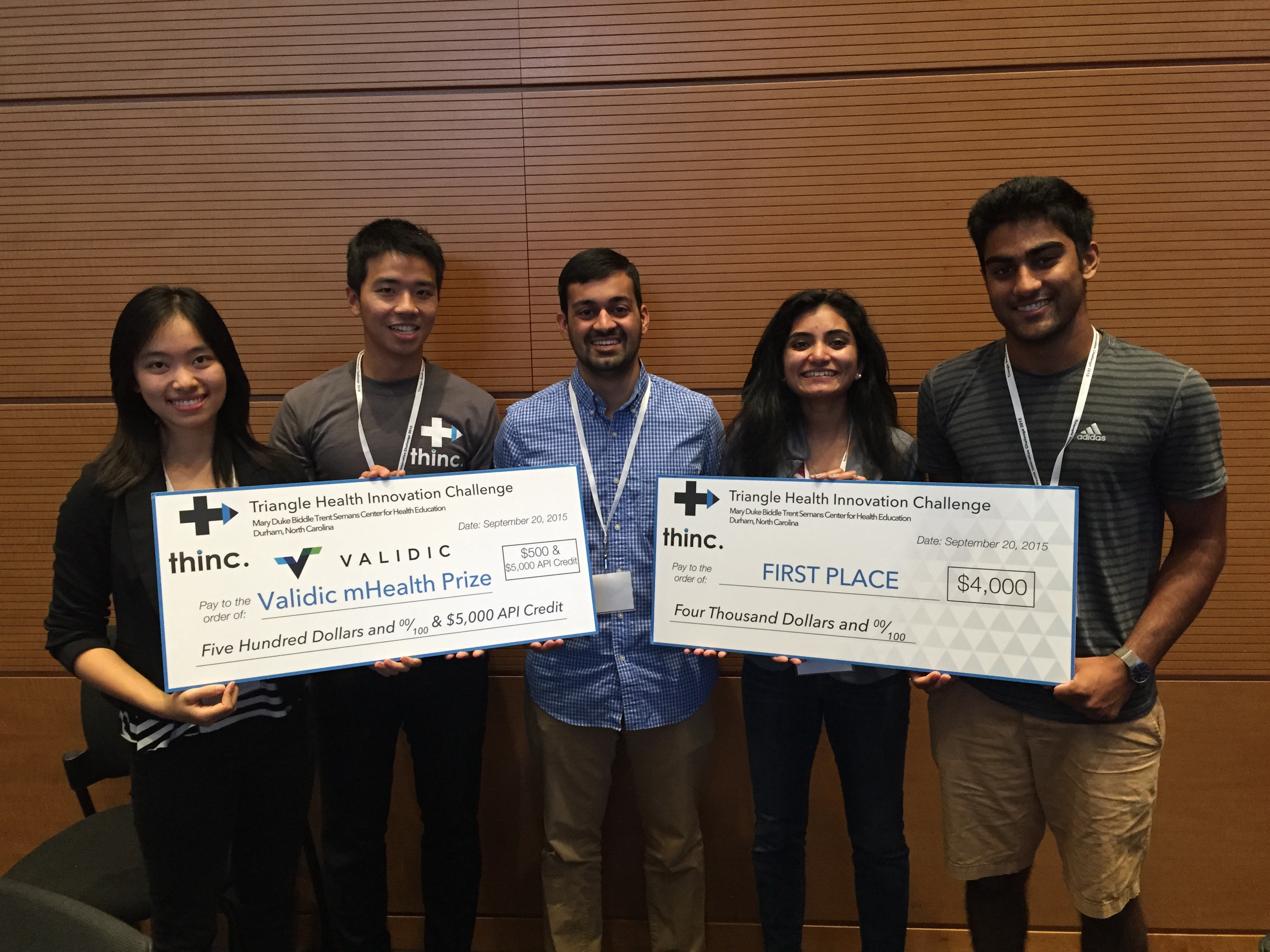
Team Tiba, the winner of the grand prize, created a wearable physical therapy activity tracker to ensure that patients performed their physical therapy exercises regularly and correctly.

Team Breeze, winner of the runner-up prize, presented a smart lung function trainer and app to encourage pursed-lip breathing exercises in patients with chronic obstructive pulmonary disease (COPD).

Team Leia, the winners of the Mosaic Health Solutions prize, developed a digital to-do list for physicians, which integrated intimately with stores of data in order to send live push notifications about patient updates and prioritize different actions for different studies. The team hoped to improve

Team Tiba, winners of the Grand Prize and the Validic mHealth Prize, pose after the awards ceremony.

Team Tiba, winners of the Grand Prize and the Validic mHealth Prize, pose after the awards ceremony.

patient and physician satisfaction as well as patient safety, by assuring that doctors were up to date on conditions and constantly in sync with changes and improvements. Their prototype piggybacked off of current medical APIs, and queried existing data, making it easy for the roughly 150,000 clinicians who already store their data online to easily transition to the app.

Given the immense success of THInC, the organizers said they’re already planning to do it again next year. They’d like to recruit more students as well as more professional developers and programmers so that more teams could come away with a functioning prototype of their solution.

For any questions regarding the event, or planning, promoting, or executing next year’s event, please contact info@thincweekend.org. Interested individuals can also join the Health 2.0 NC Triangle group to participate in other similar events and meet similarly minded people in the area – all are welcome!

Anika Ayyar_100Post By Anika Ayyar

A day in the life of a coding bootcamp student

7:45 a.m. – I’m already late. I know I’ve pressed the snooze button at least 4 times again.

8:15 a.m. – Rushing out the door, I balance an omelet sandwich in my right hand and a jumbled set of keys in the other. Already at eight of twelve weeks into the camp, we are learning to write uncomplicated, manageable code when building complex web applications using JavaScript.

8:40 a.m. – I can see sirens on the side of the highway and I resist the urge to groan as I sit impatiently in another traffic jam. The California sun illuminates the dried landscape in a gorgeous golden glow, and I take a moment to enjoy the view.

8:53 a.m. – I’m just in time for the 9:00 am algorithm session. It is my favorite part of the day, when the other students and I work in teams to solve data structure problems on whiteboards. I pair up with a former state trooper and an environmental engineer to figure out an efficient method for creating a linked list. I enjoy discussing our thought processes on finding the solution, sometimes listening to their interpretation, other times explaining my ideas.

10:30 a.m. – Gathering my notebook, I eagerly sit at the front of the room for lecture. Many coding courses are online, but I appreciate the in-person classroom structure where I can easily ask questions about confusing topics. The teacher is clarifying overarching concepts about the flow of instructions through the computer. The lopsided stick figures and feeble diagrams always amuse us, but they do refine my understanding of the subject.

Flow of requests and responses in a typical web application.

11:45 a.m. – “McDonalds?” someone asks, and we give him a look. It’s nearly time for lunch, so some of our classmates head towards the fridge in the kitchen to heat up leftovers, and the rest of us decide where to eat. Compromising on a good lunch spot has proven surprisingly complicated – but quite a useful skill. There’s always a vegetarian, someone who doesn’t like specific foods, someone else who’s already eaten at a place we finally agreed on, and plenty of other variables that can’t be factored into a simple Calculus equation. It feels more along the lines of –

How choosing a place to dine really works.

We end up eating at four different restaurants.

1:00 p.m. – The best part about going to an intensive coding bootcamp are the people. “What do you see as the future of your marketing agency?” “Do you think renting out rooms of your apartment was a good decision?” “How would you recommend negotiating salary?” On our way back to the camp building, I ask my classmates a plethora of questions about the working world, listening to their complaints about housing and tips on building up an enjoyable career life.

2:00 p.m. – We work together on a JavaScript group chat assignment to solidify the learning from morning lecture. I talk with my classmates on which external libraries to use, pair-program the complicated structure of files, and bicker about who changed the code that crashed the app.

6:00 p.m. – As evening ensues, we decide to fuel our minds with soup and sandwiches; despite our mental fatigue after a long day of work, dinner is a pleasant affair.

10:00 p.m. – My partner and I have steadfastly worked the day on our JavaScript online store to sell diamonds, swords, and Lego mugs. It’s gotten late, but I’m still burbling about the features we have yet to code. As I head out the door, keys swinging on my forefinger, I’m already excited for tomorrow – another day to learn, another time to grow with new friends, and another adventure to enjoy.

Advertisement for Lego mugs on my JavaScript online store.

Advertisement for Lego mugs on my JavaScript online store.

Post by Anika Radiya-Dixit, ECE/Comp Sci 2017

Student Ideas Have a Place to Call Home

Student project teams have become an important part of engineering education at Duke and elsewhere in recent years, but our campus wasn’t always the easiest place for them to work.

Foundry_450

DukeMakers showed off a 3D-printed replica of Duke Chapel in the same blue as its construction tarping.

When the robotic submarine team needed to test for leaks in their craft, “we used to roll a bin down the hallway at CIEMAS and fill it up at the water fountain,” said Will Stewart, a junior on the club.

Stewart was showing off his team’s shiny new workroom in The Foundry, a purpose-built 7,600-square-foot space on two levels in the basement of Gross Hall. It has a huge industrial sink.

FoundryStairs_300

The Foundry’s airy main workspace was once the home to grimy, ugly machinery that sustained Gross Hall.

Throughout the Foundry, lockers for gear double as whiteboards and sturdy butcher block tables stand ready to take any pounding, grinding and soldering the students can dream up.

In addition to the dedicated spaces for the larger project teams. there is plenty of meeting space and shop space for optics and electronics and some light machining.

Originally the home to big, ugly utilities for the one-time chemistry building, the Foundry space was converted for student use with input from students and faculty representing the Pratt School of Engineering, the Innovation Co-Lab, Duke Innovation and Entrepreneurship, the Nicholas School of the Environment, the Physics Department, and Gross Hall neighbors the Energy Initiative and the Information Initiative.

“It’s amazing that what was actually an ugly space in the basement could turn into a beautiful space for students,” Interim Engineering Dean George Truskey said in brief remarks.

Foundry_IEEE_450

Owen Chung demonstrated IEEE’s robo drink mixer that can combine six different fluids on command from an iPhone app.

The Electric Vehicle Club is looking forward to having one good space, rather than six cramped rooms spread around Hudson Hall to build their super-efficient carbon fiber prototypes. “So far, what we have fits, but we’re actually looking for more space,” said club president Charlie Kritzmacher. “We’re a pretty big club.”

Karl Leif Bates

By Karl Leif Bates, Director of Research Communications

An Exploration in Tech: From Altamira to Google

Six countries and eight months later, I’m finally back at Duke after a junior-spring hiatus for a study abroad program in Spain. My experience abroad, while just as colorful as the Spanish

View of Spanish street from Plaza Mayor, Madrid

View of Spanish street from Plaza Mayor, Madrid

stereotype (and equally filled with paella and sangria), extended much deeper than beaches and bullfights. Fulfilling my Trinity requirements of social sciences through my Duke in Madrid courses unveiled challenging perspectives on memory, particularly of the Spanish Civil War, and on the psychology of the Spanish population and its individuals.

One of the greatest themes throughout my experience was the evolution of technology. Our Duke cohort of eight students visited the Cave of Altamira in rainy, northern Spain, which holds some of the world’s most famous, miraculously preserved cave paintings. More than anything, the physicality of the paintings, the oldest of which dated 35,600 years old, shocked me. The sheer passage of time embodied by the paintings eclipsed our human history twenty-fold, and our generation many times over.

In Altamira, I witnessed the evolution of perspective, as the cave artists experimented with foreground and background using raised and lowered ridges of the cave; simultaneously, my perspective on self-importance, at least in comparison to the whole of human history, changed. Not only is a lifespan negligible compared to the age of the world, but it is also only a drop in the bucket of the world’s population. A scientific discovery only makes an impact in the context of the accumulation of the world’s intelligence and knowledge, just as one cave painting gains more meaning from the context of all the paintings, older and newer, around it.

In May, I transitioned to a much more temporal study of technology in the Silicon Valley,

Photo credit: Robert Hahn

Photo credit: Robert Hahn

specifically as a software engineering intern at Google. I worked on the Fonts and Text team under Internationalization, where I sharpened my engineering prowess under a canopy of red, yellow, and blue umbrellas amid a sea of cheerful bike bell rings. While I met a wide range of interns and engineers working on a range of fascinating, impactful projects, I definitely applied my mind in a much more focused, practical manner. A modern day in engineering definitely stands in stark contrast to the lofty speculation I undertook in Spain.

Back in Durham, as I navigate foreign pathways, puzzle at the changed food venues, and double-take at new Duke buildings that seem to have popped up out of nowhere after construction, I’m thoroughly happy to have returned to Duke with a fresh mindset and renewed energy. After time away, the research that occurs here only seems more incredible, and I’m excited to explore it and write about it in the coming year.

Olivia_Zhu_100Post by Olivia Zhu, senior, Biophysics major and Computer Science minor

Undergrads Share Results, and Lack Thereof

ashby and grundwald

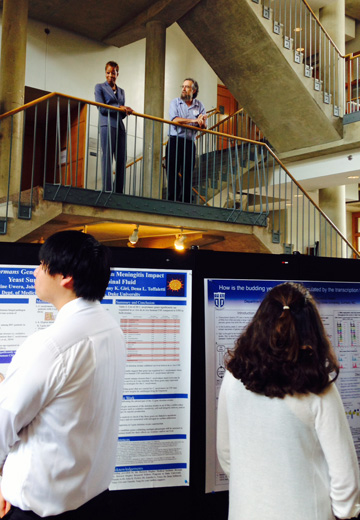
Arts & Sciences Dean Valerie Ashby and Associate Dean for Undergraduate Research Ron Grunwald got the big picture of the poster session from an LSRC landing.

Dozens of Duke undergrads spent the summer working in labs, in part to learn why science is called “research” not “finding.”

“About a third of these students ended up without any data,” said Ron Grunwald, associate dean for undergraduate research, during a Friday poster session in the atrium of the LSRC building for three of the summer research programs.

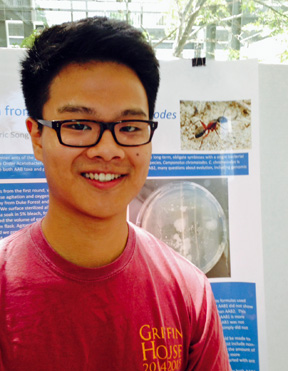
Biology junior Eric Song gets it now. He spent the summer trying to culture one specific kind of bacteria taken from the abdomens of an ant called Camponotus chromaiodes, which he collected in the Duke Forest. All he got was

Eric Song

Eric Song’s poster featured a photo of the ant and the mysterious white stuff.

“this white stuff showing up and we don’t even know what that is.” His faculty mentor in the Genomics Summer Fellows Program, Jennifer Wernegreen, was hoping to do some genetic sequences on the bacteria, but the 10-week project never made it that far. “We’re only interested in the genome basically,” Song said good-naturedly.

Christine Zhou did get what she set out for, mastering the art of arranging E.coli bacteria in orderly rows of tight little dots, using a specially adapted ink jet printer. Working with graduate student Hannah Meredith and faculty mentor Linchong You, she was able to lay the bugs down at a rate of 500 dots per minute, which might lead to some massive studies. “In the future, we’re hoping to use the different colored cartridges to print multiple kinds of bacteria at the same time,” she said.

Sean Sweat

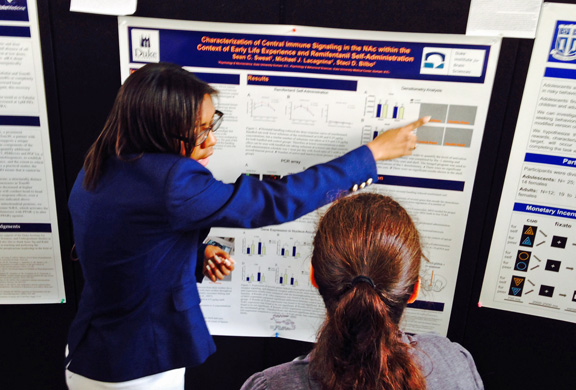
Sean Sweat (left) discusses her mouse study.

Neuroscience senior Sean Sweat also got good results, finding in her research with faculty mentor Staci Bilbo, that opiate addiction can be lessened in mice by handling them more, and identifying some of the patterns of gene expression that may lie behind that effect.

Neuroscience senior Obia Muoneke wanted to know if adolescents are more likely than children or adults to engage in risky behaviors. Muoneke, who worked with mentor Scott Huettel, said her results showed the influence of peers. “Adolescents are driven to seek rewards while with a peer,” said Muoneke. “Adults are more motivated to avoid losing rewards when they are by themselves.”

The new dean of Trinity College, chemist Valerie Ashby, worked the room asking questions before addressing everyone from a landing overlooking the atrium. “How many of you wake up thinking ‘I want nothing to happen today that I am uncertain about?’” she asked. Well, Ashby continued, scientists need to become comfortable with the unexpected and the unexplainable – such as not having any data after weeks of work.

“We need you to be scientists,” Ashby said, and a liberal arts education is a good start. “If all you took was science classes, you would not be well-educated,” she said.

_ post by Shakira Warren and Karl Leif Bates

Warren_Shakira_hed100

Karl Leif Bates

Duke's MOOCs Used to Supplement Education

Startup Stock PhotosA new Duke study of Massive Open Online Courses, or MOOCs, has found that they are democratizing learning by supplementing traditional forms of higher education.

A study of 13 free, open-access digital courses offered by Duke using the Coursera platform illustrates that MOOCs are popular among youngsters, retirees and other non-traditional student populations.

The study is in the current issue of Educational Media International.

Duke researchers analyzed data from pre-course surveys administered to everyone who registered for a Duke MOOC in the Fall 2014 semester. They looked specifically at three groups: people under 18, adults over 65, and people who reported that they did not have access to higher education opportunities. Based on comments from over 9,000 learners who fell into these groups, the researchers found qualitative evidence that MOOCs met their needs for content they would not otherwise have access to.

student_laptop_link“The idea was trying to get a better handle on individuals who were underserved, because so much of the popular press has focused on highly-educated, white (for the most part), upper middle class folks taking Coursera courses,” said Lorrie Schmid, the lead researcher on the study. “We wanted to get a sense of these other groups and how they might be approaching, in similar or different ways, these types of classes. “

The study, based on surveys of MOOC enrollees, found that many people under 18 took MOOCs to learn about topics not taught at their school and to explore different disciplines, often to help them choose their future academic or career path. Adults over 65 often took MOOCs to pursue lifelong learning and keep their minds active, regardless of age, and because they wanted to mentor younger students in their professional field.  In addition, the online courses were the only option for some older adults with limited mobility and finances, the study found.

A few examples: A 10-year-old with autism who is home-schooled reported taking a MOOC to learn more about chemistry. A grandmother took a MOOC course in order to help her granddaughter prepare for nursing school. And a graduate student took a Duke statistics MOOC to hone research and analysis skills.

Schmid said that across all three groups, “the theme that was most pronounced was that Coursera classes were supplementing or enhancing their education that they were getting from other either K-12 or higher education formal courses.”

LockemerGuest Post by Courtney Lockemer, Center for Instructional Technology

Outsmarting HIV With Vaccine Antigens Made to Order

AIDS vaccine researchers may be one step closer to outwitting HIV, thanks to designer antibodies and antigens made to order at Duke.

HIV was identified as the cause of AIDS in 1983. Despite decades of progress in understanding the virus, an effective vaccine remains elusive.

The lack of success is partly due to HIV’s uncanny ability to evade the immune system.

IMG_0674

Duke graduate student Mark Hallen and his advisor, Duke computer science and chemistry professor Bruce Donald. Hallen was awarded a 2015 Liebmann Fellowship for graduate studies.

Now, a team of researchers including Duke computer scientist Bruce Donald and graduate student Mark Hallen have published a 3-D close-up of a designer protein that, if injected into patients, could help the immune system make better antibodies against the virus — a step forward in the 30-year HIV vaccine race.

Led by structural biologist Peter Kwong at the Vaccine Research Center in Bethesda, Maryland, the team’s findings appeared online June 22 in the journal Nature Structural & Molecular Biology.

More than 35 million people worldwide are living with HIV, and about two million more people are infected each year.

Antiretroviral drugs can prevent the virus from reproducing in the body once someone is infected, but only a vaccine can stop it from spreading from one person to the next.

Vaccines work by triggering the immune system to make specialized proteins called antibodies, which prime the body to fight foreign substances. But in the case of HIV, not all antibodies work equally well.

One reason is that HIV is always mutating in the body.

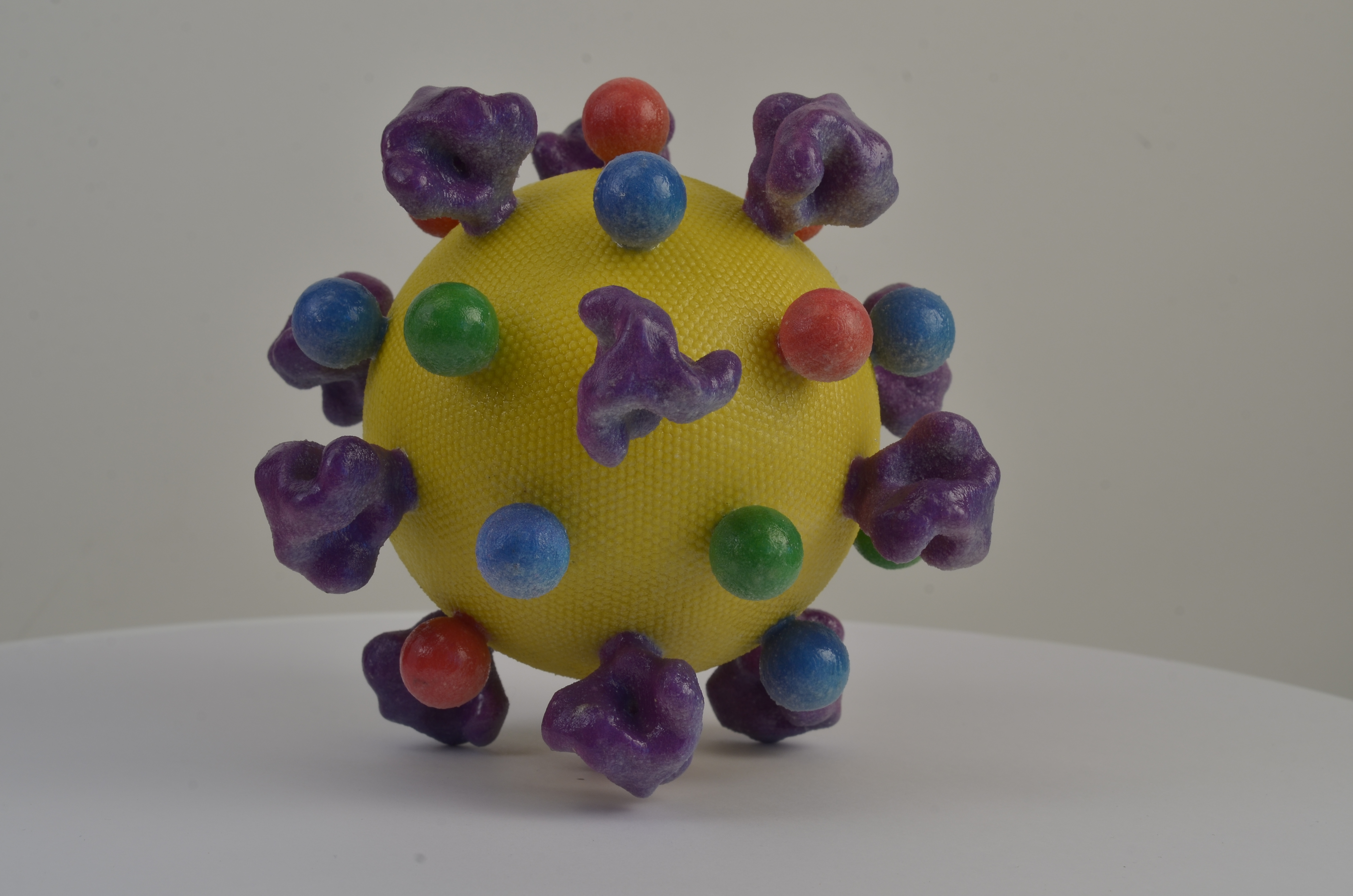
3D print of HIV. Thousands of times smaller than the width of a human hair, the virus is covered with proteins (purple) that enable it to enter and infect human cells. Photo by Daniel Mietchen via Wikimedia Commons.

3D print of HIV. In real life the virus is thousands of times smaller than the width of a human hair. HIV is covered with proteins (purple) that enable it to enter and infect human cells. Photo by Daniel Mietchen via Wikimedia Commons.

HIV incorporates its genetic material into the DNA of its host, hijacking the cell’s replication machinery and forcing it to make more copies of the virus. Each round of replication generates small genetic “mistakes,” resulting in slightly different copies that the host’s antibodies may no longer recognize.

Even before the body makes an antibody that works against one strain, the virus mutates again and makes a new one.

“It’s a race against a moving target,” said Hallen, who was also an undergraduate at Duke majoring in chemistry and mathematics.

In the early 1990s, researchers discovered that a tiny fraction of people infected with HIV are able to produce antibodies that protect against many different strains at once.

These “broadly neutralizing antibodies” fasten to the virus’s surface like a key in a lock and prevent it from invading other cells.

But HIV can evade detection by these powerful antibodies, as the part of its outer coat that is vulnerable to their attack is constantly changing shape.

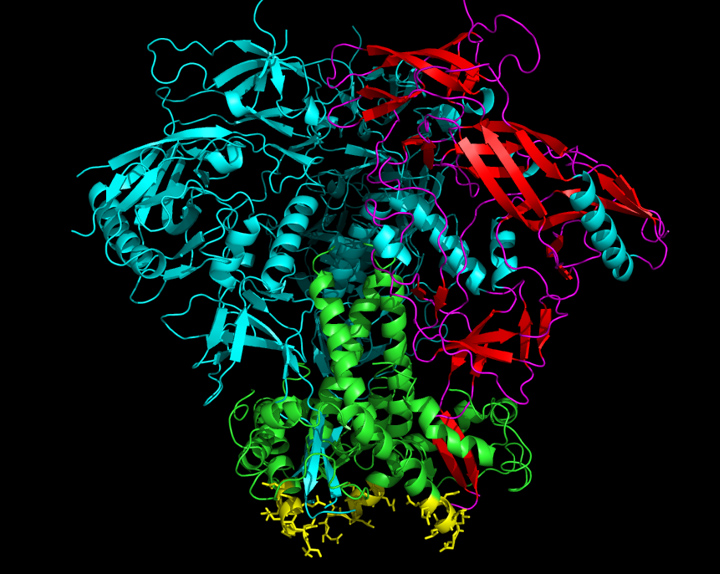
To overcome this problem, first the researchers needed a close-up look at the region of interest — a spike-shaped virus protein known as Env — in its most vulnerable state.

A 3-D closeup of a key virus protein frozen in a shape the researchers say could serve as a template for a vaccine. Image courtesy of Bruce Donald.

A 3-D closeup of a key virus protein frozen in a shape the researchers say could serve as a template for a vaccine. Image courtesy of Bruce Donald.

With this 3-D blueprint in hand, Hallen and former Duke PhD Ivelin Georgiev developed a scoring system and rated dozens of antibodies according to how well they bound to it. They confirmed that the specific conformation of the Env protein they identified was visible to effective antibodies but not ineffective ones.

The team then identified amino acid sequence changes that would freeze the protein in the desired shape.

Once locked in place, the researchers say, the protein could be injected into patients and used to coax their immune systems into preferentially churning out only the most effective antibodies.

“The idea is to ‘tie’ the protein so that it can’t transition to some other conformation and elicit ineffective antibodies as soon as the effective antibodies bind,” Donald said.

Support for this research included grants from the US National Institutes of Health, the US National Institutes of General Medical Sciences, the US National Institute of Heart, Lung and Blood, the US National Science Foundation and the Bill and Melinda Gates Foundation.

CITATION: “Crystal Structure, Conformational Fixation and Entry-Related Interactions of Mature Ligand-Free HIV-1 Env’,” Kwon, Y. et al. Nature Structural & Molecular Biology, June 22, 2015. DOI: 10.1038/nsmb.3051.

RobinSmith_hed100


Robin Smith joined the Office of News and Communications in 2014 after more than ten years as a researcher and writing teacher at Duke. She covers the life and physical sciences across campus.


Summer Data+ Groups Pursue Pigs and Purchases

Many students spend their summer breaks going on vacations and relaxing, but not the 40 students selected to participate in Data+, a summer research program at Duke.

They meet twice a week for lunch to share their work on the third floor of Gross Hall.

A pair of pigs and their piglets. Photo by Alan Fryer via Wikimedia commons

A pair of pigs and their piglets. Photo by Alan Fryer via Wikimedia commons

Mercy Fang and Mike Ma are working on a research project involving prolific pigs, those that make a lot of piglets. They are trying to determine if the pigs are being priced rationally, whether or not the livestock market is efficient and the number of offspring per pig.

Fang said the most challenging part is the research data. “Converting PDF files of data into words has been hard,” said Fang.
The students are using four agricultural databases to determine the information on the pigs, including pedigrees.

Most of the students in Data+ are rising sophomores and juniors majoring in a variety of majors that include math, statistics, sociology and computer science. The program started in mid-May and runs for 10 weeks and allows students to work on projects using different research methods.

Another group of student that presented on June 18 is working on a research project involving data on food choices.

A produce stand in New York City, photo by Anderskev via Wikimedia Commons.

A produce stand in New York City, photo by Anderskev via Wikimedia Commons.

Kang Ni, Kehan Zhang and Alex Hong are using quantitative methods of study using the “clustering process” to determine a recommendation system for consumers to help them choose healthier food choices. The students are working with The Duke-UNC USDA Center for Behavioral Economics and Healthy Food Choice Research (BECR) center.

“Consumers already recognize a system to get a certain snack,” said Zhang. “We want to re-do a system to help consumers make better choices.”

The students are basing their research on nutrition information and food purchases from the BECR Data warehouse, which comes from consumer information from throughout the US. This includes food purchases and nutrition information from 2008-2012.

Zhang added that the hardest part was keeping up with information.
“It’s a lot of data in the future, and it will be challenging putting it into use,” said Zhang.

Students in attendance said the food choices data research group provided good information.

“I liked the quantitative methods they used to categorize food,” said Ashlee Valante.

The Data+ research program is sponsored and hosted by the Information Initiative at Duke (iiD) and the Social Science Research Institute (SSRI).  The funding comes from Bass Connections and from a National Science Foundation grant managed by the Department of Statistical Science.

Warren_Shakira_hed100Guest post by Shakira Warren, NCCU Summer Intern

Page 14 of 20

Powered by WordPress & Theme by Anders Norén