Following the people and events that make up the research community at Duke

Students exploring the Innovation Co-Lab

Category: Biology Page 24 of 32

An Intersection of Math and Medicine: Modeling Cancerous Tumor Kinetics

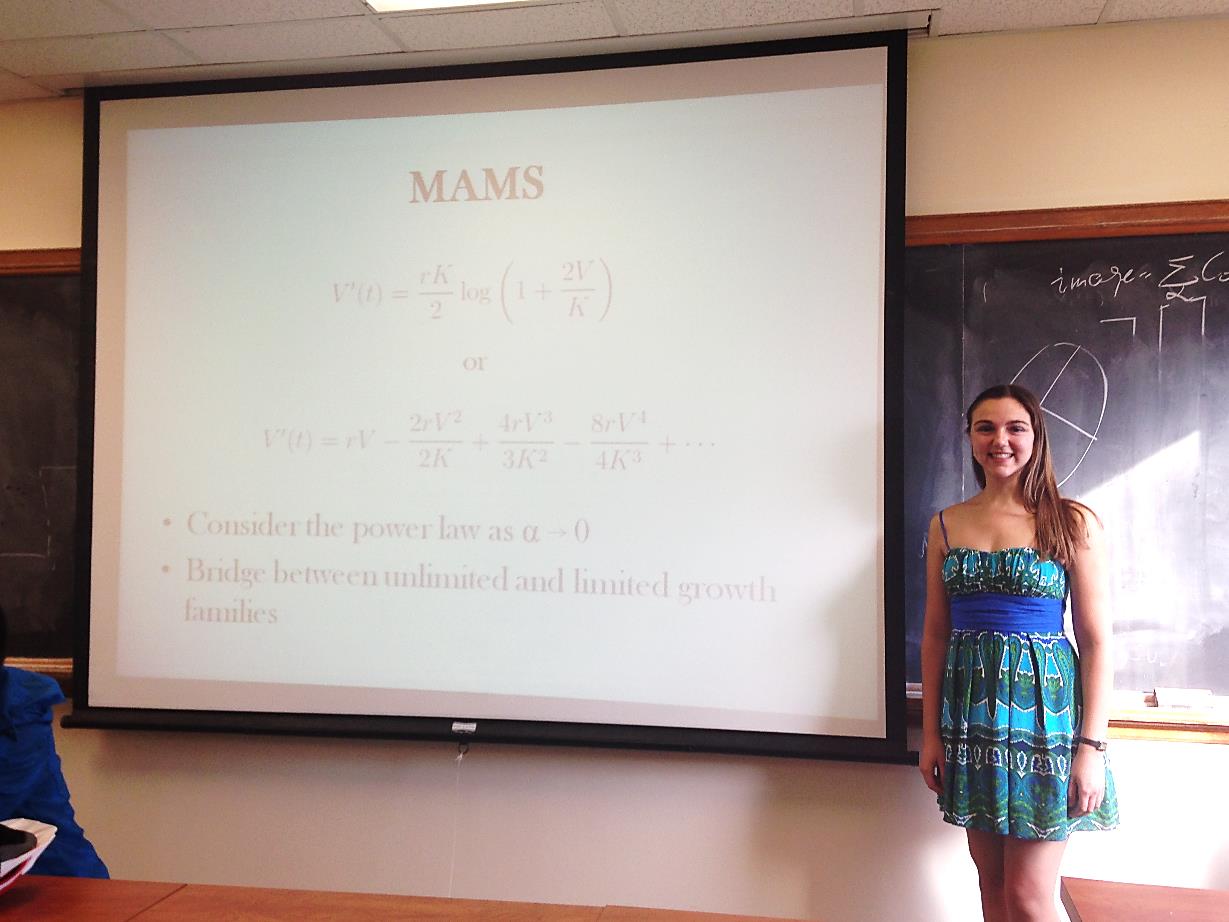
Anne Talkington with the MAMS function

Anne Talkington with the MAMS function

By Olivia Zhu

Anne Talkington, an undergraduate Mathematics student under the auspices of Richard Durrett, attempts to gain a quantitative grasp on cancer through mathematical modeling. Historically, tumor growth has only been measured in vitro (in a laboratory setting); however, Talkington looks at clinical data from MRIs and mammograms to study how tumors grow in vivo (in the human body).

Talkington is primarily interested in how fast tumors grow and if growth is limited. To analyze these trends, Talkington extracted two time-point measurements of tumor size — one at diagnosis and one immediately before treatment — and compared their change to a variety of mathematical functions. She studied unlimited functions, including the exponential, the power law, and the 2/3 power law, which represents growth limited by surface area, as well as limited functions, including the generalized logistic, which has an upper growth limit, and the Gompertz. Her favorite function is an unlimited function that she created called the Modified Alternating Maclaurin Series, or MAMS, which she originally intended to model microbial growth.

Talkington also examined various types of cancer: breast cancer, liver cancer, tumors of the nerve that connect the ear to the brain, and meningioma, or tumors of the membranes that surround the brain and spinal cord. She expected growth rates among clinical groups to be constant, but she did not generalize between the groups due to demographic bias and other confounding factors.

Ultimately, Talkington found that breast cancer and liver cancer grew exponentially, while tumors of the meninges or vestibulocochlear nerve grew according to the 2/3 power law. Talkington’s work in model-fitting cancer growth will facilitate the administration of effective treatment, which is often growth-stage dependent.
The Mystery Behind the Camel Statue

Knut Schmidt-Nielsen

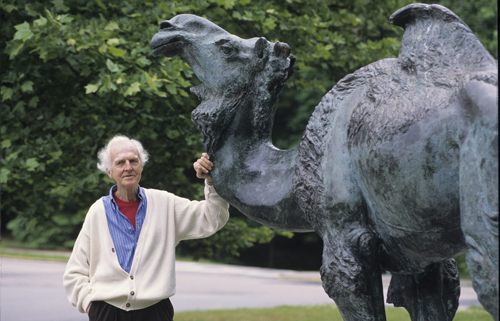
A file photo of the real Knut Schmidt-Nielsen, not the bronze one, standing with the enigmatic camel statue dedicated to him and his work.

By Olivia Zhu           

The camel statue between the Biology Building and Gross Hall is a staple of Duke’s campus, but the significance behind this landmark is generally unknown.

On Monday, September 22, faculty from the Biology Department gathered for a dedication to remember the man behind the camel statue (or rather, in front of it), Dr. Knut Schmidt-Nielsen, who died in 2007.

Knut Schmidt-Nielsen, who would have turned 99 this Wednesday, was “the father of comparative physiology and integrative biology” and a James B. Duke professor at Duke’s Biology Department starting in 1952.

Schmidt-Nielsen studied the physiology of the camel’s nose, received the International Prize for Biology, and wrote the authoritative text on animal physiology.

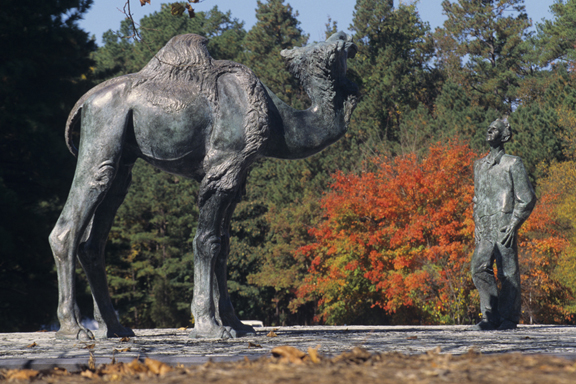
Dr. Stephen Wainwright, who was present at the dedication, commissioned the camel to British sculptor Jonathan Kingdon, who finished the bronze camel statue in 1993. The inscription for the statue, “Tell me about yourself, Camel, that I may know myself,” encapsulates Schmidt-Nielsen’s outlook on physiology.

According to Dr. Steven Vogel, who was recruited to Duke’s faculty by Schmidt-Nielsen 49 years ago, Schmidt-Nielsen was actually shy and rather uncomfortable with the statue of himself. Vogel reported that Schmidt-Nielsen greatly advanced the zoology department with his high standards and “great charm and urbanity.”

“You could never say no to Knut,” Vogel said. Schmidt-Nielsen was also reportedly  “a very serious wine drinker”—accordingly, the dedication ceremony ended with wine and champagne.

To learn more about Knut Schmidt-Nielsen, read Vogel’s memoirs or a recommended autobiography, The Camel’s Nose.

Knut Schmidt-Nielsen

The statue as it appears now, with Knut in bronze. (File photo)

In the Woods, Stalking Destroying Angels

CAPTION _ WHO IS STUDENT?

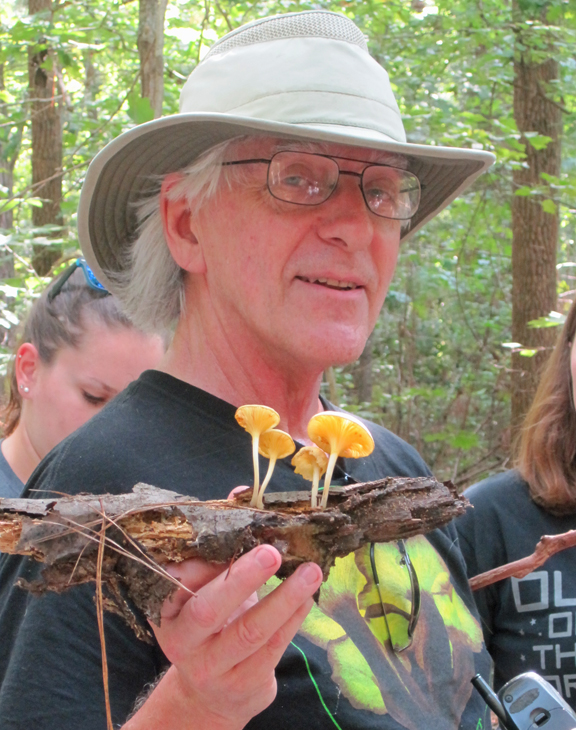
Duke student Jordan Forte peers at a Pluteus mushroom growing on a piece of rotten wood.

Story and photos by Robin A. Smith

The dozen or so undergraduate students fanning out in Duke Forest are new to mushroom hunting. The class turns over rotting logs and fallen branches and stirs the leaf litter, on the lookout for signs of fungi. Their guide is Duke professor and mushroom expert Rytas Vilgalys. Like many of the researchers in Duke’s twelve-lab mycology group, he often studies pathogenic fungi known to make people sick, but on this muggy September afternoon Vilgalys is more interested in collecting mushrooms simply for the sake of enjoying them. He plucks a tiny flamingo-pink red chanterelle from the forest floor and gives it a sniff. “They almost smell like apricots,” he said. “You can sprinkle these over your salad.”

CAPTION?

One of the mushrooms the students found was this white coral mushroom growing in leaf litter.

An unusually wet August  makes this a good time for mushrooms and their ilk. Student Jasmine Nee picks up a rotten log studded with what looks like tiny pink bubble gum balls — the fruiting bodies of a slime mold called Lycogala epidendrum. They ooze pinkish goo when popped. “They look like pimples,” she said. Vilgalys has been taking students like Jasmine into the forests of central North Carolina for nearly 30 years as part of his introductory mycology class. Their mission: to collect, photograph and identify one or two new fungi every week. “Think of your photos as the 2014 mushroom calendar for Duke Forest,” he said to the students as they headed down the trail and into the woods. “Don’t let me down.”

CAPTION?

Edible red chanterelles get their color from a natural pigment also found in brightly colored crustaceans and fish.

Today the group is also accompanied by Taylor Lockwood, a world-renowned mushroom photographer whose latest project is a movie about his worldwide quest to find and photograph elusive mushrooms that glow in the dark. Lockwood doesn’t have his tripod or reflectors or other gear with him today. Armed with nothing more than cell phone cameras and collecting baskets, he and the students disappear into the loblolly pines and sweetgum trees in ones and twos, and reappear carrying fistfuls of fungi.

ras_shroom_Lockwood_4617

Mushroom photographer Taylor Lockwood shows off some of the mushrooms found in North Carolina forests.

Lockwood passes around a white specimen with a long stalk and gills. It’s a deadly poisonous mushroom called Amanita, also known as the destroying angel. “You can touch it. Just don’t eat it,” Lockwood said. “Destroying angel is such a great name,” Vilgalys said. “It’s like a bike gang.” They find pale-green Russula mushrooms, white coral mushrooms, red chanterelles, pink slime molds and yellow brain fungus, or witches’ butter. There are also waxcaps, jelly babies, puffballs, hedgehog mushrooms, kidney-shaped soft slipper mushrooms, even a creamy yellow mushroom that appears to have a belly button. “That’s called Gerronema strombodes,” Vilgalys said. “They break down wood.” One student points to something at the base of a pine tree that looks like a dried cow patty. It’s a velvet-top fungus, or Phaeolus schweinitzii – known as a source of natural brown pigments often used for dying wool. “We’ve probably got about 20 or 30 species,” Vilgalys said, looking at their assembled mushrooms laid out on a picnic table. Dressed in a green Lithuania t-shirt, he glances down at his cell phone for an update on the United States versus Lithuania game in the Basketball World Cup when he spots something that looks like a crusty dark brown Q-tip poking up through the leaf litter. It’s a type of mushroom known as earth tongues. “Who wants to see something really cool?” he calls to the group.

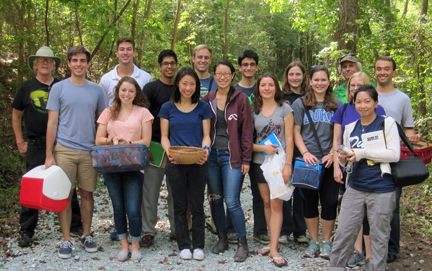
Students in bio XXXXX are new to mycology, and hope to find  at least two new fungi every week this term.

Students in bio 540 are new to mycology, and hope to find at least two new fungi every week this term.

A Summer In The Lab, Wounding Flies

By Ashley Mooney

Senior biology major and chemistry minor Rachel Shenker is working as a Dean’s Summer Research Fellow, trying to figure out how certain proteins affect wound-healing in flies.

Rachel Shenker is in Durham this summer, not Sydney.

Rachel Shenker is in Durham this summer, not Sydney.

In particular, she’s working with a protein called integrin, a cell surface signaling protein found in every animal from sponges to humans. Shenker, who is from Rockville Centre, New York, is studying how the protein is involved in fruit fly embryo development and wound healing.

Using fluorescent dyes and a microscope, Shenker is able to see where the protein of interest is in the fly embryos as they develop. She also records images of the embryos for later comparisons.

“What I find really interesting about it is to see how the smallest protein can really change an entire organism,” Shenker said. “Every organism has it in different combinations, so that’s why it’s really relevant to humans and other animals.”

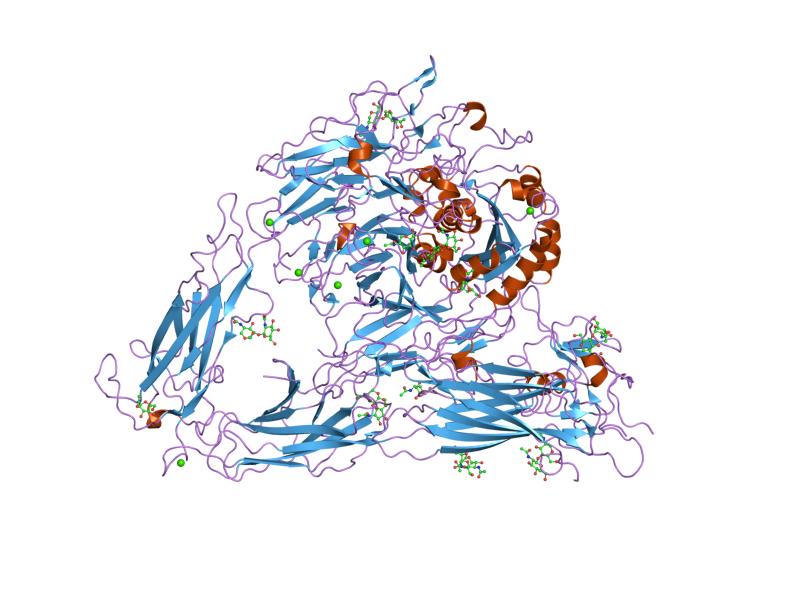
This is the alpha subunit of an integrin receptor. Fruitfly receptors have  5 of these; mammals have 18.

This is the alpha subunit of an integrin receptor. Fruitfly receptors have 5 of these; mammals have 18. (Credit: European Bioinformatics Institute)

Shenker is still trying to understand how integrins function in normal fly embryos, and has not yet started experiments that involve wounding the embryos and observing their reactions. She said once she has a better idea of how the proteins work, she will begin wound-healing experiments.

Shenker conducted similar research in high school and decided to get involved in Biology Professor Daniel Kiehart’s lab after seeing his name in several published papers. She began working in his lab during orientation week of her freshman year, and has been doing research and independent studies ever since. Shenker will use her current research to complete a senior thesis this year.

Beyond her involvement with research, Shenker volunteers at the Duke Cancer Center, is involved with the Jewish Student Union and participates in Greek life. She is also on the executive board of Duke Global Medical Brigades, and has gone on a few trips to Honduras with the program.

“We went to some of the rural areas of Honduras and volunteered in a clinic that we set up to help provide basic healthcare to citizens who really needed it,” she said. “It was a great experience that really put me out of my comfort zone.”

Shenker is currently applying to medical school.

Math and Comp Sci Junior Studies Fruit Flies

By Ashley Mooney

dorsal closure

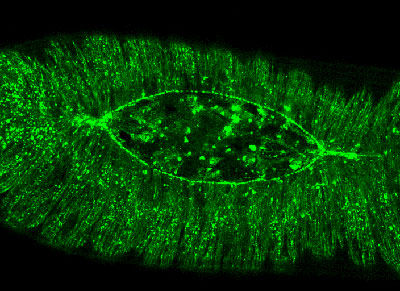
Dorsal closure is a stage in fruitfly embryonic development that is used to study wound-healing.

Roger Zou, a computer science and math major from Solon, Ohio, is working on creating more efficient ways to study wound-healing in fruit flies. It turns out that the way fruit flies heal actually has implications for how mammals heal too.

The junior is developing computational methods that can more accurately quantify cellular properties of fruit flies. As fruit fly embryos develop, he tracks cells through space and time to learn more about a process called dorsal closure. It’s a developmental stage that is similar to wound healing, where a gap in the embryo’s epithelium—which is like its skin—is closed by the coordinated effort of different types of cells. (see movie below)

Roger Zou is a junior spending the summer in Dan Kiehart's lab.

Roger Zou is a junior spending the summer in Dan Kiehart’s lab.

“It’s fun to study the morphological forces because it’s not entirely understood how organisms develop,” Zou said.

In his analysis, Zou uses a laser under a microscope to make cuts on areas of the fly embryos. After making cuts, Zou uses computational methods to measure the wound healing.

Beyond collecting such data, Zou is developing a computer program that analyzes images from the microscope more accurately.

Zou has worked in Biology Professor Daniel Kiehart’s lab since his freshman year. His project was originally a component of a graduate student’s dissertation, but after she graduated, he continued some aspects of her research.

His project has been funded by the Dean’s Summer Research Fellowship for two consecutive summers. He also has done several independent study projects. Although Zou is planning on publishing his research this summer, he will likely use the data eventually to do a senior thesis.

Several of Zou’s math and computer science classes have given him a background in the techniques needed to use a computer to analyze large sets of image data, he said.

“My favorite thing about my research is the ability to learn new things independently,” Zou said. “[Kiehart] is very good at leading me in the right direction but allowing me to be very independent and I think because of that I’ve been able to learn a lot more and learn from my mistakes.”

Outside of his research, Zou is a teaching assistant for the computer science class Data Structures and Algorithms. He also tutors  Duke students in organic chemistry and middle school children in math through the America Reads*America Counts program. And he also does web development for The Chronicle, Duke University’s independent student newspaper.

After graduating, Zou said he hopes to pursue a PhD in either computational biology or computer science or maybe go for a combined MD-PhD program. No matter which program he chooses, Zou said he wants to continue doing research.

[youtube http://www.youtube.com/watch?v=Yk-O_W1Wqbc?rel=0]

Duke Undergrads Sink Their Teeth into Evolution Research

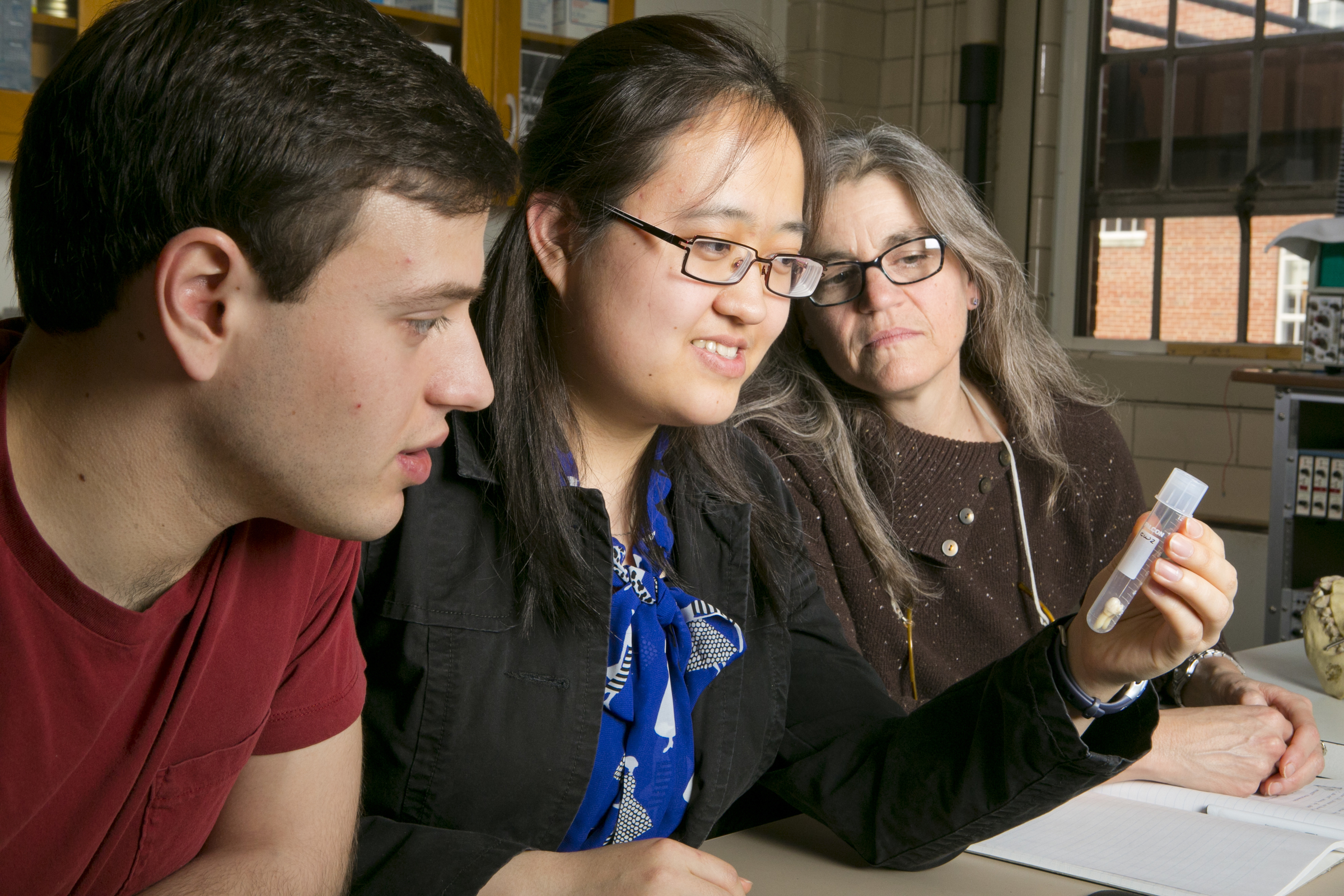
Undergraduates Ben Schwartz (left) and Amalia Cong (center) have spent the past year studying enamel evolution in the labs of Christine Wall (right) and Greg Wray (not pictured).

Undergraduates Ben Schwartz (left) and Amalia Cong (center) have spent the past year studying enamel evolution in the labs of Christine Wall (right) and Greg Wray (not pictured).

By Erin Weeks

The evolution of thick tooth enamel helped turn our species into hard food-chomping omnivores, and two undergraduates are taking a bite out of research to unravel how that happened. Amalia Cong and Ben Schwartz are building on the work of a recent paper that identified precisely where in the human genome natural selection worked to give our species thick tooth enamel. The original study looked only at the potential role of four genes with a known role in tooth development — so now the team is broadening their scope.

“They’re really excited to expand out and push the envelope on new genes,” said Christine Wall, associate research professor of evolutionary anthropology and one of the authors of the paper, along with professor of biology Greg Wray.

Cong and Schwartz arrived in the Wall and Wray labs last summer through a special research session at Duke, the Howard Hughes Vertical Integration Partners (VIP) Program. For ten weeks, they received a crash course in primate evolutionary genomics.

“They had very little time, and the progress they made was astounding,” Wall said. “The success that they had is really a testament to how hard they worked. This has developed into their own research.”

“We’ve begun to expand our tooth enamel gene analysis to include proteins in conjunction with the RNA in order to gain a more holistic understanding of the evolutionary differences that exist between chimpanzees and humans,” Schwartz said. He will continue to work in the lab through this summer, turning the work into a senior thesis.

“One of our goals was to look at the relative expression of these few genes,” Schwartz said, which they’ve done by comparing tooth development in primates of different ages. “Our results correlated very heavily with known functions of these genes in other animals, such as rats.”

The experience has given both students a taste for research, which they hope to continue doing after graduating from Duke. Cong, who hails from a small city outside of Toronto, will be attending dental school in the fall, while Baltimore native Schwartz is interested in pursuing a joint MD/PhD.

Hey, Tone it Down Little Man

By Karl Leif Bates

If your preferred method of attracting a mate is to bob your head vigorously and flash your chin-fan, you’d better tone it down a notch when there are predators around, lest you become lunch and not Dad.

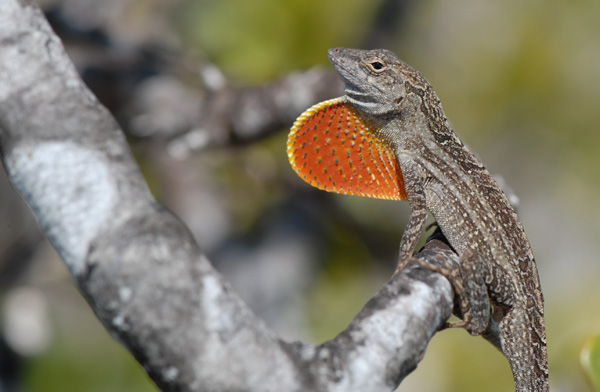
The fan-waving, head-bobbing social display of a frisky male Anole sagrei tends to be more subtle and subdued …

The fan-waving, head-bobbing social display of a frisky male Anole sagrei tends to be more subtle and subdued …

That’s the take-away advice generated by biology assistant professor Manuel Leal and graduate student David Steinberg in a new paper appearing the week of May 19 in the Proceedings of the National Academy of Sciences. (Visit their lab.)

On nine tiny islands in the Snake Creek region of Great Abaco Island in the Bahamas, the biologists videotaped and observed the social mating behavior of head-bobbing, fan-waving  Anole sagrei studs. Five of the islands also harbored the anoles’ predator, the curly-tailed lizard Leiocephalus carinatus, who is a bit bigger and mostly stays on the ground.

When the predators were present, the anoles chose to do their displays twice as high off the ground and they reduced the amplitude of their head bobs by as much as 60 percent.

...when his major predator, the curly-tailed lizard Leiocephalus carinatus is at large. (credits: Manuel Leal)

…when his major predator, the curly-tailed lizard Leiocephalus carinatus is at large. (credits: Manuel Leal)

The anoles spent just as much time displaying when the predators were around, but doing so a little less flamboyantly may mean the females have to be closer to catch the signal, Leal said. And that, in turn, may affect mating success and how the anole males set up their territories.

CITATION: “Predation-associated modulation of movement-based signals by a Bahamian lizard,” David S. Steinberg, Jonathan B. Losos, Thomas W. Schoener, David A. Spiller, Jason J. Kolbe and Manuel Leal. Proceedings of the National Academy of Sciences, week of May 19, 2014. DOI: 10.1073/pnas.1407190111

Lawrence David Gets to the Gut of the Matter

microbiome_streamplot-1024x453

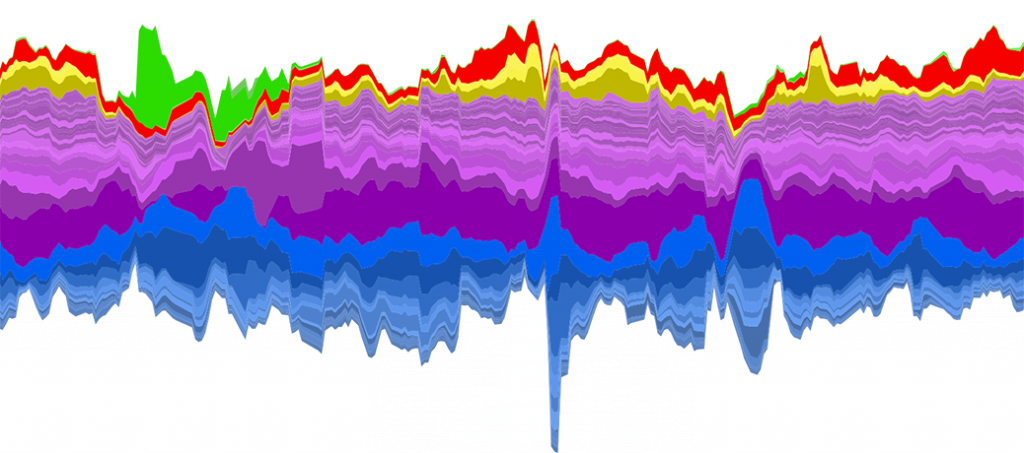
This “stream plot” is a running tally of various microbial populations in the gut over time.

By Karl Leif Bates

Assistant Professor Lawrence David of molecular genetics and microbiology in the Medical School, recently did a star turn on the Radio In Vivo program, talking about his work on the human gut’s incredible rainforest of microbial biodiversity and its interactions with infections, the immune system and our diets. There are ten non-you cells in your gut for every cell of you and their genes outnumber yours about 100 to one.

Lawrence David

Lawrence David

“Our guts are probably some of the world’s most densely colonized microbial communities,” David told host Ernie Hood. It’s a paradise really, with a steady supply of nutrients, constant climate, no sunlight “and only one way in and out.”

Listen to the one-hour April 30 podcast here

And then maybe take another 14 minutes to hear Lawrence absolutely kill at a  Story Colliders session in December 2012, telling the outrageous tale of sampling his own poop for a year and making it through airport security with a backpack full of um, specimens. (Warning – includes some pretty unavoidable scatalogical profanity.)

Studying patterns in bacterial organization

credit to Gerard Wong, of the California NanoSystems Institute

credit to Gerard Wong, of the California NanoSystems Institute

by Olivia Zhu

Bacterial biofilms, at first glance, may seem to be spontaneous, random phenomena from which we have no power to protect our environment or ourselves.

They’re potentially useful as an aid to wastewater treatment, but they also cause infections that account for $6 billion a year in health care costs. Biofilms are also more resistant to antibiotic drugs, making them difficult to eradicate.

Dr. Kun Zhao, of the California NanoSystems Institute at UCLA, refuses to see biofilms as arbitrary: he emphasizes the fact that biofilms are communities of bacteria in self-produced polymeric matrices of polysaccharides, and using a biophysical approach, he studies the pattern behind their organization.

Central questions in Zhao’s research include how bacterial colonies transition from reversible to irreversible attachment, how they migrate, and how they ultimately disperse. Specifically, Zhao examines the polysaccharide Psl, which poses a positive feedback loop because it is both secreted by moving bacteria and serves as a chemo-attractant for future bacteria movement. The positive feedback creates an inherent pattern, as bacteria are more likely to visit a location they have been to before.

Zhao and colleagues have also discovered that bacterial mutants that cannot produce Psl exhibit more random and uniform movement.

To better quantify bacterial movement,Zhao has created a computer algorithm that shows the full movement history of each individual bacterium on a dish, and that provides a “search engine” allowing researchers to find every bacterium performing specific life cycle activities, like division.

Zhao has postulated a “rich get richer” mechanism for biofilms. He compares bacterial organization to Wall Street because concentrated movement ensures that some cells become extremely enriched. In the future, he hopes to model colloidal structures for biological problems, like the growth of the bacterial cell wall. Zhao currently uses colloids, which in physics are used as models for atomic systems, to observe how shapes affect self-assembly. He also would like to look at cell-substrate interactions, which are implicated in bacterial territoriality and social interactions.

Discovering “CRISPR” methods for genetic recombination

Screen Shot 2014-03-27 at 9.54.19 PM

By Olivia Zhu

In a lecture to an overflowing auditorium in the Bryan Research Building on March 27th, Dr. Jennifer Doudna, of the University of California, Berkeley, unraveled her story of research into CRISPRs, or “clustered regularly interspaced short palindromic repeats.” Dr. Doudna specializes in RNA; she started her project on CRISPRs seven years ago, when CRISPRs were denounced as no more than junk.

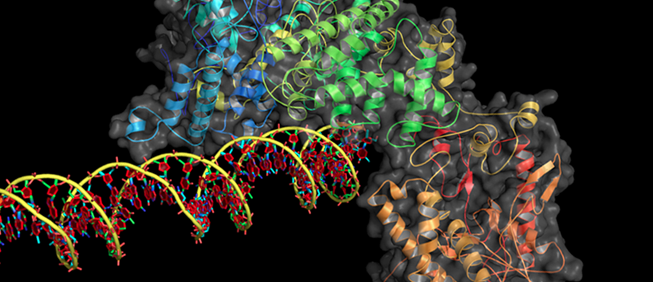
The CRISPR method includes a modifiable RNA sequence whose function is to recognize target sequences on DNA. The RNA also includes a target sequence that induces cleavage by the associated protein, CAS9. CAS9 introduces double-stranded breaks and represents an exciting improvement over the previous, less efficient collection of nine proteins used to cleave DNA; the breaks make room for insertion of new genes. The CRISPR-CAS9 system has inserted genes into a wide range of organisms, including bacteria, yeast, nematode worms, fruit flies, plants, fish, mice, and even human cells.

Jennifer Doudna

Jennifer Doudna of UC Berkeley and the Howard Hughes Medical Institute

While researchers are actively investigating the possibility of using CRISPR technology to alter genes, Doudna said the mechanism behind CRISPR gene editing remains unclear. For example, it seems extraordinary that the CRISPR-CAS9 system can locate and unwind specific DNA sequences in human cells, as the DNA there is highly condensed around histones and methylated.

Doudna’s lab is working to understand the details of the CRISPR process. One current hypothesis includes the idea that there is a spring mechanism that allows the CAS9 protein to effectively cleave DNA strands.

Nevertheless, CRISPR technology has been instrumental in allowing more precise and efficient genetic modification. What we once considered junk has spurred substantial advances across various fields of science.

Page 24 of 32

Powered by WordPress & Theme by Anders Norén