Following the people and events that make up the research community at Duke

Students exploring the Innovation Co-Lab

Category: Animals

OP Effects on Developing Zebrafish Nervous System

Jeannie Chung

Organophosphates were some of the most widely used pesticides before mounting evidence of harm to ecosystems caused the U.S. and Europe to ban them. Unfortunately, OPs are still being used in China, India and other developing countries, causing water pollution that may have far-reaching effects.

Jerry Yen,  a doctoral candidate, presented his talk on OP(organophosphate compound) effects on the Zebrafish’s nervous system as part of the series sponsored by the Integrated Toxicology and Environmental Health Program Seminar.

Yen said Zebrafish are useful for study because they are relatively fast developing, exhibit high fecundity (lots of embryos to work with) and mostly transparent, allowing visualization of the anatomy through early development.

Early exposures to organophosphates can lead to alterations in adult phenotypes, Yen said.  Specifically, he studied the possible effects of OPs in a specific gene, Kcc2, expressed only in the nervous system.

Kcc2 is the gene for a potassium chloride transporter responsible for lowering Cl- neurons in the system. 86% of the zebrafish Kcc2 gene matches with the human gene, so the effects it shows can be related to the effect OP doses will have on humans. At two days development of the Zebrafish, OP exposure causes the spinal cord to lose all of its Kcc2 expression.

Yen said the different variations of the expression of Kcc2 may affect muscle movement. An audience member suggested studying the variations of the speed the Zebrafish swims at depending on the Kcc2 expression.

Here is a short video that was played in the seminar. The embryo was studied under the microscope. Note how specific parts of the spinal cord are very clear despite being under development. Zebrafish egg development

Sharing is caring, when it comes to scientific data

By Becca Bayham

Worms don’t typically evoke a sense of awe. But C. elegans nematode worms — all 558 cells of them — played an important role in how scientific data is shared today.

Scientists Robert Waterston and Sir John Sulston described this connection during the James B. Wyngaarden Distinguished Lecture on Nov. 14, sponsored by the Institute for Genome Sciences and Policy. [Watch the whole lecture – 1 hour, 9 minutes)

During the 80s, Waterston and Sulston were unraveling the nematode genome at their University of Cambridge lab. Worms make good subjects for study because they are finite, transparent and genetically manipulatable.

The Worm Breeder's Gazette - Volume 8, Issue 2When Waterston moved from Cambridge to Washington University in St. Louis, he felt isolated from the research community he’d left. However, an informal and creatively-covered publication — the Worm Breeder’s Gazette (see photo at left) — helped bridge that physical divide. Researchers used the Gazette to share short summaries of their discoveries.

“Through this very informal means, the community was made aware of what was going on, and invited to share in it,” Waterston said. “Indeed, it worked spectacularly. Now we knew not just these anonymous pieces of DNA, but where they belonged. And that made [the data] much more useful for us and the community.”

Waterston and Sulston were the first to sequence a multi-cellular organism’s genome. Following their success with worms, the two moved on to the holy grail of science at the time: the human genome.

In terms of data sharing, “human genetics was the polar opposite of the worm field. Human geneticists held things very close to their chests,” Waterston said.

In 1996, the two scientists joined other researchers at a conference in Bermuda to discuss how human genome data should be handled. Should it be stored in proprietary databases, with limited access? Or shared freely with the world? Waterston and Sulston advocated for the latter, and this opinion ultimately prevailed. If it hadn’t, the humane genome story might have ended differently — or not at all. Data sharing “kept the lines of communication open” between researchers, Waterston said, and greatly facilitated the sequencing process.

Sure enough, following the human genome’s completion in 2000, the entire sequence was released into the public domain. Public data sharing has become standard practice for other animal genomes and other areas of science. However, even though Waterston and Sulston’s efforts encouraged data sharing on a massive scale, the tendency towards secrecy still exists.

“Pushing for more open science continues to be important,” Waterston said. “The nature of science is that private initiatives continue to push on public domain. If we don’t push back, we’re going to be the poorer for it.”

A sip or quick dip could change your DNA

By Ashley Yeager

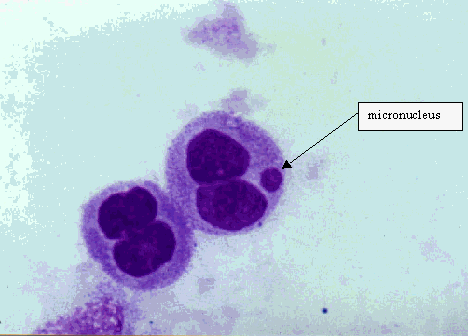
Micronuclei in mammalian cells form when DNA undergoes stress and not all the material makes it into the two new nuclei of a dividing cell. Credit: CRIOS.

As a long-time swimmer, I was a bit disturbed when EPA scientist David DeMarini said he had scientific evidence showing that extra time in the water could damage my DNA or even raise my risk for bladder cancer.

The damage, he said, comes from leftover chemicals from the treatment process in which bromine and chlorine are used to kill E. coli and other bacteria in drinking, bath and swimming water.

There are at least 600 of these chemicals, called disinfection byproducts or DPBs, released into the water after treatment, and DeMarini has spent more than a decade identifying them and how they interact with the molecules in our bodies.

Through his research, he has shown that many of the DPBs, whether ingested, inhaled or absorbed through our skin, can change our DNA. Yet, only 11 DPBs, all from drinking water, are regulated in the U.S., and none are regulated in any of the other developed countries, DeMarini said during a Nov. 11 Integrated Toxicology & Environmental Health seminar at Duke.

No one really thought about pool water until about five years ago because “people always thought swimmers weren’t at risk for anything. They thought, ‘swimmers are healthy, so why waste our time studying them,’ ” DeMarini said.

That assumption changed in 2007. Researchers in Spain found, based on interviews, that swimmers had a 1.6-fold increase for bladder cancer. Then, in 2010, DeMarini and his colleagues showed that after a 40-minute workout, swimmers’ cells created micronuclei, suggesting damage was done to the DNA so that another nuclei formed as the cell began to divide.

Together, the teams were able to identify a specific gene that makes some individuals more susceptible to DNA damage from DPBs, further increasing their cancer risks. About 28 percent individuals in the U.S. have this gene.

That doesn’t mean we should stop swimming, bathing or drinking municipal water though, DeMarini stressed. He said that the known benefits of drinking, bathing with or swimming in chlorinated water are still much greater than the potential health risks from DPBs.

“You’re naïve, though, if you think that the environment you live in is pristine,” he said. “It’s not.”

But to keep pools a little cleaner and reduce the burden of disinfection byproducts, he suggested not peeing in the water and showering before taking a dip. Drinking pool water is not a good idea either.

Being The Shy Kid May Have Its Benefits

Guest post by graduate student Kia Walcott

In a culture that seems to value outgoing personalities, the quiet kid in the corner may have the upper hand.

Since our lineage moved away from other primates, the human personality has evolved in a way that affects a broad range of behaviors. A study conducted by Duke anthropologist Brian Hare and psychologist Esther Herrmann at the Max Planck Institute of Evolutionary Anthropology compared the reaction of our closest ape relatives, the chimpanzee and the bonobo, to the reaction of human infants age 2.5 years to unfamiliar objects and people. (Orangutans were also included in this study as an ‘outgroup’.)

The baby family tree of primates

The ape family tree, decorated with adorable babies. (image adapted from http://phylogenous.files.wordpress.com/2011/01/treea.png

Test subjects were presented with items from three categories: human, object, and food.  The items within each category varied in familiarity (human: stranger vs. non-stranger), newness and excitement (objects: boring, bland toy vs. loud, exciting toy) and preference (food: delicious vs. not so delicious).  The items were presented differently over a period of three days. On day one, the items were only visible, on the second day the items were moved, and on day three the items could be touched.  The attraction to or avoidance of the unfamiliar objects was used to measure the test subject’s shyness or boldness.

Human children avoided unfamiliarity and thus most closely resembled the behavior of bonobos, though these apes did not seem to show either avoidance or attraction to the unfamiliar items. Chimpanzees and orangutans approached unfamiliar food and objects more quickly.

The differences seen across species may help explain the development of how we as humans think and react in social situations. For example, a shyer child may be more likely to seek reassurance from parents and peers, which in turn provides an opportunity for social learning and teaching that is unique to humans.

The results of this study also suggest that differences in ecology or where we live shape responses to uncertainty and risk-taking behaviors. Chimpanzees and orangutans have evolved in more unpredictable feeding environments than humans or bonobos, and Hare believes  this may explain why, despite being distantly related, these two species showed a similar attraction to unfamiliarity. Chimpanzees and orangutans may have evolved preferences that favor risk over certainty, especially when food payoffs are involved.

On the other hand, Bonobos evolved in an environment with plentiful resources where competition within the group and male aggression are less common.

Research done on domesticated animals has shown that in an environment where male aggression is less common, there is a decrease in both exploratory behavior and stress in new situations. This may explain why bonobos did not seem to care as much about the items presented.

It seems that a more reserved personality may predict better social interaction and thinking later in life.

Citation:  “A comparison of temperament in nonhuman apes and human infants,” Herrmann et al. Developmental Science, Nov. 2011. DOI: 10.1111/j.1467-7687.2011.01082.x


Going DEEP in the Genome

By Karl Leif Bates

Duke has a growing number of researchers looking into how genes are played differently from one organism to the next, based not on the spelling of their genes, but on cues their mothers gave them. The field is called epigenetics – epi meaning above or beyond the genes.

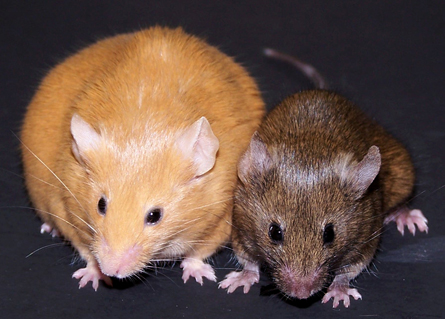
Same genes, different maternal diets. Amazing, huh?

Your momma (and probably daddy) clamped some of these external molecules called “methyl groups” onto your DNA, based on the environmental conditions they were experiencing. Methyl groups are a way of turning down a gene’s activity without changing its spelling or taking it out. It’s a neat trick, but it creates a huge new layer of complexity above and beyond just the bare-bones spelling of your genome.

In a landmark 2003 epigenetics study Duke’s Randy Jirtle showed that the color and size of second-generation mice could be altered simply by changing their mother’s diets. Their genes were essentially the same as their pale, fat cousins, but their mothers had clamped epigenetic controls on their DNA that made them darker and skinnier. (see Jirtle on Duke’s Office Hours)

A Wednesday morning symposium kicked off the existence of DEEP, the Duke Epigenetics and Epigenomics Program and introduced more than 140 members of the campus community to some of our leading researchers in epigenomics, the broad-based search for epigenetic changes.

I missed the first half of the show, but caught Susan Murphy of Ob-Gyn talking about a huge epigenetic study she’s doing with 2000 human mother-baby pairs right now. They’re hoping to correlate environmental factors during the pregnancy – nutrition, stress, smoking, alcohol etc. – with epigenetic differences in the babies from birth to age 5. And then, hopefully, they’ll find some insights into developmental differences, obesity, ADHD, diabetes, asthma, autism, etc.

Murphy said there are already some diseases thought to stem from epigenetic imprinting, and she’d like to find more. (Yes, it’s always a bad idea to smoke during pregnancy, and she already has the low-birth-weight data to prove it.)

Greg Crawford of Pediatrics and IGSP finished the session with a view of the huge landscape to be explored. Only 2 percent of human DNA is genes that make proteins. In their search so far for other areas of DNA that may be sensitive to signaling (as from epigenetic changes), they’ve found that maybe 12 percent of the genome is involved in sending and receiving signals. That still leaves 86 percent mystery.


A Festival of Lemur Babies

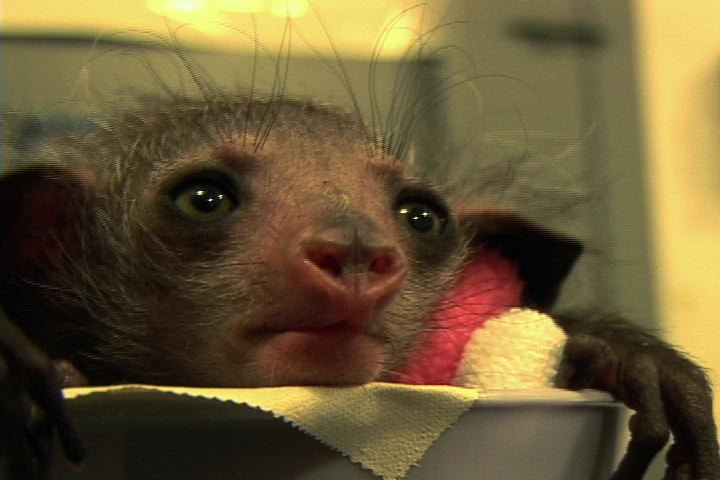
Ichabod the Aye-aye baby

Ichabod the baby Aye-Aye was the somewhat nervous 2008 result of a painstaking 2-year effort to teach his sire how to make babies.

A BBC Television production called “Miracle Babies” is airing this week on the Nat Geo Wild cable channel, with two segments about the captive breeding programs at the Duke Lemur Center.  Their crew travelled all over learning about captive and not-so-captive breeding programs – all of which seem to  result in adorable infants, strangely enough!

Tuesday, Sept. 13 at 10 p.m. Eastern on National Geographic Wild, learn about DLC’s efforts to breed nocturnal, bug-eating Aye-Ayes.  (The male needed more than mood lighting to figure things out, let’s just put it that way. )

Then on Wednesday Sept. 14 at a more reasonable 8 p.m., they check in again with a segment about the stunning Coquerel’s sifakas and their spindly little infants. View the complete schedule.

Preview here: Miracle Babies Preview

Coincidentally, the Lemur Center posted a baby video of its own over the weekend, starring an impossibly small baby mouse lemur and its mum.

See it here: Mouse Lemur baby


Blue Crab Love Is Indeed Blind

Guest post from graduate student Kia Walcott

A reconstruction of what a female crab may see of a displaying male when her lenses are off.

Female blue crabs (Callinectes sapidus) are literally blind when they choose their mates, according to new research from Duke biologists Jamie Baldwin and Sönke Johnsen.

Blue crabs are one of many crustacean species that undergo molting and mating at the same time.  Because the multi-faceted lenses that make up the crab’s eyes are part of the exoskeleton, they too are shed.  So it’s like a molting female has taken out her contact lenses.

Baldwin and Johnsen put the crabs in an eye exam of sorts, with a rotating black-and-white striped drum. When the crab can see, she will move her eyes in the same direction as the rotating stripes. When she can’t see, she will not perform this behavior. By finding the width between the stripes that the female no longer moves her eyes, Baldwin and Johnsen were able to measure visual acuity.

They found that a female’s vision can be blurry from 3 days prior to molting until 3-6 days after molting.

This means that during the critical time of mating, when these female crabs should be experiencing all of the romantic courtship behaviors displayed by male blue crabs like claw waving, standing tall on the walking legs, and rhythmic waving of swim paddles, these single ladies can’t see a thing.

The males, on the other hand, can see perfectly, and in fact, use their color vision to choose females with red claws versus those with claws of other hues. Baldwin and Johnsen say all hope is not lost for female blue crabs however. They believe that chemical cues, what we would call smell, may help overcome her blurred vision.

Other studies have found that visual sexual cues are nearly non-existent or at least not documented in species that mate and molt simultaneously like this. These findings may explain why, at least for one species, looks aren’t everything.

CITATION: Baldwin and Johnsen. (2011) Effects of molting on the visual acuity of the blue crab, Callinctes sapidus. J Exp Biol. 214: 3055-61. <http://jeb.biologists.org/content/214/18/3055.long>


Lemur film features future Duke post-doc

silky sifaka

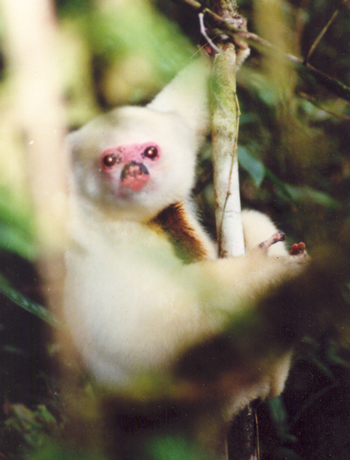
Primatologist Erik Patel studies the endangered silky sifaka, seen here. Credit: Erik Patel.

Primatologist Erik Patel is trying to study and save a cute lemur called the silky sifaka (Propithecus candidus).

In a recent online documentary, he takes viewers through Marojejy National Park, a 148,387-acre area of jungle with rugged mountainous terrain, and gives them a rare, up-close look at the silky in its wild habitat.

These lemurs are most at risk of extinction, which is one of the reasons Patel studies them, and, as the documentary shows, the illegal logging and bushmeat trade are likely accelerating the loss of the lemurs’ habitat and their overall population.

Patel, who will join Duke’s Lemur Center in January, told the New York Times that “stopping illegal logging in Madagascar will be impossible until the government stabilizes and some measure of accountability is put in place.”

“It’s about money,” as the individuals in government are now “organizing and profiting from the problem,” he told the Times reporter.

One of Patel’s roles when he joins Duke will be to oversee the Lemur Center’s new conservation initiative to help individuals in cities near Marojejy understand and value the distinct environment and animals found only in their country.

Watch the full feature here.

Lemurs leap in back-to-school lessons

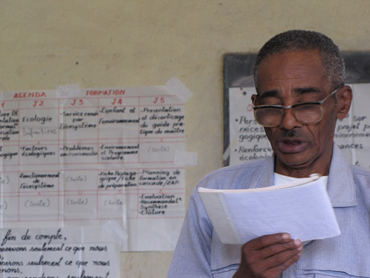
Mr. Gimod, an education specialist, reads notes taken from the Malagasy Teacher's Guide, a teaching tool to help preserve the country's lemurs and biodiversity. Courtesy of Lanto Andrianandrasana.

By Ashley Yeager

Halfway around the world, in Madagascar’s northeastern city of Sambava, 30 students crowded into a classroom to start lessons in biology and conservation.

These students weren’t your average school children, however.

They were mostly Chefs ZAP, officials from the local school districts in Sambava and another nearby city, Andapa.

People in these cities “are not yet conscious” that it’s urgent to protect the biodiversity in this region, says Lanto Andrianandrasana, a Malagasy field assistant and who helped organize the lessons.

The lessons are to help individuals there to appreciate and understand the importance of the environment through a new Duke Lemur Center conservation initiative.

One reason the center chose to develop a new conservation education initiative in Sambava is because the nearby national parks are experiencing devastating effects from illegal logging and lemur trapping.

In 2009, armed gangs began harvesting rosewood trees worth hundreds of millions of dollars and trapping and killing critically endangered lemur species after a military coup overthrew democratically elected president, Marc Ravalomanana. The illegal activity continues, with the wood being shipped to China for use in high-end furniture and the lemurs eaten or sold as bushmeat.

Andrianandrasana, who is the on the ground coordinator for the DLC conservation initiative, says that to protect the lemurs and the rosewood trees in the region, the people must learn to love them. He says they need to understand the importance of the environment, and that’s why it is essential to give them basic biology knowledge, particularly in primary and secondary school.

Through the initiative, he and others will train the Chefs ZAP to use a Malagasy-prepared Teacher’s Guide, which discusses the biology of the rosewood and lemur populations and the environmental strategies to preserve them, along with other conservation topics.

The Chefs ZAP will then share the guide with the directors of the schools in the region. The directors are then to train their teachers to use the guide so they can share it with their students. This is a training cascade technique that has worked in schools in other eastern Madagascar cities to encourage enthusiasm for environmental issues not only among teachers and students, but also adults in the community, says Duke Lemur Center conservation coordinator Charlie Welch.

Welch worked with Andrianandrasana and other Malagasy conservationists to plan and implement the new initiative. The lessons and the Teacher’s Guide are borrowed from an already successful conservation initiative run by the MFG, or Madagascar Fauna Group. The Duke Lemur Center, or DLC, is a founding and managing participant of this 27-member group, which for the past ten years has sponsored Malagasy education specialists to train teachers in the Tamatave region in environmental education.

Malagasy Chef Zaps

The Chefs Zap from Andapa and Sambava after their biology and conservation training. Courtesy of Lanto Andrianandrasana.

But Welch and others at DLC thought the center could “do more” to broaden the efforts of the MFG, he says. Using DLC grants and donations, Welch arranged for the most experienced MFG trainers, along with Andrianandrasana, to work with the local Chefs ZAP in Sambava and Andapa.

The first session was on Aug. 15, and the trainings will continue through the school year.

Welch, meanwhile, has been working with other Duke departments, including four masters students in the Nicholas School who will evaluate the trainings, to further develop the education initiative.

Page 19 of 19

Powered by WordPress & Theme by Anders Norén