Following the people and events that make up the research community at Duke

Students exploring the Innovation Co-Lab

Category: Animals Page 18 of 19

Maji Moto: Dispatches from a Drought

By: Nonie Arora

Photogram of Drought in Amboseli Basin, Courtesy of Courtney Fitzpatrick and Horse & Buggy Press

All of the wildebeest died.  The cattle died. The zebra died.

The people starved.

“Someone once told me that as we live, we either become broken or we soften,” says Courtney Fitzpatrick, a graduate student in evolutionary biology who conducted fieldwork in Kenya’s Amboseli basin during 2009, the worst drought in living memory. “In hindsight I see that making Maji Moto was a panicked attempt not to break.”

Maji Moto, Swahili for “hot water,” is the name of the watering hole Fitzpatrick encountered every morning going from camp to the baboon study range. Her work of creative nonfiction, Maji Moto: Dispatches from a Drought, is composed of lyrical essays and photographs that detail the protracted suffering of the ecosystem imposed by the drought. Fitzpatrick says the experience truly tested her ability to protect her empathy.

Fitzpatrick was there to study sexual selection, mate choice, and reproduction. While humans have “concealed ovulation,” many old world monkeys like chimps and baboons have an exaggerated signal of fertility called an estrous swelling. It has been hard to fully understand the evolution or function of this trait in the past, according to Fitzpatrick. Her hypothesis was that estrous swellings evolved like a peacock’s tail – as a consequence of sexual selection pressure. She set out to answer the question of whether males prefer females with larger swellings.

Fitzpatrick is a field biologist at heart. To study organisms in their natural environment, she spent about eighteen months obtaining measures of swellings in Kenya’s Amboseli basin through the Amboseli Baboon Research Project. The project is ongoing from the 1960s and has rich longitudinal data. For Fitzpatrick, measuring thousands of swellings was tedious and required careful attention to detail. But in the end, she says now that “it’s just fun having all that data.” Along with measuring estrous swellings, she observed mating behaviors such as how close males stayed to females and how they groomed each other.

Broadside from Maji Moto, Courtesy of Courtney Fitzpatrick and Horse & Buggy Press

Maji Moto originated organically as Fitzpatrick compiled essay blog posts and photographs she had shared with friends and family during her time in Kenya. She was “seeing incredible sights I couldn’t not photograph.” As the drought became more serious, so did her writing. By the end, her creative nonfiction was as serious as the science. Fitzpatrick said she couldn’t analyze the data free from distress until after  Maji Moto was finished.

Fitzpatrick brings a unique background to her scientific endeavors: she studied studio art as an undergraduate student and taught photography for a New York social service organization before pursuing graduate school. She grew up in naturalist family, and so was always interested in evolution and behavior. When she started missing the sense of intellectual engagement from an academic environment, she decided to pursue graduate school at Duke.

Her studio art background had practical implications – comfort with the camera made it easier to collect her data, which involved taking pictures and making careful measurements. But even more so, thinking about the world from an artist’s perspective informs the way she thinks about and does science. Fitzpatrick says the process of generating hypotheses often requires relaxed creativity, like a painter conceiving an image on a canvas. Moreover, many scientists are loyal to particular methods, like artists, as they “arrive closer and closer to an unknown truth.”

The book and photographic prints from Maji Moto are on display in the Foyer Gallery (401B Foster Street) every Friday from 11am to 2 pm. The hand-printed, limited edition art book is also available for purchase from Horse and Buggy Press. Now that Maji Moto has been published, Fitzpatrick’s next steps are finishing her dissertation and beginning a postdoctoral fellowship at the National Evolutionary Synthesis Center in Durham, studying theoretical models of sexual selection.

Rethinking science on pandemic-potential viruses

By Ashley Yeager

Debates over experiments subjecting ferrets to modified bird-flu strains had scientists and politicians seriously questioning how to approach and publish studies on pandemic-potential viruses. Credit: J. Smalley/NaturePL.com

Making mutant forms of bird flu and publishing the results caused a major squawk in the public and in the political and scientific communities over the last year.

The issue was whether the new mutants could ward off a major pandemic of bird flu or start one, explained Stephanie Holmer, a graduate student in Duke’s Department of Cell Biology.

She raised the issue during the May 18 meeting of the Science and Society Journal Club.

The row began when researchers at the University of Wisconsin-Madison and the Erasmus Medical Center in the Netherlands independently tweaked strains of the H5N1 virus, commonly named the bird flu. The strains, the teams report, are more easily transmitted between ferrets, the lab-double for humans.

“The fear was that if the mutant forms of the virus got out of the lab, bioterrorists could use them to make a super-virus and start a pandemic. But there was not any guarantee that what the scientists had was a weapon. The mutant strains weren’t even that efficient at killing a ferret,” Holmer said.

During the forum, about a dozen students and faculty from departments across campus debated whether this kind of research should have been done, if journal editors should publish the full results and what can be done to prevent future squawks about similar types of research.

Electron micrograph of influenza A virus. (Centers for Disease Control, Erskine Palmer)

Scientists want to study H5N1 to find out how fast the virus mutates and how virulent those strains are in mammals, including humans. So far, outbreaks of the non-mutant form of the bird flu in humans have been limited. The cases, about 100 to 200 from 2003-2012, have occurred most often in Indonesia, Egypt and Vietnam, according to statistics from the World Health Organization.

In two separate papers, the teams from Madison and the Netherlands reported the strains of H5N1 that seemed to be more virulent in ferrets. The Madison team submitted its paper to Nature; the Netherlands’ team submitted to Science. Both papers came under government scrutiny before they were published because the methods in each could potentially be misused to make a bioweapon.

But the researchers had already presented their data at conferences, and they had institutional approval to initiate the experiments, facts that led Subhashini Chandrasekharan, co-coordinator of the journal club, to wonder aloud why it took until the point of publication to prompt a government and scientific scuffle over the experiments and the results.

“I’m not a virologist, but I don’t find any reason that the study should not be done or that the results should not be published. The jump of this virus from birds to humans is going to happen. It’s only a matter of time. If we already understand the mutations, then we’ll be faster at finding treatments and vaccines,” Chandrasekharan said.

She added that if a bioterrorist is going to make a weapon from a virus, it didn’t seem likely that they’d need the papers, which were finally approved for publication on April 20, to make the mutations. They’d do it anyway, she said, explaining that preventing publication was probably not going to be “the wall” to stop a terrorist from plotting an attack.

That issue, of course, raises another whole set of squawks.

Non-human Apes Cooperate, Negotiate

By: Nonie Arora

The Scientist and Nature Credit: Nonie Arora

A large bronze camel resides on Science Drive. Students may think it’s a landmark or a place to take scavenger hunt photos, but the camel has greater meaning.

At the annual Knut Schmidt-Nielsen Memorial Lecture, students learned that the Scientist and Nature statue depicts  Schmidt-Nielsen and his research subject for 20 years, the camel. Dr. Brian Hare explained how Schmidt-Nielsen, a pioneer in animal physiology, hoped to learn more about humans by studying camels.

Hare, a professor of evolutionary anthropology, works on what he calls the “exciting problem of human cooperation” by comparing animal species. He is interested particularly in cognition and evolution with goal of understanding what it is that makes us human and how we got that way.

Hare defines cognition as the “the inferential abilities that allow for flexibility and understanding.” He wants to see if species can solve a problem in a new situation with flexible problem solving. Two of the species Hare studies are bonobos and chimpanzees, the two closest living relatives of humans.

People often say that collaboration, negotiation and altruism are unique human traits, Hare said. But he has seen non-human apes exhibit these traits in his experiments. He believes that to see how we are special, we need an accurate assessment of differences between humans and non-human apes.

Many researchers believed non-human chimps could not negotiate when they had conflicting interests because these animals don’t have norms and language like humans. For a while researchers were faced with a paradox: animals were exhibiting cooperative behavior in nature but not in experiments. The problem was the small sample sizes of these trials. When Hare began working at sanctuaries in Africa – Ngamba, Tchimpounga, Lola ya Bonobo – with large numbers of apes, he found evidence of cooperation.

He observed that changing chimp pairings could turn on spontaneous cooperation, and if the chimps were tolerant of their partners, they were much more likely to work together to get the banana.

In another set up, dominant and subordinate apes were paired together. Although subordinates initially refused selfish offers by the dominant ape, after negotiation, a cooperative decision was made within a few minutes in 95 percent of the trials. Hare said he was surprised at the extent of cooperation given the apes’ lack of norms and language.

Bonobos at the Cincinnati Zoo. Credit: Wikimedia Commons

Hare also found that bonobos will voluntarily share food with a stranger, but not with a member of their in-group. He hypothesizes this is because sharing with a stranger enables them to expand their social network, but sharing with an in-group member does not significantly alter that relationship.

Hare’s research has shown that traits traditionally associated with humans like tolerance and negotiation, among others, are also present in other non-human apes, suggesting that we may not be as different from them as we thought.

Improve science to explain everything, Dawkins says

By Becca Bayham

Have you ever wondered what people in the Middle Ages would have thought about airplanes? Or automatic doors? What would we have thought about iPhones 10 years ago?

Advanced technology can seem like magic, scientist Richard Dawkins said at a public lecture on March 29. But as cool as these technologies are, we know there’s nothing mystical about them.

Dawkins made the case that science, too, can seem magical or divinely-inspired. Take human evolution; some people believe that God, instead of natural selection, is responsible for the incredible complexity of life on Earth.

In response to that idea, Dawkins described a card game where a straight flush in any suit gives you a perfect hand. The odds of all four players getting a perfect hand are infinitesimally small, almost impossible. (If that happened to you, you might consider divine influence.)

“Evolution is not like that, but a lot of people think it is,” Dawkins said.

“Changes come about through the process of natural selection, which is often thought to be random chance, even though it is the opposite of random chance. It works because every one of those steps is only slightly improbable. But after 1,000 steps, you can end up with something beautiful, looking improbably like it was designed,” he explained.

Given a sufficiently large number of generations, very significant changes can occur. But evolution doesn’t guarantee change, Dawkins said. Chimpanzees, for example, have had as much time to evolve as we have. And yet they resemble our African ape ancestor more closely than we do.

When Christian academic John Lennox spoke at Duke earlier this year, he argued that science and religion are not mutually exclusive. Dawkins, an evolutionary biologist, falls on the other end of the faith vs. science spectrum. He said he doesn’t believe in religion, instead advocating an evidence-based approach to life.

“There are lots of people who actually do believe that a first century prophet turned water into wine, walked on water and fed the 5,000. There’s no more reason to believe that than to believe Cinderella’s fairy godmother turned a pumpkin into a carriage,” Dawkins said.

If something happens that science can’t explain, he argued that we should keep improving our science until we can explain it.

“Don’t ever be lazy enough to say ‘I can’t explain it, so it must be a miracle,'” Dawkins said. “The proper and brave response to any such challenge it to tackle it head on.”

Kratt's Creatures come to life

By Ashley Mooney

Duke alumnus Martin Kratt detailed his journey from his time as an undergraduate throughout the creation of several wildlife shows targeted toward children.

Kratt spoke Monday to a crowd of students, wildlife enthusiasts and some of his younger fans about his roots in wildlife conservation. With his brother Chris, Kratt created several wildlife television shows—including Kratts’ Creatures, Be the Creature and Wild Kratts—as a way to aid education and preservation of endangered species. Several of his roots tie back to Duke, namely the star of his popular show Zoboomafoo, which featured Jovian, a captive Coquerel’s Sifaka from the Duke Lemur Center.

Kratt got his start as a student technician at the Lemur Center—then known as the Duke Primate Center—in his junior year.

Jovian, the Coquerel's sifaka who played Zoboomafoo. Photo courtesy of David Haring from the Duke Lemur Center.

Although he initially wanted to be a conservation veterinarian, he credited his beginning in wildlife television to a class at Duke called amphibian ecology. Kratt borrowed an underwater camera and filmed salamanders during class field trips, creating a video on the amphibians for another class he had been taking for fun. His film ended up winning the Hal Kammerer Memorial Prize for Film and Video Production.

“Every weekend our professor would take us on field trips to the coastal plains of Piedmont to the Smokey Mountains—looking for salamanders, that was the course,” he said.

He joined Ken Glander, professor of evolutionary anthropology, on a research trip to Costa Rica. There, Kratt helped Glander catch Howler monkeys amidst the dry northern rainforest. He remained in Costa Rica for an additional six months, filming the wildlife in the area.

“We started taking these videos . . . to elementary schools in New Jersey. We sat and ate pizza at lunch, asking them what they liked and what they didn’t like. And the great thing about kids: They are honest critics,” he said. “Overall, they liked it, from kindergarten to fifth grade.”

Despite positive reviews from their younger audience, several networks did not find the Kratt brothers’ idea feasible.

“One comment we got from National Geographic was, ‘it’s cute but it will never be a TV show.”

Despite many setbacks, Kratt created a known collection of children’s wildlife programs. His new endeavor, Wild Kratts, aims to teach kids about animal behaviors that are known or suspected to exist, but have never been caught on camera.

“There’s animal behaviors that nobody’s ever seen, for example sperm whales fighting colossal squids,” he said. “If we did a series using animation we can show all of these behaviors that eluded us.”

This idea evolved into the current series Wild Kratts. The show is now ranked number eight in ratings of animated shows, two spots ahead of SpongeBob, Kratt said.

“We’re all working together [to help endangered species]. Scientists are studying to gather new information; educators are educating [and] policy makers can make policy,” he said. “Everybody can find their own path and their own way to help save endangered species.”

Probing our Internal Universe

By Prachiti Dalvi

Dr. Nicolelis was recently featured on the Daily Show with Jon Stewart to discuss his new book: Beyond Boundaries.

At the 2014 FIFA World Cup, Dr. Miguel Nicolelis hopes to see a quadriplegic child walk into the pitch and deliver the kickoff of the opening game. A pioneer in brain machine interface research and recent author of Beyond Boundaries, Nicolelis gave an evening talk on March 14 at the Nasher as a part of Brain Awareness Week.  Dr. Nicolelis grew up in São Paulo and came to Duke in 1993. Since then, he has focused his research efforts on facilitating two-way dialogue between brains and machines.

Recent advancements in biomedical engineering allow us to use filaments implanted in several parts of the brain to obtain brain function readings: something that was impossible several decades ago. In one of Dr. Nicolelis’s first experiments, monkeys learned to use a joystick to catch a moving object on a screen. After the monkey was able to accurately catch the object 90% of the time, a brain-machine interface was turned on linking the robotic arm to the brain signals. The joystick was eliminated from the setup. The only way to obtain the reward (Brazilian orange juice) was to imagine catching the object.

The brain-machine interface allows for the translation of mental movements into digital commands while recording muscle activity. Using data collected from this experiment, on March 28, 2003, the Nicolelis team was able to design and operate the first robotic arm.

Until recently, neurons were considered the basic functional unit of the brain. More recently, scientists have focused their attention on populations of neurons as functional units instead.

Nicolelis and others are focusing on cell assembles as key functioning units of the brain, not simply neurons. “Populations of neurons across multiple brain structures are working together to make movement possible,” says Nicolelis. Thus, a holistic approach of looking at brain activation is necessary to understand and replicate movement in machines. Differences in the number of neurons activated have been observed when neurons are operating a robotic arm instead of a biological arm.

In a second set of studies, Nicolelis studied the effect of virtual simulations on the brain’s ability to assimilate other things as extensions of the human body. For example, if a professional tennis player is blindfolded and asked to point where his/her arm ends quickly after they have been playing tennis for an hour or so, they will point to the end of the racket as the end of the arm. In other words, the tennis player is assimilating the racket as an extension of the body. Similarly, if a monkey sees a knife approaching a rubber limb that is in the place where his arm should be, he will experience the anxiety, increase in heart rate, and even remove his real arm away from the perceived source of danger.

In an international collaboration with a team from Kyoto, Japan, researchers were able to send brain activity data of a monkey walking on a treadmill to a robot in Japan. The video of the robot walking was then transmitted back to the monkey. Even when the treadmill was stopped, and the monkey was rewarded for each step the robot took, the monkey began imagining that she was the one taking steps in order to be rewarded.

This brain-machine interface research has interesting implications in medicine, ranging from spinal lesions to Parkinson’s disease. When a spinal lesion forms, the brain continues to produce brainstorms to direct movement; however, the body does not have access to muscles. This is where the brain-machine interface comes into play: the brain can provide the directions that can be converted to digital commands, which can ultimately lead to functioning of the machine. To use the brain-machine interface to treat Parkinson’s, Dr. Nicolelis has been using a mouse model developed by Dr. Marc Caron in which 80% of the neurotransmitter dopamine is depleted. The rigid movements of Parkinson’s patients can be refined using brain-machine interface technology.

The brain-machine interface has the ability to alter medicine tremendously.

Dr. Nicolelis’s research implies that it is “possible to use brain activity beyond epithelial boundaries we have,” he says. Perhaps we will be able to do things using this technology, which we customarily cannot do because of the physical constraints of our body because there is no limit to what our minds are capable of doing. “There is a tremendous range of opportunities in this field.”

With the progress the Nicolelis lab is making, perhaps we will be able to see something truly unique at the 2014 FIFA World Cup in Brazil!


Meet Joel Bray, Lemur Enthusiast

 By Nonie Arora 

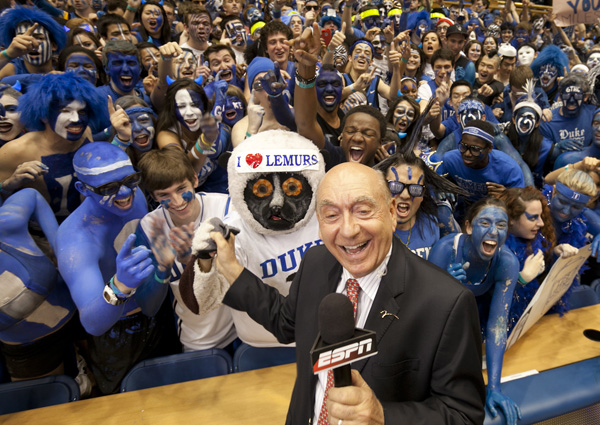
Joel the Lemur and the rest of the Crazies meet Dick Vitale at the March 3 UNC game. (Duke Photo)

You may have been wondering who the student dressed as a lemur was for the Duke-Carolina game. Meet Joel Bray, lemur enthusiast and Trinity Junior.

Joel works in Brian Hare’s cognitive psychology lab where he does research on the psychology and evolution of nonhuman primates.

“Primates are an amazing way to understand human behavior, and specifically cognition,” Bray says. He studies lemurs at the Duke Lemur Center, which is home to the largest population of lemurs outside of Madagascar. Lemurs, most similar to the last common ancestor of all primates, are interesting because all 100 species are closely related at the genetic level, but they live in very different social and ecological environments.

In his first project, Joel studied inhibitory control in lemurs to understand how cognition evolves. This was part of a larger effort under NESCent, the National Evolutionary Synthesis Center. The project sought to compare dozens of species, including primates, birds, and rodents, on the same tasks using the same methods.

Joel tested the lemur’s inhibitory control by presenting them with an opaque cylinder with openings on both ends and food inside. The animals first learned how to retrieve the food. Then, the opaque tube was replaced with a transparent one. The impulse is to reach directly for the food item through the obstructed barrier, but to successfully retrieve the food the lemurs had to inhibit that response and reach from the side. Inhibitory control is considered to be important in both social and foraging contexts, and certain environments are expected to exert more selective pressure for the ability. In human children, it is predictive of future academic and social success.

Joel, out of costume, studies a troop of ringtailed lemurs because he's a method actor. (Courtesy of Joel Bray)

More recently, Joel has investigated social cognition, specifically asking what lemurs understand about the perception of other individuals. Humans display “theory of mind,” the notion that other individuals have perceptions, knowledge, and beliefs different from one’s own. While lemurs are unlikely to have a complex understanding of the minds of other individuals, they may display more basic abilities.

In his current project, Joel is asking whether lemurs will take advantage of information about a human competitor’s visual perspective to acquire food. One food item is visible to the experimenter and the other is not, and the lemur must decide which to approach. It is expected that that species in large or complex social groups will perform better because their evolutionary history has selected for being able to understand what other individuals can perceive (i.e. “social intelligence”).

Ultimately, this research may lead to a better understanding of human cognition and whether our “big brains” evolved because of complex social environments.

Animal emotions may mirror our own

Photo by Becky Phillips, WSU

By Becca Bayham

Did you know that rats can laugh?

All you have to do is tickle them. Oh, and get a supersonic noise detector so that you can hear their happy chirps. [Click here for video]

“It’s one of the most remarkable phenomena I’ve seen in my life,” renowned researcher Jaak Panksepp said during a lecture at Duke, March 15. Panksepp spoke as part of Brain Awareness Week, a series of events dedicated to increasing public awareness about brain research.

Panksepp is well-known for his work in the field of affective neuroscience, or the study of the neural mechanisms that underlie emotion. He argues that important inferences about human emotions can be made from studying emotion in animals. However, this idea has met resistance in the neuroscience community.

“Most scientists are skeptical that animal feelings can ever be studied,” Panksepp said. At this, he gestured toward the audience.

“Well, I will never know what any of you feel, nor will you ever know what I feel,” he said. “But do we close discussion on this important topic, or do we try to work past it?”

Panksepp considers the idea worth investigating, and he has conducted many experiments to test the relationship between human and animal emotions. For example, he found that rats exposed to cat hair exhibited signs of fear, even when they’d never seen a cat before.

“I think you can identify a category of human feelings that correspond with animal feelings. There are going to be differences – there have to be … [But] if we understand their basic feelings, we will begin to understand our own.”

Ewwww, Squishy! …and Kind of Cool

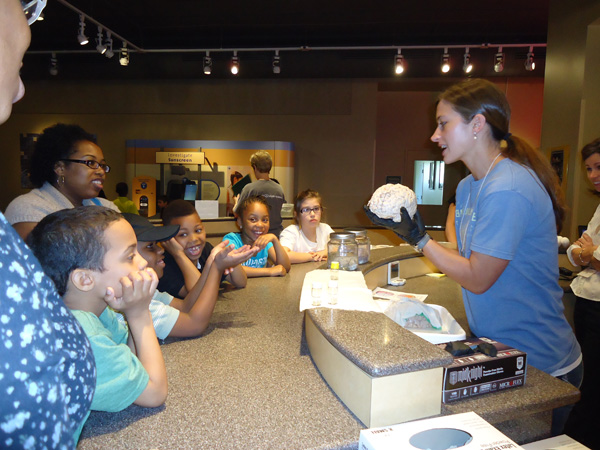
A museum volunteer shows an ACTUAL HUMAN BRAIN -- ewwwwww -- to some kids.

Guest post by Sandra Ackerman, Duke Institute for Brain Sciences.

Cries of “Eew!” and “Squishy!” and a fair amount of giggling marked the arrival of Brain Awareness Week at the North Carolina Museum of Life + Science last week as it offered visitors some great hands-on activities.

The museum’s second floor demonstration lab became the Brain Lab, where kids and adults learned about the three layers of protection that nature has provided to our brains. First the visitors examined half a dozen animal skulls and tried to identify them. There was a beaver, a boar, a deer…  What was that huge one, a toothed whale?  No way!

The next step was to check out a few specimens of preserved brains, each tightly encased in the tough membrane called the meninges.  The most courageous or curious visitors even got the opportunity, after donning latex gloves, to touch the surface of a human brain—an experience they will not soon forget.

Finally, for the purpose of active experimentation, each lab visitor was given a raw egg in its shell, representing the human brain within the meninges.  If the egg was shaken vigorously inside a plastic container (the “skull”), the shell often cracked, spilling its precious contents.  However, after adding water (“cerebrospinal fluid”) and a new egg to the container, a participant could shake the container or even slam it down on the counter, most often with the result that the egg just bobbed gently in the protective liquid.  In cases of extreme trauma, the eggshell sometimes cracked after all—thereby showing vividly why cyclists and skateboarders should always wear a fourth layer of protection, a helmet.

Skulls were compared for their relative brain cases.

Nearby, kids wearing vision-distorting “prism glasses” took turns throwing sponge balls at targets marked on the wall.  Before putting on the glasses, most participants took a few tries to hit the target, then quite a few more to home in on it while their vision was distorted by the prisms.  What really shocked them, though, was how hard it was throw accurately once they had taken the glasses off again.

Asked to give her overall opinion of the scientific experience, one tired participant said, “Hmm, kind of dumb.”

“You think it’s dumb?” her mother asked, surprised.

“Except—except the squishy part!”

New Blogger Ashley: Welcome to blogging

Meet Ashley Mooney, or Ashe as my friends call me.  I am a coffee addict who loves her animals.

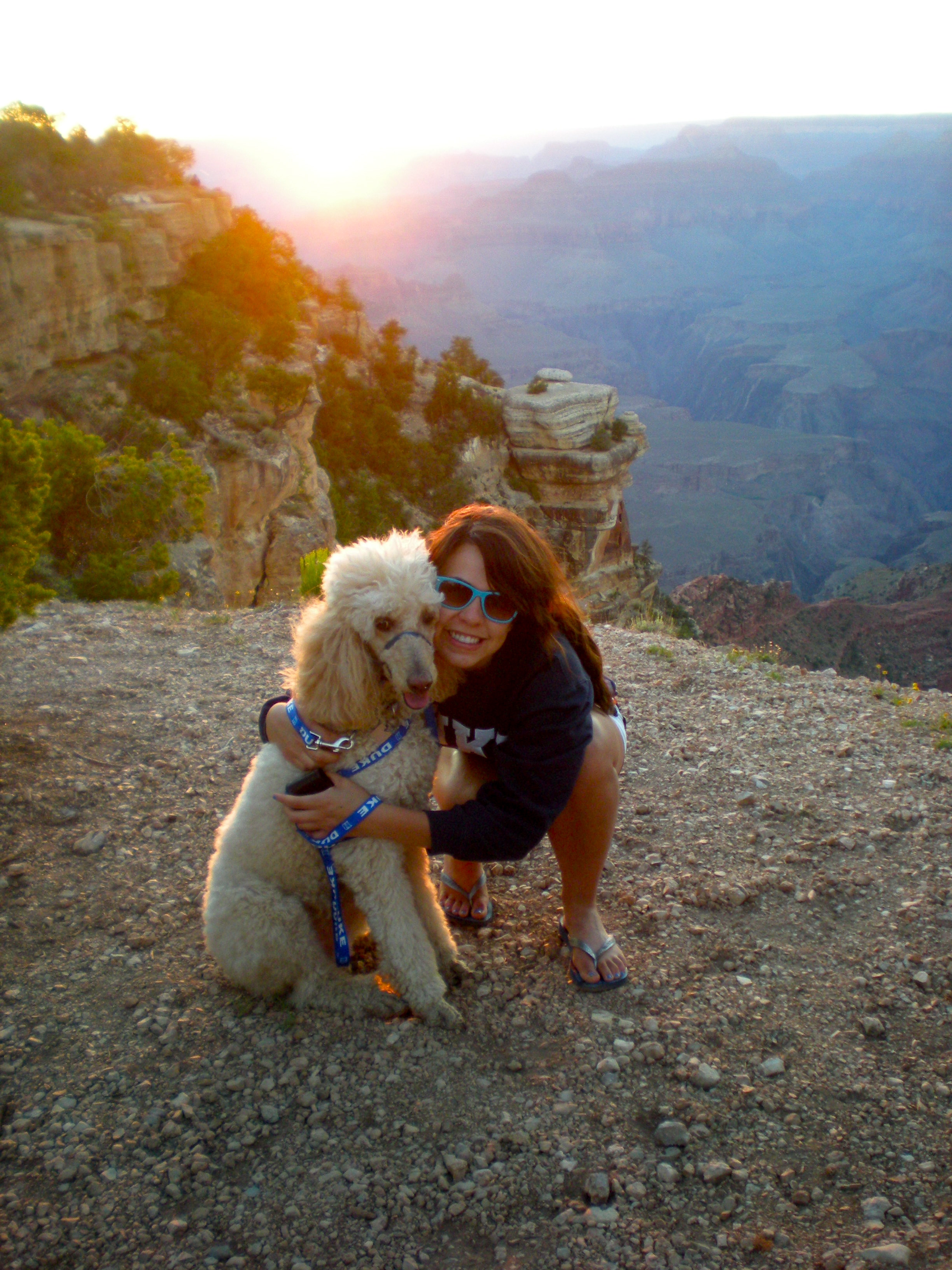
Me and Misty at the Grand Canyon.

I’m a sophomore majoring in evolutionary anthropology and receiving a certificate in policy journalism and media studies. I’m from Portland, Oregon—the home of coffee and rain. After school, I’m hoping to attend either medical or veterinary school.

Besides writing for the research blog, I write for the Chronicle. Although it may be a bit of a conflict of interest, I love science writing in general. I can also be found swimming and feasting.

One of my favorite things in the world is delectable food.  Pumpkin, chocolate, and cheese are my ultimate flavors. So far, I have eaten at all but two grub spots on campus—the Nasher and Starbucks (in the Medical Center).  I hope to change that by the end of this year, as well as dabbling in Durham’s dining options.

I have a standard poodle, Misty, and a blue parakeet, Archie.  Archie currently lives here with me at Duke in a super secret location. My goal is to own a macaw as soon as possible after graduation.

Page 18 of 19

Powered by WordPress & Theme by Anders Norén