
Following the people and events that make up the research community at Duke

Students exploring the Innovation Co-Lab

Category: Physics

Shaping and shattering theories of glass

By Ashley Yeager

An artist shapes a piece of molten glass. Credit: Sarah Weiser / The Herald

The nature of a glass is a debate that runs far deeper than whether one appears half empty or half full.

For years scientists have known that the atoms and molecules in glasses arrange themselves randomly, like the non-uniform pattern of particles in a liquid.

What’s puzzling, though, is that while the molecules in a glass are arranged like in a liquid, the overall structure is solid.

“We’re close to understanding why certain materials do not crystallize, but it’s still an open challenge to explain how these materials then become viscous and form glasses,” says Patrick Charbonneau, a theoretical chemist at Duke.

In other words, scientists do not yet have an accurate theory to describe both the liquid and solid characteristics of glass.

Instead, there’s just an old joke that says there are more explanations about how glasses form and behave than there are theorists to propose the ideas.

molecular structure of glass

Click the graphic to learn more about the molecular intricacies of glass. Credit: Jonathan Corum, The New York Times.

Using new computer simulations, Charbonneau has begun to wipe away some of the less influential theories, and with his collaborators Atsushi Ikeda, Giorgio Parisi and Francesco Zamponi, he has identified serious flaws in one of the leading explanations describing the nature of glass.

The results of the research appear in the Oct. 28 issue of the journal Physical Review Letters.

In the study, Charbonneau tested the glass theories using simulations designed to look at a material’s atomic and molecular interactions in up to 12 dimensions. If scientists can make sense of how glass particles interact in these higher dimensions, then “we’ll be in a better position for understanding two and three-dimensional glass formation,” he says.

One of the leading theories of glass works, sometimes, but for it to hold more water, it needs to be modified so that its predictions match what the 12-dimensional simulations are showing.

If scientists can’t corroborate the predictions and simulated results, they may need to completely overhaul all they think they know about the nature of glasses — empty or full.

Citation: Charbonneau et al. Phys. Rev. Lett. 107, 185702 (2011).
DOI: 10.1103/PhysRevLett.107.185702

Science Under the Stars

Building on earlier successes with K-12 classroom outreach and a huge appearance at the 2010 USA Science and Engineering Festival, Duke University students and faculty are inviting Triangle-area families to join them for an evening of interactive science demonstrations called SCIENCE UNDER THE STARS.

USA Science and Engineering Fest

Duke students wowed kids and grownups alike at last year's national science festival in Washington DC.

The October 19 festival will include hands-on, all-ages activities from Chemistry, Physics, Biology, Engineering, Genomics, Environmental Science,  Microbiology, Immunology, and Molecular Genetics.

SCIENCE UNDER THE STARS will be from 6 p.m. to 8 p.m. on Wednesday, Oct. 19, on the front lawn of the French Family Science Center on Duke’s West Campus.

At 7:30, the chemists will stage a spectacular grand finale — not quite fireworks, but close!

Free parking is available in the Chemistry parking lot at Research Drive and Towerview, and overflow parking will be available in the Bryan Center structure on Science Drive as well.

RAIN DATE – Thursday, Oct. 20.

For more information contact Kenneth Lyle, PhD at kenneth.lyle@duke.edu


Astroplanets: What we can now see.

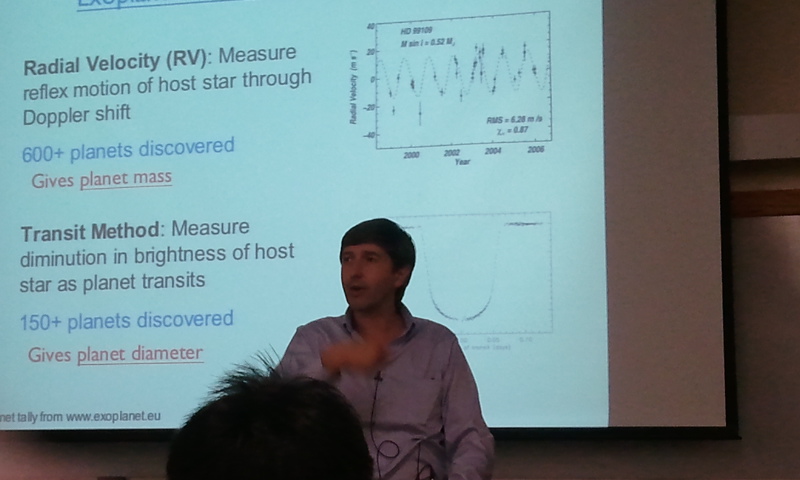
Dr.Ronald Walesworth lecturing about the two methods

By Jeannie Chung

Duke Physics hosted Ronald Walsworth of Harvard last week to hear about his use of something called an “astrocomb,” a tool that could help astronomers make more precise measurements of distant astronomical objects, including planets like Earth.

An astrocomb uses a a laser and an atomic clock to improve the calibrations on the instruments astronomers use to measure tiny shifts in the spectra of a star. The shifts can indicate if a star has a planet.

Currently, astrophysicists cannot measure the minute shifts of planets the size of Earth, or other cosmological phenomena, with these spectrographs. The shifts are too tiny. But this laser calibration astrocomb could be seen as the sunrise on a bright future.

Walsworth said that in five years, discovery and characterization of Earth-like planets would be possible, and that in 10-20 years, direct measurement of cosmological dynamics —  the change and characteristics of celestial bodies – may be possible. He said the laser frequency comb will allow us to see a live feed of the expansion of the universe, instead of looking at hindsight and making inferences from snapshots of a past universe.


Detecting disease with sound

By Becca Bayham

Most people experience ultrasound technology either as a pregnant woman or a fetus. Ultrasound is also employed for cardiac imaging and for guiding semi-invasive surgeries, largely because of its ability to produce real-time images. And Kathy Nightingale, associate professor of biomedical engineering, is pushing the technology even further.

“We use high-frequency sound (higher than audible range) to send out echoes. Then we analyze the received echoes to create a picture,” Nightingale said at a Chautauqua Series lecture last Tuesday.

According to Nightingale, ultrasound maps differences in the acoustic properties of tissue. Muscles, blood vessels and fatty tissue have different densities and sound passes through them at different speeds. As a result, they show up as different colors on the ultrasound. Blood is more difficult to image, but researchers have found an interesting way around that problem.

“The signal from blood is really weak compared to the signal coming from tissue. But what you can do is inject microbubbles, and that makes the signal brighter,” Nightingale said.

Microbubbles are small enough to travel freely throughout the circulatory system — anywhere blood flows. Because fast-growing tumors require a large blood supply, microbubbles can be particularly helpful for disease detection.

Like most other electronics, ultrasound scanners have gotten smaller and smaller over the years. Hand-held ultrasounds “are not as fully capable as one of those larger scanners, just as with an iPad you don’t have as many options as your computer or laptop,” Nightingale said. However, the devices’ portability has earned them a place both on the battlefield and in the emergency room.

Nightingale’s research explores another aspect of ultrasonic sound — its ability to “push” on tissue at a microscopic scale. The amount of movement reveals how stiff a tissue is (which, in turn, can indicate whether tissue is healthy or not). It’s the same concept as breast, prostate and lymph node exams, but allows analysis of interior organs too.

“We can use an imaging system to identify regions in organs that are stiffer than surrounding tissue,” Nightingale said. “That would allow doctors to look at regions of pathology (cancer or scarring) rather than having to do a biopsy or cut someone open to look at something.”

Z-prime search may hurdle Higgs hunt

Z' plush toy

This plush Z-prime represents a new particle physicists are hoping to find early next year. Credit: The Particle Zoo.

By Ashley Yeager

If you’re bummed about humanity’s biggest accelerator not producing a Higgs particle yet, maybe the latest effort to find a Z-prime will make you feel better.

The new results can’t claim a discovery of this sub-atomic particle, a gauge boson. But Duke physicist Ashutosh Kotwal says his team is narrowing in on the less press-frenzied particle, which, if discovered, means our understanding of particle physics would need some revisions.

Physicists have been looking for Z-prime just as they have the Higgs, by slamming fast-moving particles into each other at the Large Hadron Collider, or LHC, in Europe.

Scientists are interested in these predicted particles because they could fix holes in the current model, the Standard Model, that explains particle physics. One of the biggest holes of the model is its inability to explain the origin of mass.

The Higgs boson is supposed to correct this, but there are other problems, such as why neutrinos oscillate, why there is more matter than antimatter in the universe or where dark matter and dark energy originate.

Discovering new particles, like the Z-prime, could answer these questions, Kotwal says.

In April, scientists using Fermi Lab’s Tevatron accelerator in Illinois reported possible signs of a Z-prime particle and with it, new forces of nature, but the physics community has been cautious to claim discovery.

A few months later, Kotwal’s team published data from LHC that did not find a Z-prime, despite working in similar energy levels as the U.S.-based accelerator.

Now, LHC is “far and away” more sensitive than the Tevatron, and by Christmas, the European collider will have produced four times more data in a range of energies and masses where Z-prime could be, Kotwal says. The latest LHC data has been submitted to the journal Physical Review Letters.

Kotwal adds that Z-prime particles also appear to behave similarly to gravitons, the hypothetical particles that could provide a quantum explanation for gravity. Any progress made in narrowing the mass and energy range where Z-primes sit will bring physicists closer to finding gravitons and possibly unifying the four fundamental forces of nature.

Of course, LHC has much more data to collect and there’s more work to do, Kotwal says. While hopes for a Higgs have been pushed back to the end of 2012, a Z-prime particle could pop into the data early next year, he adds.

Page 11 of 11

Powered by WordPress & Theme by Anders Norén