Following the people and events that make up the research community at Duke

Students exploring the Innovation Co-Lab

Category: Guest Post Page 10 of 14

Brain Camp Makes 'Aha Moments'

Final presentations for the Neuroscience and Neuroethics Camp were held in the new headquarters of the Duke Institute for Brain Sciences.

Final presentations for the Neuroscience and Neuroethics Camp were held in the new headquarters of the Duke Institute for Brain Sciences. (photo by  Jon Lepofsky)

Given just two weeks to formulate a hypothesis about brains, Duke’s Cognitive Neuroscience and Neuroethics Camp students spoke with impressive confidence as they presented at the Duke Institute for Brain Sciences (DIBS) on July 16.

The high school students had designed experiments using the concepts and methods of cognitive neuroscience to demonstrate what is unique about human brains.

“It was good to see the curiosity, energy, and critical thinking that was present throughout the students’ projects,” said Jon Lepofsky, Academic Director for the Cognitive Neuroscience & Neuroethics camp, the Duke Youth Programs summer program of hands-on, applied problem-solving activities and labs was developed in partnership with DIBS.
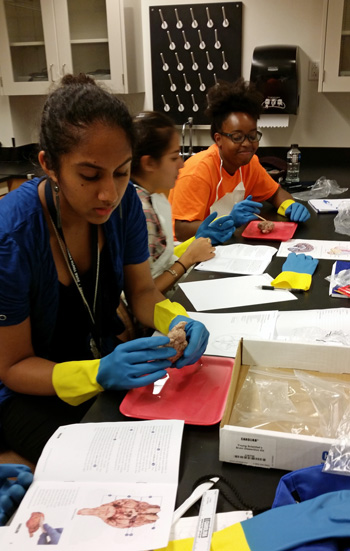
Campers dissected sheep brains

The campers dissected real sheep brains

Lepofsky said he was pleased to start the first year of the camp with an engaged, diverse, and thoughtful group of 22 students.

Andie Meddaugh, Xi Yu Liu, Emily Lu and Anand Wong were working on a project involving the logic and the emotion of the human brain. Their hypothesis was that the ability to combine logic and emotion to create a subjective logic shows the difference between human brains and other intelligence processing systems, like artificial intelligence.

Meddaugh said she liked thinking about the brain and logic.

“I enjoy thinking about the problem of what makes us special,” said Meddaugh.

Another group of students presented a project involving the social construct and morality of the brain.

Nicolas Douglass, Abigail Efird, Grace Garret and Danielle Dy are using a hypothesis that suggests if organisms are presented with an issue of resource availability how they respond is a matter of survival.  They proposed using birds, humans, and monkeys to test the reactions of each organism as it is placed outside of its comfort zone.

Abigail Efird said teamwork and “aha moments” were the best way to conduct this project.

“It took human ingenuity and scientific development in order for us to come up with different strategies,” said Efird. “It was surprising to see that humans are not as special and are very much similar to other organisms. “
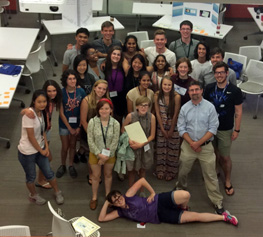
The group's final "class picture" before heading home to High School.

The group’s final “class picture” before heading home to High School.

Lepofsky said at the end of the program, students will leave with a new set of critical thinking tools and a better understanding of decision- making.

“I know the students will walk away with a deeper understanding of how to evaluate news stories celebrating neuroscience,” Lepofsky said. “They will know how to think like scientists and how to ask quality questions.”

Along with developing a hypothesis on the human brain, the students participated in interactive workshops on perception and other forms of non-conscious processing with Duke researchers. They’ve engaged in debates about topics in neuroethics and neurolaw. In addition to that they went on lab tours and visits to the DiVE.

For more information on Duke’s Cognitive Neuroscience and Neuroethics Camp visit http://www.learnmore.duke.edu/youth/neurosciences/ or call (919) 684-6259.

Warren_Shakira_hed100 Guest post by Shakira Warren, NCCU Summer Intern
Undergrads Share Results, and Lack Thereof

ashby and grundwald

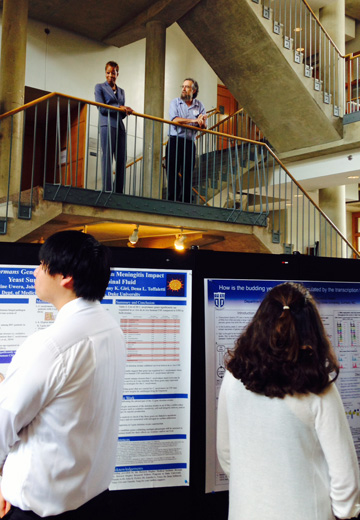
Arts & Sciences Dean Valerie Ashby and Associate Dean for Undergraduate Research Ron Grunwald got the big picture of the poster session from an LSRC landing.

Dozens of Duke undergrads spent the summer working in labs, in part to learn why science is called “research” not “finding.”

“About a third of these students ended up without any data,” said Ron Grunwald, associate dean for undergraduate research, during a Friday poster session in the atrium of the LSRC building for three of the summer research programs.

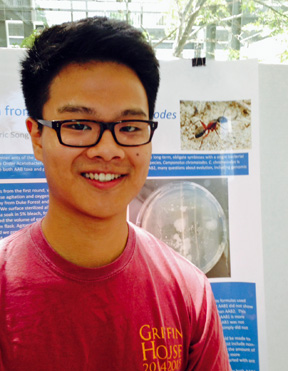
Biology junior Eric Song gets it now. He spent the summer trying to culture one specific kind of bacteria taken from the abdomens of an ant called Camponotus chromaiodes, which he collected in the Duke Forest. All he got was

Eric Song

Eric Song’s poster featured a photo of the ant and the mysterious white stuff.

“this white stuff showing up and we don’t even know what that is.” His faculty mentor in the Genomics Summer Fellows Program, Jennifer Wernegreen, was hoping to do some genetic sequences on the bacteria, but the 10-week project never made it that far. “We’re only interested in the genome basically,” Song said good-naturedly.

Christine Zhou did get what she set out for, mastering the art of arranging E.coli bacteria in orderly rows of tight little dots, using a specially adapted ink jet printer. Working with graduate student Hannah Meredith and faculty mentor Linchong You, she was able to lay the bugs down at a rate of 500 dots per minute, which might lead to some massive studies. “In the future, we’re hoping to use the different colored cartridges to print multiple kinds of bacteria at the same time,” she said.

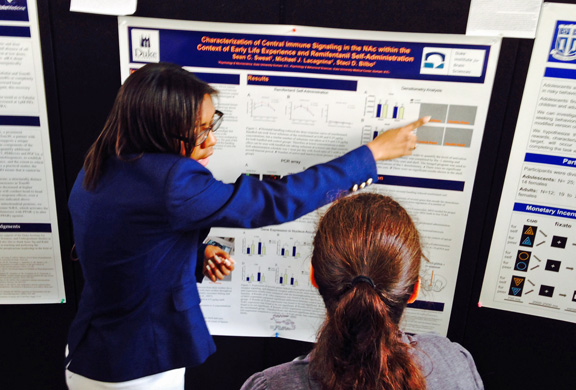
Sean Sweat

Sean Sweat (left) discusses her mouse study.

Neuroscience senior Sean Sweat also got good results, finding in her research with faculty mentor Staci Bilbo, that opiate addiction can be lessened in mice by handling them more, and identifying some of the patterns of gene expression that may lie behind that effect.

Neuroscience senior Obia Muoneke wanted to know if adolescents are more likely than children or adults to engage in risky behaviors. Muoneke, who worked with mentor Scott Huettel, said her results showed the influence of peers. “Adolescents are driven to seek rewards while with a peer,” said Muoneke. “Adults are more motivated to avoid losing rewards when they are by themselves.”

The new dean of Trinity College, chemist Valerie Ashby, worked the room asking questions before addressing everyone from a landing overlooking the atrium. “How many of you wake up thinking ‘I want nothing to happen today that I am uncertain about?’” she asked. Well, Ashby continued, scientists need to become comfortable with the unexpected and the unexplainable – such as not having any data after weeks of work.

“We need you to be scientists,” Ashby said, and a liberal arts education is a good start. “If all you took was science classes, you would not be well-educated,” she said.

_ post by Shakira Warren and Karl Leif Bates

Warren_Shakira_hed100

Karl Leif Bates

Middle Schoolers Get a BOOST in Chemistry

Seventy middle school students oohed and aahed as soap bubbles full of propane burst into flame.

“First row, don’t get burned!” shouted Douglass Coleman, director of the BOOST program, a summer science camp program for students in grades 5 through 12.

Duke Chemistry Outreach

Duke Chemistry Outreach student Danielle Holdner makes fire do tricks.

Duke chemistry instructor Ken Lyle and student Danielle Holdner brought their travelling chemistry demos to the MDB Trent Semans Center Monday for the BOOST kids.

They created chemical smoothies and rainbows that taught the students about acids and bases. They sparked up fireworks to teach the students about gases such as butane and propane.

BOOST (Building Opportunities and Overtures in Science and Technology) is designed to teach kids from all cultures and racial backgrounds about science and inspire them to pursue careers in science, technology engineering, medicine and related fields.

“My favorite experiment was the bubbles filled with propane,” said Karen Gonzazlez a student in the program. “I enjoyed seeing them blow up with fire.”

BOOST director Coleman, who is known for his playful antics at the presentations, said the program opens doors for students and provides them with opportunities.

“These kids would not be able to meet with professors or work in labs if it was not for this program,” said Coleman. “It is important that they are around students just like them who are striving and building for success.”

BOOST is divided into three groups depending on grade level and interest of science. Rising 5th and 6th graders are in Boost, rising 7th graders who are interested in food science/chemistry or technology are in Boost XL. Rising 8th graders interested in biological science or engineering are in Boost XXL.

[vimeo 55126467 w=500 h=281]

Teachers and junior coaches at the program said it keeps students eager to learn science.

“This program keeps students engaged and motivated in hands- on activities, “said Stefanie Joyner, a teacher for Boost XXL.

Sierra Foster, junior coach for Boost XXL, said BOOST can open students’ eyes to new science.

“This program can build their knowledge and help them understand more than what they might already know,“ said Foster.

BOOST is funded through a grant from the Science Education Partnership Award (SEPA) from the National Institute of Health (NH).

For more information on BOOST, visit http://sites.duke.edu/boost/ or call (919) 681-1045.

Warren_Shakira_hed100Guest Post by Shakira Warren, NC Central University summer intern

Duke's MOOCs Used to Supplement Education

Startup Stock PhotosA new Duke study of Massive Open Online Courses, or MOOCs, has found that they are democratizing learning by supplementing traditional forms of higher education.

A study of 13 free, open-access digital courses offered by Duke using the Coursera platform illustrates that MOOCs are popular among youngsters, retirees and other non-traditional student populations.

The study is in the current issue of Educational Media International.

Duke researchers analyzed data from pre-course surveys administered to everyone who registered for a Duke MOOC in the Fall 2014 semester. They looked specifically at three groups: people under 18, adults over 65, and people who reported that they did not have access to higher education opportunities. Based on comments from over 9,000 learners who fell into these groups, the researchers found qualitative evidence that MOOCs met their needs for content they would not otherwise have access to.

student_laptop_link“The idea was trying to get a better handle on individuals who were underserved, because so much of the popular press has focused on highly-educated, white (for the most part), upper middle class folks taking Coursera courses,” said Lorrie Schmid, the lead researcher on the study. “We wanted to get a sense of these other groups and how they might be approaching, in similar or different ways, these types of classes. “

The study, based on surveys of MOOC enrollees, found that many people under 18 took MOOCs to learn about topics not taught at their school and to explore different disciplines, often to help them choose their future academic or career path. Adults over 65 often took MOOCs to pursue lifelong learning and keep their minds active, regardless of age, and because they wanted to mentor younger students in their professional field.  In addition, the online courses were the only option for some older adults with limited mobility and finances, the study found.

A few examples: A 10-year-old with autism who is home-schooled reported taking a MOOC to learn more about chemistry. A grandmother took a MOOC course in order to help her granddaughter prepare for nursing school. And a graduate student took a Duke statistics MOOC to hone research and analysis skills.

Schmid said that across all three groups, “the theme that was most pronounced was that Coursera classes were supplementing or enhancing their education that they were getting from other either K-12 or higher education formal courses.”

LockemerGuest Post by Courtney Lockemer, Center for Instructional Technology

Summer Data+ Groups Pursue Pigs and Purchases

Many students spend their summer breaks going on vacations and relaxing, but not the 40 students selected to participate in Data+, a summer research program at Duke.

They meet twice a week for lunch to share their work on the third floor of Gross Hall.

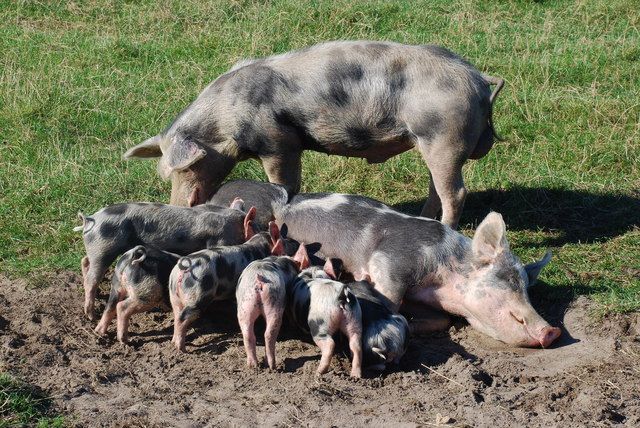
A pair of pigs and their piglets. Photo by Alan Fryer via Wikimedia commons

A pair of pigs and their piglets. Photo by Alan Fryer via Wikimedia commons

Mercy Fang and Mike Ma are working on a research project involving prolific pigs, those that make a lot of piglets. They are trying to determine if the pigs are being priced rationally, whether or not the livestock market is efficient and the number of offspring per pig.

Fang said the most challenging part is the research data. “Converting PDF files of data into words has been hard,” said Fang.
The students are using four agricultural databases to determine the information on the pigs, including pedigrees.

Most of the students in Data+ are rising sophomores and juniors majoring in a variety of majors that include math, statistics, sociology and computer science. The program started in mid-May and runs for 10 weeks and allows students to work on projects using different research methods.

Another group of student that presented on June 18 is working on a research project involving data on food choices.

A produce stand in New York City, photo by Anderskev via Wikimedia Commons.

A produce stand in New York City, photo by Anderskev via Wikimedia Commons.

Kang Ni, Kehan Zhang and Alex Hong are using quantitative methods of study using the “clustering process” to determine a recommendation system for consumers to help them choose healthier food choices. The students are working with The Duke-UNC USDA Center for Behavioral Economics and Healthy Food Choice Research (BECR) center.

“Consumers already recognize a system to get a certain snack,” said Zhang. “We want to re-do a system to help consumers make better choices.”

The students are basing their research on nutrition information and food purchases from the BECR Data warehouse, which comes from consumer information from throughout the US. This includes food purchases and nutrition information from 2008-2012.

Zhang added that the hardest part was keeping up with information.
“It’s a lot of data in the future, and it will be challenging putting it into use,” said Zhang.

Students in attendance said the food choices data research group provided good information.

“I liked the quantitative methods they used to categorize food,” said Ashlee Valante.

The Data+ research program is sponsored and hosted by the Information Initiative at Duke (iiD) and the Social Science Research Institute (SSRI).  The funding comes from Bass Connections and from a National Science Foundation grant managed by the Department of Statistical Science.

Warren_Shakira_hed100Guest post by Shakira Warren, NCCU Summer Intern
What Happens When a Language Goes Silent?

Writing by Alison Jones; Art by Jonathan Lee

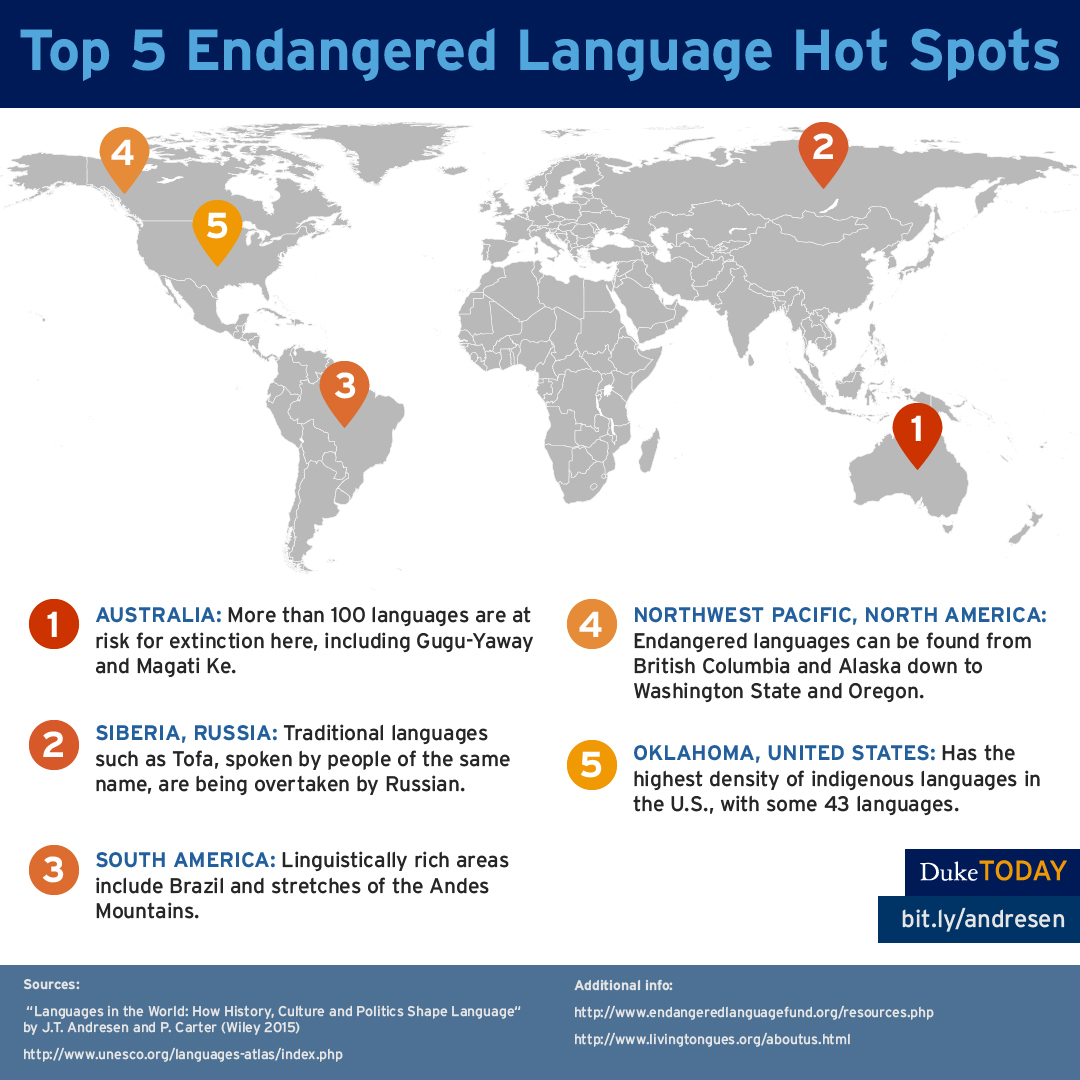
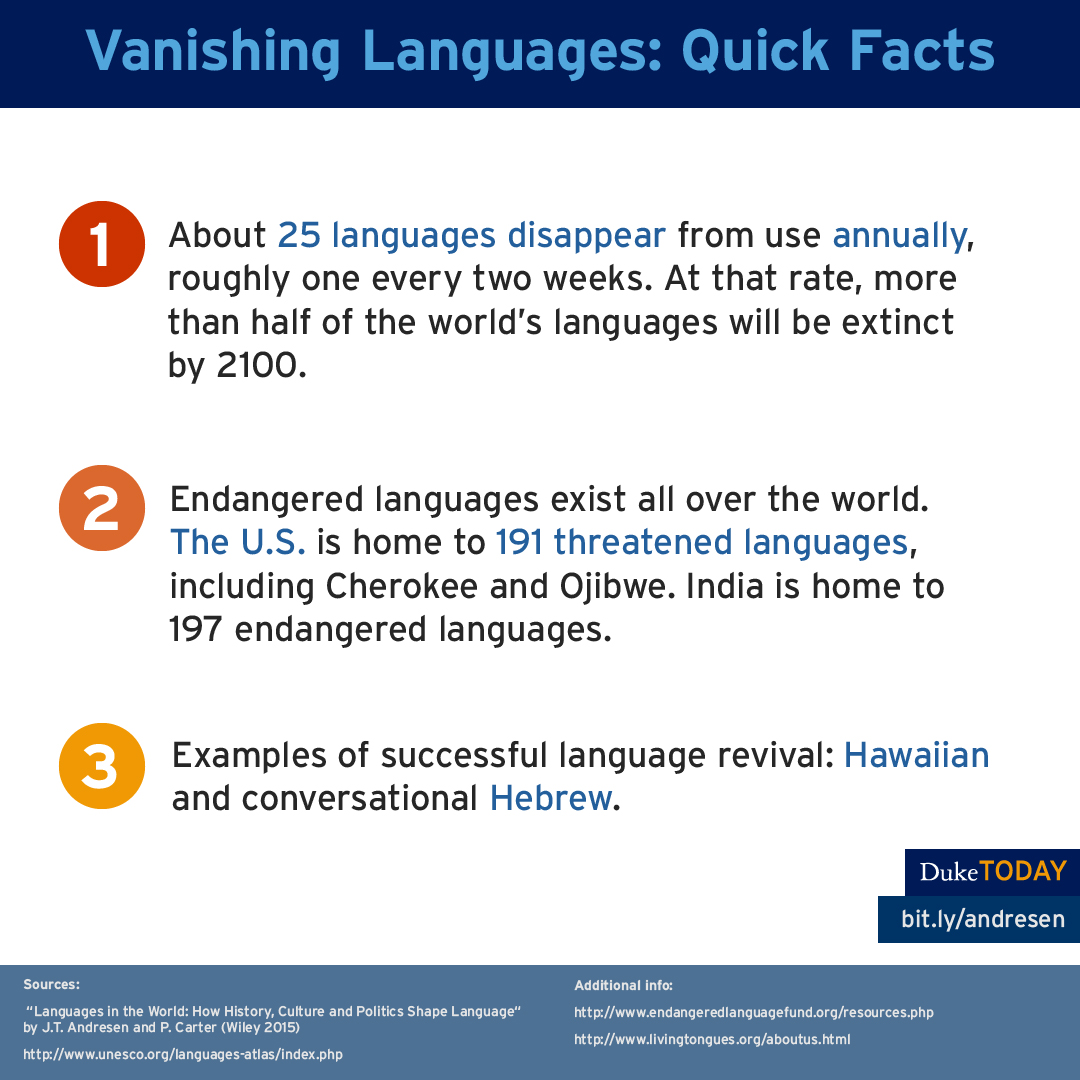
Over the millennia, some 7,000 human languages evolved around the world. Now that number is shrinking. with another language going extinct about every two weeks. By century’s end, the number of human languages could be cut in half, says linguist Julie Tetel Andresen.

When a language dies, we lose practical information about flora and fauna – and  something more intangible, says Andresen, professor of English and chair of linguistics at Duke. She is donating profits from her forthcoming book to help preserve threatened languages around the globe.

Check out five hotspots where languages are disappearing at the fastest pace, and learn about revival efforts that could keep some languages alive:

Read the full story on Duke Today.

vanishing-languages-infographics-01vanishing-languages-infographics-02

Underwater Cave is a Lemur Treasure Trove

Guest post by Gregg Gunnell, Division of Fossil Primates

(A version of this column originally appeared in the Duke Lemur Center newsletter)

Lagerstätten – that word sends a shiver of excitement up and down the spine of every paleontologist.

In German the word means ‘storage place’ or ‘deposits,’ but in paleontology it has come to mean a very rich fossil deposit that contains complete or nearly complete specimens that sample a wide variety of the creatures living at a certain time.

cave diver

A cave diver and subfossil specimen in Aven Cave, Madagascar. The plastic triangle is a scale for photographs of the specimen in situ. (Image by Phillip Lehman and Pietro Donaggio-Bitner)

As you might imagine, Lagerstätten are quite rare. Some of the more famous examples are the Burgess Shale in Canada which preserves soft body outlines of ancient (530 million years ago) Cambrian animals; the Jurassic (150 Ma) Solenhofen limestones in Germany where the famous Archaeopteryx is found; and the middle Eocene (45 Ma) Messel Oil Shale in Germany which preserves whole skeletons of many birds, mammals, reptiles, amphibians, and insects.

I have had the good fortune to be in on the discovery of two Lagerstätten in addition to studying specimens from two others. The first one our team discovered was in 1998 in Pakistan, a place we named Gandhera Quarry. It preserves a remarkable wealth of early Eocene (52 Ma) mammals from Balochistan Province – an assemblage that has yet to completely studied.

But the latest and most exciting to me as Director of the Division of Fossil Primates in the Duke Lemur Center happened late last year in Southwest Madagascar.

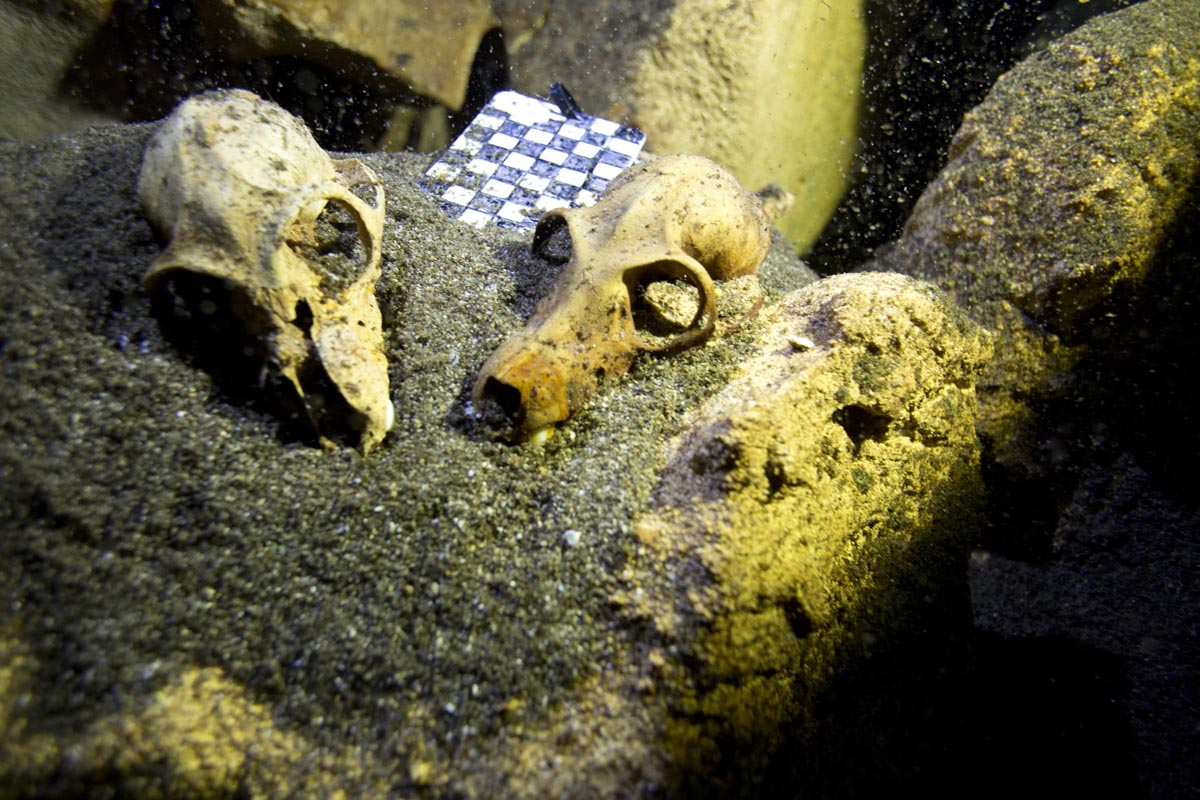
The discovery of subfossils at a place called Aven Cave was known to local people, but not reported to the scientific community until an Australian cave diver named Ryan Dart saw it. The cave and its specimens are underwater. The specimens are called subfossils, because they aren’t old enough to have completed (or in some cases even started) the fossilization process.

A joint team from the University of Antananarivo, Duke University, University of Massachusetts, Brooklyn College and Midwestern University led an expedition to this cave site in October 2014. Cave divers Phillip Lehman  and the Dominican Republic Speleological Society dive team helped us find a treasure trove of subfossils.

lemur skulls

Lemur skulls, as they were found in the cave, with a scale marker. (Photo courtesy of Phillip Lehman and Pietro Donaggio-Bitner)

Only a preliminary survey has been made of Aven Cave to date, but it is clear already that it is one of the richest subfossil sites ever discovered in Madagascar. The initial list of animal specimens found in the cave includes three genera of extinct lemurs (Pachylemur, Mesopropithecus, and Megaladapis) as well as one species of a living form, Lemur catta, the familiar ring-tailed lemur. In addition to the primates there are abundant specimens of bats (Hipposideros), carnivores (the extinct fossa Cryptoprocta spelea as well as a smaller, still living species, C. ferox), two species of rodents, an extinct pygmy hippopotamus, crocodiles, turtles, and two bird species including the extinct elephant bird Mullerornis.

Not only is there a diverse assembly of species coming from Aven Cave, the sample is also abundant, with many species represented by multiple specimens. Many specimens appear to be complete or nearly complete skeletons.

The expedition was aided by Mr. Lovasoa Dresy, the director of Tsimanampetsotsa National Park, and was generously supported by the National Science Foundation and the National Geographic Society.

We anticipate many more and surprising discoveries in the future. Stay tuned for updates from Aven Cave!

Mouse Lemur Quandary Stumps Researchers

By Sheena Faherty, Ph.D. Candidate in Biology

What does famous lemur researcher, Dame Alison Richard, do when she has a burning question she can’t answer?

She visits Duke and appeals to a room full of lemur enthusiasts to help out.

Richard’s question concerns the curious case of the mouse lemurs at Beza Mahafaly in southwestern Madagascar, where she has been involved in a wildlife-monitoring program since the mid-1990s.

Alison Richard (left) and Lemur Center Director Anne Yoder (right) lead a discussion in the 'Beach House' at DLC.

Alison Richard (left) and Lemur Center Director Anne Yoder (right) lead a discussion in the ‘Beach House’ at DLC.

“What do I know about mouse lemurs?” she questioned a group that gathered at the Duke Lemur Center on March 3 as the first of three talks she held at Duke this week as part of the Von der Heyden Fellows Program. “Probably less than you do. But I am incredibly interested in what is going on with them at Beza Mahafaly.”

Everywhere else in Madagascar, mouse lemurs that look indistinguishable are classified as different species due to big variations at the genetic level. But at Beza Mahafaly, Richard is finding that mouse lemurs with major deviations in appearance are genetically the same.

Dame Alison Richard (Photo: HHMI)

Dame Alison Richard (Photo: HHMI)

For a long time, the general view was that there were two species of mouse lemur in the forests of Beza Mahafaly : the gray-brown mouse lemur and the gray mouse lemur (both being exceptionally adorable).

A few studies in the mid-1990s and early 2000s compared the shapes of certain features such as jawbone shape and leg length, and confirmed this view. Then, researchers started noticing a few trapped animals that had very noticeable differences in coat coloration. These animals were redder than the other two known species. Was this a possible third species?

In 2006, Duke Lemur Center Director, Anne Yoder, and her former Ph.D. student Kellie Heckman examined this same population of mouse lemurs from a genetic standpoint. Comparing sequences of DNA they expected to find major genetic differences between the two known species, and possibly confirm the existence of a third species.

“The genetic data was a disaster for the mouse lemurs,” Richard said.

All the samples collected from animals at Beza Mahafaly, regardless of the animal’s outward appearance, sorted together and seemed to be one species.

Dame Alison and the bedeviled mouse lemur of Beza Mahafaly

Dame Alison and the bedeviled mouse lemur of Beza Mahafaly

“There’s a part of me that’s very distressed about this, but there’s a part of me that thinks this is great,” Richard said. “At Beza Mahafaly we swim upstream. We’re contrarians,” she said laughing. “But we still don’t know how to best explain the diversity that we do see.”

She offered up some suggestions: A glimpse of an ongoing process of change? A replacement by one species over another? The beginning of a new species?

Flashing a picture of a mouse lemur displaying ominous eye shine from a headlamp, she said: “The mouse lemurs are waiting with an evil gleam in their eye to be told the truth about themselves. The question is how should we take this forward?”

Madagascar's Conservation Superhero to Visit Campus

Guest Post By Sheena Faherty, Ph.D. Candidate in Biology

Dame Alison Richard is the epitome of someone who puts her money where her mouth is. And her dedication is directed precisely where it’s needed most.

Richard, a protector of lemurs, artisanal salt entrepreneur and endless optimist, is not just doing something about Madagascar’s conservation crisis. She’s doing everything about it.

Alison Richard (Photo: HHMI)

Alison Richard (Photo: HHMI)

She’ll visit Duke March 3-5 to give three-part lecture series discussing her role in over forty years of community-based conservation efforts in Madagascar.

Members of the Duke community know all too well that our beloved lemurs— many of which can only be found at the Duke Lemur Center or in Madagascar—are in dire straights.

Their plight has been a life’s work for Richard, who is best known for her research on sifakas in the spiny forests of Madagascar.  But she also lays claim to having been the first female vice-chancellor at Cambridge. She has now returned to Yale, where she spent most of her career, as a senior research scientist and professor emerita.

“Sometimes I think that because I’m covering so many bases, I end up doing nothing very well,” Richard said. “But it’s what I do and I can’t imagine not doing any of them—so it’s too bad,” she said laughing.

Richard is a conservationist who understands that without considering the local people’s well-being, all attempts to save wildlife habitats will fail.

“There are a variety of ways in which we are trying to facilitate socio-economic enhancements to people’s lives,” Richard said. “[On a recent trip to Madagascar] I met with the association of women salt producers, who are producing artisanal salt by techniques that have been in place for hundreds of years.”

In collaboration with a start-up company that is highly focused on sustainability, she recently shipped the first 500 kilos of the Madagascan salt to the U.S.

Verreaux's Sifaka, a favorite of Richard's in Southwestern Madagascar. (Credit: Flickr user nomis-simon, CC)

Verreaux’s Sifaka, a favorite of Richard’s in Southwestern Madagascar. (Credit: Flickr user nomis-simon, CC)

Taking time away from protecting the lemurs and enhancing the lives of the Malagasy people, Richard said her Duke lectures will have broad appeal for anyone interested in conservation, or for those who just enjoy seeing adorable pictures of lemurs.

She hopes to focus on writing a book, the topic of which will draw from her public lecture on March 5 at 6:00 pm at the Great Hall of the Mary Duke Biddle Trent Semans Center for Health Education. This lecture is set to explore how an array of different sciences has changed our understanding of Madagascar’s history.

And the conservationist who said she does everything has some advice for conserving her own mental sanity.

“One thing I need to do going forward is to find things to stop doing,” she admits. “And I’m not good at that because they are all too interesting and seemingly too important,” she said.

So, what’s next for Alison Richard?

“More of doing everything!” she said.

Richard's installation as vice chancellor of Cambridge in November 2009 was occasioned by a visit from  her Majesty Queen Elizabeth II, who's husband, Prince Philip, is the chancellor.

Richard’s installation as vice chancellor of Cambridge in November 2009 was occasioned by a visit from her majesty Queen Elizabeth II, who’s husband, Prince Philip, is the chancellor.

Research, New Policies Protect "The Lungs of India"

Guest Post By Sheena Faherty, Ph.D. Candidate in Biology

You can’t see into the lungs of the people of Agra, India, home of the Taj Mahal. But just a glance at what should be pristine white marble domes of the local landmark shows that air quality is a major concern. The iconic domes are tarnished and need frequent cleaning to keep them white.

taj mahal

A cleaning in progress shows how much discoloration grimy air  deposits on the Taj Mahal. (Courtesy of Mike Bergin)

A study by Duke researchers published in Environmental Science and Technology has determined the exact air particles that are the cause of the Taj’s discoloration and threat to the health of the local people.

“The Taj Mahal can be thought of as the lungs of India,” says Mike Bergin, the lead author of the study and a new faculty member in Duke’s Civil and Environmental Engineering department, who credits his wife Michelle with coming up with the analogy.

What he means is that the same particles discoloring the Taj Mahal are depositing in the lungs of people in Agra and are having a negative impact on their health.

Within weeks of the publication of the study, the Indian government started putting air pollution control strategies in place. In the city of Agra, diesel-guzzling vehicles have been banned from the streets, new policies are being enacted to stop the burning of trash and refuse, and local governments are replacing the traditional heating and cooking method of dung-burning with free compressed natural gas.

Air sampling devices were set up to determine the exact particles causing the discoloration. (Courtesy of Mike Bergin)

Air sampling devices were set up to determine the exact particles causing the discoloration. (Courtesy of Mike Bergin)

This might be one of the fastest “science into policy” actions ever and Bergin couldn’t be more pleased.

His research looks at how small particles in the atmosphere have impacts on human health and climate. A few years back, while attending a scientific meeting in India, he visited the Taj Mahal and noticed something strange.

“Part of it was covered in scaffolding and under the scaffold, part of the dome was brown, and there was a thick line that was white. I took a photo right away and thought, ‘That’s the weirdest thing I have ever seen.’”

He started asking people about it and kept getting the same story: The Taj Mahal gets really dirty. It has something to do with the quality of the air. We don’t know what it is, but we clean it off.

And for Bergin—a scientist whose expertise lies in air quality—the wheels began to turn.

While serving as faculty at Georgia Tech, he assembled a multi-disciplinary team from international in both the US (University of Wisconsin at Madison) and India (IIT Kanpur and the Archaeological Survey of India) to tackle the challenge of sampling both particulates in the air, as well as those that collect on the surface of the Taj Mahal, to determine which particles were the cause of the unblemished white domes turning brown.

The team found that collected samples contained high concentrations of carbon-based particles and dust. Both sources are known to absorb light, which gives the appearance of a brown hue.

Findings from this study and the impact it has had on policy-makers in India demonstrate how deeply celebrated our cultural icons, such as the Taj Mahal, are.

“People knew the air there was bad, but nobody was really doing that much about it. The interesting thing is that they moved very quickly because they didn’t want to see the Taj Mahal getting discolored,” Bergin says.

Page 10 of 14

Powered by WordPress & Theme by Anders Norén