Following the people and events that make up the research community at Duke

Students exploring the Innovation Co-Lab

Category: Entrepreneurship

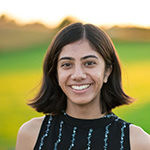
New Blogger Michelle Li: Shrek, Minecraft, and Discovering New Things

My mom likes to introduce me by telling a childhood story. She’s told the same one for years, but it never fails to crack her up. (Watch out—she will genuinely cry from laughter!) It goes like this:

I was in second grade, and I was taking the ESL test. It’s straightforward—they show you flashcards, and you name them in English. I breezed through tree and house; but when I saw a bird, I fell silent.

“Don’t you know what a bird is?” my mom asked.

Cheeks red, I responded, “I knew it was a bird, I just wasn’t sure what species.”

At this point we’re both chortling, and she tells me that aiyah, Michelle, you were always so serious as a child.

That’s me on the left looking resolute at preschool graduation.

Which is a fair analysis—I was shy. I overthought. And I was a perfectionist. If I didn’t have the best answer or the most interesting remark, I was often too scared to speak at all.

But I love formulating answers, and I love talking to people. So going into high school, I told myself this mindset would change. I would shoot every shot and carpe every diem, fear be darned.

Like all new things, it was difficult. The learning curve was so steep it may as well have had a vertical asymptote. (If you liked that math joke, ask me about my calculus-themed promposal!)

Fortunately, life has a way of placing us in situations that help us grow. Sophomore year, I volunteered to teach STEM classes to middle schoolers. The chaos of pre-teens with pent-up quarantine energy is unparalleled—needless to say, I was terrified. But I found solace in the familiarity of science—as I rambled about CRISPR-Cas9 and coral ecology, I became more comfortable speaking to others.

I learned that Shrek is an icon, Minecraft is a competitive sport, and I should never click links in the Zoom chat—lest I be lured into a Rickroll. I also discovered that it didn’t matter whether my presentation was perfect or even if I acted a little weird.

Zooming with my middle school STEM buddies—note the Elmo background.

What mattered was watching students who’d never heard of engineering before prototyping egg parachutes and Rube Goldberg machines. What mattered was seeing Vicky return for a second year, evolving from student to TA. What mattered was watching a kid’s face light up with the joy of learning something new.

That’s what I hope to accomplish with the Duke Research Blog. As a freshman, I know the endless possibilities on campus—while a blessing—can be intimidating. STEM and academia have seemingly high barriers to entry. But I’ve also seen that discovering something new can be the best feeling in the world. I hope to play a small part in helping you, the reader, get there.

And as a baby Dukie, I hope to connect with the inspiring community here. Whether through a Research Blog interview or a quick conversation on the crowded C1, I am so excited to meet y’all.

So, if you see me around campus, come say hello! And if you’re a people-person-but-introverted like me and could use a conversation starter, here are a couple:

  • Tell me what songs you’re jamming to! I’m currently looping Gracie Abrams and Wallows. Debussy and Tchaikovsky are also regulars—String Quartet No. 1 goes so hard.
  • Talk about football! As a lifelong Cincinnatian, Joe Burrow is our king.
  • Share whatever you’re working on! Whether it be uber-complicated math (shoutout to Nikhil) or the perfect matcha latte (shoutout to Krishna), I’d love to know what you’re experimenting with.

Until then, remember to stay hydrated and keep discovering new things. ☺️

Post by Michelle Li, Class of 2027

A Peek Inside the Climate Situation (V)room

As part of this year’s Energy Week at Duke, graduate and undergraduates were able to participate in a competitive “situation room” style event in which participants were split into five teams and given seventy-five minutes to create a plan for expanding EV (electric vehicle) access in Durham. 

For just over an hour in a Fuqua School of Business classroom, my fellow participants and I mulled over the complexities of an issue facing municipalities across the country and produced a variety of solutions, representative of the range of specialties within each group. One more CS-minded group proposed an app to both help residents locate charging stations and help the city collect data on the use of new EV infrastructure, while another group explored the technological and price saving perks of utility pole-mounted charging stations.

The resulting ideas were reviewed by a panel of judges who covered multiple areas of EV expertise: Jennifer Weiss, Senior Advisor for Climate Change Policy at the North Carolina Department of Transportation; Matt Abele, Director of Marketing and Communications at North Carolina Sustainable Energy Association; Sean Ackley, E-Mobility Segment Lead at Hitachi Americas, Ltd.; and Evian Patterson, Assistant Transportation Director in the Durham Department of Transportation.

The goal of Duke’s EnergyWeek is to “promote collaboration, knowledge-sharing, and professional networking” for students interested in the energy sector.  The situation room event was not strictly research oriented – our team rooms had windows and we were given free supper and lemonade – but it promoted the fundamentals of research: idea generation, collaboration, and outside-of-the-box thinking. 

The victors of the 2023 EnergyWeek Situation Room (photo: Michael Wood III)

The teams were tasked with crafting a strategy that combined technical, business, marketing, and policy considerations to increase EV penetration in Durham.  The teams operated under a hypothetical $10 million budget and strategies were to align with the Justice40 initiative, the federal plan to ensure that forty percent of the benefits of new clean transit jobs flow to “disadvantaged communities that are marginalized, underserved, and overburdened by pollution.”

Participants were encouraged to consider “potential barriers to EV adoption, the existing distribution of EV charging stations, and opportunities for community and business involvement” and to be creative.

My team was comprised of students from a range of scholarly backgrounds, from a freshman beginning a mechanical engineering track to a grad student at the Nicholas School with prior work and research in school bus electrification policy.  For our plan, we spent little time discussing electric cars and instead focused on expanding access to electric micro-mobility and electrified public transportation.  

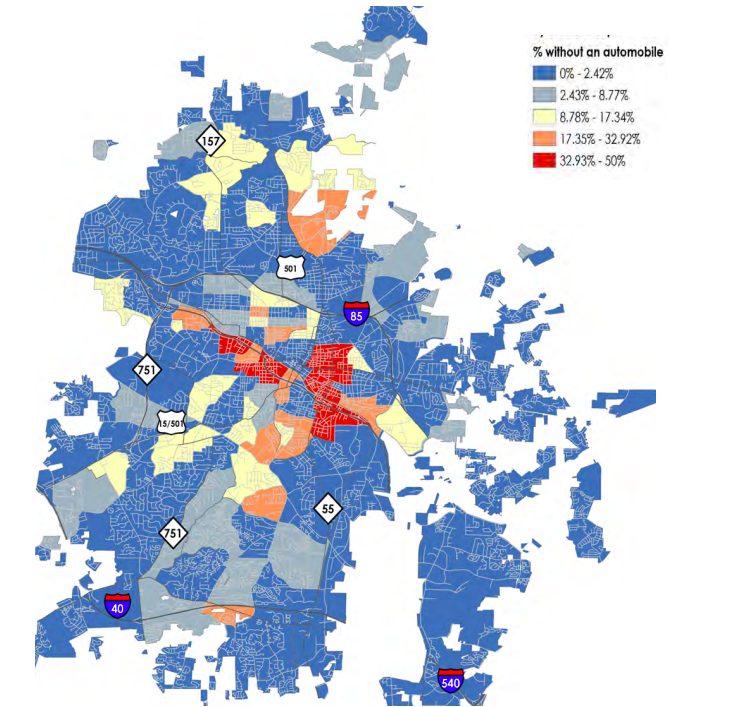
Our team consulted this map from the Durham Bike+Walk Implementation plan in determining that electric cars are not a silver bullet
(map: durhamnc.gov)

We had many reasons for doing so.  Many Durham residents don’t own cars, so the likelihood of increasing the adoption of electric cars in a timely and affordable manner seems low.  Countries around the world are instead focusing on expanding e-bike access, citing, in addition to climate and affordability concerns, the desire to move away from the safety issues and traffic burden of car-centric urban design. 

We saw Durham, which is expected to double in population in just twenty-five years, as a city perfectly positioned to develop around micro-mobility and robust public transportation before it’s too late and set an example for growing urban centers across the country.  We used our $10 million to add bike lanes, fund electric buses, and subsidize electric bikes across income levels.

Our team placed second (no big deal!) and walked away with a full stomach and a rekindled spark to break the Duke bubble and get involved in the exciting development of the Bull City.

My winnings!
By Addie Geitner, Class of 2025

Duke Alum Dr. Quinn Wang on Medicine, a Healthcare Startup, and the Senior Thesis That Started it All

As a senior at Duke University in 2010, Dr. Quinn Wang was simply Quinn, an undergraduate English major on the pre-med track, wondering how to combine her love for medicine with her love for English. This is how her senior thesis was conceived – Through the Lens of Medicine: Landscapes of Violence in Cormac McCarthy’s Blood Meridian (1985), All the Pretty Horses (1992), and No Country for Old Men (2005) – which ended up winning the English department’s award for “Most Original Honors Thesis.”

Dr. Quinn Wang

Fast forward 12 years, and Wang can now call herself a double Dukie, having completed medical school here. She went on to complete ophthalmology residency at UCSF and this past Saturday, November 5, came back to her alma mater as part of the Duke Medical Ethics Journal’s Medicine, Humanities, and Business celebration to talk to an eager audience at Schiciano Auditorium about her path from Duke until now.  

She began her story during the infamous year of 2020, when she was forced to stop seeing patients at her private practice in California’s Bay Area due to COVID-19. Restless and anxious about how her patients were doing, she tried to keep up with them as best she could, but of course there were limitations. And then, a few months in, one of her patients went blind.

This tragic moment sparked a frustrating realization by Wang that in the tech capital of the world – San Francisco – there was still no good way to test people’s eyesight from home to prevent what should have been preventable. She decided to put together something herself, guided by the one question she thought was most important to answer until COVID-19 abated and people could come into clinics again – “how do we make sure people don’t go blind?”

Wang took common visual eye-testing tools used in clinics, and with some simple Photoshop editing and a little bit of code, turned them into a series of easy multiple-choice questions that could be answered from home. This simple but powerful transformation turned into Quadrant Eye, a start-up she co-founded with software engineer Kristine Hara.

A common visual tool used to test eyesight is the Snellen chart

The Quadrant Eye journey has taken her from running a private practice as an ophthalmologist to taking the plunge into business by applying to and getting selected for Y Combinator, which calls itself a “graduate school for startups”. YC invests $500,000 into a selection of early-stage startups twice a year. Then, for three intense months, they provide support to get startups off the ground and in good shape to present to investors for funding. At YC, Hara worked on turning Quadrant Eye into an app, and Wang renewed hundreds of prescriptions.

Quadrant Eye

Ultimately, though, the most significant place Quadrant Eye has led Wang to is a journey of self-mastery that applies to any human endeavor, from building a startup to doing research to just getting up every morning.  As she describes, startup life entails always learning new things and always messing up – which, for someone who professes that “I don’t like to do things I’m not good at” – can be challenging. She candidly admitted that she, like everyone, has bad days, when sometimes all she can do is throw in the towel and end work early. “I have more doubts than I care to admit,” Wang says, but at the end of the day, “we’re all climbing our own mountains”. Pushing through requires “superhuman effort” but it’s worth it.

And as for that English thesis? Wang describes how Quadrant Eye’s very first investor – “let’s call him Charlie” – asked her all the requisite questions investors ask early-stage startups (think Shark Tank). But he also asked her for something non-traditional – all fifty or so pages of her undergraduate honors thesis she had written ten years back. Apparently, he had seen a mention of it on LinkedIn and was intrigued. A few weeks later, Wang received a phone call that he was interested in investing – and he admitted that her thesis had played a part. To him, the uniqueness and quality of her thesis showed that Wang could problem-solve, communicate well, and think creatively, and Wang herself agrees. “My English thesis showed me that I can do hard things,” she said, and if Quadrant Eye is any indication, clearly, she can.

Post by Meghna Datta, Class of 2023

Page 2 of 2

Powered by WordPress & Theme by Anders Norén