“Why isn’t Lenna wearing any clothes?” I implored my friend, shocked at seeing the shoulders-up nude photo of a woman on a mundane Monday in the Duke library. I had been going through a MATLAB tutorial on computer vision, and the sample image was, surprisingly, a naked lady. Apparently, when the USC developers behind a computer vision algorithm needed a sample face in 1973, someone just happened to walk into the lab with a Playboy magazine. The face of the woman on the centerfold, Lenna, has since become the default data for computer vision classes around the world. Because, of course, it’s totally normal to walk into an academic setting waving around a copy of Playboy, which would naturally be the first place one would go looking for a face.
Unfortunately, seeing female objectification in professional programming environments isn’t exactly an isolated incident. With the advent of the “brogrammer” culture, women have reported being exposed to workplaces in which male programmers share porn over open communication channels, according to CODE: Debugging the Gender Gap. When they’ve asked their male coworkers to stop, they were told, “Stop being such a girl.”
The percentage of women earning degrees in computer science has been decreasing, rather than increasing, since the 1980s.
Carolina Women’s Center, on February 29 at UNC. RENCI, while addressing issues of staffing diversity within its own organization, was inspired to bring the issue to light in the greater UNC community. By 2020, we expect to see more than one million unfilled software engineering jobs. As of now, only 23% of technical jobs nationwide are filled by women, leaving a huge gap to fill in this important workspace.
The response of the largely female audience to the film was overwhelmingly positive. Lilly, a first-year math student at UNC, noted that the issues the film addressed were “obvious,” both in academic settings and in the online blogosphere. She appreciated the positive messages, such as in this GoldieBloxsuperbowl ad, that counter expectations of young girls to study more “social” subjects and encourage them to pursue science, technology, engineering and math. Addy, a first-year computer science student, noted that a supportive group of women in her CS401 class at UNC makes the dearth of women less noticeable.
Olivia, Tabatha, and Megan with a collage of “Why We Love Tech”
Tabatha, a first-year computer science student at UNC, said that she feels intimidated in introductory computer science classes, where male students often have years of background knowledge that she doesn’t. She hesitates to show men her code until it is perfect, since she feels that as a woman, she has to prove that she is just as good as a man. This additional pressure and worry, CODE observed, often causes women to perform worse in quantitative classes. Tabatha, Megan, and Olivia attended the screening as part of a Women’s Studies class. Megan echoed Tabatha’s sentiment, relating that as a beginning programmer, she felt behind during HackNC, where most men already knew how to build apps.
Clearly, issues of female representation in tech persist into the university and industry level. However, CODE insists that we must remedy the problem during childhood, when girls receive societal messages that deter them from studying science and tech subjects.
If we’re going to be “changing/saving the world,” “making a better version of you,” and deciding how to “do the right thing,” (all rhetoric from the tech industry), we should probably have all genders and races represented in those responsible for effecting the change that will supposedly impact all of humanity.
Scenes like the one above are engineer Christine McKinley’s favorite views of the construction sites where she manages building designs and contracts with other engineers. McKinley, a mechanical engineer, musician, and author, enjoys the complexities, high stakes and surprises of her job. Engineers, she says, “design against [surprises] but live for surprises.”
One of these surprises, McKinley told an audience last Thursday Feb. 25 in the Nelson Music Room at Duke, was a talk she had with the director of a community college district. He told her “women aren’t as good as math and science.” Shocked and disappointed that a man in charge of the education of the young students would believe this, McKinley pointed out that several of her accomplished colleagues were women. McKinley, like many other women, was frustrated that she has to work harder than men to get a promotion.
Is this changing? Are women today more prevalent in engineering fields than they were twenty to thirty years ago?
The chart below depicts the distribution of engineers in 1989: only 15 percent are women.
Of course, 1989 was 27 years ago and a different cultural time, with Nintendo’s Game Boy and Prince William’s seventh birthday. But the chart below shows how little those numbers have changed.
For mechanical engineers, the gap is much larger: only 7 percent are women (yellow faces), while the blue faces represent men, with the some frowning ones unhappy to be working with the women.
Percent of female mechanical engineers
When the workers are broken down into teams, according to McKinley, the image below is what it actually feels like to be working as a female mechanical engineer.
What it actually feels like to be a female mechanical engineer
Let’s start with the most troubling issue regarding the lack of diversity in engineering. If women and people of color are told that we are not good at math and science, and we believe it, then we are choosing a form of helplessness. Specifically, if we don’t pick apart the data and challenge those who made up this story, then it sticks, and the “rumor” becomes a narrative – and that’s dangerous, McKinley said. However, everyone needs to know basic chemistry, math, and physics to participate in conversations about topics such as medicine, NASA, one’s cholesterol level, and energy conservation as a knowledgeable adult. People need to be STEM-literate to be able to analyze this data, and men, especially in the 1950s, didn’t want women to research the facts and prove a competition.
Why should we care about women choosing careers in STEM fields?
Reason 1: Gender financial inequity: STEM grads make more than non-STEM grads
If we care about the gender pay gap, and only 19 percent of engineering graduates are women, then that aggravates the situation. This gender inequity can be addressed – partly – by women choosing to study engineering, McKinley said.
Of course, money is not the only thing in life; we want jobs with meaning, she added. However, even civil engineers understand that they are in a helping profession, always excited to build a new bridge, for example, to help people cross a flooded river. At the same time, money gives one the ability to leave a spouse, to take care of a disabled child, to find a better job, to afford healthier food; making real money gives one a way to become independent and make better choices. Working a job, however, does not imply that we must “sacrifice [our] life and fun.” McKinley enjoys what she does and has a lot of fun on the job; studying math and science, she says, is not that complex with the right motivation and support.
Reason 2: Humanity’s Survival
A coronal mass ejection (CME) is an enormous eruption of gas and magnetic field that launches billions of tons of plasma from the sun’s surface into space. Such an event occurred in 1859. As a result, farmers plowing field with horses noticed a bright flash of light, steam engines continued to run on schedule, and telegraph operators were confused when their telegraph batteries stopped working. Overall, there were few problems due to the limited technology at the time.
Imagine a CME happening today. All our large pieces of equipment – power stations, transformers, and transmission lines – would get fried.
Equipment involved in the transportation of energy from power plants to users
If these power houses blow up, what are we going to do? With three-year lead-time and $2 trillion cost, they will not be repaired in time for us to continue our daily functions. We now have a civilization-changing event on our hands – what Hurricane Katrina gave us, but now, for entire countries. We are in a time where our dependence on technology is constantly rising – until it’s not. In such a disastrous scenario, we will need more engineers. At this time, everyone – men and women – will come together to work on simple, elegant solutions to make the world better.
Currently, we have a mass shortage of engineers, so those today are overbooked with work. If these engineers are unable to find time to think through the entire solution and review all possible sources of error, then it creates a problem not only for engineering but also for the entire world in general. We are in need of good engineers and a diverse workforce to bring together all our ideas for a better world.
McKinley notes that she finds herself more comfortable when there are other women in the room. As a result, the whole team gets more relaxed, “elevating everyone’s game,” and people get more creative and feel more secure in sharing their ideas.
Grace Hopper created the computers advertised in this flyer.
Reason 3: The third reason we care about this view about engineering is the history of STEM achievements by women being ignored or the credit being taken by men.
Women who became mathematicians in the 1900s had to fight hard to have their contributions to the field recognized. The world misses out significantly if the achievements of half of humanity are ignored.
Hertha Aryton was a brilliant mathematician who had been elected the first female member of the Institution of Electrical Engineers in 1899. In 1902, she became the first woman nominated a Fellow of the Royal Society of London. “Because she was married, however,” McKinley quoted, “legal counsel advised that the charter of the Royal Society did not allow the Society to elect her to this distinction.”
Amalie Noether was another incredible mathematician who invented a theorem that united symmetry in nature and the universal laws of conservation. Some consider Noether’s theorem, as it is now called, to be as important as Albert Einstein’s theory of relativity. Einstein himself regarded her as most “significant” and “creative” female mathematician of all time. However, McKinley tells the audience, she was denied a working position at universities simply because they did not hire female professors.
In the 1900’s, more than 1000 women joined an organization called Women Airforce Service Pilots. They transported newly-made planes to the fighter pilots; however, many of the planes were untested, causing 38 of them to die in service. While they went through intense military training and had prior experience, the women were considered “civilian volunteers” and had to fight to be recognized. Further, most of the accepted women to the organization were white, and the only African American applicant was asked to withdraw her application.
Nancy Fitzroy was American engineer and heat transfer expert in the 1900s. She received plenty of criticism as well, but she said it didn’t affect her: “The reaction I pretty much have gotten most of my life is ‘little girl, what are you doing here?’ but I was a good engineer. That’s what made all the difference.”
Curiosity, inventiveness, and the urge to improve are not male traits. They are human traits. Women are half of humanity; they are not the spectators. Women must step up and contribute even if it is more difficult. Constantly underestimated as a female mechanical engineer, McKinley says she uses this underestimation as fuel to work harder and become better.
Being an engineer is worth it. Ask great questions, and be really good.
Remember, McKinley told her audience, that engineering is full of surprises. And for people who underestimate you, you’ll be that surprise.
—–
Christine McKinley gave her talk in the Nelson Music Building at Duke last Thursday for Feminist/Women’s month.
Christine McKinley is a mechanical engineer, musician, and author. Her musical Gracie and the Atom, won a Portland Drammy for Original Score. Her book Physics for Rock Stars was published in 2014 by Penguin Random House. Christine hosted Brad Meltzer’s Decoded on History Channel and Under New York on Discovery Channel.
You can view her website, read her book, or contact her via email.
If you’ve ever wanted to watch a killer T cell in action, or see human cancer make new cells up-close, now is your chance.
A collection of 3-D movies captured by Duke biology professor Dan Kiehart and colleagues has won the 2015 Newcomb Cleveland Prize for most outstanding paper in the journal Science.
The paper uses a new imaging technique called lattice light-sheet microscopy to make super high-resolution three-dimensional movies of living things ranging from single cells to developing worm and fly embryos.
https://www.youtube.com/watch?v=fwzIUnKNw0s
Cutting-edge microscopes available on many campuses today allow researchers to take one or two images a second. But the lattice light-sheet microscope, co-developed by 2014 Nobel Prize winner Eric Betzig, lets researchers take more than 50 images a second, and in the specimen’s natural state, without smooshing it under a cover slip.
You can watch slender antennae called filopodia extend from the surface of a human cancer cell, or tiny rods called microtubules, several thousand times finer than a human hair, growing and shrinking inside a slide mold.
Daniel Kiehart and former Duke postdoctoral fellow Serdar Tulu made a video of the back side of a fruit fly embryo during a crucial step in its development into a larva.
Chosen from among nominations submitted by readers of Science, the paper has been viewed more than 20,000 times since it was first published on October 24, 2014.
The award was announced on February 12, 2016, at an award ceremony held during the annual meeting of the American Association for the Advancement of Science (AAAS) in Washington, D.C.
Winners received a commemorative plaque and $25,000, to be shared among the paper’s lead authors Eric Betzig, Bi-Chang Chen, Wesley Legant and Kai Wang of Janelia Farm Research Campus.
Matthew McCann, Pratt ’16, spent his summer translating thoughts into movements.
A biomedical engineering and mathematics major, the Duke senior contributed to work in the field of prosthetics by creating a brain-machine interface that senses different brain waves of a subject and converts them into movements of a mechanical hand.
McCann combined two prominent biomedical techniques, tri-polar concentric electroencephalograms (tEEG) and near-infrared spectroscopy (NIRS), to pick up the brain activity of his subjects. EEGs are the typical devices one pictures when imagining recording brain activity: electrodes stuck all over a subject’s skull to pick up neuron firing when particular brain regions are active.
NIRS is a novel way of measuring brain activity. A common application of NIRS is in the pulse oximeter, or the plastic clip-like contraption doctors place on your finger to measure pulse and blood oxygenation. McCann used NIRS to measure the blood flow in different regions of the subject’s scalp. Different patterns of blood flow indicated dynamic brain activity.
Based on data obtained from these two techniques, McCann categorized brain activity into three specific intentions: thinking about moving the right hand, thinking about moving the left hand, and thinking about moving the feet. Each different intention to move was then connected with moving one finger of a mechanical hand. An example of the hand moving in response to different intentions is shown below (at 8x speed):
McCann’s major challenges in the project were processing complicated EEG signals and removing noise from these signals in order to correctly classify each of the movement intentions. He worked with vast amounts of training data from subjects who had practiced focusing acutely on each of the movements.
He ultimately isolated the specific frequency bands whose power was modulated most drastically during the three movement intentions he was targeting. These frequency bands served as the basis for his machine-learning algorithm, which matched known data the subjects had been trained to produce with unknown thoughts about movement.
After developing his algorithm, McCann tested it on unknown data, in which subjects thought about moving their right hand, their left hand, and their feet in some arbitrary sequence. McCann’s algorithm ultimately obtained impressive accuracy of up to 80% when categorizing unknown thoughts about movements.
Through his research, McCann demonstrated the feasibility of rapidly creating functional prosthetics from simple materials and only open-source software. His prosthetic hand proves promising to medical innovation, as it represents a non-invasive, functional brain-machine interface. Ultimately, his success sheds optimism on the future of prosthetics.
Learn more about McCann and his projects on his website.
On January 5, just a year after President Obama and Indian Prime Minister Narendra Modi agreed to deepen engagement between the United States and India, a group of Duke colleagues and I found ourselves on the brand new campus of IIT Gandhinagar, in Gujarat, India.
Duke Vice Provost for Research Larry Carin, left, tours the IIT Gandhinagar campus with Director Sudhir Jain.
We were part of an agreement between the United States Agency for International Development (USAID) and India’s Ministry of Human Resource Development (MHRD) to provide technical support for the Indian Institutes of Technology (IIT).
Our van was met by Sudhir Jain, the exuberant director of this young institution, who was thrilled to welcome us to the university and show us labs, offices and classrooms that will soon be bustling with activity.
Although the campus is partially occupied and remains under construction – with many students and offices still housed at a temporary campus a few miles away – all of us who work at Duke are lately accustomed to the sights and sounds of campus construction, and barely noticed the work taking place all around us.
We quickly heard from Jain that Gandhinagar is a new type of IIT, “a technical institute with a twist,” seeking to deliver outstanding technical education within a larger educational framework that emphasizes civic engagement and personal growth and development.
Our week began with a formal opening session, during which representatives of India’s MHRD; Kathryn Stevens, Duke ’92, acting mission chief for USAID India; Larry Carin, Duke’s vice provost for research, and Jain all shared their visions and expectations for Duke’s collaboration with IIT Gandhinagar.
The full group of IIT Gandhinagar leadership and the visiting Duke, RTI, and USAID delegation.
And then we were off and running for four full days of presentations and workshops.
Duke faculty members Mike Bergin (civil & environmental engineering), Krishnendu Chakrabarty and Kishor Trivedi (electrical & computer engineering) and Debmalya Panigrahi and Sudeepa Roy (computer science) discussed their own research initiatives and explored opportunities for collaboration with IIT researchers, and provided peer coaching and review sessions for IIT Gandhinagar faculty.
In parallel sessions, Larry and Marnie Rhoads, Duke’s director of faculty research and mentoring, worked with IIT Gandhinagar colleagues to review the Institute’s research operations and faculty hiring and review practices.
Minnie Glymph, executive director of communications and marketing at the Pratt School of Engineering, and I shared best practices in global higher ed marketing and communications with our counterparts in Gandhinagar, and spent several days working with them to review their existing activities and publications and begin developing a new strategic communications plan.
And just like that, four days passed in a blink and it was time for us to return to the U.S.
Luckily, a late-evening departure allowed Larry, Minnie and me time to visit the site of “A Better Toilet,” where Duke and RTI International researchers are working to address common sanitation needs in Ahmedabad. (See related post about toilets.)
Guest Post from Laura Brinn, Duke Global Communications
February is fast approaching, and with it comes a number of deadlines for funding opportunities aimed at Duke Faculty interested in expanding their research repertoires. The Office of the Vice Provost for Research is pleased to co-sponsor multiple small grant programs to help Duke Campus Faculty develop research relationships with Duke Health Faculty or Chinese Faculty, respectively. We also wish to promote institutional use of the Shared Materials Instrumentation Facility.
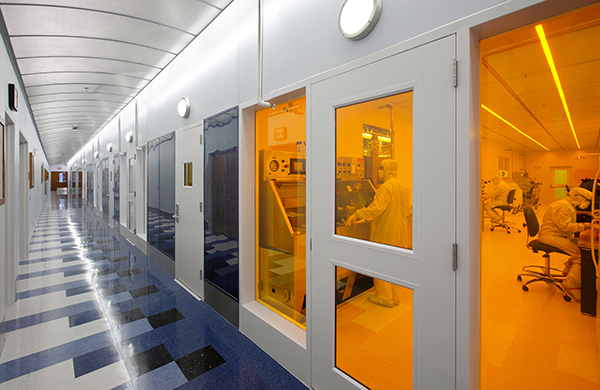
Win a grant to work in the Shared Materials Instrumentation Facility (SMIF) and maybe they’ll let you wear a bunny suit under the orange lights too! (Duke Photography)
“Collaborative Quantitative Approaches to Problems in the Basic and Clinical Sciences” is supported by many offices at Duke, with the goal of encouraging new and enhancing existing research collaborations between the Campus and School of Medicine around quantitative basic and clinical research challenges. Topics in all areas of medical research will be considered, but the area must be of potential interest to external funding agencies. The deadline to submit applications is February 1.
“Collaborative Environmental Research between Duke Campus Faculty and Chinese Collaborators” likewise provides support to Campus Faculty wishing to develop research collaborations, specifically with Chinese faculty interested in environmental science. Use of the Duke Kunshan University facilities is highly encouraged. The deadline to submit applications is February 12.
To view the full list of RFPs, please visit http://research.duke.edu/funding/OVPR-RFPs. For more information on any of the current RFPs, please contact Kelly Lindblom (kelly.lindblom@duke.edu), the Assistant Director of Research Initiatives in the Office of the Vice Provost for Research.
Jennifer Swenson is an associate professor of the practice in geospatial analysis at the Nicholas School of the Environment
Her diverse and interesting career began at UC Santa Barbara, where she chose to learn about International Relations and Geography. “I wanted to be versatile and globally aware,” she said. Undergraduate school is where she learned the geography techniques she now uses in her research, and received stacks of reading for international relations.
After this, Swenson spent three years giving bicycle tours, working at a ski resort, and other jobs, until she went on a conservation trip to Ecuador to work for an NGO (non-governmental organization). She was able to use her geospatial techniques (GIS) to map trails and land cover change in Ecuadorian national parks, and also to evaluate forest corridors for an endangered species of monkey.
Connectivity between habitat remnants for critically endangered primate, Callicebus oenanthe, in San Martin, Peru. Presented at the 2nd Simposio de Primatologia en el Peru (Iquitos, November 2013) & at the Remote Sensing forConservation Symposium (London, May 2014) Schaffer-Smith, Swenson, Bóveda-Penalba, Murrieta-Villalobos
She learned many things, including how to manage a lab, and also became fluent in Spanish thanks to the total immersion. “It’s just another barrier,” she says, to have to use English. Plus, it is useful for reading papers that haven’t been translated.
“Everyone should learn a second or third language and have the opportunity to be immersed in that country.”
After this she went back to graduate school and got a Ph.D. in forest science at Oregon State.
Swenson’s research at Duke is often about conservation or biodiversity, and occasionally ecosystem studies. She is still using her special skills to try to do the greatest good.
“Its great to work towards that, but sometimes its hard to detect that you are doing change,” she says. “I still keep trying to forge ahead and do whatever I can for the environment. In the end, all those students that we train and send out will do great things, and that’s how we have the greatest impact for the environment.”
Guest Post by Caleb Caton, a senior at the North Carolina School of Science and Math
Computer scientist Rong Ge has an interesting approach to machine learning. While most machine learning specialists will build an algorithm which molds to a specific dataset, Ge builds an algorithm which he can guarantee will perform well across many datasets.
Rong Ge is an assistant professor of computer science.
Normally this algorithm is used to speed up a slow learning process by only approximating the correct solution rather than working harder to get precision; however, Ge and his colleagues found that the small amount of “noise” created by the algorithm can be the saving grace of an algorithm which would otherwise be trapped by its own perfectionism.
“This algorithm is not normally used for this purpose,” Ge says, “It is normally used as a heuristic to approximate the solution to a problem.”
Noise allows the algorithm to escape from something called a “saddle point” on the function which the stochastic gradient is trying to optimize, which looks sort of like a sine wave. Ge describes gradient descent as being like a ball rolling down a hill. When on the slope of the hill it always seeks the lowest point, but if it is at a saddle point, a high point on a “ridge” between two different slopes, it will not start rolling.
Stochastic gradient descent remedies this problem by jostling the ball enough to start it rolling down one of the slopes. But one cannot be sure which way it will roll.
The results he has obtained relate to a certain branch of machine learning known as unsupervised learning. One common problem from unsupervised learning is “clustering,” in which the algorithm attempts to find clusters of points which are similar to each other while different from the other points in the set. The algorithm then labels each of the clusters which it has found, and returns its solution to the programmer.
A key requirement for the final result of the algorithm to be correct is that the two slopes end at low points of equal depth, which represent optimal solutions. Often two solutions will appear different at first glance, but will actually represent the same set of clusters, different only because the labels on clusters were switched. Ge said one of the hardest parts of his process was designing functions that have this property.
These results are guaranteed to hold so long as the dataset is not provided by someone who has specifically engineered it to break the algorithm. If someone has designed such a dataset the problem becomes “NP hard,” meaning that there is little hope for even the best algorithms to solve it.
Hopefully we will see more growth in this field, especially interesting results such as this which find that the weaknesses associated with a certain algorithm can actually be strengths under different circumstances.
GraysonYork
Guest post by Grayson York, a junior at the North Carolina School of Science and Math
You might be forgiven if you missed GIS Day at The Levine Science Research Center Nov. 18, but it was your loss. Students and faculty enjoyed a delightful geography-themed afternoon of professional panels, lightning talks, and even a geospatial research-themed cake contest.
What is GIS and why is it important?
Geographic information systems (GIS) give us the power to visualize, question, analyze, and interpret data to understand relationships, patterns, and trends in the world around us. Those who work with data and analytics have a responsibility to contribute to this change by helping us make the right decisions for our future. As noted during ESRI’s 2015 User Conference in the video below, “We have a unique ability to impact and shape the world around us. [Yet] for all of our wisdom, our vast intellectual marvels, we still choose a path of unsustainability and continue to make decisions that negatively impact the Earth and ourselves. […]We must accept our responsibility as stewards of the Earth. […] We must apply our best technology, our best thinking, our best values. Now is the time to act. Now is the time for change.”
How does GIS help?
Doreen Whitley Rogers, Geospatial Information Officer for the National Audubon Society, led a lively discussion about GIS and the World Wide Web at Duke’s GIS Day. She said GIS is essential to understand what is happening in the geographic space around us. As GIS becomes increasingly web-based, efficiently distributing the system to other people is crucial in a time when new data about the environment is being created every second.
3D map displaying the height of buildings at which birds fly into windows in Charlotte, NC
Rogers and her team are aiming to move authoritative GIS data to web for visualizations and create a centralized system with the potential to change our culture and transform the world. As the technology manager, she is working on bringing the information to people with proper security and integrity.
In order to get people to use GIS data in a generalized way, Rogers needed to implement several core capabilities to assist those integrating GIS into their workflow. These include socializing GIS as a technology to everybody, creating mobile apps to work with data in real time, and 3D maps such as this one of bird-strikes in downtown Charlotte.
Case Studies
ClimateWatch helps us predict the seasonal behaviour plants and animals.
Mobile apps connecting to the GIS platform promise a strong “return on mission” due to the vast number of people using maps on phones. By mobilizing everyone to use GIS and input data about birds and geography in their area, the platform quickly scales over millions of acres. In the Bahamas, an app allows users to take pictures to support bird protection programs.
ClimateWatch is an app that gives us a better understanding of how bird habitats are affected during temperature and rainfall variations – motivating people to speak up and act towards minimizing anthropogenic climate change. Developed by Earthwatch with the Bureau of Meteorology and The University of Melbourne, the app enables every Australian to be involved in collecting and recording data to help shape the country’s scientific response to climate change.
Virtual simulation of scenic flights from the perspective of an endangered bird.
Apps such as the 3-D flight map give users the vicarious thrill of cruising through nature landscapes from the view of endangered birds.
With the movements toward cleaning air and water in our communities, our planet’s birds will once again live in healthier habitats. As the Audubon Society likes to say: “Where birds thrive, people prosper.”
For more information about bird-friendly community programs, you can visit Audubon‘s site or send them a message.
Doreen Rogers after her presentation on National GIS day.
To learn more about data visualization in GIS, you can contact Doreen Whitley Rogers via email here.
“I just threw eggs at the robot!” grad student Keaton Armentrout said to Amitha Gade, a fellow biomedical engineering master’s student.
“He just said, ‘Thank you for the egg, human. Give me another one.’ It was really fun.”
In what world does one throw eggs at grateful robots? In the virtual world of the HTC Vive, a 360 degree room-size virtual reality experience created by Steam and HTC that is now offering demos on the Duke campus from November 9 – 13. There is a noticeable buzz about Vive throughout campus.
I stepped in to the atrium of Fitzpatrick CIEMAS expecting a straightforward demonstration of how to pick up objects and look around in virtual reality. Instead, I found myself standing on the bow of a realistic ship, face to face with a full-size blue whale.
A Tiltbrush drawing I created with HTC Vive during my internship at Google. (Tiltbrush was acquired by Google/Alphabet).
Peering over the side of the shipwreck into a deep ravine, I seriously pondered what would happen if I jumped over the railing –even though both my feet were planted firmly on the ground of CIEMAS.
Armentrout observed that the Vive differentiates itself from other VR devices like Oculus by allowing a full range of motion of the head: “I could actually bend down and look at the floorboards of the ship.”
In Valve’s Aperture Science demo, based on their game Portal, I attempted to repair a broken robot so real it was terrifying. I was nearly blown to bits by my robot overseer when I failed at my task. In total, I progressed through four modules, including the shipwreck, robot repair, a cooking lesson, and Tiltbrush, a three-dimensional drawing experience.
Game developers naturally are pursuing in virtual reality, but technologies like HTC Vive have implications far beyond the gaming realm. One of the applications of the Vive, explained one of the Vive representatives, could be virtual surgeries in medical schools. Medical schools could conserve cadavers by assigning medical students to learn operations on virtual bodies instead of human bodies. The virtual bodies would ideally provide the same experience as the operating room itself, revolutionizing the teaching of hands-on surgical skills.
Gade brainstormed further potential applications, such as using robots controlled by virtual reality to navigate search-and-rescue situations after a crisis, reducing danger to rescue crews.
The first time I tried the HTC Vive was not at Duke; it was at a Tiltbrush art show in San Francisco.
HTC Vive Tiltbrush masterpiece displayed at the San Francisco Tiltbrush art show
On the stage, an artist was moving her limbs in grand arcs as she painted the leaves of trees and brushing the ground to create a sparkling river. A large screen projected her virtual 3-D masterpiece for the audience.
Gilded frames on stands emphasized the interactive Vive devices, each of which housed a Tiltbrush masterpiece created by a local artist trained in the technique. Well-dressed attendees marvelled at seemingly invisible waterfalls and starry skies in the virtual reality paintings. Clearly, the Vive, by opening another dimension of artistic creation, is changing our notions of space and pushing the bounds of creativity.

 “Why isn’t Lenna wearing any clothes?” I implored my friend, shocked at seeing the shoulders-up nude photo of a woman on a mundane Monday in the Duke library. I had been going through a MATLAB tutorial on computer vision, and the sample image was, surprisingly, a naked lady. Apparently, when the USC developers behind a computer vision algorithm needed a sample face in 1973, someone just happened to walk into the lab with a Playboy magazine. The face of the woman on the centerfold, Lenna, has since become the default data for computer vision classes around the world. Because, of course, it’s totally normal to walk into an academic setting waving around a copy of Playboy, which would naturally be the first place one would go looking for a face.


 By Anika Radiya-Dixit
 Matthew McCann, Pratt ’16, spent his summer translating thoughts into movements.