
Following the people and events that make up the research community at Duke

Students exploring the Innovation Co-Lab

Category: Climate/Global Change

Science Under the Stars

Building on earlier successes with K-12 classroom outreach and a huge appearance at the 2010 USA Science and Engineering Festival, Duke University students and faculty are inviting Triangle-area families to join them for an evening of interactive science demonstrations called SCIENCE UNDER THE STARS.

USA Science and Engineering Fest

Duke students wowed kids and grownups alike at last year's national science festival in Washington DC.

The October 19 festival will include hands-on, all-ages activities from Chemistry, Physics, Biology, Engineering, Genomics, Environmental Science,  Microbiology, Immunology, and Molecular Genetics.

SCIENCE UNDER THE STARS will be from 6 p.m. to 8 p.m. on Wednesday, Oct. 19, on the front lawn of the French Family Science Center on Duke’s West Campus.

At 7:30, the chemists will stage a spectacular grand finale — not quite fireworks, but close!

Free parking is available in the Chemistry parking lot at Research Drive and Towerview, and overflow parking will be available in the Bryan Center structure on Science Drive as well.

RAIN DATE – Thursday, Oct. 20.

For more information contact Kenneth Lyle, PhD at kenneth.lyle@duke.edu
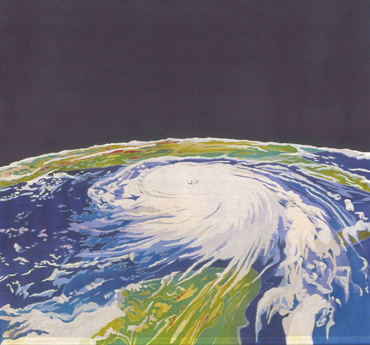
 

Hurricane's ashore

Mary Edna Fraser's artist rendition of Hurricane Katrina. Credit: maryedna.com.

By Ashley Yeager


Seeing the satellite images of Hurricane Irene reminded me of a piece of art I’d seen a few weeks ago. It was a stunning wax-fabric batik of Hurricane Katrina by Mary Edna Fraser.

Flipping to a print of it in Global Climate Change: A Primer, I read about a few cities that were swallowed by the sea.

Edingsville, S.C., in 1893. Broadwater, Va. in 1941. But Diamond City, N.C., may have the best story.

After being pummeled by three successive hurricanes in the late 1800s, citizens tore down their houses.

They packed them on sailboats and navigated them across Back Sound to Harkers Island, where they rebuilt them.

Today, in the U.S., 53 percent of the population lives on the 19 percent of land area near the coast, according to the Primer’s authors, geologist Orrin Pilkey and his son, Keith.

Imagine 165 million people tearing down their homes and moving them inland.

Page 11 of 11

Powered by WordPress & Theme by Anders Norén