Following the people and events that make up the research community at Duke

Students exploring the Innovation Co-Lab

Category: Computers/Technology Page 19 of 20

Lab "cloud" goes global

By Ashley Yeager

A network of individual computers are linked through a server. Credit: TAS Software

The National Science Foundation has awarded computer scientist Jeff Chase $300,000 to move a computer cloud he now has in his lab to the university’s campus network, and beyond.

Chase has been building the cloud to improve server networks. In his new model, servers, the computers that process requests and deliver data over a local network or the Internet, have become critical, public infrastructures with open, flexible, secure, robust and decentralized control.

The work, once reproduced outside of the lab, will let Duke scientists across campus and throughout the world to more easily connect to one another through existing networks and to share computational services and access data, according to Tracy Futhey, Duke’s vice president for information technology and chief information officer.

Based on software-defined networking and other technologies, the new, on-demand cloud services will be launched through a distinct network that connects science resources, such as the large datasets generated in physics and genomics experiments.

The project is part of the NSF-funded Global Environment for Networking Innovation, or GENI.

Chase’s work was also recognized on June 14 when the White House launched an initiative, US Ignite, to develop a publicly available system of advanced networks based on important contributions from GENI scientists. Duke is among more than 60 universities across the country that has participated in the project.

Student Profile: Jack Matteucci

By Nonie Arora

It may be summer, but student scientists are still on the job. Rising Trinity junior Jack Matteucci is heading to CERN in a few weeks to join the many scientists working with data from the Large Hadron Collider.

A Simulated Collision Producing a Higgs Boson Particle, Wikimedia Commons

Scientists working with data from the Large Hadron Collider are trying to determine whether the Higgs Boson, the so-called “God particle” exists. While the Higgs Boson has been called the “God particle” by some because it is currently the last predicted particle in the Standard Model to be observed, physicists are less fond of the name. “There is no doubt that it’s a huge missing piece to the puzzle, accounting for the observed phenomenon know as invariant mass, but it by no means explains everything about particle physics,” Matteucci says.

Einstein’s famous E= mc^2 showed a relationship between mass and energy. According to Matteucci, the Higgs Boson and its associated field would account for certain observed nonsymmetrical weak interactions, which would explain why certain particles have an inherent mass apart from the energy from their motion.

When collisions happen in Large Hadron Collider, thousands of protons collide and sophisticated computer programs must separate these interactions. After these interactions have been separated, data analysts like Matteucci enter the picture. He will be using ATLAS computing to analyze decay processes of elementary particles and confirm particle interactions.

Jack Matteucci

“During these interactions a plethora of particles are created and destroyed within tiny fractions of milliseconds which decay and lead to secondary products,” Matteucci explained.  “Then, scientists try to backtrack to information about primary particles.”

 While the collective effort is huge, the data is still analyzed one person at a time and interactions have to be confirmed thousands of times, according to Matteucci.

At Duke, Matteucci works under the guidance of Al Goshaw, the James B. Duke professor of physics. He’s also collaborating with Meg Shea and Yu Sheng Huang to build a cosmic ray detector. Cosmic rays are high-energy particles from the sun. Particles are produced from the interaction of the sun’s radiation and the Earth’s atmosphere. The team in Goshaw’s lab believes this detector will be very reliable and will be used to test more precise, future detectors.

People, Embedded in a Network

Guest Post By Steve Hartsoe, Office of News & Communications

“While social network analysts 20 years ago struggled with networks of hundreds of nodes, we now routinely face networks of hundreds of thousands,” according to James Moody, a Duke sociology professor and director of the school’s Network Analysis Center.

James Moody analyzes networks.

Moody, who was studying social networks long before they became a movie title, says that the abundance of material now available has created new opportunities to test scientific models for cultural behavior. But that growth has also generated a need for new tools and investments in computational social science.

He was one of the featured speakers at an April 26 symposium in Chapel Hill called “Social Networks. Analysis: Opportunities and Realities.” The event also featured  speakers from Duke’s Social Science Research Institute, the University of North Carolina at Chapel Hill’s Odom Institute for Social Science Research, and the iLab at North Carolina A&T State University.

A common thread was how to adapt to the abundance of information now available via the Web, and how to make the best use of high-tech tools for analyzing social networks.

Moody urged the audience to stay focused and consider the merits of working with smaller samples. He also told participants to think of social networks as simply “people embedded in a context.”

An image from one of Moody's earlier studies on social networks.

“There’s a lot of data out there, but a lot of that data doesn’t answer the question you want to answer, right?” Moody said. “So I think there’s a data-question mismatch in some cases.”

Moody also stressed the importance of using the right tools for analyzing social networks. “Don’t trade a good idea for a bad instrument,” he said. “Global networking tools can easily apply to a network of 20 or 30 nodes.”

Speaking remotely via an audio feed, John Haaga, deputy director at the National Institute on Aging, urged researchers seeking federal funding to follow a basic tenet for hitters in baseball: Start smaller “and then swing for the fences.”

More than one attendee in the rapid-fire, three-hour discussion likened it to being on the receiving end of a fire hose of information.

TEDxDuke 2012

By Becca Bayham

You may have some superhero in you, according to a speaker at TEDxDuke, March 31. Borrowing the format of TED, a popular lecture series, the second-annual event featured 12 mini-lectures spanning subjects from poetry to ballet to historical architecture. Below, I discuss the three speakers that resonated with me the most.

Dasan Ahanu, poet and spoken word performer

Batman might win in a popularity contest, but fellow superhero the Green Lantern has a lot to teach us, according to Dasan Ahanu.

Ahanu described several parallels between artists and the green-garbed superhero. The Green Lantern overcomes his fear and protects the Earth by tapping into an energy source with a magic ring. Artists channel power too, Ahanu said — but with a pen, paintbrush or microphone instead of a fancy ring.

Artists, too, have to overcome fear, but it’s fear of criticism and embarrassment, rather than fear of interstellar criminals (fortunately). Also like the Lantern, artists access a central source of energy — creativity.

“The only limit to their power is imagination,” Ahanu said.


Patty Kennedy, marketing and communications professional

Patty Kennedy opened with a clip from the Matrix, when Morpheus tells Neo to jump from one building to another. Neo tries… and fails.

“Sometimes we jump, and we fall really hard,” Kennedy said. “What we’ll talk about today is why you need to jump anyway.”

Babies fall all the time when they’re learning how to walk, but that doesn’t keep them from trying.

“If we’re born with the willingness to move forward, what happened to us?” she asked. “My theory is that we unlearned courage.”

Courage doesn’t imply the absence of fear, she said. It means overcoming your fear — jumping even though you know you might fall.

“In all respect to this esteemed university, it’s not what made you great — you started that way.”


Jimmy Soni, Duke ’07 and chief of staff at the Huffington Post

History is like castor oil, Jimmy Soni said. It’s good for us, but it tastes bad.

“I might be going out on a limb, but I think we can make history taste better.”

To demonstrate, he told a story. He described how the Eiffel Tower was heavily criticized by Parisians during the years after its construction in 1889 (indeed, it was almost torn down in 1909). One particularly-vocal critic could be seen eating at a cafe under the landmark every day. When questioned about this, he said: “It’s the only place where I can’t see the Eiffel Tower.”

Our cultural past is full of interesting stories, Soni said. Working those stories into the curriculum could make history a lot more appetizing.

Solving the world's humanitarian problems

By Becca Bayham

What will the world of 2050 look like?

Popular fiction tells us we’ll have hoverboards, spaceships and artificial intelligence. According to USAID advisor (and Duke alum) Alex Dehgan, we’ll also have new ways of addressing humanitarian challenges — and we’ll need them. Dehgan kicked off the Student International Discussion Group‘s Water & Energy Symposium, Feb. 10.

“We know that climate change is going to affect the U.S., the Middle East, Central Asia and North Africa. This is actually a national security issue for us,” Dehgan said. “One thing that I think has been forgotten is, it’s not just climate, it’s climate times the environment. It’s the interaction of these two pieces.”

Dehgan described a patch of tropical forest where all the trees had been cut down. Trees send moisture back to the atmosphere via transpiration. No trees, no rain. The ground dried up, and the area is now 30 degrees warmer than it was before.

The world of the future may look different in other ways. According to Dehgan, 51 countries will lose population between now and 2050, largely due to declining birth rates. Other countries such as India, Pakistan, Nigeria, Bangladesh, the Democratic Republic of the Congo, China, Uganda, Ethiopia and the U.S. will experience massive population growth. Some of those countries already face problems providing their people with sufficient food, energy and clean water.

“[USAID] sees the developing world as the future of the U.S. economy,” Dehgan said. “Many of these challenges aren’t just bad news. They’re challenges we can take on to develop our markets.”

To that end, Dehgan cited five trends that will help organizations tackle humanitarian challenges in the future:

  1. Democratization of Science
    It took researchers 13 years and 2.7 billion dollars to sequence a single human genome for the first time. Now a company can sequence 100 genomes a day for less than $100 each. Lower costs allow humanitarian groups to deploy innovative technologies (such as vaccines) on a large scale.
  2. Increase in Computing Power
    “The power of computing is increasing exponentially, while the cost is decreasing exponentially. This provides us with exceptional ability to use computer power to help understand and solve problems,” Dehgan said.
  3. Data, Data, Data
    “A kid in Africa has more power and knowledge in his hand with a smart phone than President Clinton had 15 years ago,” Dehgan said. Technologies such as remote sensing, crowd sourcing and bioinformatics will add new types of data to our pool of knowledge.
  4. Connectivity
    Cellphones act as gateways to human knowledge, providing people with access to information they didn’t have before.
  5. Decentralization of Manufacturing
    Certain 3D printers, for example, now have the ability to produce 70 percent of the parts needed for another 3D printer. Online course materials such as iTunesU and MIT OpenCourseWare help support individuals that are trying to solve their own problems.

Dehgan also says he hopes that a sort of “humanitarian X Prize” could identify solutions to our changing world by catalyzing new research.

In 1996, the X Prize Foundation announced a $10 million reward for the first group to launch a manned, reusable vehicle into space twice within two weeks. The foundation hoped to spur innovation that would make low-cost space flight possible, and they succeeded. The winning team claimed the prize in 2004, after investing $100 million in new technologies.

“With grants, you don’t know what you’re going to get,” Dehgan said. “If you have a prize, you only win the prize once you’ve actually solved the problem. And one of the great things about it is that you get more than one solution.”

Composing music with Xbox Kinect

By Ashley Yeager

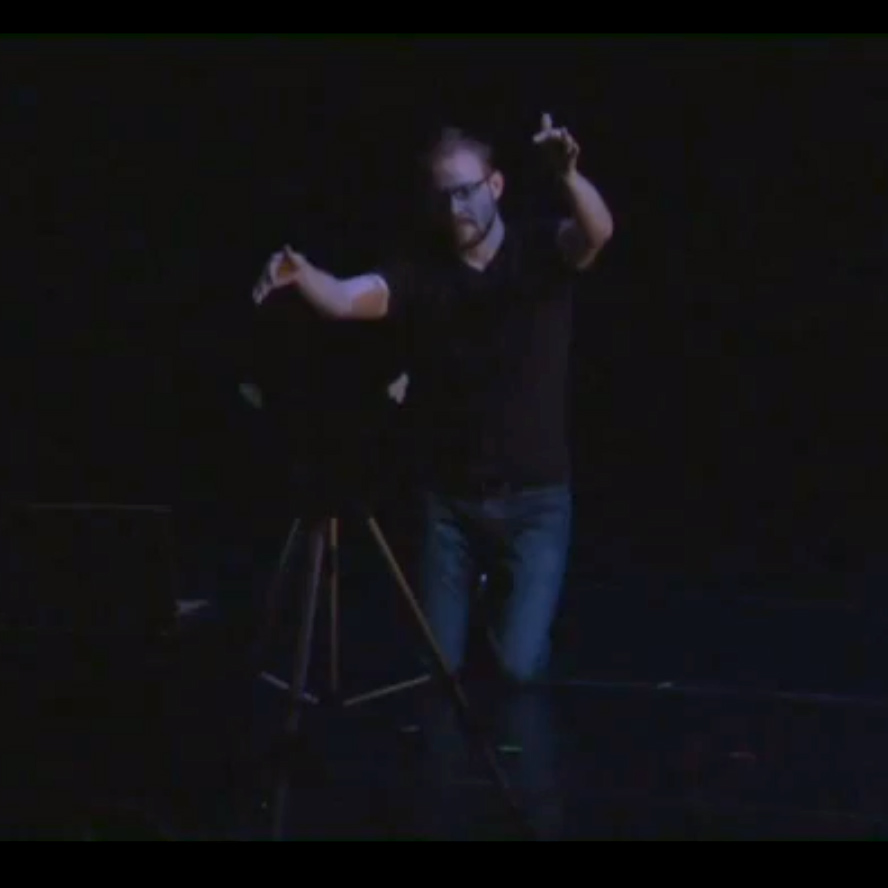
Ken Stewart uses his motions and an XBox Kinect to narrate, musically, a dance by Thomas DeFrantz. Credit: Duke University Dance Program.

To watch Ken Stewart dance in front of his Xbox Kinect gives a whole new meaning to the “Dance Your Ph.D.” contest.

Stewart, a graduate student in the music department and a composer, is using the camera, along with specialized computer software, to narrate dance with sound. He demo’ed the program while walking an audience through his imnewhere, or I’m new here, composition of dance professor Tommy DeFrantz’s journey to Duke.

The Jan. 27 presentation was part of the Visualization Friday Forum and gave attendees a behind-the-scenes look at the research and mathematics behind Stewart’s new, “more expressive way” to write music.

With the Kinect, which has motion-detection technology for interacting with video games, Stewart can transform his gestures into sound, intimately controlling the loudness, pitch and rhythmic intensity of the score he creates. The system records 15 points on a controller’s body, including his head, neck, shoulders, knees and feet.

Using a library of sounds, the controller can then correlate and choreograph a composition, using the computer to calculate angles between his hands or distance between his body and the camera. These angles are converted to become the musical notes.

The work, Stewart says, gives him a way to use his ears and actions to “feel out” a song. He concedes that there are hiccups between how he moves and the sounds created, but, he says he thinks that the imprecision adds to the expressivity of the composing process.

Stewart said he and DeFrantz are still working on imnewhere. They plan to expand the piece to 15 minutes and will perform it again in Grand Rapids, Mich., Berkeley, Calif. and Belfast, UK.

'Knowsphere' could solve climate problems, Revkin argues

By Becca Bayham

Does the world seem a little angsty-er to you? It should, it’s got way more adolescents.

“There were only a billion people [on Earth] in 1800; now we have a billion teenagers,” said Andrew Revkin, a prize-winning journalist and New York Times blogger, during a lecture on Jan. 18.

“Is this a sign of overpopulation?” someone in the audience joked, referring to the jam-packed classroom.

Likely not, but, as Revkin discussed, resource limits and an explosive human population growth may eventually cause population or economic declines.

“We don’t seem to have distinguished ourselves from bacteria on a plate of agar yet,” Revkin said. “Science is saying hey, hey, there’s an edge to the dish! But we’re still in go-go-go mode.”

The fact that we will reach the edge of the dish is undeniable — and it won’t be pretty. To illustrate, Revkin showed a picture of Black Friday shoppers fighting over a sale item.

“Can you imagine everyone doing this?” he said.

Unfortunately, we humans are historically bad at confronting problems that don’t affect us here-and-now. If in doubt, see our lackluster response to the national debt. Or global climate change, for that matter (a topic Revkin often blogs about).

“There’s a big chunk of everyone who just doesn’t want to deal with global warming, to tell you the truth… it’s hard, it’s complex, it’s laden with layers of complicit uncertainty. What is it and what do you do about it?”

Revkin believes that global connectedness, powered by the internet, offers a solution to the many problems humanity will face in coming years.

Communication between people — sharing information and exchanging ideas — has long fueled our economy and fostered human progress. According to Revkin, a network of collaborating schools, libraries, businesses and other institutions (a “knowsphere”) could help combat problems ranging from natural disaster preparedness to the treatment of diseases.

“Much of human progress can be charted in relation to our linkages with others,” he said.

In the 1920s, philosophers Vladimir Vernadsky and Teilhard de Chardin conceptualized the idea of a “noosphere” (from the Greek “nous”, mind and sphaira, “sphere”), a philosophical sphere of intelligence around the Earth that humans could draw from — a planet of the mind. Back then, it was just an idea.

“But now, it’s happening,” Revkin said.

Solving problems with iPad (or Android) apps

eCLIP iPad applicationBy Becca Bayham

When a patient comes into the E.R. with a lung problem, doctors usually put them on a ventilator. Unfortunately, this procedure helps some patients, but hurts others. Doctors have difficulty predicting which will be the case, due to a lack of data on risk factors. A predictive model was recently developed to solve this problem, but the calculations require more time and information than E.R. doctors usually have.

Enter Raquel Bartz, an emergency room doctor at Duke Hospital. She envisioned an iPad application where doctors and family members could input the necessary medical information, and the app would spit out the treatment protocol for a particular patient. Bartz turned to Richard Lucic and Robert Duvall’s Software for Mobile Devices class (COMPSCI 196) to make her idea a reality.

The result? An application called eCLIP, developed by students last Fall and available now in iTunes’ App Store. (See photos at left)

eCLIP is one of five applications created by students during the two semesters COMPSCI 196 has been offered. Lucic and Duvall described the course — and its various student-produced applications — at last week’s Visualization Friday Forum, sponsored by the Visualization Studies Initiative (http://visualstudies.duke.edu/) and Duke’s computer science department.

“We’re trying to teach students about the mobile app world,” Lucic said. “In addition, we’re trying to teach students about the software development process, from conception of an idea to delivering a product to a client.”

Lucic emphasized the importance of teamwork, as well as the value of visual design skills for increasing a product’s appeal. Furthermore, user testing is a critical step for identifying problems.

This semester, nine clients pitched their application ideas. Students voted for their favorite projects, and three were ultimately chosen:

  • Ajay Patel, IT Manager in the Duke Cancer Center, wanted a way to track medical samples during processing and reduce human error
  • Allison Besch, educational curator for the North Carolina Maritime Museum, wanted a fun, educational tool for teaching marine resource conservation to 4th graders
  • Rachel Cook, Duke alumna and former futures trader, wanted an app to encourage microlending and bridge the gap between lenders and borrowers

Each client worked with a team of 3-4 students, and met with them every other week to discuss the team’s progress.

“A lot of students are learning how to code mobile apps for the first time, so there’s only 6-7 weeks of actual coding time,” Duvall said.

Despite the time crunch, students try to present a finished product to their clients by the end of the semester. But who keeps the app going after the course’s conclusion?

“What we’re trying to do is have the students provide enough documentation and write their code well enough that the app can be maintained by the client’s organization,” Lucic said. “Clients have been thrilled with the experience. I think we’ve done a superb job of meeting their needs, as much as you can in a one-semester course.”

Science Under the Stars

Building on earlier successes with K-12 classroom outreach and a huge appearance at the 2010 USA Science and Engineering Festival, Duke University students and faculty are inviting Triangle-area families to join them for an evening of interactive science demonstrations called SCIENCE UNDER THE STARS.

USA Science and Engineering Fest

Duke students wowed kids and grownups alike at last year's national science festival in Washington DC.

The October 19 festival will include hands-on, all-ages activities from Chemistry, Physics, Biology, Engineering, Genomics, Environmental Science,  Microbiology, Immunology, and Molecular Genetics.

SCIENCE UNDER THE STARS will be from 6 p.m. to 8 p.m. on Wednesday, Oct. 19, on the front lawn of the French Family Science Center on Duke’s West Campus.

At 7:30, the chemists will stage a spectacular grand finale — not quite fireworks, but close!

Free parking is available in the Chemistry parking lot at Research Drive and Towerview, and overflow parking will be available in the Bryan Center structure on Science Drive as well.

RAIN DATE – Thursday, Oct. 20.

For more information contact Kenneth Lyle, PhD at kenneth.lyle@duke.edu


Open source science

By Becca Bayham

In 2009, mathematician Timothy Gowers posed this question to the blogosphere: “Is massively collaborative mathematics possible?” He described an unsolved math problem and asked for help figuring it out. Over the next few hours and days, commenters began to pick at the problem together. They brought up incomplete ideas, which were expanded and incorporated into other peoples’ ideas, until Gowers posted 37 days later that the problem had (probably) been solved.

Which raises the question — Can open source principles be applied to scientific problems? Michael Nielsen explored this idea during a lecture last Tuesday, sponsored by the Duke University Libraries.

When a non-profit needed a technology that didn’t exist (an affordable solar-powered wireless router), they turned to InnoCentive, a website that allows organizations to post descriptions of scientific problems they’d like solved. Rewards range from a couple thousand dollars (for designing a better beverage container) to a cool million (for finding the biomarker for ALS).

The challenge was solved by a man who’d made a hobby of building his own low-cost radio networks and solar power systems. The moral of the story — if a problem requires an unusual combination of expertise, someone somewhere might have it. Or a collaboration of people might generate the “conversational critical mass” to make easy work of the problem.

Open source science can be difficult to achieve, however. Nielsen said that numerous wikis and online communities have tried to facilitate idea sharing, but failed for a lack of incentives.

“Imagine you’re a young scientist who wants to get a job at some point,” Nielsen said. “You know that from the point of view of some hiring committee, a long slew of brilliant contributions to a wiki doesn’t count as much as a single mediocre scientific paper that no one is going to read.”

Nielsen advocated creating incentives for scientists to share in new ways. For example, including blog posts in Google Scholar searches, or publishing data sets instead of just papers.

“The payoff is to develop new methods for the construction of knowledge … and to expand the range of scientific problems that we can attack,” Nielsen said.

Page 19 of 20

Powered by WordPress & Theme by Anders Norén