Following the people and events that make up the research community at Duke

Students exploring the Innovation Co-Lab

Category: Computers/Technology Page 18 of 20

New Course Offers Lessons from Lasering Priceless Art

Duke graduate student Tana Villafana and chief conservator at the NC Museum of Art William Brown stand over The Crucifixion (inset). (Photo: Martin Fischer)

Duke graduate student Tana Villafana and chief conservator at the NC Museum of Art William Brown stand over The Crucifixion (inset). (Photo: Martin Fischer)

By Erin Weeks

A group of chemists at Duke University has gained recognition in recent years for shooting lasers at medieval artwork — technology that allows a harmless peek at the many layers and materials in a painting and offers insight into long gone eras and artists. Now, Duke students will have the chance to learn from this pioneering work at the intersection of chemistry and art history in a new course on the science of color.

The course coincides with the publication of the first scientific measurements from the laser work, reported Jan. 20 in the Proceedings of the National Academy of Sciences.

“The images we have now are enormously better than a year ago,” said Warren S. Warren, head of the lab performing the imaging and the James B. Duke professor of chemistry. He and fellow Duke authors, grad student Tana Villafana and associate research professor Martin Fischer, have not only demonstrated the technology works — they’ve shown it works at an incredible level of detail, telling the difference, for example, between nearly identical pigments.

But lasering The Crucifixion by Puccio Cappano was just the start, as the team envisions countless more cultural applications of the technology. Given enough funding and manpower, they could visualize ancient scrolls of text too fragile to unroll, reveal the bright colors that once adorned Greek statues, learn the secrets of China’s terracotta warriors, and even detect the beginnings of pigment degradation in aging artwork.

There are talented people in art conservation, Warren said, whose work could benefit from more advanced technology, and there are talented people at the cutting-edge of laser science looking for meaningful ways to apply their inventions. For the past several years, Warren’s lab has brought these people together.

Now, he hopes to accomplish something similar with students at Duke. Warren, Fischer, and another chemistry instructor, Adele DeCruz, are teaming up to teach “The Molecular, Physical, and Artistic Bases of Color” in the second half of spring semester.

The class will visit the Nasher Museum of Art, the North Carolina Museum of Art in Raleigh, and possibly even the National Gallery of Art in Washington, D.C, to learn first-hand from art conservators and working artists. Students can expect to learn about how humans have used and made pigments over the millennia; how color works at a molecular level; and the basics of how human vision, microscopes, cameras, and lasers all see or image color.

Students can register for the half course, CHM 590, until the add/drop deadline for classes on January 22. “Students should not be scared off by the course number,” Warren said. “The prerequisite is one college-level science course, and the intent is to make both the science and artistic components accessible to a broad audience.”

Funding for the research was provided by National Science Foundation grant CHE-1309017.

CITATION: “Femtosecond pump-probe microscopy generates virtual cross-sections in historic artwork.” Tana E. Villafana, William P. Brown, et al. Proceedings of the National Academy of Sciences, Jan. 20, 2014. Doi: 10.1071/pnas.1317230111

Pretty pictures show lemurs responding to changing climate

Guest Post by Sheena Faherty, Biology Graduate Student 

Madagascar’s much-adored and fuzzy lemurs might be “sweated out” of habitats by warming environments under global climate change. Or will they?

A team of researchers at the Duke Lemur Center is employing high-tech heat cameras used in  fire fighting, sports medicine and cancer diagnostics to take “glowing” rainbow pictures of lemurs and their forest surroundings. The results look similar to a child’s coloring project gone rogue.

A mother and baby Coquerel's Sifaka at the Lemur Center in thermograph and visible light. (Leslie Digby)

A mother and baby Coquerel’s Sifaka at the Lemur Center in thermograph and visible light. (Leslie Digby)

This technology, known as infrared thermography, is a camera that allows researchers to detect surface temperatures of lemurs and their hang-outs in the forest—at different depths and heights—and on varying surfaces such as the ground, leaves, and tree trunks.

Combining these data with records of where an animal prefers to spend time, the researchers can begin to determine what temperatures make lemurs most happy.

Leslie Digby, an associate professor in the Department of Evolutionary Anthropology, and her students want to see  how the lemurs are changing their behavior to warm-up on cool days, and cool-down on warm days without having to shiver or sweat.

This sounds rather like a lizard basking on a rock during a sunny day to warm his cold-blooded body up, but lemurs aren’t cold-blooded. They shouldn’t have to do this.

It turns out that even though lemurs are warm-blooded, they can conserve precious energy by channeling their inner Buddha — using sunning behaviors, just like lizards, to fine-tune core body temperatures.

Digby’s team is trying to understand why some species have seemingly restricted territories, even without obvious geographical barriers like mountain ranges or rivers. They suspect temperature plays a part.

“We know that primate species ranges have been very different in the past, so understanding how flexible these animals are, or [are] not, to temperatures can help us understand these larger scale impacts [of changing climate]”, says Digby.

Figuring out how animals respond to alterations in their environment, like rising temperatures, can help scientists anticipate species’ survival in the face of globally changing climates. And knowing which areas of the forest are preferred by lemurs, could help direct conservation efforts, like reforesting parts that have been cut down, or preserving those areas that have not.

Changing temperatures will undoubtedly have major impacts on lemur home ranges in the future, potentially altering them until the animals  are forced into an area outside their thermal limits. By gearing her research toward understanding the thermal tolerances of lemurs, Digby is doing her part to protect the vulnerable lemurs.

A ringtailed lemur striking the classic belly-warming Buddha pose in one of the natural enclosures at Duke Lemur Center. (David Haring)

A ringtailed lemur striking the classic belly-warming Buddha pose in one of the natural enclosures at Duke Lemur Center. (David Haring)

Social Networks for Sharing Science and Health

Guest post by David Jarmul

Facebook, Twitter and other new social networks are making it easier than ever for people to share useful information about medicine and science, whether it’s about choosing a good physician or reducing one’s carbon footprint.

Adjunct professor Brian Southwell cautions in a new book, however, that the emergence of these forums doesn’t mean people will benefit from them equally. There are some significant disparities in how people use the forums – and not all can access them.

Cover of Southwell book“This book reflects a sense of urgency that I developed over several years as it became apparent that our networked future won’t guarantee the equity that some suggest it will,” writes Southwell, a senior research scientist at RTI International in the Research Triangle Park and an adjunct professor with Duke University’s Energy Initiative. “Despite enthusiasm about 21st century possibilities for social contagion as a mechanism for public education, we have distinct reasons to expect not only inequality but also inequity.”

Southwell says disparities in information access present a host of ethical and policy challenges. “People involved in educating large masses of people about the latest research on topics like healthy behavior or the natural environment do not typically have access to bullhorns that can reach everyone at once,” he writes. “By acknowledging and addressing the reality of existing disparities between people and between communities in information sharing, we can work toward a future in which more people can participate in (and benefit from) ongoing dialogues, which in turn may help to craft healthier communities and even a healthier planet.”

At Duke, Southwell is exploring ways to engage low-income populations in a project he is pursuing with Dan Vermeer of the Fuqua School of Business and Laura Richman of the psychology department. Working with partners at Clean Energy Durham and the Bass Connections initiative, they will assess how innovative communication strategies might enhance household energy conservation efforts.

Social Networks and Popular Understanding of Science and Health: Sharing Disparities is published by RTI Press and Johns Hopkins University Press.

Students Create Multimedia Ocean Conservation Text

By Ashley Yeager

This screenshot shows one of the opening page of of Johnston's new iBook. Image courtesy of Dave Johnston, Duke.

This screenshot shows one of the opening pages of a chapter in Johnston’s new iBook. Image courtesy of Dave Johnston, Duke.

Duke marine biologist Dave Johnston and his students are back in business on iTunes.

They’ve just released The View From Below, a free iBook for middle school students and teachers that uses multimedia and classroom exercises to discuss overfishing, marine debris, climate change, invasive species and other issues related to marine conservation.

This is Johnston’s second digital textbook. His first was Cachalot, an iPad textbook covering the latest science of marine mammals like whales, dolphins and seals. Experts contributed the text, images and open-access papers.

The View From Below, however, is a bit different.

Undergraduate students in Johnston’s Marine Conservation Service Learning class wrote the book using Apple’s iBooks authoring tool. Johnston and Tom Schultz, Director of the Marine Conservation Molecular Facility at Duke’s Marine Lab, edited it.

“There are a lot of people exploring the use of the iBooks platform for student-generated content, among other development platforms,” Johnston says. “I don’t think we’ve seen many that focus on marine science yet though, and I’m pretty sure it’s the first marine conservation textbook written by students on the iTunes store.”

Johnston says the class chose to use the iBooks software because the technology is free, easy to use and provides “great templates to get things going quickly.” The software also works well because Duke’s Marine Lab has an iPad loaner program, making the tablet the platform of choice for developing and testing the textbook.

The middle school that the service learning class works with also has access to iPads for students and instructors, so the audience was there for the iPad format, Johnston adds.

His students chose to write the book as the class project to spur learning and discussion about some of the most serious problems facing Earth’s oceans.

“As the text indicates, all life on earth is ultimately supported by the ocean, so we need to take care of it,” he says.

Film Presents Alan Turing In Full; Duke Preview Monday

Guest post by Pender M. McCarter, Trinity College (1968), Senior Public Relations Counselor, IEEE-USA/Washington

Codebreaker publicity image

A scene from the movie “Codebreaker” about the life of Alan Turing.

Alan Turing has been hailed as a digital Darwin, an Einstein and a Newton who helped to “catapult civilization in to the digital age.” The British mathematician laid the groundwork for everything we do with computers today, according to Apple co-founder Steve Wozniak. The Turing Machine incorporated all the basic aspects of computer input and output. His 1950 paper, “Computing Machinery and Intelligence,” posited that computers can be programmed to mimic human behavior. And at the end of his life, Turing wrote about pattern formation in biology, what he called morphogenesis, that could be observed in animal stripes and spirals and even exist in ecosystems and galaxies.  Turing is best known for leading the British Bletchley Park code breakers team that cracked Germany’s Naval Enigma Code, helped end World War II, and saved perhaps millions of lives.

Yet until recently Turing’s contributions have been little known or appreciated outside of the sci-tech community. And his personal life as a gay man has generally been glossed over. In 2012, the centenary of Alan Turing’s birth, hundreds of events have been held worldwide. A new film, Codebreaker, presents Turing’s personal and professional life without flinching, including how his sexual nature contributed to his extraordinary achievements and tragic downfall.

The drama documentary emphasizes that the support and encouragement Turing enjoyed with other eccentric and brilliant technologists at Bletchley Park motivated and sustained him. When he lost this community after World War II, at a time when there was a craving for normalcy and scant tolerance for non-conformists, Turing learned how unforgiving the world could be.

The drama scenes in Codebreaker center on the psychotherapy sessions Turing participated in during the last 18 months of his life.  In these final months, Turing faced persecution as a gay man under the same 19th century British laws that were used to prosecute Oscar Wilde.  In 1954, at the age of 41, Turing committed suicide leaving us to wonder about potential future accomplishments  in a more accepting and tolerant time. In 2009, former British Prime Minister Gordon Brown apologized posthumously to Turing: “We’re sorry; you deserved so much better.”

Codebreaker will be screened at the Duke Center for LGBT Life (02 West Union Building) on Monday, Oct. 29, from 7-8:30 p.m., with underwriting from IEEE-USA, the Washington-based office of the IEEE, the world’s largest professional association for the advancement of technology. The drama documentary will be introduced by Executive Producer Patrick Sammon, who will also answer questions about the film.

Here’s a link to the trailer: http://www.turingfilm.com/

Refereed physics for Twitter and Facebook, maybe

By Ashley Yeager

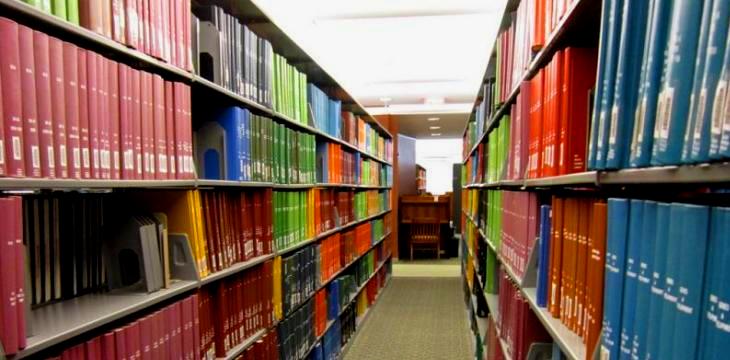
These library stacks of science journals are going out of style as more publishers opt for online-only, open access formats. Credit: UCSF.

When journal publishers send peer-reviewed tweets, they’ll have truly entered the digital age. They’re not there yet, but that doesn’t mean they’re not trying, said Gene Sprouse, editor-and-chief of the American Physical Society(APS) and a physics professor at Stony Brook University.

Sprouse, speaking at an Oct. 17 physics colloquium, described how the Internet is changing the way scientists share their research. They used to submit papers to journals, have their ideas vetted by other scientists, and then see their arguments and data in print — or not. He said it has been this way since the 1660s when the first journal, Philosophical Transactions, was first published.

But with online journals available right on researchers’ desktop and open-access digital archives, such as arXiv.org, journal editors, like those at the helm of magazines and newspapers, are trying to figure out how to shift print publications online while still making a profit.

“Eventually print journals will disappear,” Sprouse said, explaining that sans paper, authors and publishers could include new types of content like movies and active graphics in their articles. But even with new media features, “what physicists want is rapid acceptance of their paper into a prestigious journal with no hassles during peer review. They want attention for their work, and they want it widely distributed.”

To meet those demands in the new media landscape, APS has developed a Creative Commons license for authors to share their articles on their personal web sites and encourages them to publish pre-prints in online digital archives, such as arXiv.org.

Hoping to merge the prestige of the “baby Nature” journals – Nature Photonics, Nature Optics, Nature Physics, etc. – with the open-access model of the Public Library of Science, or PLOS, journals, the society has also created Physical Review X.

It’s the society’s first online-only, fully open-access journal. The one-year-old publication, which charges authors $1,500 per accepted article, is already comparable in prestige to APS’s other leading journal, Physical Review Letters. The difference is that now authors have an open-access journal to submit to at APS, which is important as more funders push researchers to submit to that type of publication, Sprouse said.

The society isn’t ignoring Twitter and Facebook either. When asked when the society would post the first refereed physics tweet, Sprouse said he couldn’t really say because he personally doesn’t use social media. But, APS, he added quickly, is working on its social media strategy and would “welcome any advice from those of you exploring that realm.”

A second crack at the nature of glass

By Ashley Yeager

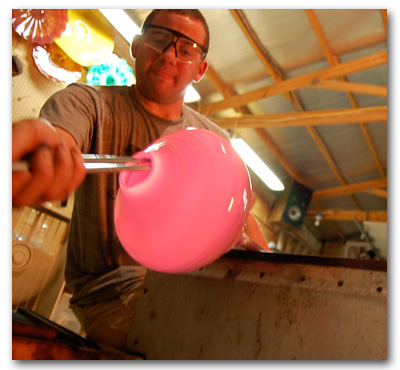
Glassblowers shape molten silica before the glass transitions from liquid to a more solid structure. Credit: handblownglass.com.

Patrick Charbonneau and his collaborators have taken another crack at understanding the nature of glass. Their latest simulations show that a key assumption of theoretical chemists and physicists to explain the molecular structure of glass is wrong.

Glass forms when liquids are slowly compressed or super-cooled, but don’t crystallize the way cooled water turns to ice. The liquidy pre-cursors to glass, like molten silica, do become hard like a solid, but the atoms in the material don’t organize themselves into a perfect crystal pattern.

The result is a substance that is as hard as a solid but has the molecular arrangement of a liquid — a phenomenon that scientists can’t quite explain, yet.

Previous theories assumed that at the transition point between a liquid and glass, the material’s atoms become caged by each other in a “simple” Gaussian shape. This same shape describes the distribution of people’s height in the U.S. and is known as a bell-shaped curve.

But new simulations, described online Aug. 13 in PNAS, suggest this assumption is wrong. The simulations model the interactions of glass particles in multiple dimensions and show the shape of the particle cage is much more complex than a Gaussian distribution.

The discovery is a “paradigm shift in the sense that so many people have been having the same, wrong, conception for so long, and they should now revisit that basic assumption,” says Charbonneau, a theoretical chemist at Duke. “The assumption was actually constraining how they thought about the problem.”

Even with a new shine on the way scientists think about glass, it is not clear how close or far the theorists are from writing an accurate description of what happens at the liquid-glass transition. But “the path to get there seems clearer than it has been in a long time,” Charbonneau says.

The next step in the research is to understand the relationship between glassy states of matter and those that are jammed, like pieces of cereal wedged in a grain hopper. Charbonneau and collaborators are already at work about how to study the connections between the two forms of matter.

Citation:
“Dimensional study of the caging order parameter at the glass transition.” 2012. Charbonneau, P., et al. PNAS Early Edition. DOI: 10.1073/pnas.1211825109

Reading between the lines of light

By Ashley Yeager

Harry Potter's invisibility cloak is not exactly what scientists have in mind for their light tricks. Credit: Warner Brothers.

The way we understand light is largely based on how we see it. To our eyes, light is like a stream of particles.

Scientists usually study these particle streams by measuring their wavelengths and how they interact with objects. But over the last decade, researchers have begun to realize that light particles can interact with objects within wavelengths too.

Now, scientists are looking inside wavelengths to control and manipulate light, which is transforming the traditional field of optics, according to Duke engineer David Smith and his colleagues.

They describe the changes to the field of optics in a review article appearing online Aug. 2 in Science, and they describe how, at a tenth or even a hundredth of the wavelength of visible light, the classic picture of how we see breaks down.

In this regime, streams of light particles can bend away from an object, essentially tricking the eye into thinking the object is not there. As a result, scientists can no longer think of light in terms of particle streams. Instead, they must think of it as a manipulation of electric and magnetic field lines.

Thinking of light this way, Smith and other scientists are beginning to understand how they can hide one object within another and even harvest energy. The new understanding “will be the design tool of choice” as scientists continue to play with the forces between electrically charged particles, the authors argue.

Citation:

“Transformation Optics and Subwavelength Control of Light.” Pendry, J., et. al. 2012. Science 337: 549-552.
DOI: 10.1126/science.1220600

'Chicken' Logic Secures Planes, Trains and Ports

By Ashley Yeager

U.S. goalkeeper Hope Solo deflects a penalty kick. Credit: AP

Soccer penalty kicks, ‘Chicken’ and other games may thwart terrorist attacks, drug smugglers and even freeloaders trying to board trains without tickets.

It’s not so much the intensity and adrenaline of the games that lead to better security, but the logic the players use, says Vincent Conitzer, a professor of computer science and economics at Duke.

This logic is called game theory and now scientists are using it to compute solutions for security issues, Conitzer explained at a July 11 talk with undergraduates completing summer research projects on campus.

During the talk, Conitzer gave a brief overview of game theory using real-world examples, such as penalty kicks in soccer and a set of drivers playing chicken. In the soccer example, he described a “zero-sum game” between the goalie and the kicker, where no matter the outcome, one player wins and the other loses.

But in the case of chicken, in which two cars drive straight at each other until one of the drivers “chickens out” and diverts course, the stakes of each choice are a bit higher. If both drivers stay straight, they crash. It’s no longer a zero-sum game.

When it comes to preventing security problems, there are more angles of attack, smuggler entry points and ways to board a train than the simple left, right or straight of these game examples.

Cars and buses wait to clear a security checkpoint at LAX. Credit: cardatabase.net

To make predictions about what the bad guys will do in the security scenarios, Conitzer is working with Milind Tambe and his group at USC. The team has designed game theory algorithms to set the schedule of security checkpoints and canine rounds at LAX airport, smuggler-scouting in Boston Harbor and even methods for preventing terrorist attacks in Mumbai.

Tambe “treats the problem of Mumbai personally” since that is his home city, Conitzer said, adding that he is only directly involved in this project with the USC group.

While the talk focused mainly on security applications, Conitzer also thinks that some “surprising new applications have yet to emerge” from the work. The new uses won’t necessarily help win a game of chicken or score a penalty kick.

But they could help scientists understand how to better use incentives to designgames with only good outcomes, such as encouraging smart energy use.

Citation: “Computing Game-Theoretic Solutions and Applications to Security.” Conitzer, V. In Proceedings of the 26th National Conference on Artificial Intelligence (AAAI-12), Toronto, ON, Canada, 2011.

CSI-House teams could make better medical diagnoses

By Ashley Yeager

Comparing a child's DNA to his parents' could help with identification of hard-to-diagnose genetic diseases. Credit: Henrik Jonsson/iStockphoto

Dr. Gregory House, star of House, M.D., and the lab techs on CSI never fail at their jobs. But that’s Hollywood. In real life, diagnosing illnesses and sequencing DNA isn’t so straightforward. It doesn’t always lead to a happy ending either, especially for children who are sick but can’t be diagnosed, even by gifted, real-life doctors.

That’s exactly why geneticist David Goldstein has teamed with pediatrician Vandana Shashi to combine a little House and CSI to identify apparent genetic diseases and quickly end some families’ diagnostic odysseys.

So far, the team has provided likely genetic diagnoses in six of 12 children it has worked with, said Goldstein at a Cardiovascular Research Center Seminar Series talk on June 27.

The children were referred to Shashi for a pilot study where she would record their symptoms, or phenotypic behavior, much like House. Then, Goldstein and his team at the Center for Human Genome Variation collected DNA samples from the children and both of their biological parents.

Using next-generation genetic sequencers, as well as traditional DNA scanners, Goldstein and his team looked for genetic variations between the children’s and parents’ complete genome. Like looking at DNA to identify a criminal, Goldstein and his genetics team are scouring the sequences for genetic fingerprints of the diseases disrupting the children’s lives.

Once variations were identified, the entire team looked for known diseases with similar gene mutations and symptoms. Goldstein explained that the study not only pinpointed the undiagnosed congenital diseases in some patients but also presented new genes that could also be linked to the illnesses. The study’s success has led to the creation of the Genome Sequencing Clinic.

The clinic will begin to help the families of the 50,000 children (out of the four million) born each year in the US with difficult-to-diagnose genetic diseases. These types of studies will likely be the “earliest drivers for large-scale genetic sequencing,” Goldstein said.

But, he cautioned, “there’s a whole lot of junk,” or variation, in DNA. Every genome has the narrative potential for devastating diseases, and that means that House-CSI teams, like Shashi and Goldstein’s, need to be extremely careful when making diagnoses, especially if the results will influence treatment, he said.

Citation: Clinical application of exome sequencing in undiagnosed genetic conditions. Need, A. et. al. 2012. J. Med Genet. 49:6 353-361. doi:10.1136/jmedgenet-2012-100819

Page 18 of 20

Powered by WordPress & Theme by Anders Norén