Following the people and events that make up the research community at Duke

Students exploring the Innovation Co-Lab

Author: Ashley Mooney

Solving the mystery of the American psycho

by Ashley Mooney

New studies show that psychopathy in criminals is the best predictor of future offenses.

Kent Kiehl, associate professor of psychology at the University of New Mexico, spoke Friday, April 20 on his research on psychopathy—a personality disorder characterized by a persistent pattern of disregard for the rights of others and the rules of society—in prison populations in the United States and Canada. Using a trailer equipped with a mobile MRI unit that could travel to prisons, Kiehl scanned the brains of 2,000 inmate volunteers, which included 200 female offenders and 250 juvenile offenders, in medium and maximum-security prisons in Wisconsin and New Mexico.

Mugshot of Charles Manson, an infamous psychopath. Courtesy of Wikimedia Commons.

“Psychopathy is currently considered the single best predictor of future behavior,” Kiehl said. “If you have a diagnosis of psychopathy and you’re going for parole or something, they view that as a risk factor.”

He found that compared to the average offender, 60 percent of psychopaths reoffend within the next 200 days. Maximum-security juveniles showed a similar pattern: 68 percent of individuals who were at high risk for psychopathy reoffended.

Using images of the brain, Kiehl said he could predict psychopathy as well as one can with clinical error.

“If you have different behavior, you’re going to have a different brain. Just like men and women: different behaviors, different brains.”

Kiehl noted the role of the MAOA gene in violent behavior. He said if one has the gene and comes from a stressful environment, he or she has a significantly elevated risk for committing a violent offense. The gene may contribute to variability in grey matter density in some parts of the brain, which is a risk factor for psychopathy.

Although Kiehl noted the strengths of group therapy in prisons, he said treatment might actually make things worse. Treating psychopaths leads to “violent failure,” meaning that they have a high chance of violent recidivism (relapsing into the behavior).

In juveniles, however, Kiehl said positive reinforcement techniques have reduced recidivism by deemphasizing punishment and treating impulsivity. The kids in the program show a 50 percent reduction in violent recidivism compared to those who undergo normal treatment. Besides the reduction in violent recidivism, the juveniles are also less likely to commit the same types violent crimes, such as murder.

Diagnosing psychopathy and using cost-effective treatments, such as positive reinforcement, can help alleviate the burden of the prison system in the United States.

“We have a problem in the United States: We incarcerate a lot of people,” he said. “We incarcerate more per capita than any other country. It’s expensive—it costs $2.34 trillion per year, which is about the same as the annual estimate for all health care [in the country].”

Kratt's Creatures come to life

By Ashley Mooney

Duke alumnus Martin Kratt detailed his journey from his time as an undergraduate throughout the creation of several wildlife shows targeted toward children.

Kratt spoke Monday to a crowd of students, wildlife enthusiasts and some of his younger fans about his roots in wildlife conservation. With his brother Chris, Kratt created several wildlife television shows—including Kratts’ Creatures, Be the Creature and Wild Kratts—as a way to aid education and preservation of endangered species. Several of his roots tie back to Duke, namely the star of his popular show Zoboomafoo, which featured Jovian, a captive Coquerel’s Sifaka from the Duke Lemur Center.

Kratt got his start as a student technician at the Lemur Center—then known as the Duke Primate Center—in his junior year.

Jovian, the Coquerel's sifaka who played Zoboomafoo. Photo courtesy of David Haring from the Duke Lemur Center.

Although he initially wanted to be a conservation veterinarian, he credited his beginning in wildlife television to a class at Duke called amphibian ecology. Kratt borrowed an underwater camera and filmed salamanders during class field trips, creating a video on the amphibians for another class he had been taking for fun. His film ended up winning the Hal Kammerer Memorial Prize for Film and Video Production.

“Every weekend our professor would take us on field trips to the coastal plains of Piedmont to the Smokey Mountains—looking for salamanders, that was the course,” he said.

He joined Ken Glander, professor of evolutionary anthropology, on a research trip to Costa Rica. There, Kratt helped Glander catch Howler monkeys amidst the dry northern rainforest. He remained in Costa Rica for an additional six months, filming the wildlife in the area.

“We started taking these videos . . . to elementary schools in New Jersey. We sat and ate pizza at lunch, asking them what they liked and what they didn’t like. And the great thing about kids: They are honest critics,” he said. “Overall, they liked it, from kindergarten to fifth grade.”

Despite positive reviews from their younger audience, several networks did not find the Kratt brothers’ idea feasible.

“One comment we got from National Geographic was, ‘it’s cute but it will never be a TV show.”

Despite many setbacks, Kratt created a known collection of children’s wildlife programs. His new endeavor, Wild Kratts, aims to teach kids about animal behaviors that are known or suspected to exist, but have never been caught on camera.

“There’s animal behaviors that nobody’s ever seen, for example sperm whales fighting colossal squids,” he said. “If we did a series using animation we can show all of these behaviors that eluded us.”

This idea evolved into the current series Wild Kratts. The show is now ranked number eight in ratings of animated shows, two spots ahead of SpongeBob, Kratt said.

“We’re all working together [to help endangered species]. Scientists are studying to gather new information; educators are educating [and] policy makers can make policy,” he said. “Everybody can find their own path and their own way to help save endangered species.”

Informed or uninformed consent?

By Ashley Mooney

Patients giving consent for medical research often do not know what they are getting into, said Christine Grady, chief of the department of bioethics at the National Institutes of Health Clinical Center.

In a March 28 lecture entitled “Ethics in Global Health Research: New Data on Enhancing Informed Consent,” Grady presented the results of her quantitative study on informed consent in the developed and developing countries. As low as 10 percent of patients understood the studies they were participating in, she said, adding that patients in the first and third worlds showed no statistical difference in understanding.

Hospital Corpsman 1st Class Dennis Gamad from Leaitle, Wash., questions a patient who is waiting to see a doctor from the 31st Expeditionary Unit (31st MEU). U.S. Navy photo by Photographer's Mate 1st Class Winston C. Pitman, via Wikimedia Commons.

Using results of 49 studies of the quality of consent—31 in developing countries and 18 in developing countries, Grady compared the quality of informed consent based on patient understanding and voluntariness.

“Informed consent is an ethical, a legal and a regulatory requirement in most healthcare and research with human subjects, but it’s not the only thing that makes research ethical,” Grady said. “There should be a lot of attention to the purpose of doing it, the value of doing it, how the studies are constructed [and] what the risks and benefits are.”

She noted that literacy rates, lack of familiarity with research, cultural-specific patterns of decision making and socioeconomic factors did not prevent informed and independent consent.

“Written documents are increasingly becoming longer and more legalistic, making it impossible for people to understand what they’re getting into,” she said.

Several patients did not understand the use of placebos in research trials, or that they might be randomly selected as members of a control group and not actually receive the treatment.

To improve informed consent, Grady noted that researchers can use tests and feedback, multimedia, enhanced consent forms and extended discussion with a research team member or neutral educator. These methods, however, are based on Western models that do not work in developing countries, she said.

“Informed consent can be improved everywhere. There’s no logical reason to insist that informed consent be identical in countries with different cultures,” Grady said. “We need to be creative in terms of our methods of giving people information, asking them about their understanding [and] enhancing their ability to make decisions.”

CITATION: “The quality of informed consent: mapping the landscape. A review of empirical data from developing and developed countries,” Amulya Mandava, Christine Pace, Benjamin Campbell, Ezekiel Emanuel, Christine Grady. Journal of Medical Ethics, online Feb. 7, 2012. DOI: 10.1136/medethics-2011-100178. Full text.

9/11: A public health failure

By Ashley Mooney

In the wake of 9/11, the United States suffered a massive public health cover-up, Laurie Garrett, senior fellow for the global health on the Council on Foreign Relations recently told a Duke audience.

Garrett spoke on the public health devastation caused by the attacks on 9/11 and the growing HIV/AIDS epidemic. As only person to win the three “P”s of journalism—the Pulitzer, the Polk and the Peabody— she served as the keynote presenter on March 26 for Duke’s student-led Global Health Week.

Ground Zero on September 13, 2001 by Andrea Booher (FEMA), via Wikimedia Commons.

During her presentation, Garrett showed her photo-essay of September 11, 2001, flashing images of the debris and smog emanating from Ground Zero.

“The plume [of smoke from the Twin Towers’ collapse] swept over—it invaded your lungs, it invaded your soul. We knew that it was toxic but we were told otherwise,” she said. “For four months the debris cleared and for four months we had a chemical soup in New York City…. We now know that a massive cover-up and a true public health catastrophe occurred.”

She noted that although government and public health officials reassured those who were in New York at the time that they were at little risk, chrysotile asbestos and potent carcinogens saturated the air.

“We had all this exposure to a kind of salt that the human body is unable to clear,” she said. “It was akin to throwing lye or Drano down your throat.”

Only the bombing of Dresden produced a comparable amount of exposure to human beings, she said.

Despite data suggesting staggering negative health consequences from exposure to the smoke cloud of 9/11, Garrett said the White House’s primary concern was on the threat of Anthrax infection.

She said the anthrax threats and infections were a form of asymmetric warfare—where one side spends very few resources and has a huge impact on the other side. While those responsible for the biological attacks spent an estimated $200,000, the United States spent millions in chemical forensics and tracking down “phony” tips.

Laurie Garrett speaking at Poptech 2008 by Kris Krug, via Wikimedia Commons.

Although 9/11 devastated the country, Garrett noted that it caused a spike in attention and funding for global health initiatives. This funding, however, was “fast, urgent and sloppy.”

Countries receiving aid had never dealt with such large sums of money before, she said.

She detailed several problems that contribute to this failure, including budgetary problems and political priorities that do not match public-health interests.

The “single greatest failure in global health,” has been the response to AIDS, she said. In June 2011, there were 1.8 million AIDS-related deaths, a decrease from the 2.1 million deaths in 2004. However, an estimated 65-75 million people acquired HIV in 2011, she said.

“I don’t think we win this war by creating one stream of success,” she said. “It requires sustained activism—the momentum slides off—and that is the crisis we’re in right now.”

The Duke Partnership for Service, Duke Global Health Institute, DeWitt Wallace Center for Media & Democracy and the Sanford School of Public Policy sponsored the event.

Biomass Evaluation Has To Include Market Forces

By Ashley Mooney

As researchers look for alternative fuel sources, researcher Christopher Galik of the Nicholas Institute for Environmental Policy Solutions finds that any discussion of biomass has to include market forces.

Galik and fellow scientist Robert Abt wanted to eliminate the differences between studies on the feasibility of biomass to compare them evenly. Theyidentified which variables caused both positive and negative conclusions in earlier studies and  found that accounting for market forces changes the estimated greenhouse gas emissions of biomass.

“One of the things that is often mentioned with regard to biomass—specifically when you’re talking about greenhouse gas emissions—is whether or not it’s better or worse than a fossil fuel alternative,” Galik said. “Does using biomass help bring down greenhouse gas emissions or bring it up? There have been a number of studies that said both.”

A biomass-fired power plant in Italy. (Photo by Threecharlie via Wikimedia Commons)

The term biomass can include agricultural residues or leftovers from the processing of wood products—such as scraps or other mill residues. Galik, however, uses a more narrow definition in his study: forest-based material, referred to as woody biomass, which includes trees and parts left over after harvest.

“When you include market responses, you actually see a larger greenhouse gas benefit than if you didn’t,” Galik said. “If you assume you go into a forest and cut down more wood that could be used for energy, but you didn’t account for other market effects—such as how it will affect prices —then you have a negative greenhouse gas effect.”

In studying market effects, the researchers examined the viability of biomass as an alternative renewable energy source specifically in the southeast, a region well known for its forest resources. Galik said wood’s abundance and readily available data and expertise on  forests in the region made it ideal for study.

Galik compared biomass emissions to that of coal, which has a relatively stable amount of emissions per unit. The issue with forest biomass, he said, it that trees can either stand on the landscape sequestering carbon or burn as fuel, so the net greenhouse gas emissions depend on how much there is of one versus the other.

“When you create a market for biomass, you can provide the incentives for landowners to plant more acres and manage their forests more intensely, storing more carbon than you would have otherwise…. This on balance brings down total greenhouse gas emissions from bioenergy.”

With varied evidence regarding biomass’ viability as a fuel source, the U.S. EPA Science Advisory Board is investigating how to measure the carbon debt of biomass, according to a Climate Wire  article. The agency is trying to create environmental policy and quell some of the controversy.

New Blogger Ashley: Welcome to blogging

Meet Ashley Mooney, or Ashe as my friends call me.  I am a coffee addict who loves her animals.

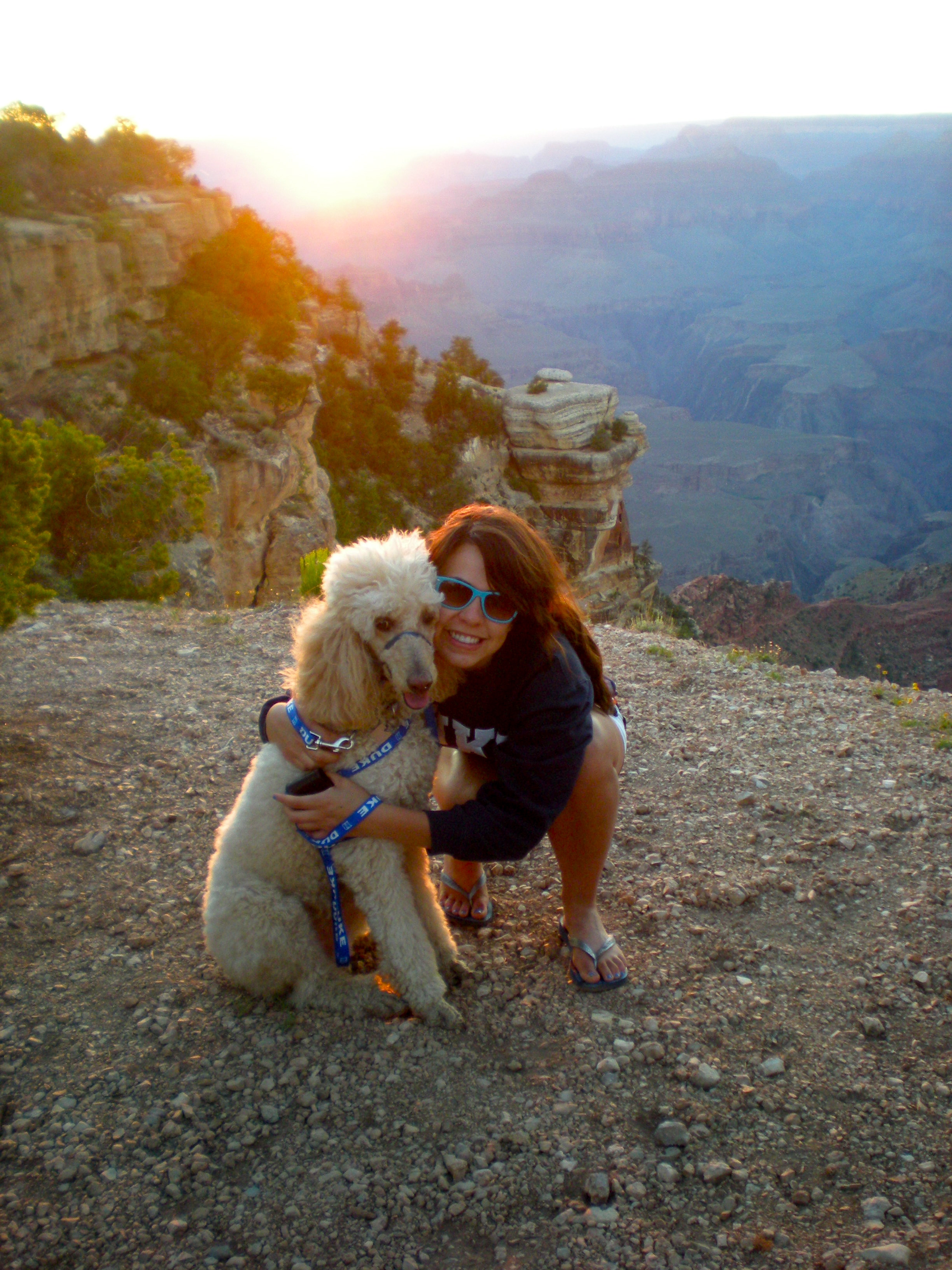
Me and Misty at the Grand Canyon.

I’m a sophomore majoring in evolutionary anthropology and receiving a certificate in policy journalism and media studies. I’m from Portland, Oregon—the home of coffee and rain. After school, I’m hoping to attend either medical or veterinary school.

Besides writing for the research blog, I write for the Chronicle. Although it may be a bit of a conflict of interest, I love science writing in general. I can also be found swimming and feasting.

One of my favorite things in the world is delectable food.  Pumpkin, chocolate, and cheese are my ultimate flavors. So far, I have eaten at all but two grub spots on campus—the Nasher and Starbucks (in the Medical Center).  I hope to change that by the end of this year, as well as dabbling in Durham’s dining options.

I have a standard poodle, Misty, and a blue parakeet, Archie.  Archie currently lives here with me at Duke in a super secret location. My goal is to own a macaw as soon as possible after graduation.

Cancer drug shortage is ‘a real nightmare’

By Ashley Mooney

A national shortage of the cancer drug methotrexate is causing concern for Duke doctors and their patients, and is part of a larger national trend of shortages in cancer drugs and antibiotics.

“It’s been a real nightmare—it’s a very real shortage,” said Dr. David Rizzieri of Duke Medicine’s Cellular Therapy Division. “It’s part of a bigger [drug shortage] problem, not just a methotrexate problem.”

Six bottles of different cancer drugs. Methotrexate is not pictured. Image courtesy of the National Institutes of Health.

Ben Venue Laboratories—the largest manufacturer of methotrexate—temporarily closed its manufacturing facility in Bedford, Ohio, because it could not guarantee product safety, according to an article from the New York Times. Shortfalls have also been caused by prescription drugs going generic and becoming less profitable, according to an article from WRAL.

Rizzieri said members of the Duke community and others have approached Congress and national advocacy groups, but not much can be done about the lack of medication. Shipments from other countries are currently providing American hospitals with the drugs.

Issues of quality control and cost make the duration of drug shortages unknowable, Rizzieri said.

“The shortages have been at variable length with the drugs over the last couple of years,” he said. “Sometimes we’ve had shipments arrive from China and be held up at the docks [while] the drugs were tested to see if they were at the right quality to be released in the United States.”

A shipment of methotrexate will soon arrive in the United States, with enough medication to last the entire nation about a month, according to the New York Times article.  But the shortage is still not solved.

Rizzieri said patients are left with few options for care.

When his patients need medicine that is in low supply, Rizzieri said he often calls his colleagues first and if they have the proper drug, he sends his patient there to be treated. If nobody else has the right medication, a different regiment of chemotherapy may be used in its place. In some instances, he said, patients may need to travel out of the country to buy a different version of the drug.

”There are a number of good people working very hard to find drugs, but the issues of quality concern and cost remain,” he said. “With that the duration of these shortages are unknowable.”

Page 3 of 3

Powered by WordPress & Theme by Anders Norén