Following the people and events that make up the research community at Duke

Students exploring the Innovation Co-Lab

Author: sa160@duke.edu

Student Profile: Jack Matteucci

By Nonie Arora

It may be summer, but student scientists are still on the job. Rising Trinity junior Jack Matteucci is heading to CERN in a few weeks to join the many scientists working with data from the Large Hadron Collider.

A Simulated Collision Producing a Higgs Boson Particle, Wikimedia Commons

Scientists working with data from the Large Hadron Collider are trying to determine whether the Higgs Boson, the so-called “God particle” exists. While the Higgs Boson has been called the “God particle” by some because it is currently the last predicted particle in the Standard Model to be observed, physicists are less fond of the name. “There is no doubt that it’s a huge missing piece to the puzzle, accounting for the observed phenomenon know as invariant mass, but it by no means explains everything about particle physics,” Matteucci says.

Einstein’s famous E= mc^2 showed a relationship between mass and energy. According to Matteucci, the Higgs Boson and its associated field would account for certain observed nonsymmetrical weak interactions, which would explain why certain particles have an inherent mass apart from the energy from their motion.

When collisions happen in Large Hadron Collider, thousands of protons collide and sophisticated computer programs must separate these interactions. After these interactions have been separated, data analysts like Matteucci enter the picture. He will be using ATLAS computing to analyze decay processes of elementary particles and confirm particle interactions.

Jack Matteucci

“During these interactions a plethora of particles are created and destroyed within tiny fractions of milliseconds which decay and lead to secondary products,” Matteucci explained.  “Then, scientists try to backtrack to information about primary particles.”

 While the collective effort is huge, the data is still analyzed one person at a time and interactions have to be confirmed thousands of times, according to Matteucci.

At Duke, Matteucci works under the guidance of Al Goshaw, the James B. Duke professor of physics. He’s also collaborating with Meg Shea and Yu Sheng Huang to build a cosmic ray detector. Cosmic rays are high-energy particles from the sun. Particles are produced from the interaction of the sun’s radiation and the Earth’s atmosphere. The team in Goshaw’s lab believes this detector will be very reliable and will be used to test more precise, future detectors.

Maji Moto: Dispatches from a Drought

By: Nonie Arora

Photogram of Drought in Amboseli Basin, Courtesy of Courtney Fitzpatrick and Horse & Buggy Press

All of the wildebeest died.  The cattle died. The zebra died.

The people starved.

“Someone once told me that as we live, we either become broken or we soften,” says Courtney Fitzpatrick, a graduate student in evolutionary biology who conducted fieldwork in Kenya’s Amboseli basin during 2009, the worst drought in living memory. “In hindsight I see that making Maji Moto was a panicked attempt not to break.”

Maji Moto, Swahili for “hot water,” is the name of the watering hole Fitzpatrick encountered every morning going from camp to the baboon study range. Her work of creative nonfiction, Maji Moto: Dispatches from a Drought, is composed of lyrical essays and photographs that detail the protracted suffering of the ecosystem imposed by the drought. Fitzpatrick says the experience truly tested her ability to protect her empathy.

Fitzpatrick was there to study sexual selection, mate choice, and reproduction. While humans have “concealed ovulation,” many old world monkeys like chimps and baboons have an exaggerated signal of fertility called an estrous swelling. It has been hard to fully understand the evolution or function of this trait in the past, according to Fitzpatrick. Her hypothesis was that estrous swellings evolved like a peacock’s tail – as a consequence of sexual selection pressure. She set out to answer the question of whether males prefer females with larger swellings.

Fitzpatrick is a field biologist at heart. To study organisms in their natural environment, she spent about eighteen months obtaining measures of swellings in Kenya’s Amboseli basin through the Amboseli Baboon Research Project. The project is ongoing from the 1960s and has rich longitudinal data. For Fitzpatrick, measuring thousands of swellings was tedious and required careful attention to detail. But in the end, she says now that “it’s just fun having all that data.” Along with measuring estrous swellings, she observed mating behaviors such as how close males stayed to females and how they groomed each other.

Broadside from Maji Moto, Courtesy of Courtney Fitzpatrick and Horse & Buggy Press

Maji Moto originated organically as Fitzpatrick compiled essay blog posts and photographs she had shared with friends and family during her time in Kenya. She was “seeing incredible sights I couldn’t not photograph.” As the drought became more serious, so did her writing. By the end, her creative nonfiction was as serious as the science. Fitzpatrick said she couldn’t analyze the data free from distress until after  Maji Moto was finished.

Fitzpatrick brings a unique background to her scientific endeavors: she studied studio art as an undergraduate student and taught photography for a New York social service organization before pursuing graduate school. She grew up in naturalist family, and so was always interested in evolution and behavior. When she started missing the sense of intellectual engagement from an academic environment, she decided to pursue graduate school at Duke.

Her studio art background had practical implications – comfort with the camera made it easier to collect her data, which involved taking pictures and making careful measurements. But even more so, thinking about the world from an artist’s perspective informs the way she thinks about and does science. Fitzpatrick says the process of generating hypotheses often requires relaxed creativity, like a painter conceiving an image on a canvas. Moreover, many scientists are loyal to particular methods, like artists, as they “arrive closer and closer to an unknown truth.”

The book and photographic prints from Maji Moto are on display in the Foyer Gallery (401B Foster Street) every Friday from 11am to 2 pm. The hand-printed, limited edition art book is also available for purchase from Horse and Buggy Press. Now that Maji Moto has been published, Fitzpatrick’s next steps are finishing her dissertation and beginning a postdoctoral fellowship at the National Evolutionary Synthesis Center in Durham, studying theoretical models of sexual selection.

Biomedical Engineering Seniors Share Novel Research

By Nonie Arora

Pratt senior Alex Sun hopes to be able to repair cartilage using stem cells.

Alex Sun at BME Reception

The study Sun has been working on in Dr. Farshid Guilak’s laboratory has found that engineered cartilage constructed from a particular type of stem cell integrate well with host cartilage, but not necessarily in a uniform way.

Sun was one of about thirty biomedical engineering students who presented at the department’s graduation with distinction reception on April 26. Other students have been working on exciting projects in optic imaging of tumors, synthetic biology, and deep brain stimulation, among other topics.

Sun’s project focused on how induced pluripotent stem cells can be used to study cartilage regeneration and repair.

Sun said articular cartilage has limited healing potential and contributes to progressively degenerative diseases like osteoarthritis. The best treatments now require major surgery and total joint replacement. But spontaneous cartilage healing does happen in some animals, like fetal lambs and infantile rats. Better understanding these mechanisms for spontaneous repair could allow for their eventual integration into therapy.

Students Converse at BME Graduation with Distinction Reception

Like many of the seniors graduating from BME with distinction, Sun’s research career has just begun. After graduation, he will be headed to the Netherlands to work on a tissue engineering project sponsored by the Whitaker International Fellowship. 

Non-human Apes Cooperate, Negotiate

By: Nonie Arora

The Scientist and Nature Credit: Nonie Arora

A large bronze camel resides on Science Drive. Students may think it’s a landmark or a place to take scavenger hunt photos, but the camel has greater meaning.

At the annual Knut Schmidt-Nielsen Memorial Lecture, students learned that the Scientist and Nature statue depicts  Schmidt-Nielsen and his research subject for 20 years, the camel. Dr. Brian Hare explained how Schmidt-Nielsen, a pioneer in animal physiology, hoped to learn more about humans by studying camels.

Hare, a professor of evolutionary anthropology, works on what he calls the “exciting problem of human cooperation” by comparing animal species. He is interested particularly in cognition and evolution with goal of understanding what it is that makes us human and how we got that way.

Hare defines cognition as the “the inferential abilities that allow for flexibility and understanding.” He wants to see if species can solve a problem in a new situation with flexible problem solving. Two of the species Hare studies are bonobos and chimpanzees, the two closest living relatives of humans.

People often say that collaboration, negotiation and altruism are unique human traits, Hare said. But he has seen non-human apes exhibit these traits in his experiments. He believes that to see how we are special, we need an accurate assessment of differences between humans and non-human apes.

Many researchers believed non-human chimps could not negotiate when they had conflicting interests because these animals don’t have norms and language like humans. For a while researchers were faced with a paradox: animals were exhibiting cooperative behavior in nature but not in experiments. The problem was the small sample sizes of these trials. When Hare began working at sanctuaries in Africa – Ngamba, Tchimpounga, Lola ya Bonobo – with large numbers of apes, he found evidence of cooperation.

He observed that changing chimp pairings could turn on spontaneous cooperation, and if the chimps were tolerant of their partners, they were much more likely to work together to get the banana.

In another set up, dominant and subordinate apes were paired together. Although subordinates initially refused selfish offers by the dominant ape, after negotiation, a cooperative decision was made within a few minutes in 95 percent of the trials. Hare said he was surprised at the extent of cooperation given the apes’ lack of norms and language.

Bonobos at the Cincinnati Zoo. Credit: Wikimedia Commons

Hare also found that bonobos will voluntarily share food with a stranger, but not with a member of their in-group. He hypothesizes this is because sharing with a stranger enables them to expand their social network, but sharing with an in-group member does not significantly alter that relationship.

Hare’s research has shown that traits traditionally associated with humans like tolerance and negotiation, among others, are also present in other non-human apes, suggesting that we may not be as different from them as we thought.

Varmus Encourages Provocative Questions

By Nonie Arora

“Provocative questions,” the important but non-obvious ones, the questions to be answered by technology that doesn’t  exist yet, are one focus of Nobel Laureate Harold Varmus‘s storied career these days.

What environment factors change the risk of various cancers when people move from one geographic area to another?

Why are different tissues so dramatically different in their tendency to develop cancer?

How does obesity contribute to cancer risk?

Harold Varmus, Director of NCI Source: cancer.gov

Varmus, director of the National Cancer Institute, visited Duke April 12 to address  the Duke Medical Scientist Training Program 2012 Symposium and to share some of these provocative questions with a full house in Love Auditorium.

Varmus said we are in a period of rapid scientific change because “clinical research and basic research are mingled in a way that is extraordinary.” And while he acknowledged recently flat NIH budgets, he said, “let’s not worry about budgets, let’s worry about opportunities.”

For example, he cited one such scientist who looked for important opportunities, Renato Dulbecco (1914-2012), a virologist from Caltech who died recently. Dulbecco advocated for a systematic approach to sequencing the human genome as early as 1986 despite the many naysayers in the biology community. Varmus called Dulbecco, “a visionary who saw beyond the technology of the day” as he encouraged his audience to think in the spirit of Dulbecco: boldly.

Varmus spoke of how the “precision medicine” of genomics may lead to more accurate diagnoses and a new taxonomy of disease. He made the distinction clear between precision medicine and personalized medicine claiming that even his father practiced personalized medicine because he knew his patients well.

Cancer deaths are rising globally, especially in less developed countries, according to Varmus. He explained how open exchange of information with cancer centers around the world is important to solving new cancer challenges. He described how cancers are more frequently related to infectious agents in the developing world, like the Epstein-Barr virus’s relationship to Burkett’s lymphoma, and the implications for research.

To fund important but non-obvious questions in cancer research, he has launched the “Provocative Questions” Project. These questions are meant to build on specific advances and address broad issues. Because researchers can be more risk-averse when funding levels are lower, this project hopes to fund intriguing questions that would otherwise remain unfunded and unanswered.

These questions need answers. Who better to answer them than the Duke MD/PhD candidates in the audience.

Sugar-coated cells not like Peanut M&M's

By Nonie Arora

Carolyn Bertozzi. Source: Wikimedia commons

UC Berkeley professor Carolyn Bertozzi spoke about sugar coated cells and peanut M&Ms following the unveiling of the English translation of Hertha Sponer’s biographyon April 5.

Hertha Sponer (1895-1968), a noted scientist who studied quantum mechanics, physics, and chemistry, was the first woman on the Duke Physics faculty. Bertozzi called it a privilege to “celebrate the life, career, and legacy of Hertha Sponer.”

Bertozzi discussed how scientists used to think of sugars on the surfaces of cells like the candy coating on peanut M&Ms – only there to serve as a protective barrier. Now, she says people appreciate the diverse information stored in the sugars as an important diagnostic tool.

These cell surface sugars, called glycans, can give us information about a cell state. In fact, human blood groups are determined by cell surface glycans. The glycans specific to each blood group are not much different chemically, but according to Dr. Bertozzi, “the human immune system is exquisitely specific to recognize functional groups. If someone who is blood type A is given type B blood, they will have a massive reaction.”

Tamiflu Source: Wikimedia Commons

Glycans are relevant to many different areas of medicine, from stem cell biology to viral infection. Drugs for influenza viruses were developed by taking advantage of glycan chemistry. Bertozzi explained that in the pharmaceutical industry, better understandings of binding to cell-surface sugars enabled creation of Relenza and Tamiflu.

Bertozzi also described how X-ray crystallography was used to understand the binding of the enzyme and sugars and that Hertha Sponer made valuable contributions to that field.

Cell surface sugars also differ between healthy and diseased cells. Cancer cells have a different profile of cell surface sugars than normal cells. For example, polysialic acid (PSA) which is usually only in neurons in brains, pops up frequently on tumor cells. According to Bertozzi, detecting the levels of the acid would allow scientists to see tumors without invasive surgery. Bertozzi’s lab has been working on several projects to develop this method for tumor and cancer imaging.

Students Discuss Property Rights to Excised Tissue

By: Nonie Arora

While students from Duke, UNC, Wake Forest and UVA enjoyed lunch at the first Duke-UNC Bioethics Symposium, Neby Teklu, a Duke sophomore, spoke on property rights to excised tissue.

The circular relationship between people who contribute and benefit from medical research. Credit: Neby Teklu

According to Teklu, when deciding who owns the property rights, the conflict is between the patient — the source of tissue — and the physician or researcher — the possessor of the tissue. Teklu said she is concerned about whether some profits should be returned to people who serve as the source of cell lines when monetary gains are made from pharmaceutical research.

Teklu referenced the Belmont Report, a 1978 document created by the National Commission for the Protection of Human Subjects of Biomedical and Behavioral Research to address ethical guidelines for human subjects research. The report stresses respect for patients, beneficence and justice.

Essentially, patient autonomy must be maintained. Patients should not be harmed, while benefits are maximized and harms are minimized, and there must be fair distribution of costs and benefits to research participants.

Still, the question remains whether patients have intellectual property rights over their bodies and should be financially compensated for profits from cell lines. Teklu argued that requiring consent for procedures done with excised tissue would hinder medical research.

Neby Teklu speaks at the Duke-UNC Bioethics Symposium. Courtesy of: Nonie Arora.

In the case of Greenberg v. Miami Children’s Hospital Research Institute, Inc., the United States District Court for the Southern District of Florida found that “the research participant’s property right in blood and tissue samples … evaporates once the sample is voluntarily given to a third party.” The Supreme Court upheld this precedent in William Catalona v. Washington University, when they decided that the university, not the researcher nor patients, had rights to the tissue samples. The university could sell, license or use the samples any way it saw fit.

Clearly, there is a trade off between social benefits of science using samples from human subjects and individual patient rights, Teklu explained. She said she believes that medical research depends on the altruism of individuals and that requiring additional measures of consent for use of tissues would be harmful for the progress of medicine.

Other students also presented including Duke Research Blogger Pranali Dalvi and Wake Forest undergraduates Elizabeth Stuart and Muhammad Siddiqui. Topics ranged from health care rationing to post-trial access for expensive medications

Meet Joel Bray, Lemur Enthusiast

 By Nonie Arora 

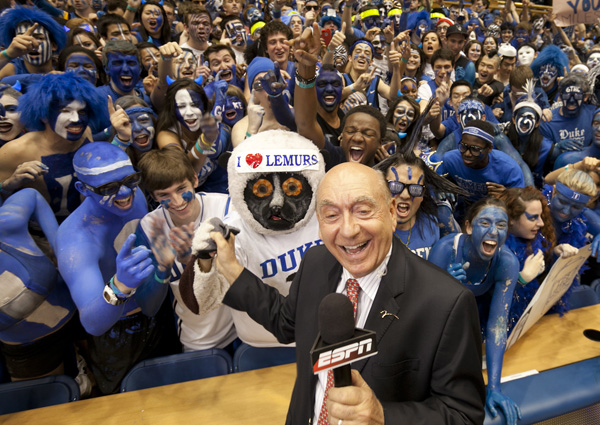
Joel the Lemur and the rest of the Crazies meet Dick Vitale at the March 3 UNC game. (Duke Photo)

You may have been wondering who the student dressed as a lemur was for the Duke-Carolina game. Meet Joel Bray, lemur enthusiast and Trinity Junior.

Joel works in Brian Hare’s cognitive psychology lab where he does research on the psychology and evolution of nonhuman primates.

“Primates are an amazing way to understand human behavior, and specifically cognition,” Bray says. He studies lemurs at the Duke Lemur Center, which is home to the largest population of lemurs outside of Madagascar. Lemurs, most similar to the last common ancestor of all primates, are interesting because all 100 species are closely related at the genetic level, but they live in very different social and ecological environments.

In his first project, Joel studied inhibitory control in lemurs to understand how cognition evolves. This was part of a larger effort under NESCent, the National Evolutionary Synthesis Center. The project sought to compare dozens of species, including primates, birds, and rodents, on the same tasks using the same methods.

Joel tested the lemur’s inhibitory control by presenting them with an opaque cylinder with openings on both ends and food inside. The animals first learned how to retrieve the food. Then, the opaque tube was replaced with a transparent one. The impulse is to reach directly for the food item through the obstructed barrier, but to successfully retrieve the food the lemurs had to inhibit that response and reach from the side. Inhibitory control is considered to be important in both social and foraging contexts, and certain environments are expected to exert more selective pressure for the ability. In human children, it is predictive of future academic and social success.

Joel, out of costume, studies a troop of ringtailed lemurs because he's a method actor. (Courtesy of Joel Bray)

More recently, Joel has investigated social cognition, specifically asking what lemurs understand about the perception of other individuals. Humans display “theory of mind,” the notion that other individuals have perceptions, knowledge, and beliefs different from one’s own. While lemurs are unlikely to have a complex understanding of the minds of other individuals, they may display more basic abilities.

In his current project, Joel is asking whether lemurs will take advantage of information about a human competitor’s visual perspective to acquire food. One food item is visible to the experimenter and the other is not, and the lemur must decide which to approach. It is expected that that species in large or complex social groups will perform better because their evolutionary history has selected for being able to understand what other individuals can perceive (i.e. “social intelligence”).

Ultimately, this research may lead to a better understanding of human cognition and whether our “big brains” evolved because of complex social environments.

Raiders of the Lost Blood Spots

By Nonie Arora

Blood Spots Assessed by CDC

Almost every newborn in the United States is pricked on the heel within hours of birth for a few drops of blood that are then tested for conditions like PKU, sickle cell anemia, and cystic fibrosis. But then the sample is often put on small piece of blotter paper and filed away by the state. Few parents know about these millions of residual dried blood spots.

Alex Kemper, Duke professor of pediatrics and community and family medicine, spoke at the Genomics and Personalized Medicine Forum on the “raiders” of these lost blood spots, researchers who might use them to improve public health. Along with issues of science, he addressed the negative public reaction to research using stored blood spots. “Why does the government have my DNA?”

Dried blood spots have many uses beyond early detection of diseases. They can be used to improve quality of current screening tests and new screening approaches. In a few cases, dried blood spots have been valuable in forensic analysis to identify an abducted child. In this era of increasingly personalized medicine, being able to use blood spots for genomic analysis would provide answers to new research questions, Kemper said.

However, the differences in the way blood spots are stored present research challenges. Kemper is very interested in how environmental toxins affect children’s health. When his research team attempted to use dried blood spots to study how flame-retardants affect thyroid problems, they ran into a major problem. Because blood spots are often stored in an environment more like the warehouse from Raiders of the Lost Ark than a controlled lab environment, the specimens were too contaminated to use for research.

Besides the inherent quality concerns, the public is wary of researchers using blood spots because of the lack of consent and confidentiality. (See “Texas Newborn Bloodspot Saga”) Should researchers be able to use blood spots from infants without consent from parents? Should the blood spots be anonymized to protect privacy even though anonymization limits the types of research that can be performed?

These questions do not have easy answers.

States differ on legislation about the retention, confidentiality, and parental control of blood spots. Some states have no rules at all. Kemper claimed that many of these laws are currently in “a state of flux” because of pending lawsuits and changing public perceptions. As the rules change, one thing is almost certain: improving the genetic literacy of the public is essential to advancing uses of dried blood spots.

New Blogger Nonie: Joining the Team

By Nonie Arora

Hello there,

This is Nonie Arora, a freshman A.B. Duke Scholar from Novi, MI. I am excited to join the Duke Research Blog team.

I’ve been involved in research since my freshman year of high school. Back then, I was obsessed with the concept of “superbugs” and antibacterial resistance. I ordered E. coli out of a catalog with my chemistry teacher and tested its resistance to common household substances, like soap and bleach. My research interests evolved as I started working in a lab at the Wayne State University Medical School. For three years, I studied genes in a yeast, C. albicans, that contribute to antifungal drug resistance.

My research took me to different science fairs, such as the International Science & Engineering Fair (ISEF) and the Intel Science Talent Search. At ISEF, being in a hall with 1500 other students from around the world – who were all enthusiastic about research – was incredibly motivating. I was eager for more research exposure. The wide variety of research present at Duke, from basic science to behavioral economics to clinical trials, is incredible. Being able to interact with renowned faculty as a freshman is a privilege.

Last semester, I was part of the Genomics FOCUS program and took classes with Hunt Willard and Bob Cook-Deegan. The captivating teaching styles of my professors coupled with a better understanding of how science affects society increased my passion for genomics. This semester, I am working in the Kontos lab studying protein interactions that may explain how endothelial cells maintain a resting state, which is relevant to cardiovascular disease.

Outside of research, I like to run, read the New York Times, and devour law thrillers. When I have the time, I indulge in watching The Big Bang Theory, House, and the Good Wife. At home, I enjoy spending time with my parents and my 11-year old sister. It’s probably easier to answer some of the questions that my professors propose than the ones she does!

I look forward to contributing my perspective on research at Duke.

Page 4 of 4

Powered by WordPress & Theme by Anders Norén